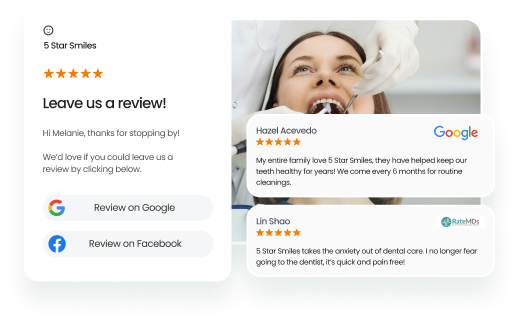
UK GDPR review management involves collecting, storing, analysing and responding to customer feedback in accordance with the UK General Data Protection Regulation (UK GDPR) and the Data Protection Act 2018. Multi-location enterprises mustapply consistent data protection policies across locations, with healthcare providers facing additional obligations when handling sensitive patient information.
Summary
Effective review management requires businesses to control how personal data moves between internal systems, review platforms and software providers. Clear data handling policies and centralised oversight help businesses protect customer confidentiality and reduce compliance risks across locations.
This blog covers UK GDPR obligations, patient confidentiality, data residency and how multi-location businesses can manage feedback while protecting personal information.
Table of contents
- Summary
- What are the UK GDPR requirements for review management?
- How does UK GDPR apply to patient and customer feedback?
- How can UK businesses collect reviews in compliance with UK GDPR?
- How can businesses respond to reviews without breaching UK GDPR?
- Where can UK businesses store customer review data?
- How can multi-location brands maintain UK GDPR compliance?
- How does Birdeye support UK GDPR review management?
- FAQs about UK GDPR review management
- How can businesses simplify UK GDPR review management across locations?
What are the UK GDPR requirements for review management?
Article 5 of the UK GDPR establishes seven data protection principles that businesses must follow when handling customer feedback. These principles apply to review collection, storage, analysis and responses.
| UK GDPR principle | Application to review management |
| Lawfulness, fairness and transparency | Establish lawful grounds for processing customer feedback and explain its intended use. |
| Purpose limitation | Use customer feedback for defined purposes. |
| Data minimisation | Collect only the personal information necessary for review management. |
| Accuracy | Maintain accurate customer information and feedback attribution. |
| Storage limitation | Establish retention periods for customer data. |
| Integrity and confidentiality | Protect information through encryption and access controls. |
| Accountability | Document processing activities and compliance decisions. |
The Information Commissioner’s Office (ICO) oversees UK data protection compliance. Multi-location businesses must demonstrate how they apply these principles across their branches and third-party software providers.
How does UK GDPR apply to patient and customer feedback?
UK GDPR applies to feedback that contains information about an identifiable individual. Patient feedback carries additional requirements because information about physical or mental health falls under special category data.
| Feedback example | Data classification |
| Google review containing a customer’s name | Personal data |
| Hotel review linked to a booking reference | Personal data |
| Dental review describing a patient’s treatment | Special category data |
| Care home review identifying a resident’s medical condition | Special category data |
| Fully anonymised customer satisfaction report | Outside the scope of UK GDPR |
Businesses must establish an Article 6 lawful basis for processing personal data. Healthcare providers processing health information must also satisfy an applicable Article 9 condition.
For example, a dental group collecting patient feedback to improve healthcare services may consider Article 9(2)(h), subject to applicable legal and confidentiality requirements. Publishing identifiable patient testimonials may require explicit consent under Article 9(2)(a).
Publicly available patient feedback does not give healthcare providers unrestricted permission to reuse sensitive information.
How can UK businesses collect reviews in compliance with UK GDPR?
Businesses can collect reviews responsibly by establishing lawful processing grounds, limiting data collection and communicating how they use customer information.
1. Establish a lawful basis
Document the appropriate Article 6 lawful basis before collecting feedback. Businesses relying on legitimate interests should assess necessity and the impact on individual privacy rights.
2. Minimise customer data collection
A dental group operating 100 practices could limit review invitation data to four fields:
- Patient name
- Contact information
- Practice identifier
- Completed appointment status
Exclude diagnoses, prescriptions and clinical records from routine review invitations. Assess the sensitivity of appointment information because it can reveal healthcare attendance.
3. Provide transparent privacy notices
Explain the purpose of feedback collection, lawful basis, third-party processors, retention periods, international transfers and individual data protection rights.
4. Follow electronic communication rules
Email and SMS review invitations may fall under the Privacy and Electronic Communications Regulations (PECR). Genuine service research may fall outside direct marketing rules, but promotional content can change how these requirements apply.
Must Read: UK businesses must understand how different review platforms and directories collect, process and publish customer information. Read our article on UK local business directories to identify relevant general and industry-specific platforms, including healthcare directories such as Doctify, WhatClinic and Carehome.co.uk.
How can businesses respond to reviews without breaching UK GDPR?
Businesses should acknowledge feedback without disclosing confidential customer records, transaction details or sensitive personal information.
The General Medical Council (GMC) and the General Dental Council (GDC) require healthcare and dental professionals to protect patient confidentiality when communicating publicly, even when patients disclose their treatment information themselves.
| Review scenario | Response to avoid | Recommended response |
| Complaint about dental treatment | We explained the risks before your extraction. | Thank you for raising your concerns. Please contact our practice manager to discuss this privately. |
| Complaint about a refund | We refunded £250 to your bank account. | Please contact our customer service team so we can investigate your concerns. |
| Positive patient review | We are pleased your surgery was successful. | Thank you for sharing your feedback. We appreciate your kind words. |
Multi-location enterprises should establish approved response templates and publication permissions. Healthcare providers should escalate clinical complaints and safeguarding concerns to authorised teams rather than discussing them publicly.
Where can UK businesses store customer review data?
UK GDPR permits businesses to store customer review data in the UK, European Economic Area (EEA) and other jurisdictions, subject to applicable data protection and international transfer requirements.
The UK recognises EEA countries under its adequacy arrangements. Restricted transfers without applicable adequacy arrangements may require safeguards such as the International Data Transfer Agreement (IDTA) or the UK Addendum to EU Standard Contractual Clauses.
According to the ICO’s international transfer guidance, businesses must assess how they transfer personal information to overseas organisations.
When evaluating review management software, businesses should establish:
- Where the provider stores primary data and backups.
- Where AI systems process customer information.
- Which subprocessors handle personal data.
- Whether overseas support teams can access customer information.
- Which safeguards protect international data transfers.
Healthcare providers should also check whether NHS contracts or procurement policies impose additional hosting requirements
How can multi-location brands maintain UK GDPR compliance?
Multi-location enterprises can support UK GDPR compliance through centralised permissions, documented risk assessments, processor agreements and standardised data handling procedures.
| Compliance measure | Implementation |
| Role-based access | Restrict location managers to assigned branches and give authorised central teams organisation-wide access. |
| Data protection impact assessment (DPIA) | Assess high-risk processing under Article 35, including large-scale processing of health data. |
| Data processing agreement (DPA) | Establish processor obligations under Article 28, including confidentiality, security and deletion. |
| Data retention policies | Define retention periods for feedback, contact information and complaint records. |
| Individual data rights | Establish procedures for handling access, correction and erasure requests. |
| Breach management | Notify the ICO within 72 hours of becoming aware of a reportable breach. |
How does Birdeye support UK GDPR review management?
Birdeye Reviews helps multi-location businesses incorporate data protection requirements into their review management workflows. Jay, Birdeye’s marketing AI coworker, coordinates specialised agents that follow business-defined collection, response and publication policies, helping organisations maintain consistent data handling practices across locations.
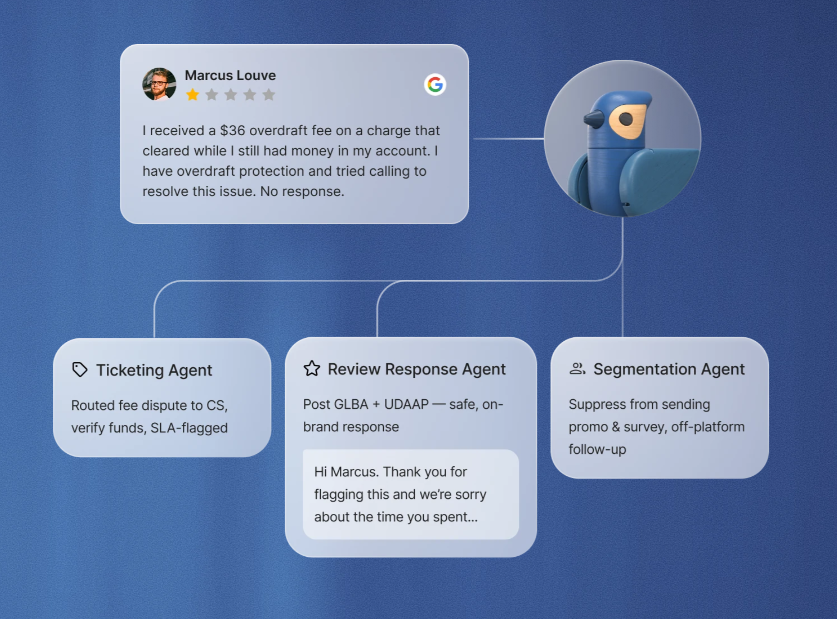
- Data minimisation in review collection: The Review Generation Agent operates through configurable workflows, allowing businesses to determine which customer information, communication channels and interaction triggers they use to request feedback.
- Patient confidentiality in review responses: The Review Response Agent follows predefined instructions, such as avoiding references to patient identities, treatment details and appointment histories. Healthcare providers can require human approval before sensitive responses go live.
- Purpose limitation in review marketing: The Review Marketing Agent follows eligibility criteria, approval requirements and publishing rules. Businesses can restrict which reviews they repurpose for marketing based on their lawful processing grounds and consent requirements.
- Controlled handling of sensitive complaints: Jay works with the Ticketing Agent to route concerns to designated teams for private investigation, reducing the risk of disclosing confidential information in public responses.
- Centralised data governance: Businesses can monitor reviews across 200+ review sites and configure workflows by location, rating and approval requirements. This helps central teams enforce consistent review management policies across branches.
These capabilities help businesses apply consistent data protection policies across review management workflows. Businesses remain responsible for establishing lawful processing grounds and configuring the platform according to their UK GDPR obligations.
How mydentist centralised patient review management across 530 locations
Background: mydentist, the UK’s largest dental care provider, serves approximately 4 million active patients. Before Birdeye, the organisation lacked a centralised system for monitoring patient feedback across Google, Trustpilot, NHS and Indeed.
Solution: With Birdeye Reviews, mydentist established a centralised review management workflow. Four dedicated team members manage responses, flag sensitive feedback for follow-up and maintain a consistent brand voice across practices.
The results:
- 99% response rate to Google reviews
- 98% response rate across all review sources
- 50% year-on-year increase in review volume
- Average rating increased from 4.4 to 4.6 in six months
For multi-location healthcare providers, mydentist demonstrates how centralised review management can improve oversight, standardise response practices and support consistent handling of patient feedback across hundreds of locations.
FAQs about UK GDPR review management
Yes. UK GDPR applies when businesses process identifiable personal information contained in public reviews. Public availability does not remove data protection obligations.
Not always. Businesses must establish an appropriate lawful basis under Article 6. Healthcare providers processing health data must also satisfy an Article 9 condition.
No. UK GDPR permits international data transfers subject to applicable safeguards. Healthcare contracts and procurement policies may impose additional restrictions.
Article 17 provides a right to erasure in certain circumstances. Businesses must assess applicable exceptions. Customers may also need to contact the third-party platform that published their review.
Birdeye hosts customer data on AWS infrastructure in the US and EEA (Frankfurt, Germany). It protects data through encryption, role-based access controls and 24/7 security monitoring, backed by SOC 2 Type II and ISO/IEC 27001 credentials. For more details, refer to Birdeye security.
How can businesses simplify UK GDPR review management across locations?
Businesses can simplify UK GDPR review management by centralising feedback collection, controlling data access and standardising response procedures across locations.
Birdeye combines European data residency, configurable permissions and AI-powered review management to help businesses protect customer information while managing their online reputation.
Request a Birdeye demo to discover how your organisation can manage customer and patient feedback across locations while supporting UK GDPR compliance.

About the Author

Somya Yesodharan
Originally published