For UK multi-location brands, proving review authenticity means linking customer feedback to genuine experiences, collecting reviews without bias, and keeping evidence of how reviews are handled. Under the Digital Markets, Competition and Consumers Act 2024, businesses must not publish fake reviews or misleading review information. Businesses publishing reviews must also take reasonable and proportionate steps to prevent and remove fake and concealed incentivised reviews.
Summary
Review compliance goes beyond verifying purchases. UK brands must apply consistent invitation policies, investigate suspicious feedback, and represent positive and negative reviews fairly across locations. The CMA expects review publishers to maintain appropriate policies, risk assessments, and procedures to prevent misleading content.
This blog explains the CMA’s requirements, how review verification works, and how multi-location UK brands can establish a documented review management process.
Table of contents
- Summary
- What is review authenticity, and why does it matter in the UK?
- What is the difference between verified and unverified customer reviews?
- What does the CMA require for online reviews in the UK?
- How can UK businesses prove customer reviews are genuine?
- How does customer review verification work in the UK?
- How can UK brands build a review compliance process across locations?
- How does Birdeye support authentic review management across UK locations?
- FAQs about Review authenticity and CMA compliance UK
- How can UK brands turn review authenticity into a consistent business practice?
What is review authenticity, and why does it matter in the UK?
Review authenticity means that customer feedback reflects a genuine experience with a business, product or service.
A genuine review does not always require a completed purchase. Customers can legitimately review dental consultations, property viewings or interactions with hotel staff without completing a transaction.
For UK multi-location brands, review authenticity involves three distinct checks:
- Experience: Did the reviewer interact with the business?
- Collection: Was the review requested without manipulating the rating or content?
- Publication: Does the displayed feedback accurately represent customers’ experiences?
According to the Competition and Markets Authority (CMA), online reviews potentially influence £23 billion in UK consumer spending annually, based on its earlier market research.
When customers rely on reviews to choose between businesses and individual locations, the authenticity of that feedback can directly influence purchasing decisions.
What is the difference between verified and unverified customer reviews?
Not every review collection method provides the same level of evidence. Some connect submitted feedback directly to a transaction, while others establish that the business requested feedback following a genuine customer experience.
Understanding these differences helps businesses determine what they can confidently claim about their reviews.
| Review collection method | How it works | What it verifies |
| Transaction-verified reviews | A unique reference links submitted feedback to a purchase, booking or service. | Connection between the review and a recorded customer interaction. |
| Transaction-linked review invitations | A customer interaction triggers an automated review request. | Evidence that the business invited a customer following a recorded experience. |
| Location-based QR code reviews | Customers scan a QR code at a business location to leave feedback. | A location-specific collection channel, but not proof of a transaction. |
| Open-platform reviews | Customers independently submit feedback on platforms such as Google. | Feedback subject to platform moderation, without necessarily requiring transaction evidence. |
| Manually verified reviews | Businesses examine receipts, booking confirmations or service records. | Supporting evidence of a genuine customer interaction. |
An unverified review is not necessarily fake. Similarly, a verified transaction cannot establish that every statement within a review is accurate or that the business collected the feedback without bias.
Businesses should only describe reviews as transaction-verified when they can establish a reliable connection between the submitted feedback and the original interaction.
What does the CMA require for online reviews in the UK?
The Competition and Markets Authority (CMA) enforces UK consumer protection law. The Digital Markets, Competition and Consumers Act 2024 introduced specific banned practices relating to fake and misleading reviews from 6 April 2025.
The legislation addresses a significant consumer protection problem.
A study commissioned by the Department for Business and Trade estimated that:
- 11% to 15% of reviews across three common product categories on e-commerce platforms were likely fake.
- £50 million to £312 million in annual harm to UK consumers results from fake product review text alone.
The research examined consumer electronics, home and kitchen, and sports and outdoors product categories.
What review practices are prohibited under UK law?
Under the DMCC Act, businesses must not:
- Submit or commission fake customer reviews.
- Submit or commission reviews that conceal incentives.
- Publish reviews or review information misleadingly.
- Publish reviews without taking reasonable and proportionate steps to prevent and remove prohibited content.
The requirements also cover misleading star ratings, review summaries, and aggregated review information. Businesses that breach consumer protection law can face penalties of up to 10% of global turnover under the CMA’s direct enforcement powers.
What does the CMA consider reasonable and proportionate steps?
The CMA does not prescribe a single verification technology or require every review to carry a verified purchase label. Instead, its guidance for businesses publishing consumer reviews sets out a risk-based approach that includes:
- Preventing fake and concealed incentivised reviews.
- Identifying suspicious submissions.
- Investigating and removing prohibited reviews.
- Explaining how reviews are collected and checked.
- Keeping procedures effective as risks change.
A business publishing thousands of reviews across hundreds of branches may need more extensive monitoring than a small business publishing occasional feedback.
How can UK businesses prove customer reviews are genuine?
Businesses can establish review authenticity by connecting feedback to operational records, applying consistent collection rules, and documenting how they investigate suspicious reviews.
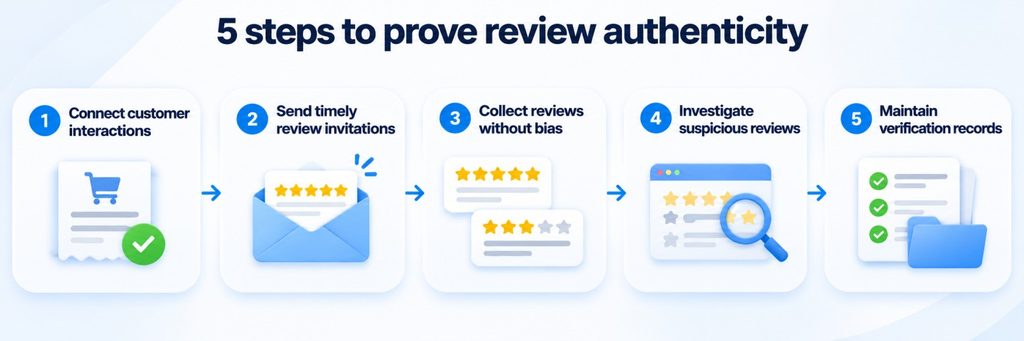
1. Connect reviews to genuine customer interactions
Use records from existing business systems to establish whether a customer had a genuine experience at a specific location.
Examples include:
| UK business | Potential verification evidence |
| Dental practice | Completed appointment record |
| Estate agency | Viewing or service record |
| Hotel group | Booking or completed stay |
| Automotive dealership | Service job or vehicle purchase record |
| Retail chain | Receipt or transaction reference |
| Property management company | Tenant service or maintenance record |
These records establish evidence of an interaction, although they cannot independently prove that every statement in a review is accurate.
2. Send invitations after genuine experiences
A business can trigger invitations after a completed appointment, purchase, service or visit. For example, a dental group operating 150 UK practices could use completed appointments to trigger review requests.
This establishes a connection between the invitation and an actual service interaction. However, it does not independently verify every review subsequently submitted on an open platform.
3. Avoid selective review requests
Businesses should not invite only customers expected to leave positive feedback. For example, asking patients to rate their experience privately and sending Google review invitations only to those who select five stars creates a biased collection process.
Instead, use consistent eligibility rules that do not depend on customer satisfaction.
4. Investigate suspicious reviews
Review monitoring should identify unusual patterns, including repeated content, unexpected submission spikes, and possible conflicts of interest.
A suspicious review is not automatically fake. Businesses should investigate using available evidence, follow the review platform’s reporting process and record the outcome.
5. Maintain verification records
Maintain an appropriate record of the review process, including:
- Customer interaction reference, where available
- Location and invitation date
- Invitation method and eligibility rules
- Review source and verification status
- Investigation decisions and supporting evidence
These records help demonstrate how the business operates its review controls. They do not guarantee legal compliance.
How does customer review verification work in the UK?
Review verification establishes whether customer feedback can be connected to a genuine purchase, service, or other experience.
Transaction-linked verification typically follows five steps:
- Record the interaction: A customer completes a purchase, appointment, booking, or service at a particular location.
- Generate an invitation: The business sends a review request using the relevant customer interaction record.
- Connect the records: A unique reference links the invitation to the purchase or service.
- Apply verification checks: The review provider or business examines available evidence and suspicious activity.
- Record the outcome: The system records the verification status and any moderation decisions.
The exact process depends on the review platform and collection method.
How can UK brands build a review compliance process across locations?
A practical process should cover five stages.
| Stage | Recommended control | Evidence to maintain |
| Collection | Use consistent invitation eligibility | Invitation rules and activity records |
| Verification | Connect feedback to interactions where possible | Transaction or service references |
| Monitoring | Identify suspicious review patterns | Alerts and investigation records |
| Moderation | Apply documented, viewpoint-neutral rules | Decisions and supporting reasons |
| Governance | Review procedures across locations | Policy versions and audit findings |
Assign a central owner for review policy and local owners for investigation support. Track operational indicators such as the percentage of eligible customers invited, unresolved review disputes, and exceptions to collection rules.
For example, if one branch invites 90% of eligible customers and another invites 15%, investigate the difference before assuming that either branch is non-compliant. These percentages are illustrative monitoring thresholds, not CMA requirements.
How does Birdeye support authentic review management across UK locations?
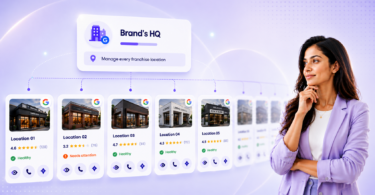
Birdeye Reviews helps UK multi-location brands connect review collection to customer interactions, standardise review requests and monitor feedback from one centralised platform.
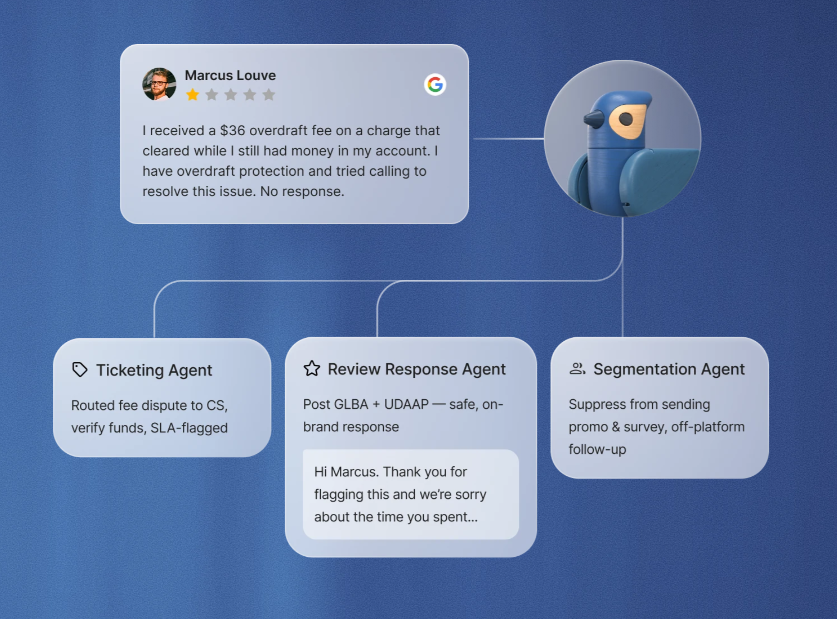
Jay, Birdeye’s marketing AI coworker, helps businesses manage review generation, responses, and reputation performance across locations.
Key capabilities include:
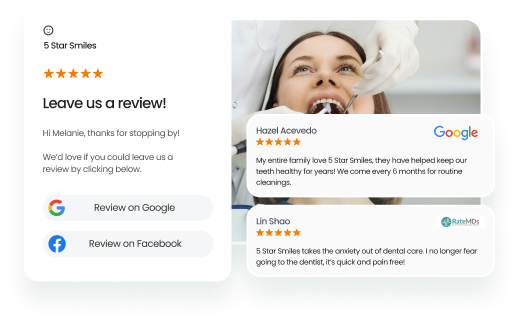
- Automated review generation: Jay sends review requests based on customer interactions, optimises timing and channels, and helps collect detailed feedback. Brands can establish consistent invitation rules across locations to reduce selective review collection.
- Centralised review monitoring: Birdeye brings ratings and reviews from supported platforms into one dashboard, helping teams identify unusual feedback patterns, monitor negative reviews, and maintain location-level visibility.
- On-brand review responses: Jay analyses review content and generates responses within defined brand guidelines. Businesses can choose automatic publishing or approval workflows to maintain oversight.
- Issue resolution: Jay coordinates with other agents, including Ticketing, to route customer complaints and address underlying service issues rather than focusing only on public responses.
- Location-level reporting: Birdeye’s Reputation Score tracks ratings, review volumes, and response activity, helping central teams compare performance and identify inconsistencies across branches.
How Timpson streamlined review collection across 6,000+ UK locations with Birdeye
Company: Timpson Group is a UK retail and consumer services business operating more than 6,000 shops, vending machines and self-service locations.
Challenge: Timpson needed to improve the consistency of its digital presence and customer review management while giving head office greater visibility into performance across thousands of locations.
Birdeye Solution: Timpson implemented Birdeye Reviews, Listings and Insights to centralise customer feedback and location-level performance. The business also introduced QR codes across its physical estate, giving customers a convenient way to leave reviews following their experiences.
Impact:
- 112% increase in review volume since go-live
- 4.3 → 4.6 average review rating across the estate
- 26% increase in review response rate
“Birdeye has had a direct impact on our top line. By making it easier for customers to find our shops, vending machines and services across the Timpson Group, and by giving every part of the business a single view of how we’re performing, we’ve seen better footfall, stronger reviews and a measurable contribution to sales growth.”
Will Lankston, Managing Director, Timpson Direct
Read the complete Timpson case study.
FAQs about Review authenticity and CMA compliance UK
Fake consumer reviews are prohibited under the Digital Markets, Competition and Consumers Act 2024. Businesses must not submit or commission reviews that falsely represent genuine customer experiences. Google also prohibits fake engagement and rating manipulation. Businesses should report suspected fake reviews through Google’s processes and retain evidence supporting their concerns.
No. The CMA does not require every review to carry a verified purchase label. Businesses publishing reviews must take reasonable and proportionate steps to prevent and remove fake and concealed incentivised reviews. Appropriate checks depend on the business’s role, review collection methods and identified risks.
UK rules require transparency around incentivised reviews, and businesses must not conceal relevant incentives. However, individual platforms may impose stricter restrictions. Google prohibits incentives in exchange for posting reviews, regardless of whether the requested review is positive or negative. Businesses should check both UK law and platform policies before running any incentive programme.
Businesses can seek removal of reviews that breach applicable rules, such as fabricated feedback or prohibited content. They should not suppress genuine negative experiences simply because the rating is unfavourable. Review moderation must follow fair, consistent criteria, and published ratings must not mislead consumers.
Multi-location brands can audit authenticity by comparing customer interaction records, review invitations, platform activity and moderation decisions. They should examine differences between branches, investigate unusual review patterns, and document outcomes. Central reporting helps identify inconsistencies, while local records provide evidence about individual customer interactions.
How can UK brands turn review authenticity into a consistent business practice?
UK review compliance requires more than collecting feedback from real customers. Businesses must also prevent biased invitations, investigate suspicious activity, and represent customer opinions fairly.
For multi-location brands, the priority is a documented process that applies across every branch. Combining genuine customer interaction records, consistent collection rules and central review oversight helps businesses demonstrate how they protect review authenticity and respond to compliance risks.
Birdeye helps UK multi-location brands centralise review management, automate review requests, and maintain consistent response practices across locations.
Book a Birdeye demo to see how you can manage customer reviews across every location from one platform.

About the Author

Somya Yesodharan
Originally published