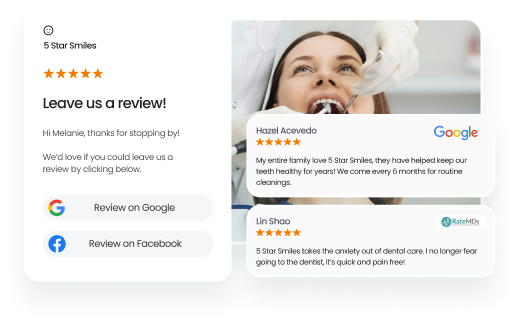
HIPAA-compliant marketing automation tools such as Birdeye, ActiveCampaign, Keap, etc., help healthcare organizations with personalized patient communications, campaign automation, review and recall management, and performance measurement while protecting patient data and meeting HIPAA requirements.
Summary
Healthcare marketing has a unique challenge: patients expect timely, relevant outreach, but privacy rules leave no room for shortcuts. That is why HIPAA-compliant marketing automation tools matter. They help you automate engagement without exposing sensitive information, reduce risk from data security gaps, and support workflows like Business Associate Agreements (BAAs) so your team can scale campaigns responsibly. If you want to reach more patients, stand out in a crowded market, and protect patient trust at every step, the right tool and process make the difference.
This blog compares the five best HIPAA-compliant marketing solutions in 2026 to help you choose with confidence.
Table of contents
- What is healthcare marketing automation?
- What makes a marketing automation tool HIPAA-compliant?
- HIPAA-compliant marketing automation tools compared
- 5 Best HIPAA-Compliant marketing automation tools in 2026
- How HIPAA-compliant marketing automation improves patient experience
- How to choose the right HIPAA-compliant tool
- FAQs about HIPAA-compliant marketing automation tools
- Make HIPAA-compliant marketing automation easier with Birdeye
What is healthcare marketing automation?
Healthcare marketing automation is the use of software to handle repetitive patient communication tasks without manual effort. Rather than sending each patient communication individually, your team sets up automated workflows that deliver the right message at the right stage of the patient journey.
In practice, healthcare marketing automation supports four core functions:
Appointment reminders: Automated SMS and email alerts reduce no-shows and keep your schedule full without requiring front-desk staff to make individual calls.
Post-visit follow-ups: After a patient visit, automated messages check in on recovery, share care instructions, or invite patients to leave a review, all within a framework that respects HIPAA’s permitted uses and disclosures.
Recall campaigns: Patients due for annual checkups, dental cleanings, or preventive screenings receive timely prompts that bring them back to your practice without your team chasing them down manually.
Review requests: Automated outreach encourages satisfied patients to share their experience online, strengthening your reputation while staying compliant with HIPAA Privacy Rule standards.
What separates HIPAA-compliant marketing automation in healthcare from standard marketing automation is the clinical context. Every message, workflow, and data point connects back to a patient relationship governed by HIPAA’s Privacy Rule and Security Rule. That means your platform cannot simply be a generic email tool. It must handle PHI responsibly across every touchpoint, from the initial message trigger to data storage.
Multi-location dental groups, dermatology DSOs, urgent care chains, behavioral health practices, and telehealth platforms all rely on HIPAA-compliant marketing automation software to scale patient engagement without increasing compliance risk.
What makes a marketing automation tool HIPAA-compliant?
Not every marketing platform qualifies as a HIPAA-compliant marketing automation tool. HIPAA sets specific technical, administrative, and legal requirements that a platform must meet before it can safely handle patient data.
Here is exactly what separates a compliant platform from one that puts your practice at risk.
The 6 Non-Negotiables
1. Business Associate Agreement (BAA)
Any vendor that creates, receives, maintains, or transmits PHI on your behalf must sign a BAA. This is a legal requirement under 45 CFR 164.504(e), not an optional add-on. Without a signed BAA, using a marketing platform with patient data constitutes an impermissible disclosure.
2. End-to-end encryption
Your platform must encrypt PHI both in transit and at rest. The HIPAA Security Rule requires covered entities to implement transmission security and access controls that prevent unauthorized access to electronic PHI (ePHI). TLS encryption in transit and AES-256 encryption at rest are the current industry standards.
3. Role-Based Access Control (RBAC)
Under the Security Rule’s technical safeguards requirements, only authorized users may access ePHI. A compliant platform uses RBAC to ensure each team member accesses only the patient data their role requires, nothing more.
4. Multi-Factor Authentication (MFA)
MFA adds a second layer of identity verification before granting access to the system. The proposed 2024 updates to the HIPAA Security Rule explicitly call for stronger authentication controls, signaling that MFA is fast becoming a firm requirement rather than a best practice.
5. Audit trails
Every access to patient data must be logged and reviewable. The Security Rule requires covered entities to implement hardware, software, or procedural mechanisms to record and examine activity in systems that contain ePHI. Audit trails let your compliance officer verify who accessed what, and when, during any OCR investigation.
6. Consent and suppression management
The HIPAA Privacy Rule’s marketing provisions require patient authorization for most marketing communications that use PHI. A compliant platform must capture patient consent, honor opt-outs immediately, and maintain suppression lists that prevent unauthorized outreach.
Why generic tools fail healthcare marketers
HubSpot, Mailchimp, and default Salesforce configurations were built for general commercial marketing. They were not designed to handle PHI, and that gap creates serious compliance exposure for healthcare providers.
Here is where they fall short:
No BAA by default
These platforms do not automatically offer a BAA for standard tiers. Without one, any patient data that flows through the platform creates an impermissible disclosure under HIPAA.
Tracking pixel risk
Generic platforms rely heavily on pixel-based tracking to measure campaign performance. The OCR’s bulletin on online tracking technologies makes clear that sharing PHI with tracking vendors without a BAA or patient authorization violates the Privacy Rule. In 2024, OCR collected over $9.4 million in penalties, many of which were tied to exactly this type of tracking technology misuse.
No healthcare-specific consent workflows
Standard marketing tools do not distinguish between commercial consent and HIPAA-required patient authorization. Sending a campaign to a patient segment built from appointment history or diagnosis data, without proper authorization, is a direct Privacy Rule violation.
Inadequate access controls
Off-the-shelf tools rarely offer the granular RBAC that HIPAA-compliant marketing solutions require, meaning a marketing coordinator could inadvertently view or export PHI they have no legitimate business reason to access.
The takeaway for any healthcare marketing manager or practice administrator is straightforward: a platform that cannot sign a BAA, encrypt PHI end-to-end, or document consent is not a HIPAA-compliant marketing automation tool, regardless of how capable it is in other respects.
HIPAA-compliant marketing automation tools compared
This table compares the five best HIPAA-compliant marketing automation tools in 2026. Each tool has been validated for BAA availability and core HIPAA compliance features.
| Feature | Birdeye | ActiveCampaign | Keap | Act-On | Demandforce |
| BAA available | Yes | Yes (Enterprise and Professional plans) | Yes (with HIPAA Security Controls enabled) | Yes | Yes |
| End-to-end encryption | Yes | Yes | Yes | Yes | Yes |
| Role-Based Access Control (RBAC) | Yes | Yes | Yes | Yes | Yes |
| Multi-Factor Authentication (MFA) | Yes | Yes | Yes | Yes | Yes |
| Audit trails | Yes | Yes | Yes | Yes | Yes |
| Consent and suppression management | Yes | Yes | Limited | Yes | Limited |
| EHR Integration | Yes (3,000+ integrations) | Limited | Limited | Limited | Yes (dental PMS native) |
| Starting Price | Custom (Based on Location & Products) | From $229/mo (with BAA) | Custom | From $900/mo | From $249/mo |
| Designed for Healthcare | Yes | No (general platform with HIPAA tier) | No (general platform with HIPAA tier) | Yes (HIPAA earned in 2023) | Yes |
Birdeye: Setting the Standard in HIPAA-Compliant Marketing Automation Tools
Want to see the impact of Birdeye on your business? Watch the Free Demo Now.
5 Best HIPAA-Compliant marketing automation tools in 2026
Not all marketing automation platforms are built for healthcare. The best HIPAA-compliant solutions combine patient engagement, communication, and compliance in one platform.
Here are five tools that help healthcare organizations automate marketing while protecting patient data.
1. Birdeye
Best for: Multi-location dental groups, dermatology DSOs, urgent care chains, behavioral health practices, specialty clinics, and telehealth providers that require enterprise-scale marketing, reputation management, and patient engagement.
Birdeye builds AI agents for multi-location healthcare brands that need trust, consistency, and compliance at scale. Powered by AI coworkers at every location, Jay for marketing, Robin for operations, and Myna for customer experience, Birdeye helps healthcare brands with 100-10,000+ locations consolidate customer data, understand performance, and automate actions across reviews, listings, messaging, surveys, social media, and AI search visibility.
Key capabilities of Birdeye include:
Full-cycle platform
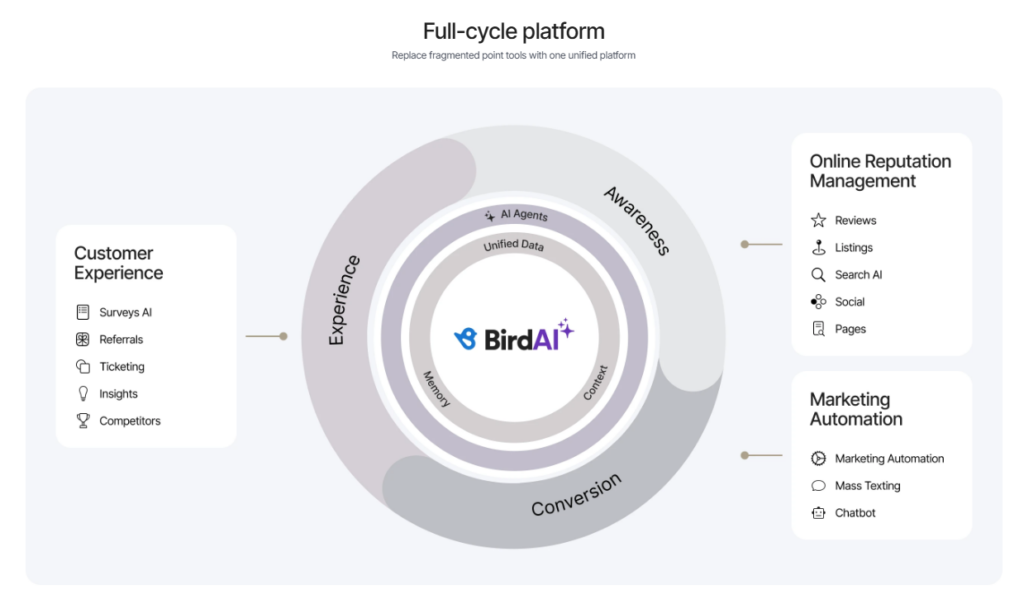
Birdeye consolidates discovery, engagement, patient communications, and customer feedback into a single platform, helping healthcare organizations manage reputation and patient experience across all locations.
- Centralizes reviews, messaging, surveys, social engagement, and patient feedback in one system.
- Unifies engagement and reputation data across locations to help healthcare organizations identify trends and improve patient experience at scale.
- Supports HIPAA-compliant forms, surveys, review requests, and communication workflows.
- Integrates with 3,000+ systems, including CRM, EHR-connected workflows, POS, Salesforce, HubSpot, and QuickBooks Online, ensuring operational consistency across complex healthcare organizations.
Local intelligence
- Ensures listing accuracy, removes duplicates, and improves local search performance through Listing Score and Local Listings Analytics.
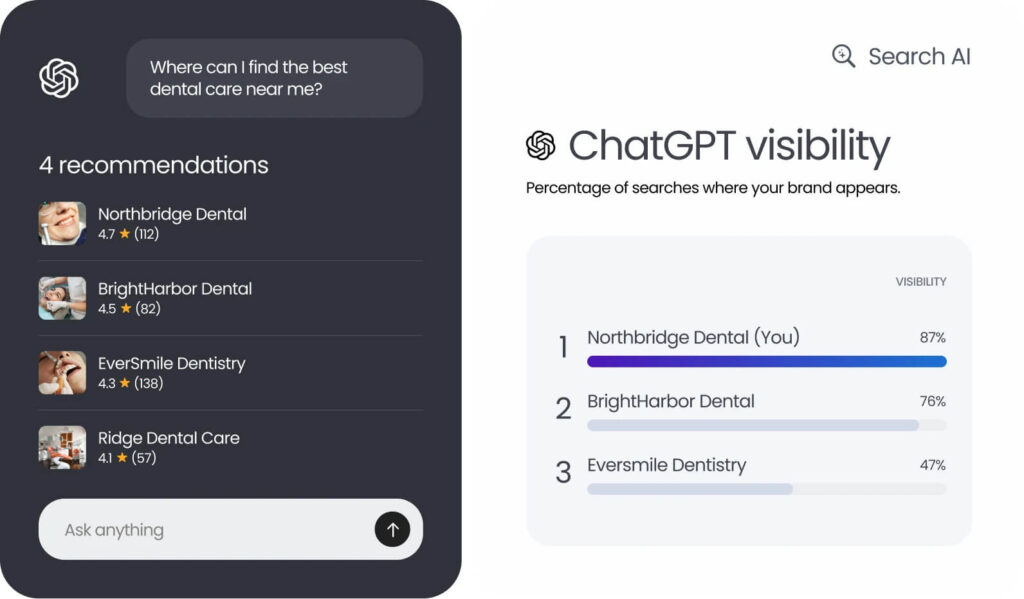
- Search AI monitors how healthcare brands appear across AI platforms such as ChatGPT, Gemini, and Perplexity, analyzing visibility, citations, accuracy, and sentiment.
- AI-driven recommendations and automated execution help resolve visibility gaps by improving listings, review generation, and local content performance.
- Tracks reputation and discoverability across 200+ review and directory sites
Marketing Agents
Birdeye’s AI coworkers and agents automate execution while maintaining brand standards, compliance requirements, and local relevance.
- Jay (Marketing AI Coworker): Helps manage reviews, listings, social media, campaigns, lead generation, and AI search visibility across locations.
- Robin (Operations AI Coworker): Streamlines operational workflows, reporting, and location-level performance management.
- Myna (Customer Experience AI Coworker): Supports patient engagement through messaging, surveys, feedback collection, and experience monitoring.
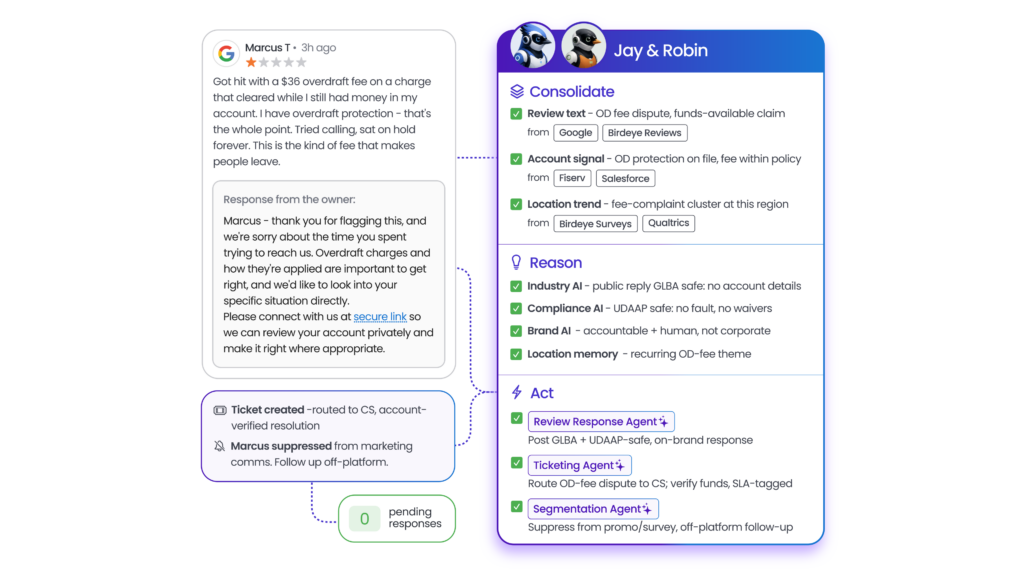
Additional AI-driven capabilities include:
- Review Generation Agent for requesting reviews at the right moment and on the right platform.
- Reporting Agent that explains performance changes and highlights anomalies in plain language.
- Listings Optimization Agent for maintaining accurate business information across Google, Apple, Facebook, Yelp, and other directories.
- Social Engagement Agent for prioritizing and responding to comments and messages.
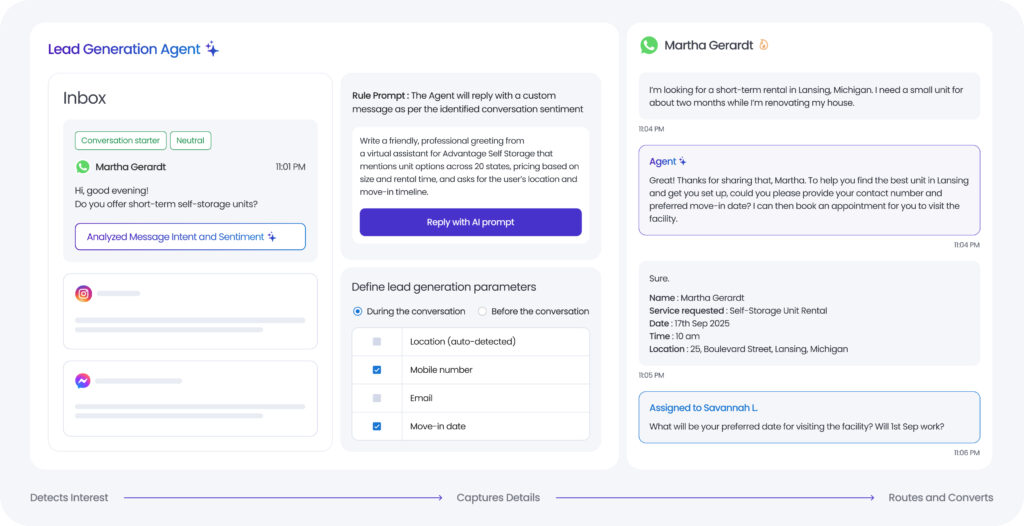
- Lead Generation Agent for capturing, qualifying, and routing inquiries 24/7.
- Survey Agents for collecting feedback and surfacing trends.
- Insights that track reputation, sentiment, and listing performance through a single Birdeye Score and prioritized recommendations.
Key Birdeye HIPAA-relevant features:
- Signed BAA for all healthcare customers (see birdeye.com/hipaa)
- End-to-end encryption for all patient communications in transit and at rest
- Role-based access control (RBAC) and MFA across all user accounts
- HIPAA-compliant forms, surveys, and review request workflows
- Full audit trails with access logging across all locations
- Consent and suppression management are built into every automation workflow
EHR integration: Yes, with 3,000+ integrations, including leading healthcare systems such as Athenahealth, eClinicalWorks, Allscripts, CareCloud, drchrono, Modernizing Medicine, Open Dental, and Dentrix, via open APIs, SFTP, and bulk upload.
Pros
- Centralizes reviews, messaging, listings, and patient feedback into one platform, eliminating the need to manage multiple tools
- AI-powered automation saves significant time on review responses, social posts, and patient outreach across all locations
- Highly rated for ease of use, with consistent feedback praising the intuitive dashboard and responsive customer support
- Delivers measurable results for healthcare providers, including increased review volume, improved local search rankings, and higher patient engagement
- Built for multi-location complexity, with location-aware AI that maintains brand consistency while enabling local customization
Cons
- Some niche integrations may require custom setup, though APIs and connectors typically address these needs
- The breadth of features can take time for teams to fully operationalize across locations
Pricing: Birdeye uses custom pricing based on location count and selected capabilities, with scalable plans designed for growing multi-location healthcare organizations (contact Birdeye for healthcare-specific pricing)
G2 Rating: 4.7/5 (4,090+ reviews)
2. ActiveCampaign
Best for: Mid-size healthcare organizations and growing practices focused on personalized patient journeys across email, SMS, and WhatsApp.
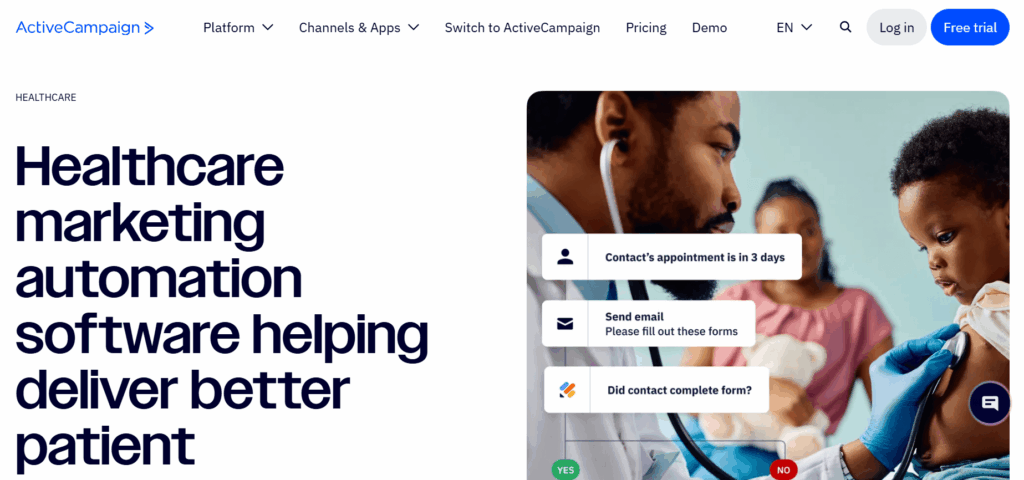
ActiveCampaign is a powerful marketing automation platform that offers a HIPAA-compliant tier for healthcare providers who need deep audience segmentation, multi-step patient journey automation, and cross-channel outreach.
Key HIPAA-relevant features:
- Signed BAA available on Professional and Enterprise plans
- Role-based access control (RBAC) and MFA
- Audit logs and access tracking
- SSL/TLS-encrypted forms and landing pages
- PHI detection and automatic suppression controls
- 1,000+ integrations, including healthcare CRMs
EHR integration: Limited. Requires third-party connectors or middleware for most EHR systems.
Pros
- Industry-leading automation builder with 135+ triggers and 750+ pre-built workflow templates
- Deep segmentation logic allows marketers to build complex, behavior-based patient audience groups
- Integration library with 1,000+ apps, making it flexible for diverse martech solutions
Cons
- Steep learning curve, cited as the top con by G2 reviewers with 431+ mentions
- Pricing increases rapidly as contact lists grow, and BAA access requires higher-tier plans
- Reporting functionality can feel limited and hard to share without manual workarounds
Pricing: From $229/month (Professional plan with BAA)
G2 Rating: 4.4/5 (14,700+ reviews)
3. Keap
Best for: Small to mid-size clinics, MedSpas, and wellness practices that need CRM, email, SMS, and automation under one roof without a large technical team.

Keap is an all-in-one CRM and marketing automation platform that offers HIPAA-compatible features for small- to mid-size healthcare practices looking to consolidate contacts, campaigns, and follow-ups in a single system.
Key HIPAA-relevant features:
- Signed BAA available after enabling HIPAA Security Controls in settings
- Encryption for data in transit and at rest
- Role-based access control and unique login credentials per user
- MFA support
- Audit controls and contact activity logging
- Consent-based tagging and suppression workflows
EHR integration: Limited. Most EHR connections require Zapier or third-party middleware.
Pros
- Powerful visual automation builder that lets teams map entire patient journeys without technical knowledge
- All-in-one platform combining CRM, email, SMS, invoicing, and scheduling reduces tool sprawl for small practices
- Customer support receives consistently high praise for responsiveness and hands-on onboarding assistance
Cons
- Steep learning curve for new users, with complex automation setup taking significant time to master
- Limited customization options compared to larger enterprise platforms, which can restrict advanced workflows
- Pricing is high for small practices, with costs scaling quickly as contact lists and user counts grow
Pricing: From $249/month
G2 Rating: 3.9/5 (28 reviews)
4. Act-On
Best for: Mid-size to large healthcare organizations, health systems, and behavioral health networks that need advanced multi-channel campaign automation with full compliance coverage.
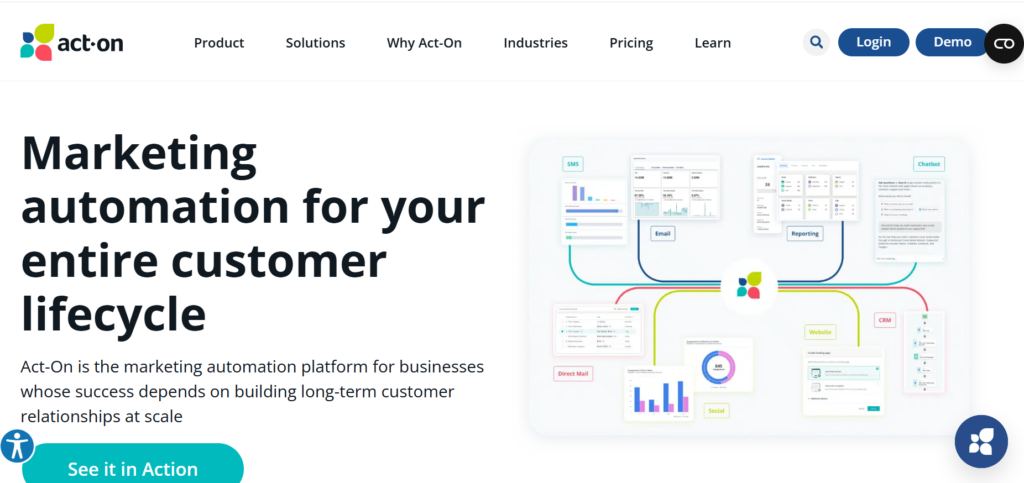
Act-On is a purpose-built marketing automation platform that earned HIPAA compliance in 2023, making it one of the few enterprise-class solutions with a signed BAA and full Security Rule alignment built into its core product.
Key HIPAA-relevant features:
- Signed BAA available across eligible plans
- End-to-end encryption for data in transit and at rest
- Role-based access control (RBAC) and MFA
- Audit trails and activity logging
- HIPAA-compliant forms, landing pages, and email campaigns
- Active contact-based pricing, so you pay only for contacts you actually engage with
EHR integration: Limited native EHR connectors; integrates with leading CRMs, including Salesforce and Microsoft Dynamics.
Pros
- User-friendly interface that marketers can operate without heavy IT involvement or technical training
- Strong CRM integration, particularly with Salesforce, enabling seamless bidirectional data sync
- Responsive customer support with dedicated onboarding assistance during initial setup
Cons
- User interface feels dated compared to newer platforms, with several reviewers noting it looks like legacy software
- Limited third-party integrations outside of major CRMs, which can create gaps in more complex martech stacks
- Pricing is prohibitive for smaller practices, with plans starting at $900/month on an annual contract
Pricing: From $900/month (Professional plan, annual contract)
G2 Rating: 4.1/5 (1,070 reviews)
5. Demandforce
Best for: Dental groups, vision care practices, and specialty clinics already using Dentrix, Eaglesoft, or ChiroTouch that need reliable appointment reminders, recall campaigns, and reputation management with HIPAA compliance included.
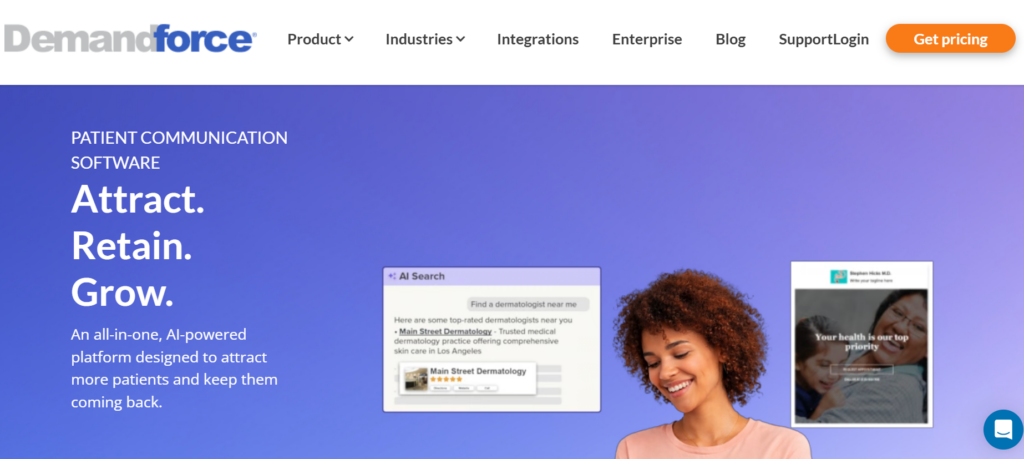
Demandforce is a healthcare-specific patient communication and marketing automation platform built for dental practices, optometry clinics, MedSpas, and specialty providers that need simple, automated outreach tightly integrated with their existing practice management software.
Key HIPAA-relevant features:
- Signed BAA included for all healthcare customers
- Encryption and secure data handling for patient communications
- Role-based access control and unique user credentials
- Automated appointment reminders via email, SMS, and voice
- Two-way HIPAA-compliant texting
- Reputation management with patient review collection
EHR integration: Yes, with strong native integrations for dental and specialty practice management systems, including Dentrix and Eaglesoft.
Pros
- Two-way texting is consistently praised for improving patient communication and reducing front-desk workload
- Automated appointment reminders and confirmations reduce no-shows without requiring manual follow-up
- Deep integration with dental and specialty practice management software makes setup straightforward for existing users
Cons
- Occasional glitches in the two-way texting system lead to unreliable message delivery, which users flag as a recurring frustration
- Initial setup is more time-consuming than expected, with onboarding requiring more effort than the platform implies
- Reporting and analytics features are basic, limiting the ability to extract detailed campaign performance insights
Pricing: From $10–$100/month, depending on practice size and features
G2 Rating: 3.4/5 (29 reviews)
How HIPAA-compliant marketing automation improves patient experience
HIPAA-compliant marketing automation helps healthcare organizations maintain consistent patient communication throughout the care journey.
Appointment reminders, recall campaigns, post-visit follow-ups, and review requests can be automated through secure workflows that reduce administrative burden while improving patient engagement. For multi-location healthcare organizations, automation helps ensure patients receive timely, relevant communication without requiring staff to manage every interaction manually.
The most effective platforms combine automation with privacy safeguards. By following principles such as the Minimum Necessary Standard and supporting requirements under the HIPAA Privacy Rule, compliant solutions help organizations deliver personalized outreach, manage patient consent and opt-outs, and protect sensitive information throughout the communication process. The result is a better patient experience, stronger patient relationships, and reduced compliance risk.
How to choose the right HIPAA-compliant tool
The checklist below helps practice administrators, healthcare marketing managers, and compliance officers evaluate any marketing automation vendor before committing to one. Print it, save it, and use it in every conversation with a vendor.
1. BAA coverage
- Confirm that the vendor signs a Business Associate Agreement that explicitly covers all services you plan to use
- Verify the BAA covers email and SMS marketing campaigns
- Verify the BAA covers form and survey data capture
- Verify the BAA covers analytics, tracking, and reporting that process patient data
- Verify the BAA covers any third-party tools to which the platform passes data
2. Encryption standards
- Confirm TLS encryption for PHI in transit
- Confirm AES-256 encryption for PHI at rest
- Request documentation confirming the vendor’s key rotation policy
- Require specific answers, not vague references to “industry-standard encryption,” as mandated under the HIPAA Security Rule
3. Access controls
- Confirm the platform restricts ePHI access by role and location, not just by password
- Confirm the platform enforces MFA for every account that touches patient data
- Verify administrators can revoke access instantly when staff changes occur
4. Audit trails
- Confirm how long the vendor retains audit logs
- Verify audit logs are exportable on demand
- Confirm audit trail capability meets OCR investigation requirements
5. Consent and suppression
- Confirm the platform captures and stores patient authorization at the point of collection
- Verify suppression lists update in real time when a patient opts out
- Confirm the platform prevents outreach to patients who have not provided written authorization, as required under the HIPAA Privacy Rule’s marketing provisions
6. EHR and practice management integration
- Confirm the platform supports FHIR or HL7 data standards or offers pre-certified connectors for your specific system
- Verify the platform does not rely on manual data exports to sync with your EHR
- Confirm integration is validated for multi-location health organizations and telehealth platforms
7. Minimum necessary standard
- Run a sample workflow and confirm the platform accesses only the minimum patient fields required to complete each task
- Confirm the platform does not default to pulling all available patient data into every automation
FAQs about HIPAA-compliant marketing automation tools
A HIPAA-compliant marketing platform is software that enables healthcare organizations to run patient outreach campaigns while maintaining the security of Protected Health Information (PHI). To qualify, a platform must provide a signed Business Associate Agreement (BAA), end-to-end encryption, role-based access control (RBAC), multi-factor authentication (MFA), audit trails, and consent and suppression management.
Birdeye is the best HIPAA-compliant marketing automation tool for multi-location healthcare brands. It combines HIPAA-compliant patient outreach, reputation management, listings, and messaging in one platform, and signs a BAA for all healthcare customers.
The most widely used HIPAA-compliant marketing automation tools in 2026 are Birdeye, ActiveCampaign (Professional and Enterprise plans), Keap (with HIPAA Security Controls enabled), Act-On, and Demandforce. Each platform offers a signed BAA and core Security Rule safeguards, though their depth of healthcare-specific features varies significantly.
Yes. Birdeye signs a BAA for all healthcare customers and provides end-to-end encryption, role-based access control, multi-factor authentication, audit trails, and HIPAA-compliant forms across its platform. You can review Birdeye’s full HIPAA compliance details at birdeye.com/hipaa.
Yes. Under 45 CFR Part 164, any vendor that creates, receives, maintains, or transmits PHI on your behalf qualifies as a Business Associate and must sign a BAA before you share any patient data with them. Operating without a signed BAA is an impermissible disclosure under HIPAA, regardless of how secure the platform claims to be. If your current marketing vendor cannot provide a BAA, you need to switch vendors before using the platform for any patient-related outreach.
Make HIPAA-compliant marketing automation easier with Birdeye
Most healthcare organizations juggle multiple tools to manage patient outreach, reputation, listings, and messaging. That fragmentation creates compliance gaps, inconsistent patient experiences, and operational drag across locations. Birdeye eliminates all of that with a single agentic marketing platform purpose-built for healthcare, backed by a signed BAA and full HIPAA compliance from day one.
What makes Birdeye different from every other HIPAA-compliant marketing automation platform is its agentic approach: Consolidate every signal. Reason with context. Act at scale. Drive outcomes.
Consolidate: One platform, complete context
Birdeye unifies all your fragmented patient and location data into a single Customer Data Platform (CDP). With 3,000+ integrations across EHR systems, practice management software, CRMs, and POS platforms, Birdeye brings reviews, local listings, social channels, and patient messaging into a single centralized hub. Every AI action the platform takes draws from complete, accurate, and HIPAA-protected data, so nothing falls short.
Reason: Context-aware intelligence, not rogue automation
Birdeye’s AI does not just execute tasks. It applies built-in memory and healthcare-specific guardrails before taking any action. The platform evaluates patient sentiment, local nuance, and your brand guidelines to ensure every automated response and campaign matches your voice and stays within compliance boundaries. For multi-location dental groups, behavioral health practices, and urgent care chains, this means consistent, locally relevant communication across every location without manual oversight at every step.
Act: Specialized AI agents that work around the clock
Birdeye deploys purpose-built AI agents that do the actual work, not just surface recommendations for your team to act on manually. Each AI agent handles a specific function within your HIPAA-compliant marketing solutions ecosystem, some of which include:
- Marketing Automation Agent builds hyper-targeted email and SMS campaigns using patient data stored securely within Birdeye’s HIPAA-compliant environment.
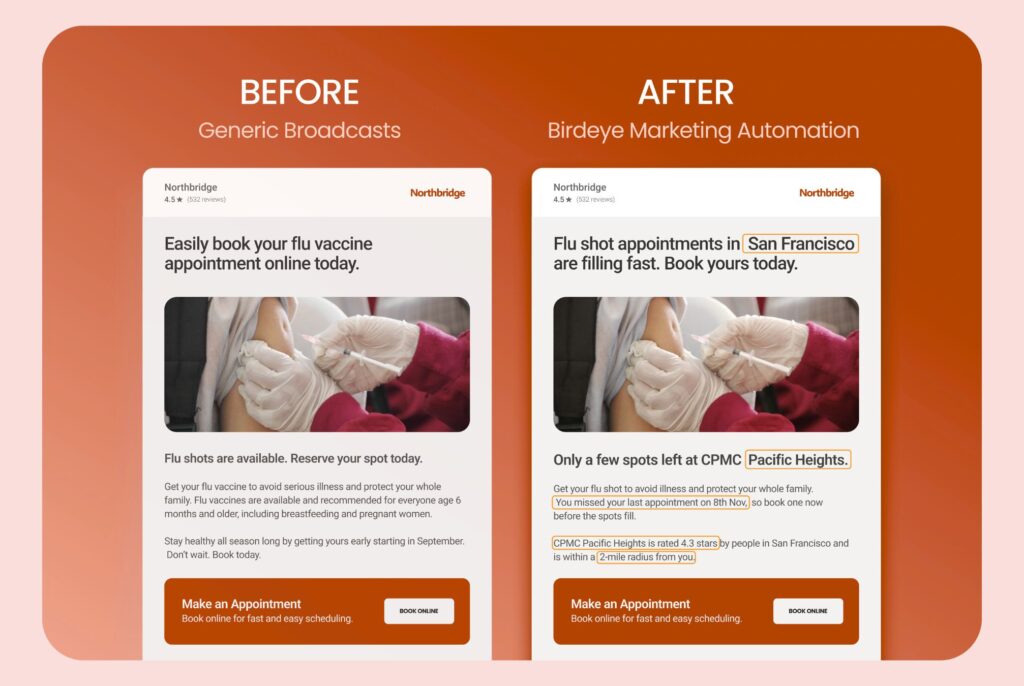
- Reviews Response Agent drafts and automatically publishes localized, on-brand review replies across all your locations.
- Social Publishing Agent generates and schedules location-specific social content that reflects each practice’s local identity.
Outcomes: ROI you can measure and explain
Birdeye closes the execution loop with Reporting Agent and Insights, two tools that go beyond dashboards to explain exactly why your performance numbers shifted.
Rather than presenting raw data for your team to interpret, Birdeye benchmarks your performance using its proprietary Birdeye Score and Sentiment Score, and surfaces the specific actions driving results.
For healthcare marketing managers and practice administrators, this means clear, defensible ROI without hours of manual reporting. No other HIPAA-compliant marketing automation software combines patient data unification, agentic AI execution, and measurable outcomes in a single platform at this scale.
Birdeye gives multi-location healthcare brands the infrastructure to grow patient volume, protect their reputation, and stay fully compliant, all from a single dashboard.
Ready to see Birdeye in action? Request a free demo today.

About the Author

Shruti Dugar
Birdeye
Originally published