Apple Business Connect is how Apple understands your business across its ecosystem. For multi-location brands, it directly affects visibility, actions, and conversions when potential customers search, navigate, or ask Siri for nearby services.
Summary of the blog:
Apple Business Connect is different than Google. Apple prioritizes rich media, precise attributes, and tightly governed location data, with little tolerance for outdated content or generic profiles. For multi-location brands, that means Apple listings cannot be treated as a secondary channel or maintained with periodic syncs.

But most listing tools are not designed for this level of control. They push basic data updates but fail to optimize how Apple surfaces businesses in Maps, Siri responses, and zero-click discovery. The result is predictable: brands lose visibility without a clear signal of what broke or what needs to change.
This blog breaks down how Apple Business Connect fits into modern listings optimization. You will see how Birdeye helps enterprise teams actively optimize Apple Business Connect alongside Google and other high-impact platforms, using continuous recommendations, prioritization, and centralized governance.
Table of contents
- How does Apple Business Connect actually work for multi-location brands?
- How Apple Business Connect and Google Business Profile differ in local discovery
- What brands gain from Apple Business Connect visibility
- How enterprise teams approach Apple Business Connect setup
- How to delegate Apple Business Connect to Birdeye?
- How Apple Business Connect features drive visibility and engagement
- How Birdeye’s Listings Optimization Agent supports Apple Business Connect
- FAQs on Apple Business Connect
- Turn Apple Business Connect into a managed asset with Birdeye
What is Apple Business Connect?
Apple Business Connect is Apple’s platform for managing how businesses appear across Apple Maps, Siri, Wallet, and Messages. It allows brands to control place cards, media, attributes, and customer actions for each location across Apple’s ecosystem.
How does Apple Business Connect actually work for multi-location brands?
Apple Business Connect controls how businesses appear across Apple Maps, Siri, Wallet, and other Apple surfaces. For multi-location brands, it determines whether individual locations are discoverable, correctly represented, and actionable when customers search or ask for nearby services.
Unlike traditional directory-style listings, Apple Business Connect is tightly governed. Apple relies on structured attributes, approved media, and verified location data to decide how and where a business appears. Each location has its own place card, and each place card is evaluated independently based on accuracy, completeness, and relevance.
Where does Apple surface business information?
Apple Business Connect listings appear primarily in:
- Apple Maps search and navigation results
- Siri responses for local and branded queries
- Spotlight and other Apple discovery surfaces
When customers search or use voice commands, Apple does not simply pull basic business details. It evaluates the place card content, including photos, categories, attributes, and available actions, before deciding which locations to surface.
What does Apple prioritize when displaying locations
Apple places strong emphasis on:
- High-quality logos, cover images, and photo galleries
- Precise categories and business attributes
- Accurate hours, location markers, and contact details
- Clear customer actions such as directions, calls, or bookings
Listings that rely on generic descriptions, outdated media, or incomplete attributes are less likely to surface consistently, even when the core business information is present.
Why Apple listings behave differently from Google listings
Google Business Profile focuses heavily on search intent, proximity, and review signals. Apple Business Connect, by contrast, applies stricter controls on how listings are presented and updated. Changes are reviewed differently, media standards are higher, and inaccuracies are less forgiving.
For multi-location brands, this means Apple listings cannot be treated as a background sync process. Each location must be maintained with intent and consistency, especially when Apple Business Connect is managed alongside Google and other platforms.
How Apple Business Connect and Google Business Profile differ in local discovery
For multi-location brands, the question is no longer which platform to manage. It is how differently Apple and Google need to be handled to maintain visibility and control across locations.
Both Apple Business Connect and Google Business Profile influence how customers find nearby businesses. However, they operate on different discovery models, apply different controls, and reward different types of optimization.
Key visibility differences between Apple and Google
Google Business Profile is optimized for high-volume search behavior. It responds quickly to changes, emphasizes reviews and proximity, and is tightly linked to keyword intent on Google Search and Maps.
Apple Business Connect, on the other hand, is optimized for presentation and precision. Apple evaluates listings based on structured attributes, approved media, and verified location data. Visibility is driven less by constant activity and more by accuracy, completeness, and how well a place card meets Apple’s quality standards.
For brands managing dozens or hundreds of locations, this difference matters. A listings strategy built only for Google often underperforms on Apple surfaces.
Feature comparison: Apple Business Connect vs Google Business Profile
| Capability | Apple Business Connect | Google Business Profile |
| Primary visibility | Apple Maps, Siri, Wallet, Spotlight | Google Search, Google Maps |
| Discovery model | Place card quality and accuracy | Search intent, proximity, relevance |
| Media importance | Very high. Logos, covers, and photo albums are tightly governed | High, but more flexible and activity-driven |
| Categories and attributes | Strict, structured, fewer tolerated errors | Broader, more forgiving taxonomy |
| Customer actions | Custom Action Links configured by the brand | Calls, directions, bookings, posts |
| Verification approach | Apple-managed verification with tighter controls | Google-managed verification with faster iteration |
| Insights and reporting | Focused on views and actions | Broader engagement and search metrics |
| Third-party management | Limited to Apple-approved partners | Wide partner ecosystem |
This comparison highlights a key operational reality. Apple and Google do not reward the same behaviors, and treating them as interchangeable listing platforms creates visibility gaps.
Why do brands need to manage both platforms (Apple Business Connect & Google Business Profile) together
Customers rarely search on just one ecosystem. A brand may be discovered on Google during initial research and selected on Apple Maps during navigation or voice-based searches. That makes parallel management essential.
In the United States, iPhone devices account for roughly 57% of smartphone market share, according to Counterpoint Research, making Apple’s ecosystem a primary discovery environment for a significant portion of consumers.
For enterprise teams, the challenge is consistency without oversimplification. Google Business Profile benefits from frequent updates and engagement signals. Apple Business Connect benefits from precise control, structured data, and approved media that remain accurate over time.
Managing both platforms together requires a system that understands these differences and applies the right optimizations to each, without forcing a one-size-fits-all approach across locations.
This distinction sets the foundation for why Apple Business Connect cannot be treated as a passive listing and why optimization, not just setup, becomes central for brands operating at scale.
What brands gain from Apple Business Connect visibility
Visibility on Apple Business Connect is not about being present on another map. It is about controlling how each location is presented when customers navigate, ask for nearby services, or make last-mile decisions inside the Apple ecosystem.
For multi-location brands, Apple Business Connect delivers three clear advantages when it is managed correctly:
- Consistent discovery across Apple Maps and Siri
- Control over how each location is presented
- Customer actions directly from Apple place cards
Let’s explore in detail:
Consistent discovery across Apple Maps and Siri
Apple Maps and Siri rely directly on Apple Business Connect place cards to surface businesses. When listings are complete and accurate, locations appear reliably for branded, category-based, and proximity-driven searches.
Research from BrightLocal shows that 58% of consumers have used voice search to find local business information, reinforcing the importance of optimizing Apple Business Connect for Siri-driven discovery.
This consistency matters because Apple surfaces fewer results than Google. There is less room for error, and incomplete or outdated listings are more likely to be skipped entirely rather than ranked lower. Brands that maintain clean place cards across locations are more likely to appear when customers are navigating or using voice search.
Control over how each location is presented
Apple Business Connect gives brands tighter control over presentation than most listing platforms. Logos, cover images, photo galleries, categories, and attributes are reviewed and displayed in a structured way, reducing noise while increasing the importance of precision.
For multi-location teams, this creates a clear benefit. Each location can reflect local realities such as services offered or amenities available, while still adhering to brand standards. That balance between consistency and local accuracy is difficult to achieve on Apple surfaces without deliberate management.
Customer actions directly from Apple place cards
Apple place cards are designed to drive action, not just discovery. From directions and calls to bookings and other custom actions, customers can engage with a location without leaving the Apple experience.
When these actions are configured correctly, Apple Business Connect listings shorten the path from search to decision. For brands, this means fewer drop-offs and more qualified interactions originating from Apple Maps and Siri.
Taken together, these gains explain why Apple Business Connect should not be treated as a passive listing. For brands that operate across multiple locations, visibility on Apple surfaces depends on accuracy, presentation, and control at the location level, not on periodic data syncs alone.
How enterprise teams approach Apple Business Connect setup
Setting up Apple Business Connect is not a one-time task for enterprise brands. The setup phase determines how smoothly listings can be governed, updated, and optimized across locations over time.
Before setting up a business, the following key information is required by Apple to create and verify listings:
- Legal name of the company and businesses
- Physical address
- Phone number
- D-U-N-S number (If you don’t know, you can find yours here)
- Brand logo
- High-quality photos
- Descriptions of your business, products & services
Here’s a step-by-step process on how to register for Apple Business Connect.
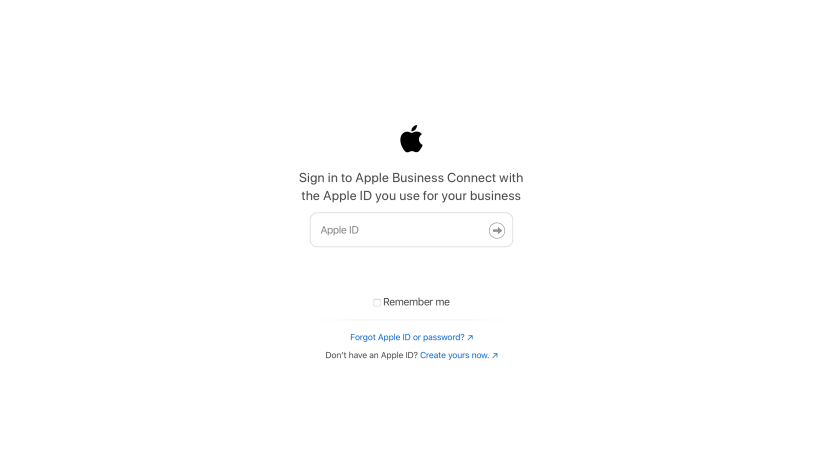
1. Login with your Apple ID
Go to Apple’s Business Connect onboarding page and click “Get Started.” Sign in with the Apple ID you use for your business. If you don’t have one, create one here.
2. Review the terms of use
Review the Terms of Use for Apple Business Connect and select “agree.”
3. Choose your type of business
Select “small business” if you have up to 24 locations.
4. Add details about your business location
- Drag the map to place the pin accurately over your building.
- Confirm location details.
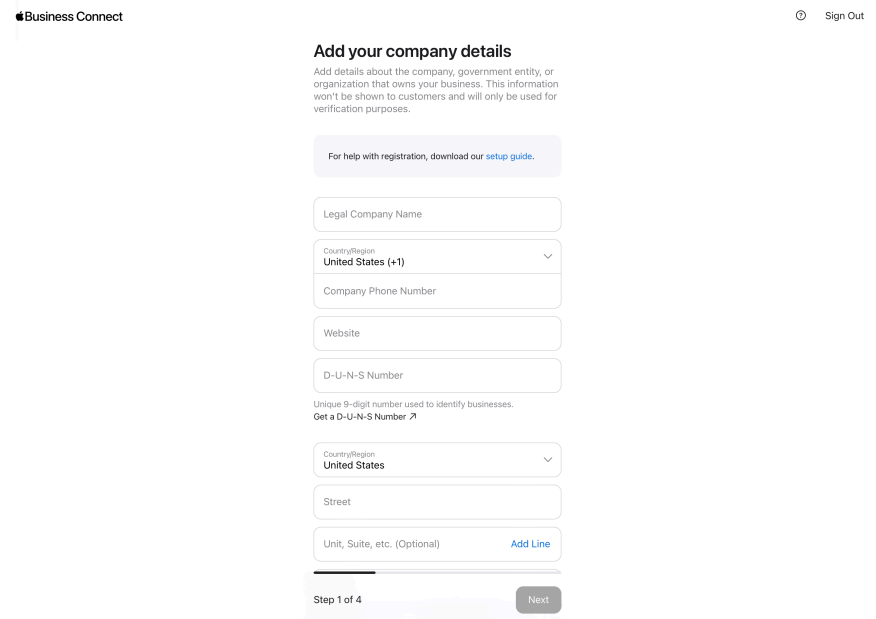
5. Update your company details
- Set the primary and additional categories for your business.
- Provide a customer contact number and, if applicable, a website link.
- Configure your hours of operation by selecting the days of the week you are open and your opening and closing times.
- Add specific hours if they vary on different days.
- Include your website and DUNS number, if applicable.
- Agree to the Apple Business Connect Terms of Use.
6. Get verified
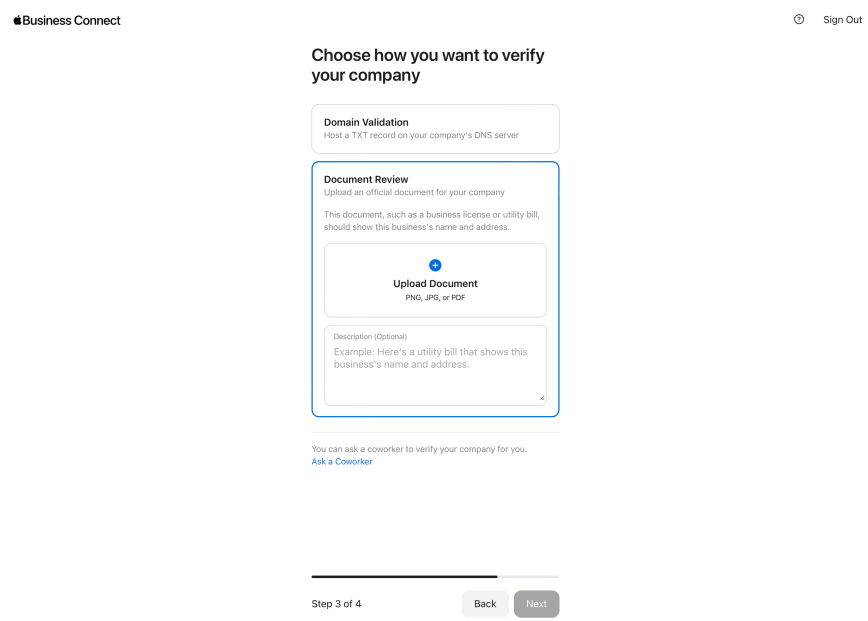
Apple Business Connect supports multiple verification options depending on business eligibility:
- Domain validation: Add a TXT record to your website’s DNS zone file (to verify your domain).
- Document review: Upload relevant documents displaying your company’s name and address, such as a business license or utility bill.
- App Store Connect (if eligible): Verify via an app associated with your company.
- The verification process can take up to 5 business days.
Remember, you’re not just adding your business to Apple Business Connect; you’re reaching more customers across the Apple ecosystem.
Where do verification delays and errors usually occur
Verification is often the most time-consuming part of Apple Business Connect setup. Delays typically occur when location information does not match external records, documentation is incomplete, or ownership details are unclear.

Enterprise teams mitigate this by preparing verification materials in advance and aligning internal records with Apple's expectations. They also plan for setup timelines that account for review periods, rather than assuming instant approval.
Show up where your customers search
Want to see the impact of Birdeye on your business? Watch the Free Demo Now.
How to delegate Apple Business Connect to Birdeye?
For enterprise teams, managing Apple Business Connect directly inside Apple’s interface can quickly become fragmented.
Apple only allows verified businesses to grant access to approved third-party partners. Birdeye is an Apple-approved partner that enables teams to manage Apple Business Connect alongside other major listing platforms without duplicating work.
Here are the steps to delegate management of your business to Birdeye in Apple Business Connect:
- Click on your company name
- Click on the Shared tab
- Click Share Access
- Enter Birdeye’s Organization ID
- Select Admin role
- Select All Businesses or a specific business
- Click Invite
Be sure to give access to Birdeye every time you create a new business.
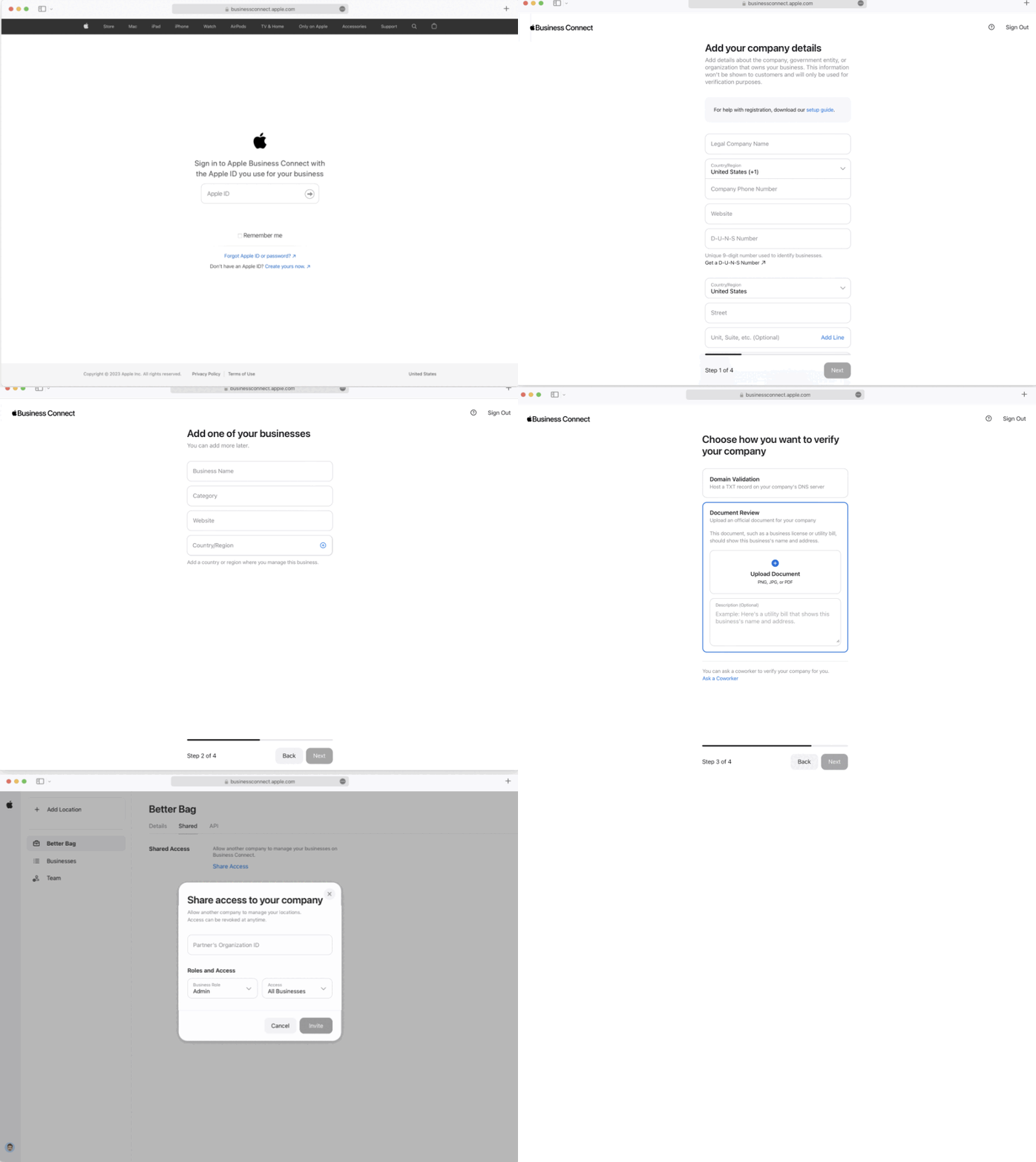
It takes around 3-5 days for Apple to verify and delegate your business to Birdeye. Once these steps are completed, you can start managing your Apple place cards from Birdeye.
What changes when Apple Business Connect is managed through Birdeye
Once Apple Business Connect is delegated to Birdeye, Apple place cards can be managed from the same environment used for broader listings governance. Location data, media, and attributes are handled within a centralized workflow rather than through individual Apple accounts.
This does not replace Apple’s controls. Instead, it provides a structured layer where enterprise teams can:
- Maintain consistency across 100-10,000+locations
- Coordinate updates across Apple and other platforms
- Reduce lag between approved changes and live listings
For brands with dozens or hundreds of locations, this shift removes operational friction without sacrificing accuracy.
What do teams control versus what is automated?
Delegation does not mean giving up control. Enterprise teams retain authority over what changes are made and when they are applied. Apple’s approval standards still apply, and brand rules remain intact.
Birdeye acts as the management layer, not the owner of the listing. Teams decide which locations are updated, what content is approved, and how Apple Business Connect fits into their broader listings strategy.
This balance between centralized oversight and platform compliance enables Apple Business Connect to be managed at scale without becoming another disconnected system.
How Apple Business Connect features drive visibility and engagement
Setting up Apple Business Connect correctly is necessary, but it is not sufficient. Apple listings do not remain static in practice, even when a business makes no visible changes. How locations are surfaced, compared, and selected shifts as attributes change, media ages, competitors update their profiles, or Apple adjusts how place cards are evaluated.
For multi-location brands, this makes optimization an ongoing requirement rather than a periodic task. That is why visibility on Apple is driven less by one-time setup and more by how brands use Apple Business Connect features such as place cards, Showcases, Custom Action Links, and insights to stay accurate, relevant, and actionable.
Let’s explore each in detail.
Why do static listings lose visibility on Apple surfaces?

Apple surfaces fewer results than Google and applies stricter quality controls. When place cards are incomplete, inconsistent, or outdated, Apple does not gradually reduce visibility. In many cases, locations are skipped entirely.
Static listings create several risks:
- Media becomes stale and less representative of the location
- Attributes no longer reflect services, amenities, or operating details
- Categories fall out of alignment with how customers search
- Competing locations present more complete or current place cards
Over time, these gaps compound, especially across dozens or hundreds of locations.
A. Place Cards
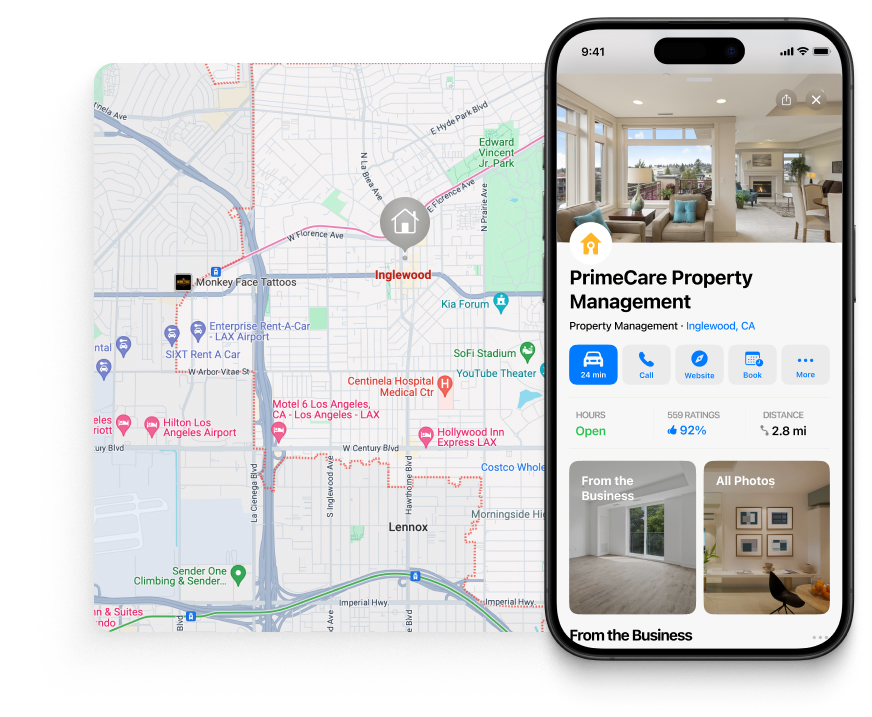
A place card is the core representation of a business location across Apple Maps, Siri, Wallet, and related Apple experiences. It is where customers see essential details before deciding whether to visit, call, or navigate.
Each place card includes:
- A logo and approved cover image
- The display name used across Apple surfaces
- Primary and secondary categories
- A short business description
- Address, phone number, and operating hours
- Website links and supported actions
- Photos that reflect the physical location
- Attributes such as accessibility, parking, or payment options
For Apple, completeness and consistency matter more than frequency of updates. Place cards that are accurate, well-structured, and visually representative are more likely to surface when customers search or navigate nearby.
B. Showcases
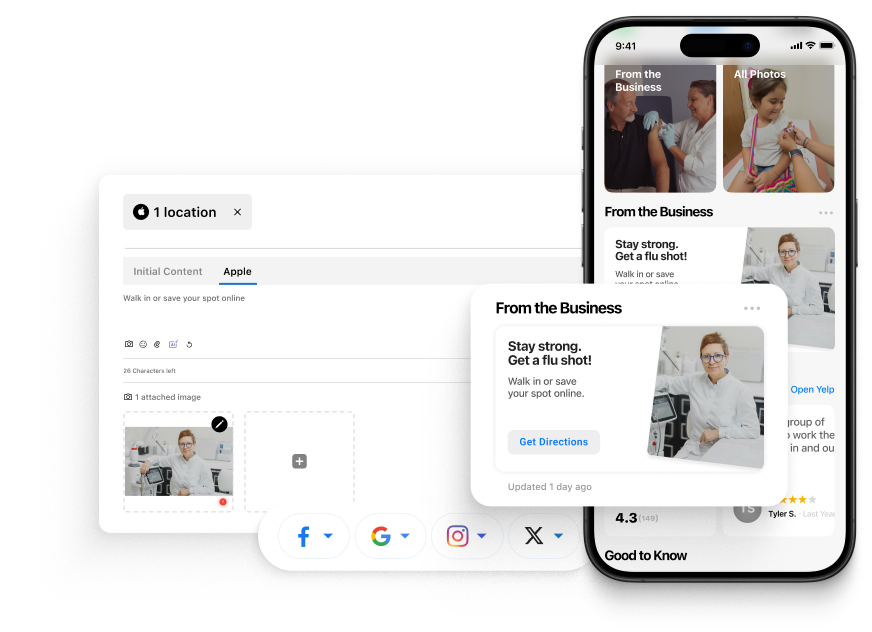
Showcases allow brands to highlight timely updates such as offers, announcements, or seasonal information directly on a place card in Apple Maps.
These updates are visible for a limited time, which makes them useful for communicating what is relevant now rather than maintaining static messaging. For multi-location brands, Showcases are most effective when used selectively, with content that aligns with local context rather than generic promotions.
Please note that Showcases remain active for up to 30 days.
C. Custom Action Links
Custom Action Links appear prominently on Apple place cards and give customers a direct path to act. These actions can include booking, ordering, or other location-specific interactions.
Each location will have a different place card, and each place card can have different Actions. This gives a seamless customer experience.
D. Insights
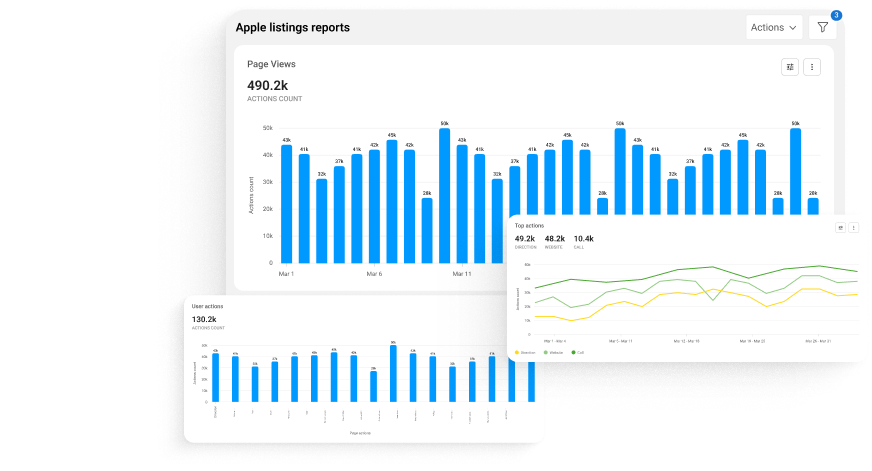
Apple Business Connect provides insight into how customers interact with place cards on Apple Maps. These insights include searches, views, and actions taken.
While the data is intentionally focused, it helps brands understand whether listings are being discovered and acted upon. For multi-location teams, these signals are most useful when viewed alongside listing completeness and feature usage, rather than in isolation.
Why is syncing listings not enough on Apple
Most listing tools are built to synchronize data, not to evaluate performance. They confirm that information exists, but they do not assess whether that information is competitive, relevant, or aligned with how Apple surfaces results.
As a result, brands often know their listings are “accurate” without knowing whether they are effective. This gap is especially costly on Apple surfaces, where precision and presentation have a direct impact on whether a location appears at all.
Why does Apple optimization alone no longer cover the full discovery journey?
Apple Business Connect plays a critical role in how locations appear across Apple Maps and Siri. But customer discovery no longer stops inside map apps alone.

More customers now ask AI tools to recommend nearby businesses, compare options, or suggest where to go next, often without opening a map or clicking through search listings. These AI-generated answers rely on a combination of business listings, reviews, citations, and brand sentiment across the web.

For multi-location brands, this changes the scope of listings management. Even when Apple place cards are accurate and optimized, visibility can be limited if the broader data AI systems are inconsistent or outdated.
How Birdeye Search AI complements Apple Business Connect
Birdeye Search AI helps multi-location brands understand and influence how they appear in AI-generated answers across platforms such as ChatGPT, Gemini, and Perplexity. Working alongside Birdeye’s Listing Optimization Agent, Search AI ensures that business information remains accurate, consistent, and trustworthy wherever AI-generated answers source their recommendations.
With Search AI, brands can:
- Measure AI visibility by tracking how often locations appear in AI recommendations compared to competitors
- Understand AI sentiment and prompts that influence how the brand is described and discovered
- Identify and fix data gaps that affect AI answers by correcting inaccuracies at the source
- Optimize the citations AI relies on, helping teams focus on the directories and signals that matter most
How Birdeye’s Listings Optimization Agent supports Apple Business Connect
Managing Apple Business Connect effectively requires more than simply syncing business data. Enterprise teams need to understand which locations require updates, what changes influence visibility, and how Apple evaluates place cards across hundreds or thousands of locations.
Birdeye approaches this through its Agentic Marketing Platform, which combines Local Intelligence with specialized marketing agents that continuously monitor, prioritize, and improve location visibility across discovery platforms.
Birdeye’s Listings Optimization Agent makes that possible by turning Apple place cards into a governed, measurable system rather than a set of static profiles.
Built on Listings AI for accuracy and control
At the foundation is Birdeye Listings AI, which keeps location data accurate, consistent, and aligned across Apple Business Connect and other discovery platforms. Listings AI handles the core data layer, ensuring addresses, hours, categories, and attributes stay in sync and compliant with Apple’s requirements.
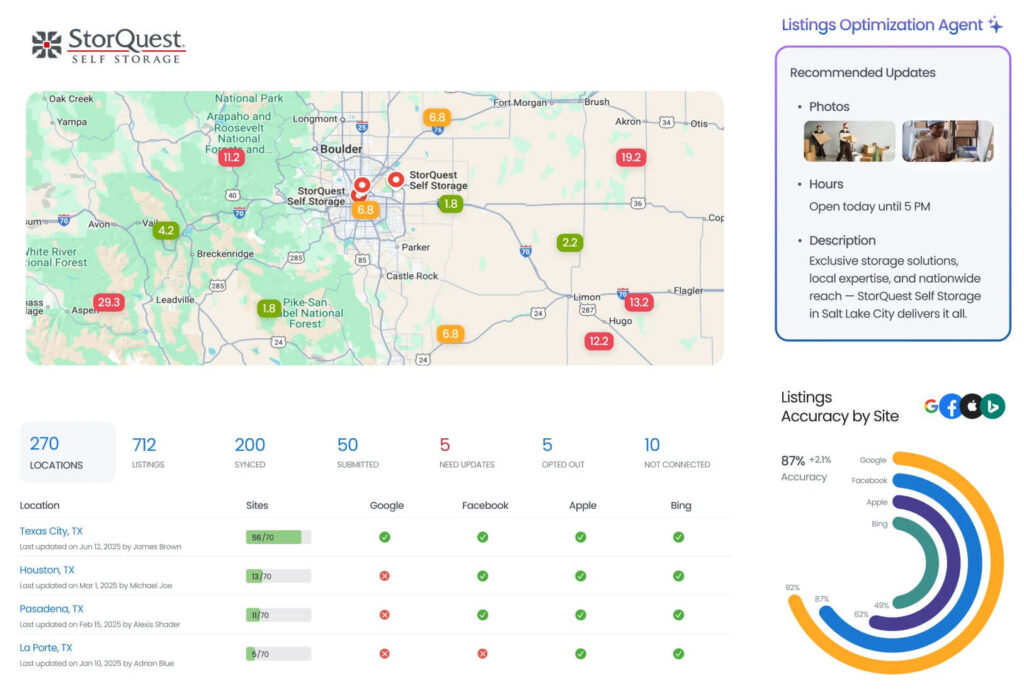
Once the data foundation is reliable, the Listing Optimization Agent focuses on identifying improvements that influence discovery and engagement. It highlights which updates are most likely to improve visibility rather than treating every listing change as equally important.
Prioritizing what actually improves Apple’s visibility
Not every update carries the same weight on Apple surfaces. Changes to categories, attributes, photos, or descriptions can affect whether a location appears at all, while other updates have minimal impact.
The Listings Optimization Agent helps brands focus on:
- Which Apple place cards are underperforming
- Which attributes or media elements need attention
- Which recommendations are likely to influence discovery or customer action
By prioritizing recommendations, teams can act on what matters instead of working through long lists of low-impact updates.
Managing Apple alongside Google and other platforms
Apple Business Connect does not exist in isolation. Listing performance depends on how locations are managed across ecosystems.
Birdeye brings Apple Business Connect into the same workflow as Google Business Profile and other discovery platforms. Teams can review recommendations, approve changes, and maintain brand standards from a single operational environment without forcing identical optimization across platforms.
The result is simpler governance, better prioritization, and actively managed Apple listings rather than passively maintained ones.
Our customers, their stories:

Fantastic Product for streamlining reviews & updating listings (Google, Apple, Bing)
We operate 4 restaurants, and responding to reviews promptly is essential. Birdeye helps me achieve this without constantly logging in and out of Google, TripAdvisor, FB, etc., which had become too tedious. The ease makes it possible to respond quickly to all review platforms, and the AI is great. I also love how it updates my Google, Bing, and Apple business details, as I have yet to find any company that does this correctly; it is so labour-intensive. Birdeye's service is what sets them apart. Highly recommend!
– Natalie Hallert Ladybird | Birdcage, Owner
FAQs on Apple Business Connect
Register for Apple Business Connect here, add your business details, and verify your location by phone or with documents.
Visit Apple Business Connect, click “Get Started,” sign in with your Apple ID, add your business details, verify your location, and agree to the terms. Your Apple business account is now set up.
Google Business Profile is optimized for search-driven discovery and frequent updates. Apple Business Connect prioritizes structured data, approved media, and precision. Apple surfaces fewer results, so accuracy and presentation carry more weight than volume or activity.
Apple and Google evaluate listings differently. Brands need a system that manages both together while applying platform-specific rules. This is where an agentic marketing platform like Birdeye helps. Its Listings AI allows enterprise teams to manage Apple Business Connect alongside Google and other platforms, using centralized workflows and governance controls.
Birdeye Listings AI maintains the accuracy and consistency of core business data across Apple Business Connect and other discovery platforms. It ensures locations stay compliant with Apple’s requirements for names, addresses, hours, categories, and attributes.
The Listings Optimization Agent builds on Listings AI by identifying which Apple place cards need improvement and which updates are likely to impact discovery or customer action. It prioritizes recommendations so teams focus on changes that matter, not every possible edit.
Turn Apple Business Connect into a managed asset with Birdeye
Apple Business Connect is no longer a secondary listing to claim and forget. For multi-location brands, it directly influences whether locations appear, how they are presented, and what customers can do next across Apple Maps and Siri.
The challenge is not access. It is execution. Apple rewards precision, structured data, and consistent presentation across locations. Brands that rely on basic sync tools or one-off updates often struggle to maintain visibility on Apple surfaces, even when their listings appear accurate on paper.
Birdeye brings structure to this complexity. With Listings AI maintaining accurate, compliant location data and the Listings Optimization Agent prioritizing improvements that matter, enterprise teams can manage Apple Business Connect alongside Google and other platforms without fragmented workflows or guesswork.
If you want to see how Birdeye supports Apple Business Connect as part of a unified listings strategy, schedule a free demo to explore how it works across your locations.

About the Author

Shruti Dugar
Birdeye
Originally published




![[Feature image] The Best Marketing Platforms for Multi-Location Brands](https://birdeye.com/blog/wp-content/uploads/Feature-image-The-Best-Marketing-Platforms-for-Multi-Location-Brands-375x195.png)