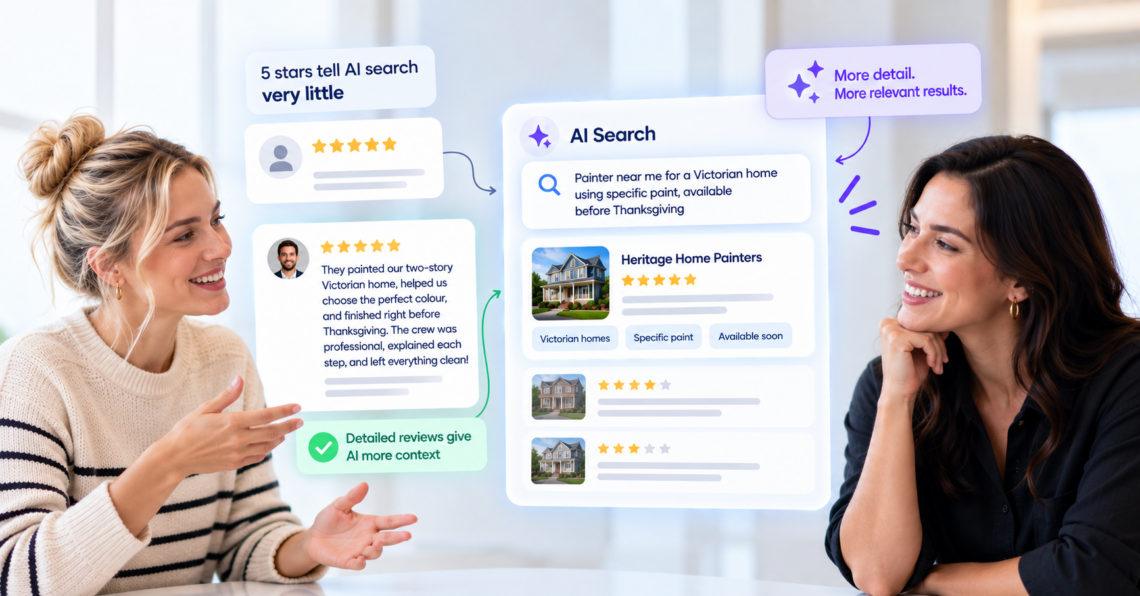
Matt Allister, VP of Marketing at Yelp, puts it bluntly: a five-star “great job” review tells AI nearly nothing. People now type four or five sentences into AI, not three or four words, and a star rating cannot match a sentence about a two-story Victorian home.
Most multi-location brands run review programs on what stars can measure, which is volume and average. AI answer engines match long, specific prompts against customer language, so what you ask customers to write, and how every location responds, is content production.
This post covers what Matt said at Birdeye View 2026 and what corporate teams should own.
Table of contents
Why can’t a star rating match an AI prompt?
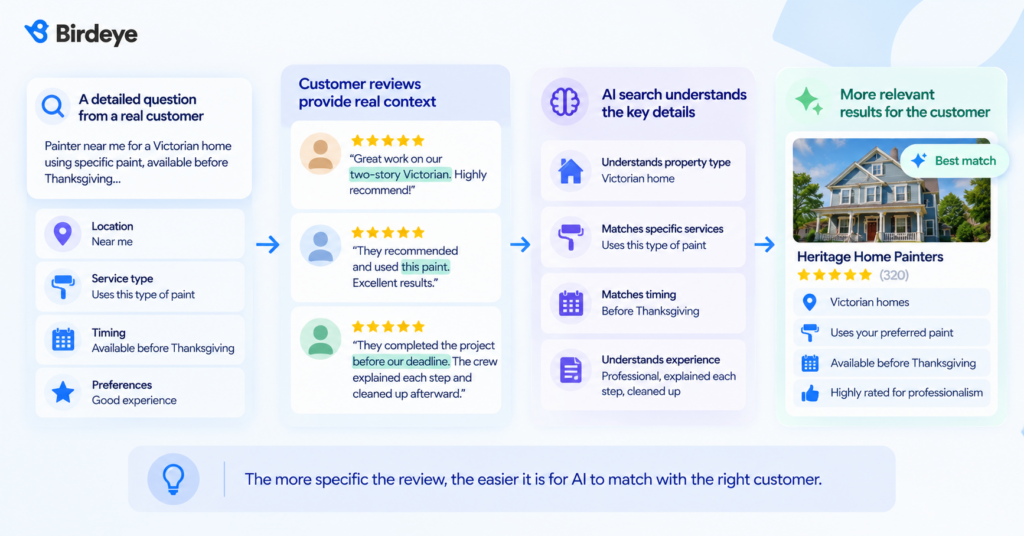
Matt used a home painting search. A traditional query is “painter near me.” An AI prompt describes a two-story Victorian, a specific type of paint, and a deadline before Thanksgiving. A review that says “great job” answers none of it. A review that describes the Victorian, the paint, and the experience gives AI language to match.
| What the customer asks | What a matching review says (illustrative) |
| Painter for a two-story Victorian | “Great work on our two-story Victorian.” |
| Uses a specific type of paint | “They recommended and used this paint.” |
| Explains the process | “The crew explained each step and cleaned up afterward.” |
Availability is the exception. Matt tied it to what a business lists on its profile, not to what a customer writes.
Brooke Henderson, who led the session, raised a Forbes example that shows the point. A homeowner left a five-star roofing review mentioning that the roofer drew a smiley face and a heart in the grime on a skylight. Matt’s response was that a star rating cannot carry that detail, and neither can an AI answer without it. Human opinion is the data AI cannot supply on its own.
The difference is not review length. It is descriptive information about the service, the experience, and the customer’s need.
How fast is AI changing local search?
Matt cited Yelp’s own tracking: about a year ago, roughly 6% of people used AI for local search. Today the figure is about 45%.
Customers still check the answer. Matt said more than 90% of people verify an AI answer somewhere else, citing research with Morning Consult [confirm with Yelp, or remove the study name]. Separate research from The Trade Desk Intelligence and PA Consulting (US and UK, January to March 2026) found that 95% of consumers double-check AI-generated results.
Customers use AI to build a shortlist and then go looking for proof. Reviews, photos, hours, and attributes are what they find, so those need to be right at every location.
What does Yelp’s OpenAI partnership change for multi-location brands?
Matt described the partnership as putting Yelp’s 330 million reviews and more than 8 million business listings into ChatGPT. ChatGPT users can see review snippets, ratings, photos, and business details. They can also book a table or join a waitlist, and Request a Quote is rolling out for home services. Matt called that rollout “incredibly early.”
Matt also described Yelp as a hub that feeds many surfaces, naming Apple Maps, Alexa, Siri, and Bing alongside ChatGPT. One Yelp profile can shape answers on several platforms.
His point on action was direct: showing up matters, and booking a job matters more. For a multi-location brand, that makes it a leadership decision whether each location’s profile is set up for reservations or quote requests.
What should corporates own?
Matt’s advice was to build these policies at the corporate level. They are the four that fall under his 30-day playbook:
1. Profile presence and consistency
Keep name, address, phone, hours, photos, and attributes accurate and consistent across every location. Matt’s challenge was to look at each page as a customer would. Past the baseline, he asked whether each location is putting its best foot forward.
2. The review request
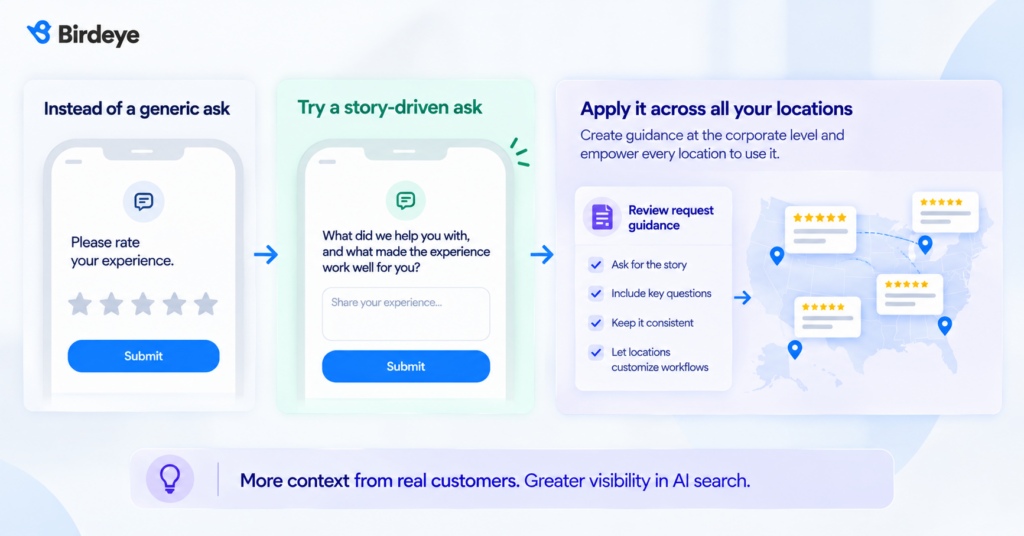
Ask for the story behind the rating. Matt agreed with the framing that it is more important to ask why the customer chose the business and why they are happy than to ask for the review alone. Corporate can write the guidance, and locations apply it in their own customer workflows. The goal is useful customer language, not scripted language. Do not tell customers what to write or offer incentives for specific wording [confirm with legal].
3. Review responses
Matt called review response “content creation today,” adding that recency and depth of responses matter in AI search. Review responses need guidelines for brand voice, location context, escalation, timing, and sensitive reviews. The goal is a response that is recognizably on-brand and still addresses the customer’s actual experience. A brand with 20 locations can manage this by hand. A brand with hundreds needs governance and workflows.
4. Actions
Audit which locations have reservations, waitlists, or Request a Quote enabled, and which software partners connect to AI platforms.
How does Birdeye help multi-location brands manage review detail at scale?
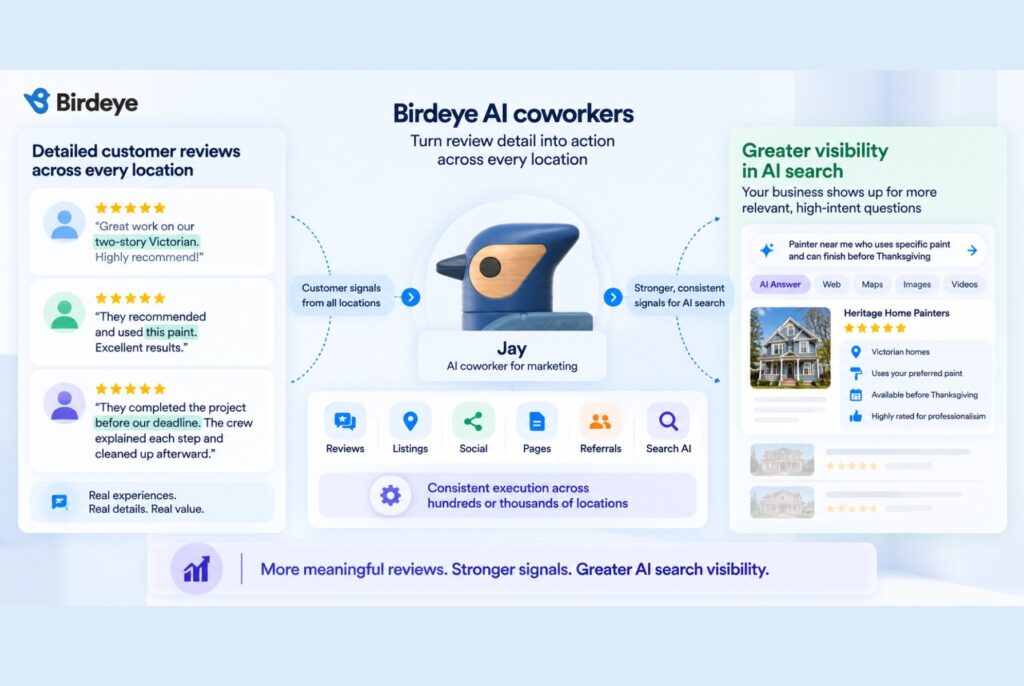
Birdeye builds AI agents for multi-location brands that need trust, consistency, and control at scale. Jay, Birdeye’s marketing AI coworker, handles work across Reviews, Listings, Social, Pages, Referrals, and Search AI. Teams keep human approval and control. Human-written feedback stays the source of the insight, and the platform handles the volume.
FAQs
Ask what the customer bought, what problem was solved, and why they chose the business. Give corporate-level guidance on the wording of the request, but let each location apply it in its own workflow. Avoid scripting the customer’s answer.
Yes, as a summary signal. Matt’s point is not that ratings disappear. It is that a rating alone gives AI too little to match against a long, specific prompt.
Corporate should own the policy: the wording of the request, the response guidelines, and profile consistency. Locations own the execution. Matt recommended setting these policies at the corporate level.
What should leaders do first?
Pick five location profiles and check photos, attributes, hours, and enabled actions the way a customer would. Then read the last 20 review requests you sent and ask whether they invite a story or only a rating.
For multi-location brands, that distinction creates an operational responsibility. Review requests, listings, review responses, and location information all need consistent management across the network.
Birdeye helps multi-location brands consolidate those signals and act on them at scale. Its AI coworkers support marketing, operations, and customer experience while keeping people in control.
[Request a demo of Birdeye →]

About the Author

Shruti Dugar
Birdeye
Originally published