


“With Birdeye proactively identifying any changes or issues with our listings, we're able to actually have the confidence and the peace of mind that they're remaining accurate.”

Liz FuscoVP of Marketing, Gentiva



Listings impressions yearly
Website visits yearly
Calls generated yearly
“With Birdeye proactively identifying any changes or issues with our listings, we're able to actually have the confidence and the peace of mind that they're remaining accurate.”
“Birdeye became our source of truth for online profiles. With hundreds of locations to manage, it allowed us to ensure accurate and consistent information across all platforms, saving us significant time and effort.”

Continuous scans, field-level recommendations, and execution within your guardrails - so listings stay accurate and out-ranking, without a quarterly fire drill.
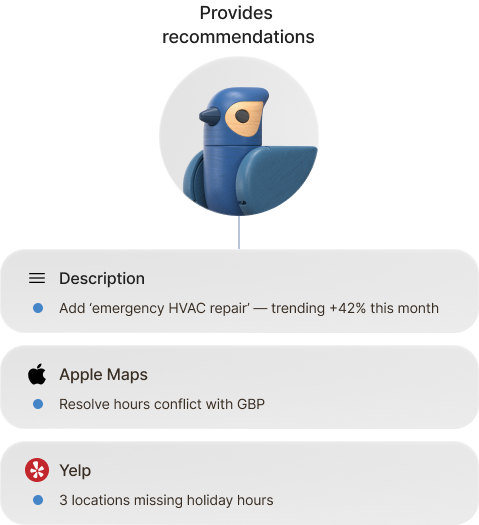
The AI Search Optimization Agent and the Listings Optimization Agent share one signal. Jay employs multi-agent orchestration to fix the issues underneath.
Visibility drops for a location. It checks the Listings Optimization Agent's live data first - since listings drive most visibility gaps.
Its continuous scan already caught outdated hours on 2 sites and a description missing the keyword driving the drop.
Updates the hours, rewrites the description with the missing keyword, then reports the improved score back to the AI Search Optimization Agent.
Jay runs native, real-time integrations with Google, Facebook, Apple, Yelp, and Bing - the platforms customers actually search.

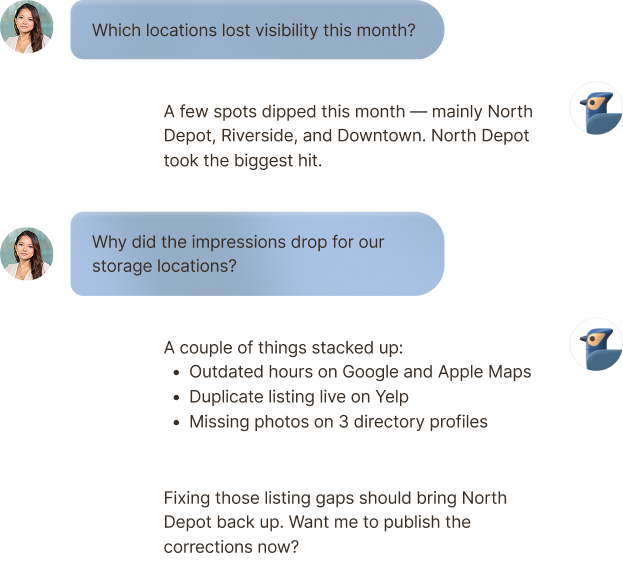
"Which locations lost visibility this month?" "Why did impressions drop for our storage locations?" Ask in plain language, and the Reporting Agent answers on the spot.
Listings is one job - he orchestrates agents across every marketing job you need done.







Birdeye's Listings Optimization Agent scans your business profiles across the platforms customers actually search - Google, Facebook, Apple, Yelp, and Bing - and recommends fixes to inaccurate or incomplete information, then applies approved updates across every location at once.
Most vendors sell "200+ directories" as a selling point, most of which customers never actually search. Jay goes deep instead of wide: native, real-time integrations with the handful of platforms that actually drive visibility and calls, rather than a padded directory count.
Yes - built for it. Every location gets its own scan, its own recommendations, and its own fix list, tracked independently so one location's issues never get lost in a brand-wide average.
Approval required by default. Jay recommends the fix; you approve it once, and it applies across every location it belongs to in a single click. Nothing goes live without your sign-off.
Continuously - not on a quarterly or manual cycle. The agent is always watching for drift: outdated hours, incorrect fields, missing photos.
Outdated hours, incorrect addresses or phone numbers, missing or incomplete service descriptions, stale photos, and descriptions that aren't keyword-optimized for the searches actually happening in your category.
Yes. It finds which keywords a competitor's website is targeting and flags the same opportunity for your locations - so you're not guessing at what's working for them.
Recommendations are guided by your own custom prompts and keyword rules, combined with live search and competitor data already gathered - so descriptions target the terms actually driving traffic in your category.
Listings are one of the strongest trust signals AI engines use to decide whether to recommend you. When the AI Search Optimization Agent flags a visibility drop caused by inaccurate or missing listing data, it hands off to the Listings Optimization Agent automatically to trace and fix the underlying cause.
One approval can apply the update across every location it belongs to - you don't have to review the same fix location by location.
Yes - each recommendation shows the specific field and the reasoning behind it.
Live search data, competitor website content, and your own configured prompts and keyword rules - combined with a continuous scan of your existing listing data across every connected platform.
Yes. Birdeye is SOC 2 Type II certified, GDPR compliant, and HIPAA compliant. Enterprise security documentation is available on request.
Native, real-time integrations cover the platforms that actually drive visibility and calls. For sources outside that set, the agent's diagnosis still tells you where inaccurate data originates, even if the fix has to be actioned directly with that source.
It's one of the agents Jay orchestrates for AI Search visibility, alongside the Blog Page Agent and FAQ Page Agent. When any of these agents finds a fix that belongs to another, they hand it off automatically and report the result back.
Gentiva's VP of Marketing has said Birdeye proactively identifying listing changes and issues gives her team the confidence and peace of mind that their information is staying accurate.
Yes - recommendation types are configurable, so you control the scope of what the agent is allowed to surface.
Yes - Listings Optimization is additive. It doesn't replace your broader SEO strategy; it makes sure the specific data AI engines and searchers see about each location is accurate and optimized.