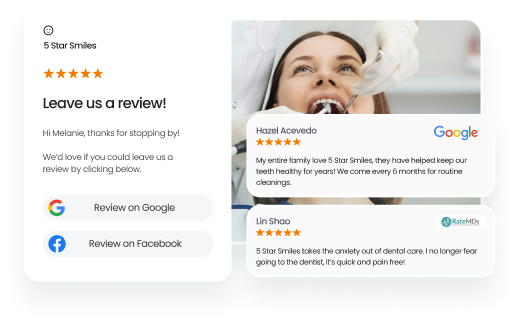
A few years ago, your biggest concern was ranking your healthcare practice on Google. Today, millions of people are asking platforms like ChatGPT, Gemini, and Perplexity to recommend a doctor or clinic they can trust.
Summary
These AI engines aren’t fooled by keyword stuffing or pretty websites. They don’t browse, they decide. They pick one or two providers, summarize their strengths, and present them as the best option.

While many still believe “SEO” means blogs, keywords, and backlinks, AI engines think differently—this shift is driving what many now call generative engine optimization. They look at your citations, NAP accuracy, reputation, reviews, and how patients talk about you. And when pieces don’t add up? You vanish from the answer's result.

This blog is written for you—the marketing, digital, and growth leaders who own pipeline, not pageviews. You’ll see what “AI visibility” really means in healthcare, which levers actually influence AI recommendations, and how platforms like Birdeye Search AI help you operationalize this at scale.
Table of contents
- Why AI Search is now the patient discovery channel
- Why AI search hits healthcare harder than retail or SaaS
- Behind the answer: How AI engines decide who gets recommended
- What to fix so that AI recommends your healthcare business
- How Birdeye Search AI turns this into executable growth for healthcare businesses
- Your next patient might not Google you, so don’t let AI decide you’re optional
- FAQs about how to get your healthcare business visible in AI search
- Birdeye Search AI makes sure you’re the one AI recommends
Why AI Search is now the patient discovery channel
When a patient types “best urgent care near me that accepts Aetna and has short wait times” into ChatGPT, that’s now a revenue moment. Either your locations are in that answer box, or your competitors are. For multi-location healthcare brands, this shift impacts patient acquisition costs, fill rates, and market share.
As per Birdeye’s State of Google Business Profile 2025, fully verified and complete Google Business Profiles appear more often in AI-driven summaries, with verified ones generating 4× more website visits, higher visibility, and stronger eligibility for AI Overviews compared to unverified listings.
And this shift matters now more than ever, because patients aren’t typing keywords into Google and scrolling through 10 blue links anymore. They’re asking AI engines highly specific, intent-rich questions like:
- “Dermatologist near me who treats cystic acne and takes Blue Cross”
- “Best pediatric dentist in Austin with evening appointments”
- “Orthopedic surgeon specializing in ACL repair for athletes”
Those aren’t casual searches; they’re high-intent buying moments. And AI is quietly deciding who gets that demand.
And here's the kicker: AI doesn't show 10 options. It recommends 2–4. That short list is the new "page one" of search, and if you're not on it, you don't exist to that patient.
What this means for healthcare businesses
Once you see how patients actually search, the business implications become clear quickly. For CMOs, VP Growth, and digital leaders at multi-location healthcare brands, this isn’t a “wait and see” trend. It’s affecting three core metrics you report on every month:
1. Patient acquisition cost (PAC)
If your brand isn’t appearing in AI recommendations, you’re paying more for patient acquisition through paid search, retargeting, and traditional SEO while competitors capture high-intent demand organically.
2. Location utilization and fill rates
AI doesn’t just favor brands—it favors specific locations based on proximity, reviews, hours, and services. Your flagship location might show up. Your satellite clinics? Invisible. That impacts which chairs fill, which service lines grow, and which markets stay underperforming.
3. Market share in competitive geographies
When a patient asks AI, “best orthopedic clinic near me,” and gets three names—none of which are yours—you’ve lost before the consideration phase even begins. In dense urban markets with 5–10 competitors, AI visibility is now table stakes for maintaining share.
Why AI search hits healthcare harder than retail or SaaS
Every industry will feel this shift, but healthcare doesn’t play by the same rules as SaaS or retail. Healthcare has unique characteristics that make AI visibility even more critical:
High-intent, zero-patience searches
When someone needs care—whether urgent or planned, they want an answer now. AI gives them that answer in seconds. If you’re not in it, they move on. There’s no “let me check page 2” behavior.
Trust and authority matter disproportionately
Patients aren’t just choosing a product, they’re choosing who to trust with their health. AI engines prioritize providers with strong citations on authoritative healthcare platforms, verified reviews, and consistent information.
Did you know: Google now accounts for approximately 80% of all healthcare reviews, and over 80% of patients read reviews before choosing a provider, making review presence and accuracy one of the most important trust signals AI engines rely on when recommending clinicians. (Source: Birdeye — State of Online Reviews 2025)
Local + specialty complexity
Unlike eCommerce, healthcare searches are hyper-local (“near me”) and often subspecialty-specific (“sports medicine orthopedic”). AI needs clean, detailed, location-level data to make accurate recommendations. If your listings are incomplete or inconsistent, you’re filtered out.
Insurance and access are decision filters
Patients frequently add constraints like “accepts Medicaid,” “open weekends,” or “telehealth available.” AI parses these from the structured data on your site and in your listings. If that data doesn’t exist or conflicts across sources, you won’t appear even if you do offer those services.
Healthcare can’t afford to be invisible in AI

AI search isn't replacing Google tomorrow. But for healthcare brands, it's already shaping which providers appear in the moment of highest intent—when a patient is ready to book.
The biggest thing you need to understand is how AI is actually deciding who to recommend.
Behind the answer: How AI engines decide who gets recommended
AI isn’t “surfing the web” like a human. It’s scoring signals and picking a short list of providers it feels safe recommending.
In healthcare, those signals fall into a few big buckets:
Structured business and provider data
AI engines rely on structured datasets, authoritative healthcare directories, and industry-specific citations to validate your legitimacy: specialties, locations, insurances, availability, languages, and more. The cleaner, more complete, and more consistent that data is, the more confident AI is in using you as an answer.
Citations on trusted healthcare and local sites
Think Healthgrades, WebMD, Zocdoc, Yelp, hospital finders, insurance directories, and other doctor review sites AI engines rely on to validate provider credibility. When these sources align on who you are, what you do, and where you are, AI treats you as a credible option. Misleading, outdated, or fake citations push you down or out of the response set.
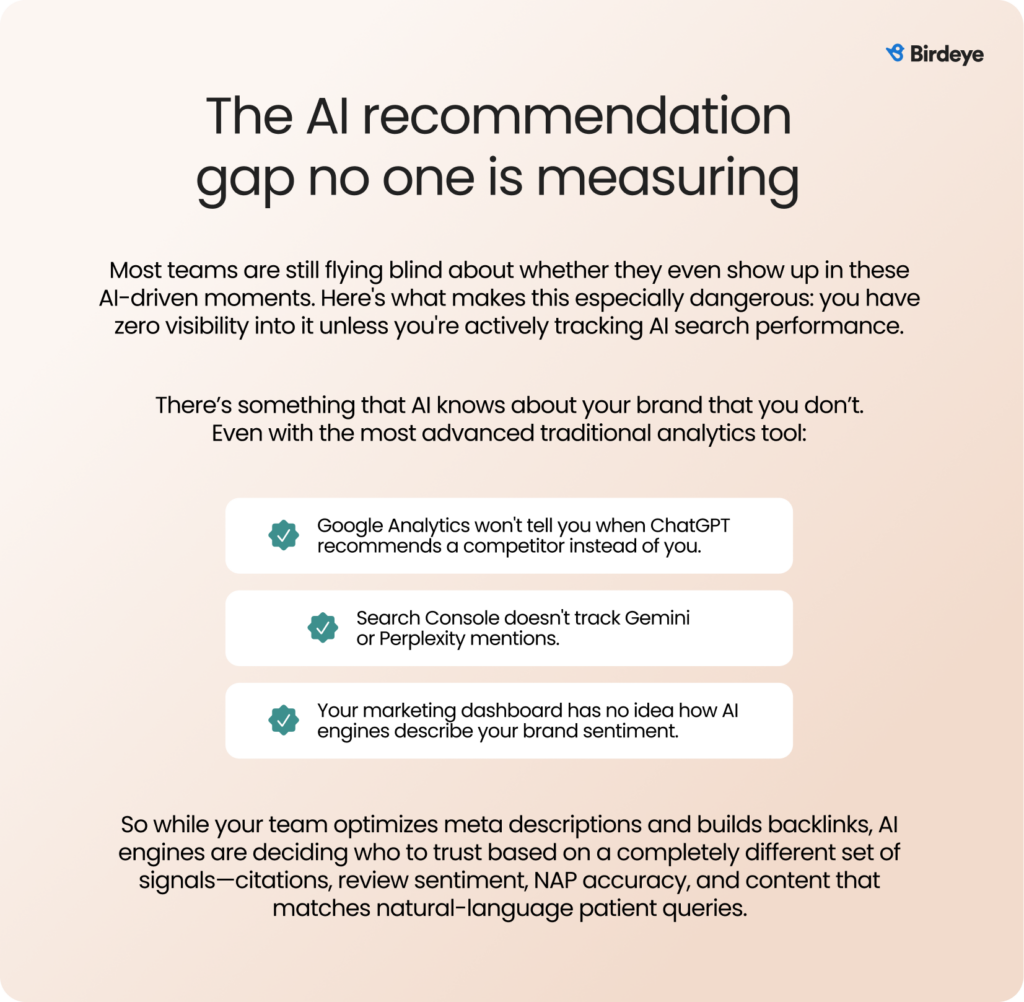
As per Birdeye’s Local Search Accuracy Benchmark: LLMs vs Traditional Search, LLMs frequently make four types of local search errors—fabrication, mislocation, stale closure, and category misclassification—especially in healthcare categories where provider data is complex, and these errors increase dramatically when business information is inconsistent across directories.
Reviews and sentiment patterns
AI doesn’t just see “4.3 stars.” It digests themes:
- Complaints: “long wait times”
- Praise: “easy scheduling”
- Operational strengths and weaknesses: “rude front desk”
- Sentiment tone: “great with kids”
- Service themes (e.g., emergency care, cosmetic dentistry, orthopedics, diagnostics)
In AI search, your reputation is not just what patients say in healthcare reviews—it’s how AI interprets those signals and patterns at scale.
- Whether you get recommended
- For which services
- In which contexts
Content that matches real questions
Pages and FAQs that mirror how patients actually ask. AI engines match your organization to the questions patients actually ask, such as:
- “Emergency dental clinic open today”
- “Top physiotherapy clinic for sports injuries”
- “Pediatric ENT specialist nearby”
If your business isn’t contextually associated with these themes, AI engines simply skip you. Dry, generic service pages that never speak in patient language are unlikely to be pulled into AI-generated answers.
Birdeye Search AI ensures AI recommends you
Want to see the impact of Birdeye on your business? Watch the Free Demo Now.
Authority and safety signals
Healthcare is high-stakes, so AI systems lean hard on signals of expertise and trust—recognised medical organizations, hospital systems, academic centers, reputable health sites, and profiles that clearly show credentials and oversight. When those signals consistently cluster around your brand and are echoed across third-party sites, AI is far more willing to surface you as a recommended option.
In practice, that’s why you see patterns like:
- Visible on ChatGPT, which leans on a mix of sources
- Partially visible on Perplexity, which pulls a slightly different set
- Completely missing on Gemini for certain themes where your data is weaker
- Showing up for broad “dentist near me” and not for high-value queries like “Invisalign provider near me”
- Outranked by smaller competitors who simply have cleaner data and stronger reviews
From an executive lens, that’s the core issue: AI isn’t rewarding the biggest brand or the largest spend—it’s rewarding the brand with the clearest, most consistent, most trusted data footprint at the exact moment a patient asks for help.
AI is constantly running a quiet scoring model behind the scenes by asking,

“Is this provider relevant for this question, verified across sources, positively perceived, and safe to recommend right now?”

The providers that clear that bar consistently become the default answers. Everyone else is invisible, no matter how much traditional SEO work they’ve done.
What to fix so that AI recommends your healthcare business
At this point, most execs are convinced AI search matters, but still stuck on the real question: “Okay, what do we actually do next, and in what order?”
Here’s a simple, operator-friendly playbook you can plug into your existing growth and digital roadmap.
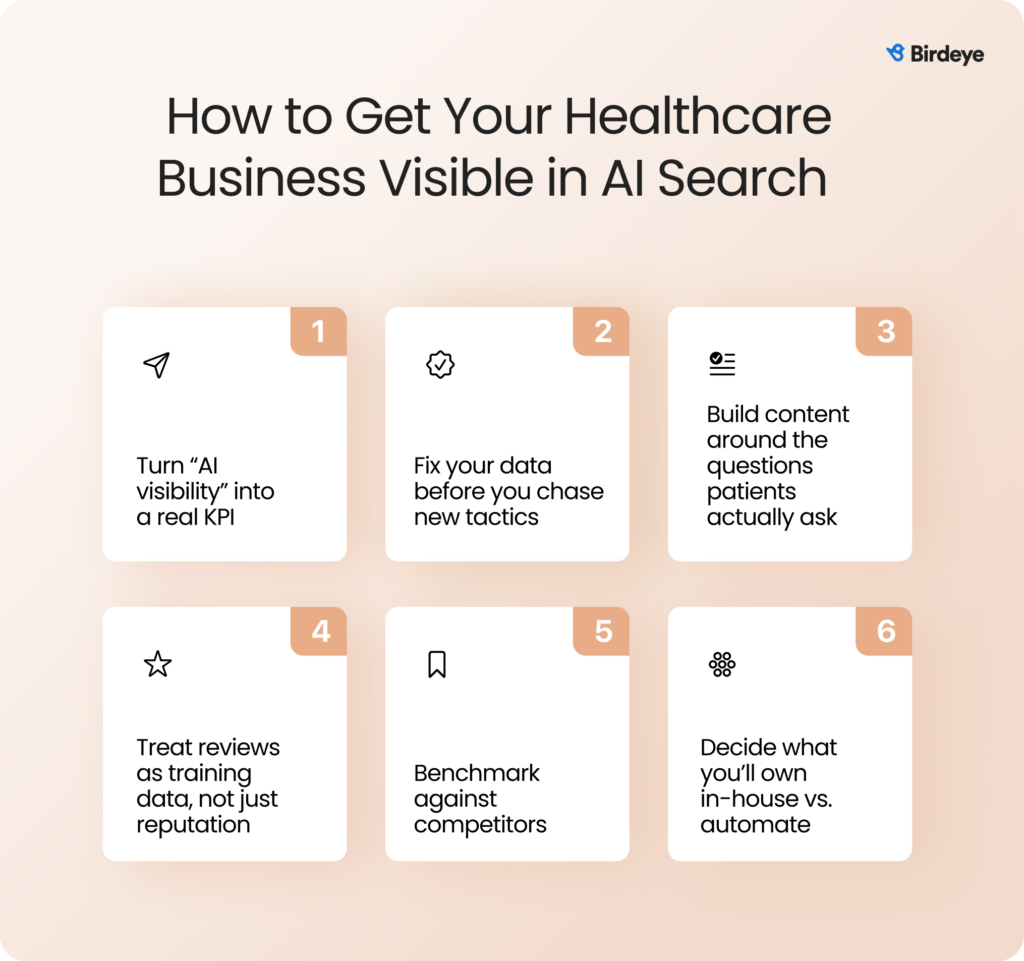
1. Turn “AI visibility” into a real KPI
If it isn’t measured, it won’t move.
For your top service lines and markets, define:
- A set of core prompts
Examples:
- “Emergency dentist near me”
- “Pediatric urgent care open now”
- “Orthopedic surgeon for ACL repair near me”
- A target:
- “We want our brand or locations mentioned in X% of AI responses for these prompts in our key markets.”
Then track, at least monthly:
- How often does your brand appear in answers across the major AI engines?
- Which competitors show up instead of you?
- Whether the descriptions of your brand are positive, neutral, or subtly harmful.
This becomes your “AI share of voice” metric, the same way you think about share of search today.
2. Fix your data before you chase new tactics
If your data is messy, no amount of “AI optimization” will save you.
Start with:
- NAP and core facts consistency
- Name, address, phone, hours, website, insurances, services, telehealth, parking, etc.
- Standardize this across your website, major directories, and key healthcare platforms.
- Duplicate and outdated profiles
- Kill legacy listings, old addresses, and ghost profiles that confuse AI.
- Align provider profiles with location data so AI doesn’t “separate” doctors from their practices.
How long does it take to see results if we start fixing AI visibility now?
Some wins are fast: correcting bad hours, broken links, or missing services on key listings can improve how AI engines present your brand within weeks. Bigger moves—like shifting review sentiment, building out content around high-intent prompts, or strengthening authority across markets tend to show impact over a few months. The key is treating this as an ongoing program, not a one-off clean-up.
3. Build content around the questions patients actually ask
Stop writing for keywords. Start writing for prompts.
Have your team (or your vendor) compile real questions patients ask, like:
- “Is there a cardiologist near me who does same-day appointments?”
- “Which pediatric dentist is best for anxious kids?”
- “Does this clinic accept Medicaid / my plan?”
Then:
- Turn those into FAQs on location pages.
- Make sure service-line pages explicitly answer them.
- Reflect that language in your business profiles where possible.
You’re not trying to game a robot—you’re giving the AI clear, structured answers it can safely reuse.
4. Treat reviews as training data, not just reputation
From an AI perspective, reviews are not just social proof; they’re labeled data about your experience.
Operationalize:
- Volume and freshness on the platforms that matter most in your category.
- The mix of themes you want amplified (access, empathy, speed, pediatric-friendliness, etc.).
- A response strategy that actively addresses patterns you don’t want repeated back to patients (“hard to reach,” “long wait times,” “billing confusion”).
In practice, this means reviews aren’t just a “reputation” problem; they’re a core healthcare reputation management lever that directly affects AI visibility and conversion.
The danger isn’t adopting AI too early—it’s letting rivals become the automatic “best option near me.”
5. Benchmark against competitors
Make competitor visibility part of your operating rhythm.
On a recurring basis, review:
- Which sites and citations does it appear to be pulling from?
- How AI describes them vs. you (e.g., “great for complex cases,” “affordable,” “faster access,” “family-friendly”).
Use this to:
- Decide where a small improvement in AI visibility could unlock outsized revenue.
- Prioritize fixes: is your biggest gap data accuracy, reviews, content, or citations?
6. Decide what you’ll own in-house vs. automate
You don’t need another tool that gives you 80 charts and zero action.
Be explicit about:
- What your internal team will own (brand, messaging, governance, high-stakes content).
- What you want automated (accuracy checks, citation monitoring, prompt analytics, bulk updates, local execution).
That’s where a platform like Birdeye Search AI becomes less “nice software” and more “core growth infrastructure”—it takes the recurring, multi-location AI search work off your team’s plate while feeding them the insights they actually need to make decisions.
How Birdeye Search AI turns this into executable growth for healthcare businesses
Most teams now get the “why.” Where they stall is the “how”—especially across dozens or hundreds of locations, service lines, and markets. That’s the gap Birdeye Search AI is built to close for healthcare brands.
Instead of one more dashboard, it gives you three things execs actually care about: clear visibility, prioritized actions, and execution at scale.
1. See what AI really thinks about your healthcare brand
Birdeye Search AI shows you how your healthcare brand and each location show up across major AI engines like ChatGPT, Gemini, and Perplexity.
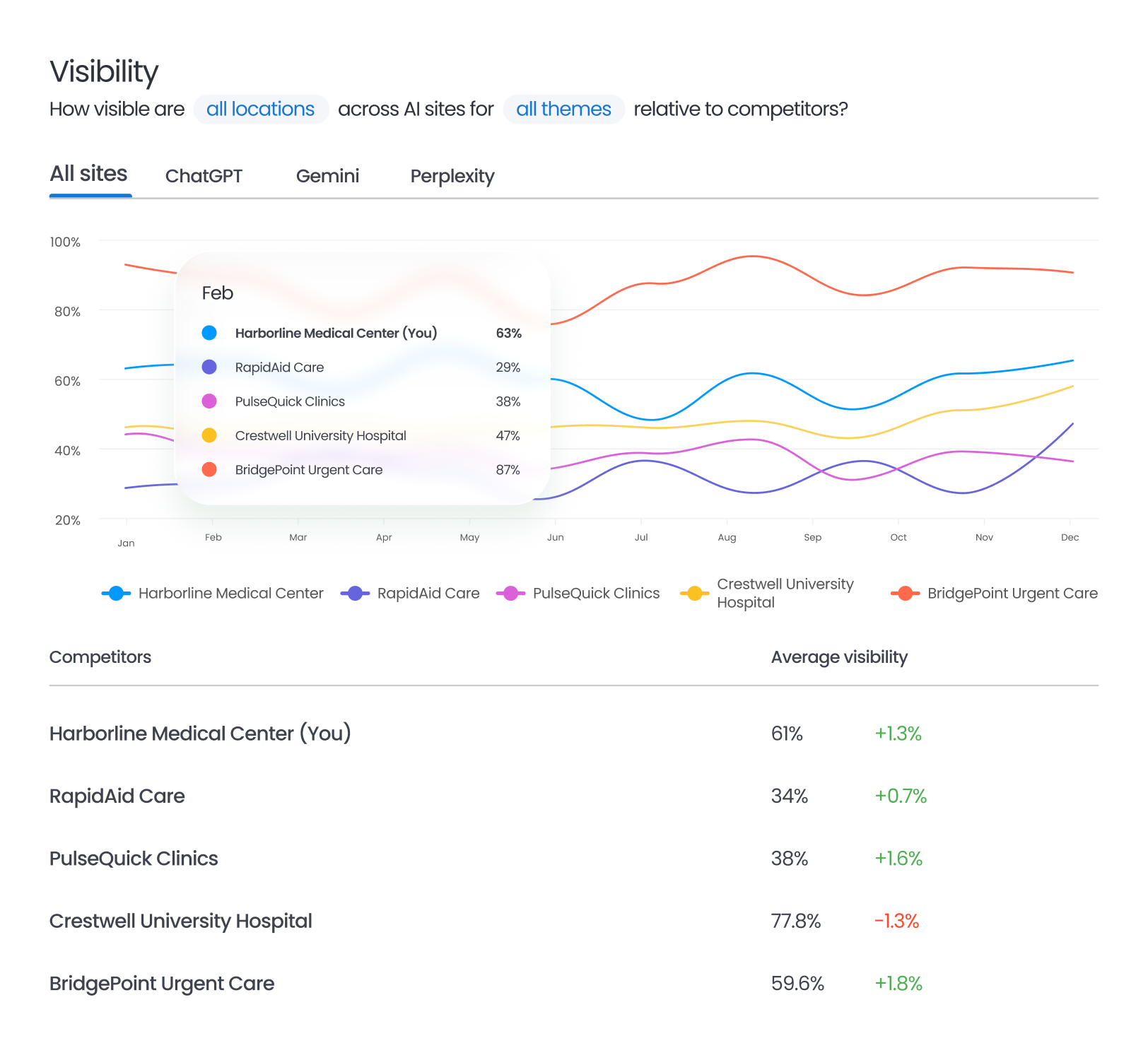
You can:
- See how often your brand appears in AI-generated answers by theme, market, and platform.
- Compare your AI visibility against key competitors for your most important prompts.
- Understand how AI is describing you—strengths, weaknesses, and recurring themes, so you can fix the narrative, not just the listings.
This turns “we think we’re visible” into “we know where we’re winning and where we’re invisible.”
2. Turn prompts into a source of truth for demand
Instead of guessing how patients search, Birdeye surfaces the real prompts people are using around your categories.
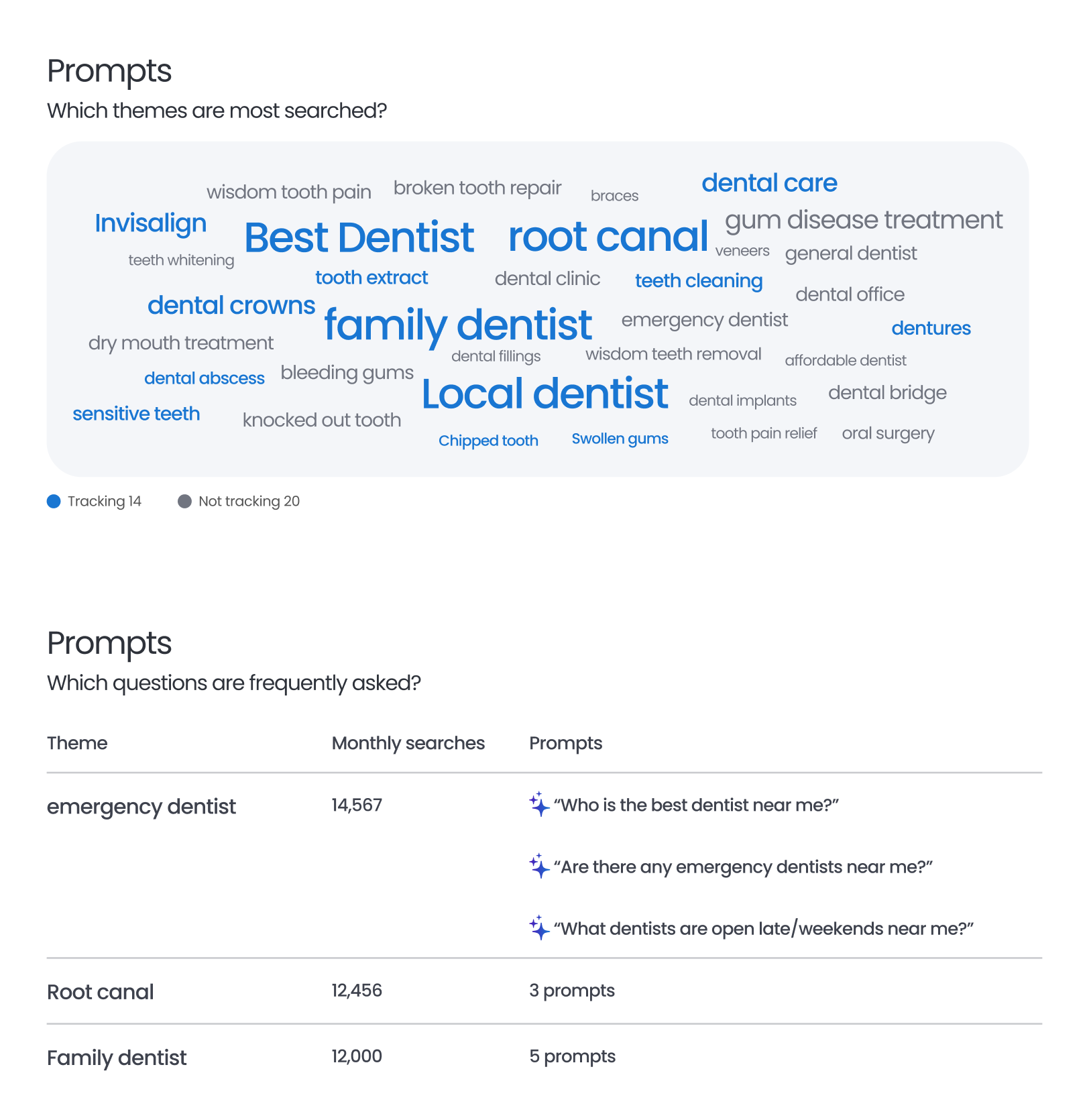
You can:
- See which patient questions (e.g., “emergency dentist near me,” “primary care doctor accepting new patients”) drive the most volume.
- Map which prompts you currently show up for and where competitors are taking the answers.
- Feed those insights into content, FAQs, provider bios, and campaigns so you’re aligned with actual demand, not internal assumptions.
3. Fix citations and accuracy where they actually matter
Birdeye Search AI pinpoints you exactly where that mess is costing you visibility.
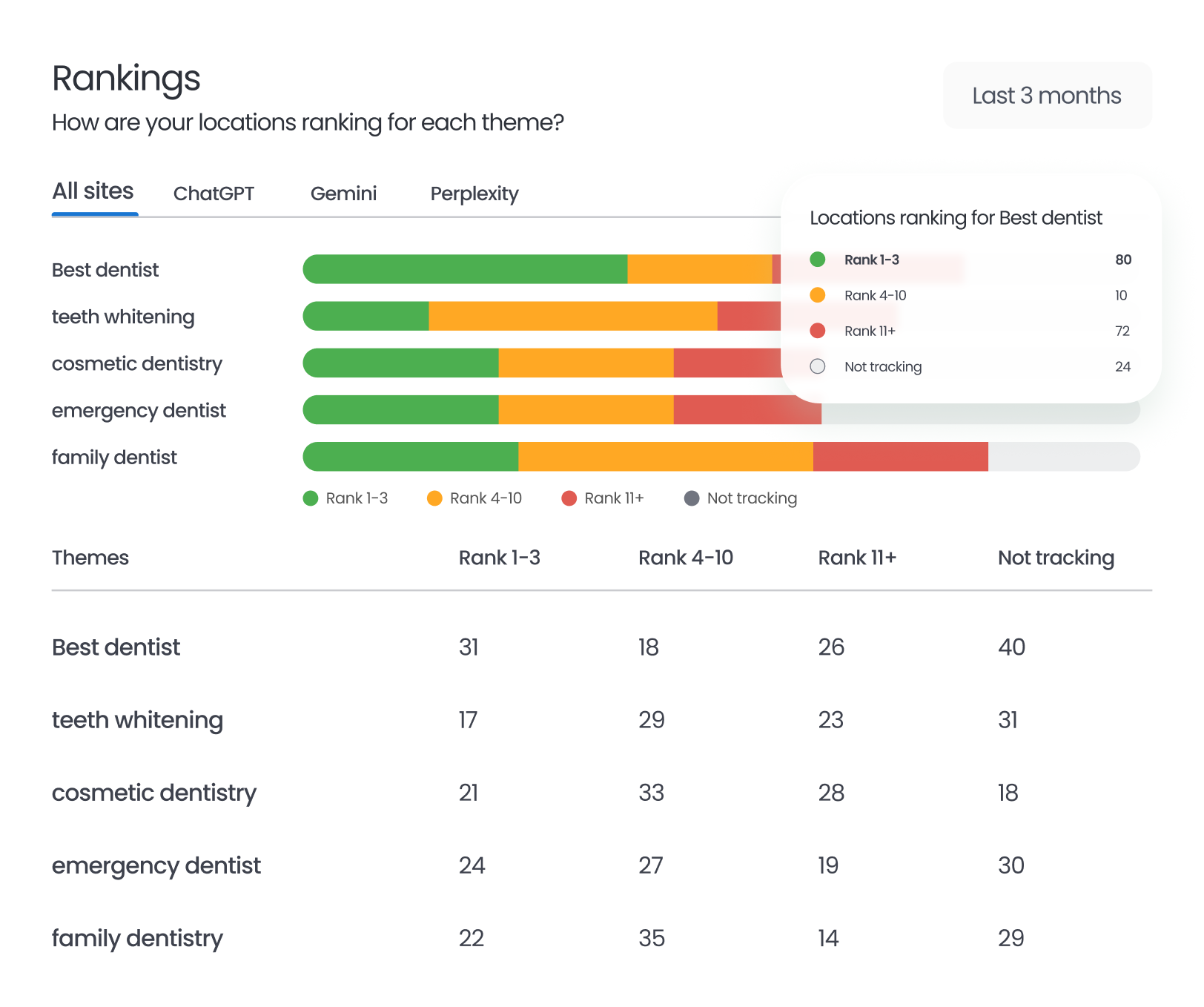
You get:
- A view of which directories and healthcare sites AI engines rely on most for your category.
- Detection of missing, inconsistent, or outdated citations across locations.
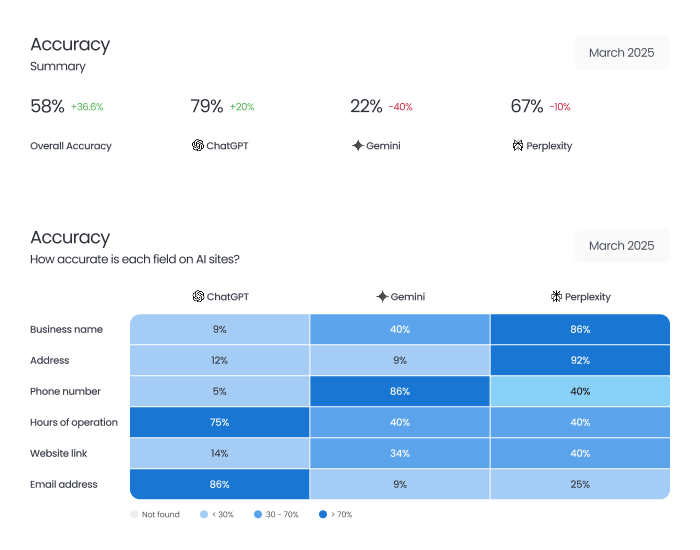
- Accuracy scores for core business fields (name, address, phone, hours, services, insurances) by platform and location.
You stop “doing local SEO” everywhere and start fixing the exact sources that move AI visibility.
4. Use AI Agents to handle repetitive work
The hardest part for multi-location healthcare teams isn’t knowing what to do—it’s doing it, everywhere.
Birdeye uses the Listing Optimization Agent to:
- Apply prioritized recommendations across locations (e.g., fix hours here, add FAQs there, expand content around a high-opportunity theme).
- Optimize profiles and listings on the platforms that most influence AI.
- Keep your data clean and consistent over time, not just after a one-off project.
That means your marketing and digital team focuses on strategy and governance, while the repetitive visibility work gets handled in the background.
5. Give leadership a clean story: Risk, Progress, ROI
Finally, Birdeye Search AI gives you a way to communicate AI visibility in board-ready language:
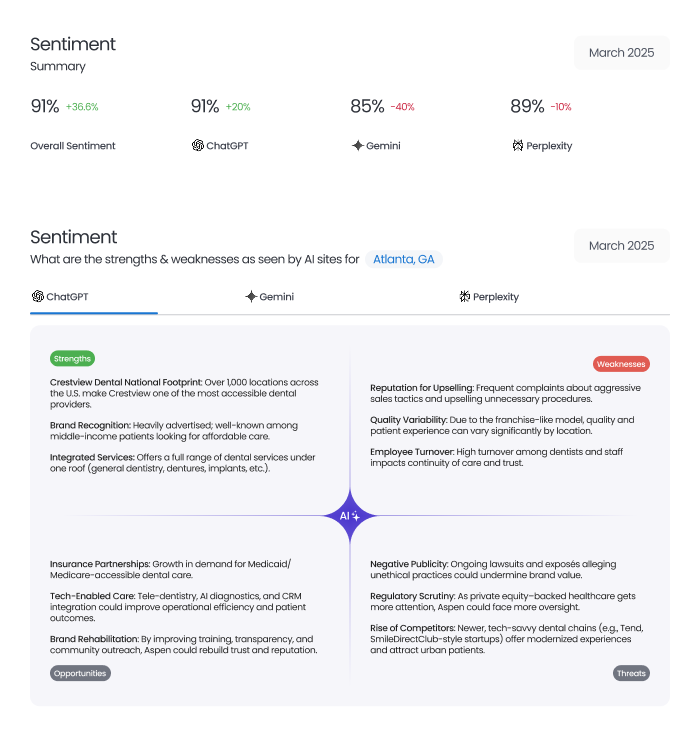
- “Here’s our AI share of voice vs. competitors for our top service lines.”
- “Here are the markets where we’re invisible today and the revenue risk tied to that.”
- “Here’s what we fixed, what moved, and where we’re focusing next.”
AI search is quickly becoming the new channel for patient discovery. Birdeye Search AI helps you do more than “be aware” of that shift—it helps you measure it, shape it, and win in it.
Your next patient might not Google you, so don’t let AI decide you’re optional
Right now, AI engines are the new patient discovery channels that are recommending you based on your citations, data accuracy, reviews, sentiment, and authority—whether you’re managing them or not.
The brands that will win the next decade in healthcare aren’t just the ones with the biggest ad budgets. They’re the ones with the cleanest, most consistent, and most trusted digital data footprint when patients ask the questions that matter.
If you wait, AI won’t be neutral. Your competitors will already be the default recommendation.
FAQs about how to get your healthcare business visible in AI search
Most teams start by manually testing prompts in tools like ChatGPT, Gemini, and Perplexity (“best urgent care near me,” “pediatrician taking new patients,” etc.) to see whether their brand appears. The problem is that this doesn’t scale across locations, service lines, and competitors. That’s where a system like Birdeye Search AI helps—by tracking your visibility across AI engines, themes, and markets in one place, so you actually know where you show up and where you’re invisible.
Yes, because AI search is using a different set of signals. Traditional SEO focuses on keywords, backlinks, and on-page optimization. AI search leans heavily on citations, NAP accuracy, reviews, sentiment, and structured data. You can rank well on Google and still be invisible when a patient asks an AI assistant for “the best option near me.” Treat AI search as a new layer on top of, not a replacement for, your current strategy.
Manually auditing prompts, citations, and accuracy across dozens or hundreds of locations is a non-starter for most in-house teams. This is exactly why Birdeye Search AI leans on agents to handle the repetitive, multi-location work, while your marketing and digital leaders focus on strategy, governance, and decision-making.
Birdeye Search AI makes sure you’re the one AI recommends
Birdeye Search AI is built to put your healthcare organization on the right side of that shift. It shows you where you stand across ChatGPT, Gemini, Perplexity, and more; reveals the real prompts patients are using; surfaces the data gaps holding you back; and uses AI agents to help you fix issues at scale across every location.
If you want to see exactly how visible (or invisible) your brand is in AI today, this is the moment to act.
Schedule a demo of Birdeye Search AI and find out what AI is really saying about your healthcare brand and how to make sure the next time a patient asks for “the best option near me,” you’re the one that gets recommended.

About the Author

Shruti Dugar
Birdeye
Originally published