ChatGPT is already deciding which real estate brands get the first call and the first showing. When someone types “best realtor near me” or “apartments under 2,000 in [city] with parking,” that AI answer is your new front door, and if your brand isn’t there, you’re out of the running before the lead even appears.
Summary
AI systems like ChatGPT, Gemini, and Perplexity pull from the sources that already dominate real estate search: Zillow, Realtor.com, Homes.com, Google Business Profiles, Yelp, your listings, and your reviews. They look at citations, review volume and sentiment, how fresh and complete your listings are, and whether your locations and agents show up consistently across the web.
If you want your brand to be the one AI recommends first, keep reading. We explore the ‘how’ behind those recommendations and why some keep appearing in AI answers. You’ll also know how Birdeye Search AI helps you track where you show up in these LLMs, fix data and citation gaps with AI agents, and turn AI discovery into measurable leads and deals.
Table of contents
- Why does real estate visibility in ChatGPT matter?
- How to improve ChatGPT visibility for real estate businesses
- How Birdeye Search AI helps real estate brands win AI visibility
- Birdeye’s GenAI tools work together with your GEO strategy
- FAQs on how real estate brands show up in ChatGPT answers
- The shortcut to the shortlist: Birdeye Search AI helps real estate brands show up in ChatGPT answers
Why does real estate visibility in ChatGPT matter?
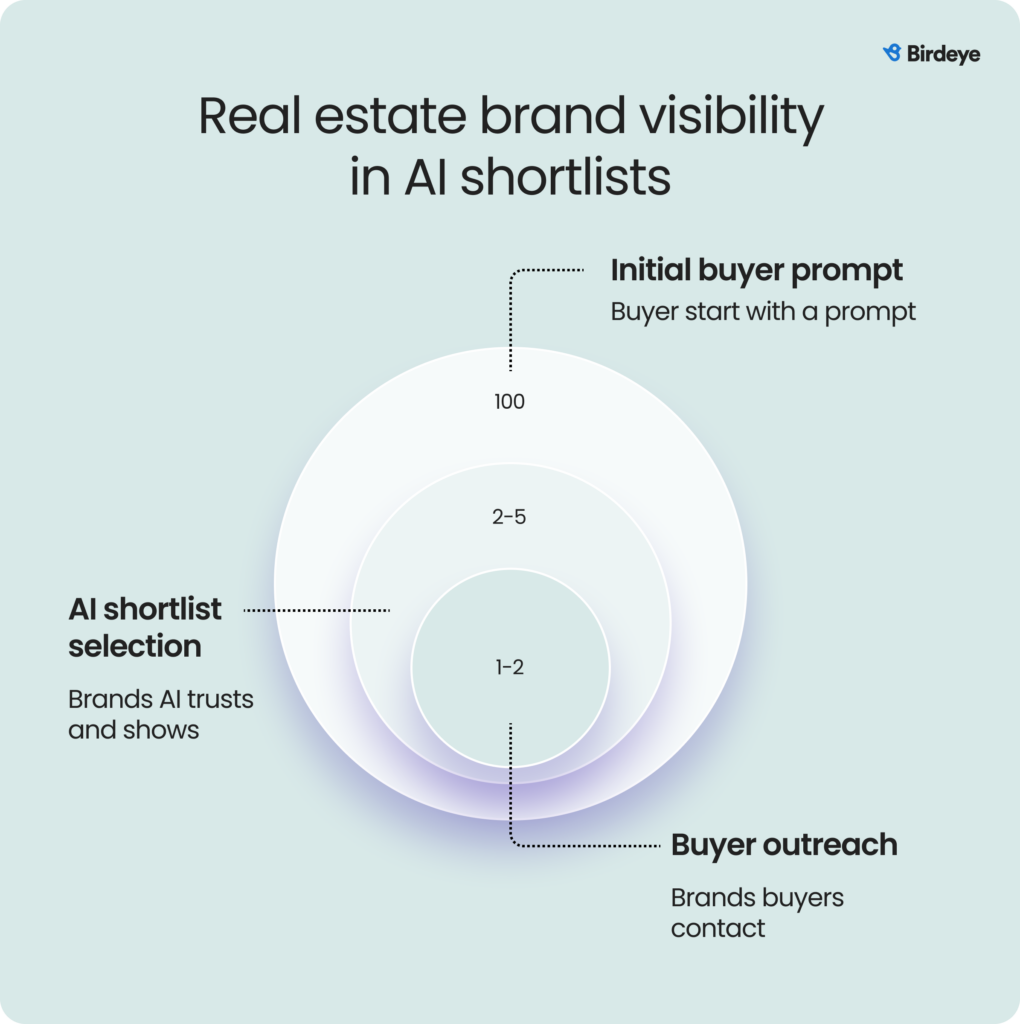
Real estate discovery has collapsed into a single moment: the AI-generated shortlist. That shortlist decides who gets considered, who gets ignored, and who receives the first inquiry. And unlike Google, where dozens of brands can compete on a results page, AI answers surface only a handful of names — sometimes just one — effectively redefining AI share of voice for real estate brands.
Generative engines don’t always get local information right. In Birdeye’s Local Search Accuracy Benchmark, every major LLM — including ChatGPT and Perplexity — displayed errors such as listing permanently closed businesses, misclassifying providers, and even recommending locations miles outside the requested search area.
These errors happen because LLMs fall back on the cleanest, most consistent profile data available. If your listings are inaccurate, outdated, or inconsistent across platforms, the model simply chooses a competitor with clearer signals. In AI search, insufficient data doesn’t just lower your ranking, it removes you from consideration entirely.
And that’s the real shift: if your brand is on the shortlist, every other channel (your website, ads, email, retargeting) gets a chance to work. If you’re not, the lead disappears upstream before it ever touches your marketing or sales funnel. AI visibility is no longer a “nice-to-have”; it is now a defining part of how demand finds, filters, and selects real estate brands.
What does this shift mean for real estate multi-location brands?
- The funnel has flattened — buyers jump from prompt to shortlist to outreach with almost no intermediate browsing.
- Only a few brands cut — AI doesn’t show 20 options; it shows 2–5 it trusts.
- Visibility gaps are invisible losses — if you’re not named, the lead never touches your website or agents.
- Multi-location brands feel this hardest — one inaccurate office or agent profile can push an entire market out of the shortlist.
- Competitive advantage compounds — once AI consistently selects a brand, it keeps reinforcing that brand across similar prompts.
This shift isn’t about “ranking higher” anymore.
It’s about being selected or being silently excluded without any analytics telling you it happened.

And that leads to the next critical question: If ChatGPT is now deciding which brands enter the shortlist, how exactly is it making those decisions?
How does ChatGPT actually choose real estate brands?
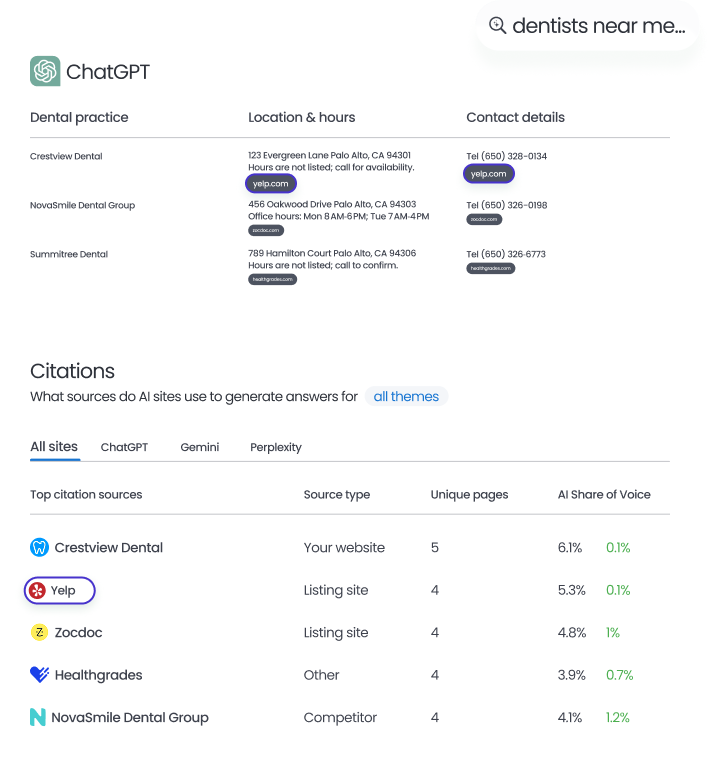
ChatGPT isn’t ‘searching the whole internet.’ It builds a ranked shortlist from a handful of trusted sources: major real estate portals, business listings, reviews, and your own content.
For example, if your Zillow profile is complete but your GBP category is wrong, or your agent profiles don’t match across portals, AI sees that as a trust gap and defaults to safer competitors.
The data sources behind AI recommendations
Under the hood, ChatGPT leans on a cluster of high-authority sources rather than one canonical index:
- Real estate portals: Zillow, Realtor.com, Homes.com, and similar sites provide inventory, broker/agent data, and market context.
- Business listings and maps: Google Business Profiles, Apple Maps, and local directories anchor your locations, categories, and contact details.
- Review and reputation platforms: Google, Yelp, and real estate review sites shape perceived quality, reliability, and recency of performance.
- Your own web presence: Your website, location pages, agent bios, and local content establish what you do, where you operate, and who you serve.
According to Birdeye’s State of Online Reviews 2025, 78% of all real estate reviews occur on Google, making GBP the single strongest trust signal LLMs use when evaluating which brands to recommend. When Google holds nearly all category-level sentiment data, even small inconsistencies or stale reviews can push a brand off the AI-generated shortlist.
When these sources line up and tell a consistent story, you look like a safe recommendation. When they are thin, outdated, or contradictory, AI has no reason to risk putting you on the shortlist.
But the sources themselves are just inputs; what really drives selection are the signals those sources carry.
The signals that push you onto (or off) the shortlist
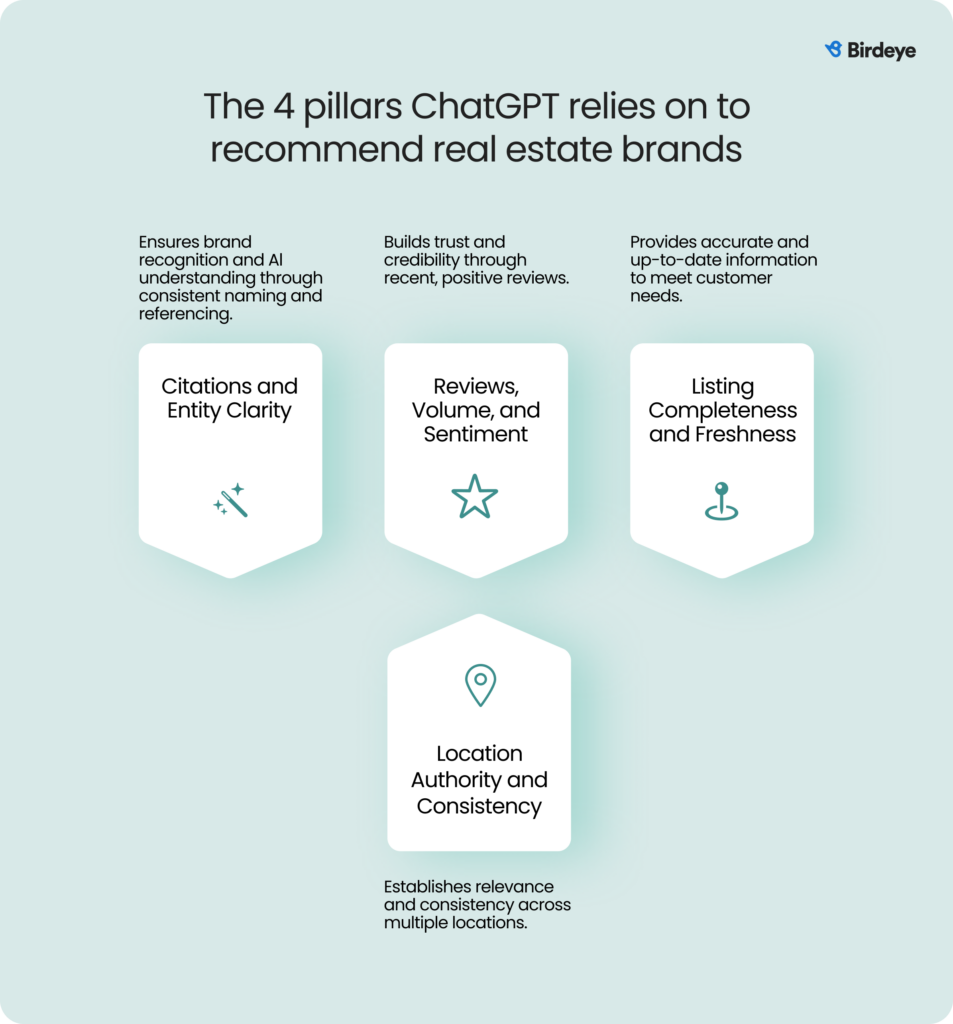
Once those sources are in play, a few practical signals drive selection more than others:
Citations and entity clarity
- Is your brand (and each office) clearly named and referenced across key portals, listings, and directories?
- Does AI have a stable “entity” to attach reviews, listings, and content to—or does everything look fragmented?
Reviews, volume, and sentiment
- Do you have enough recent reviews in the right places to look active and trustworthy?
- Is the overall sentiment strong enough that recommending you feels low-risk compared to a competitor with better proof?
Listing completeness and freshness
- Are your listings detailed, accurate, and up to date, with the attributes people actually ask for in prompts (price bands, neighbourhoods, amenities, property types)?
- Or does your inventory look stale, sparse, or misaligned with what buyers and renters are currently querying for?
Location authority and consistency
- For each city or neighbourhood, is it obvious that you are a relevant player there—across portals, maps, reviews, and your own site?
- Are your name, address, phone, categories, and descriptions consistent enough that AI can see “one brand, many locations” rather than a noisy cluster of half-related entries?
Birdeye’s State of Google Business Profile 2025 shows how strongly structured, verified data influences discovery. Verified and complete GBPs generated 4× more website visits, 12% more phone calls, and 10% more direction requests than incomplete profiles. These are the exact structured signals Google feeds into AI models — meaning real estate brands with unverified or inconsistent GBPs are far less likely to appear in ChatGPT recommendations.
Most brands assume ChatGPT is biased toward big franchises. It isn’t — it’s biased toward clean data, consistent citations, and trustworthy signals, regardless of brand size. Once you understand these signals, the next step is strengthening them systematically. That is the gap your GEO strategy and Birdeye Search AI exist to close.
Good to know: What is GEO (generative engine optimization)?
GEO is the practice of ensuring AI engines consistently see accurate, complete, and trustworthy data about your brand so they can confidently recommend you in answers.
How to improve ChatGPT visibility for real estate businesses
Improving your visibility is about strengthening the exact signals AI models rely on. It comes down to enhancing the information layer that AI models use to judge whether your brand is a safe recommendation.
That is the foundation behind what we call a GEO strategy — not SEO, but generative engine optimization: making sure AI engines have accurate, consistent, and trustworthy data about your brand so they can confidently surface your content in search results.
Fix what AI sees first
- Clean up your presence on the sources ChatGPT trusts most: Zillow, Realtor.com, Homes.com, Google Business Profiles, Yelp, and key local directories.
- Standardise names, addresses, phone numbers, categories, and office/agent profiles so AI can recognise “one brand, many locations” instead of a fragmented mess.
- Close obvious gaps: missing locations, duplicate profiles, wrong categories, outdated contact info, and old listings that should be removed or refreshed.
Feed it better proof
- Push richer, attribute-based listing content (price bands, neighbourhoods, amenities, property types) so your inventory actually matches what people ask in prompts.
- Build review volume and recency in the platforms that show up most in AI answers; prioritise locations and agents in key markets where you want to win the shortlist.
- Use your own site and location pages to reinforce the same story: where you operate, what you’re best at, and which customer segments you serve.
Real estate brands need Birdeye Search AI to secure their place in ChatGPT answers
Want to see the impact of Birdeye on your business? Watch the Free Demo Now.
Keep GEO running as an operating rhythm
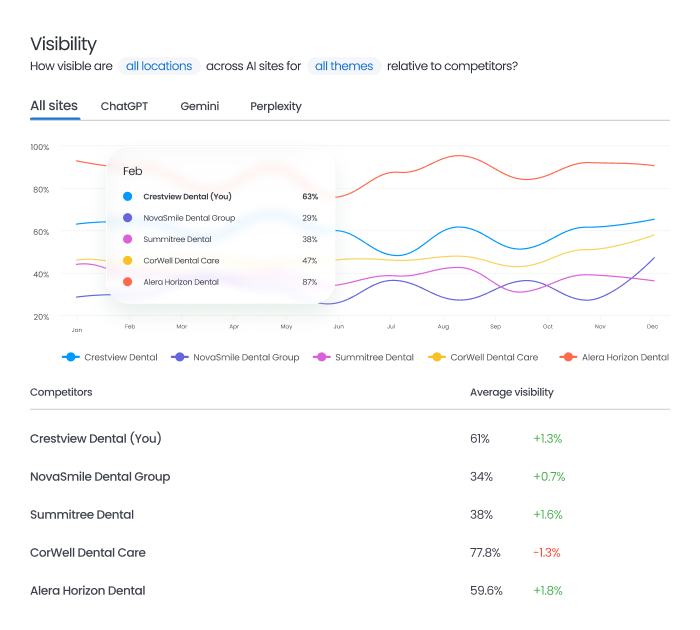
- Monitor how often your brand (and key locations) are named for your priority prompts: “best realtor near me,” “property manager in [city],” “apartments under [price] in [area].”
- Treat visibility gaps like leak alerts: when you’re missing or misrepresenting a high-intent query in a key market, that’s a signal to fix the data, content, or reviews there first.
- Use AI agents (like in Birdeye Search AI) to handle the heavy lifting for ongoing checks and updates, so your team can set direction and guardrails instead of manually editing profiles one by one.
The challenge is that maintaining this level of accuracy across dozens of platforms is operationally heavy — which is where AI-driven platforms like Birdeye come in.
How Birdeye Search AI helps real estate brands win AI visibility
Once you know how ChatGPT is making decisions, the real question is: how do you measure AI search visibility today and then change what the model “thinks” about your brand without drowning your team in manual work?
Birdeye Search AI is built to answer precisely that for multi-location real estate brands.
Birdeye Search AI doesn’t try to “influence” ChatGPT. It focuses on the actual levers that determine whether your brand is selected: data accuracy, citation strength, listing consistency, and reputation signals across every market and every agent. Instead of relying on manual cleanups, Search AI uses autonomous agents to scan, diagnose, and fix the issues that weaken your GEO foundation.
With Birdeye Search AI, you can:
- See where you show up in AI answers — across ChatGPT, Gemini, Perplexity, and new assistants as they emerge.
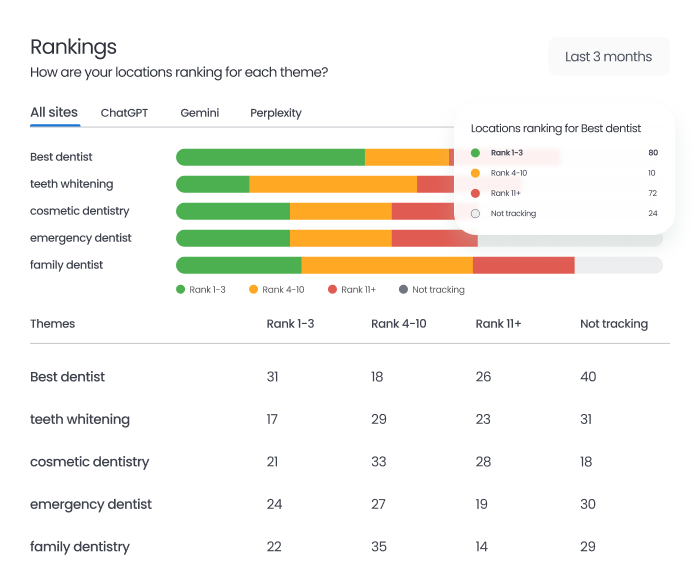
- Understand which prompts you win (and lose) — “best realtor near me,” “property managers in [city],” “apartments in [area] under [price].”
- Identify accuracy and trust gaps — wrong categories, outdated listing details, fragmented agent profiles, inconsistent NAP data.
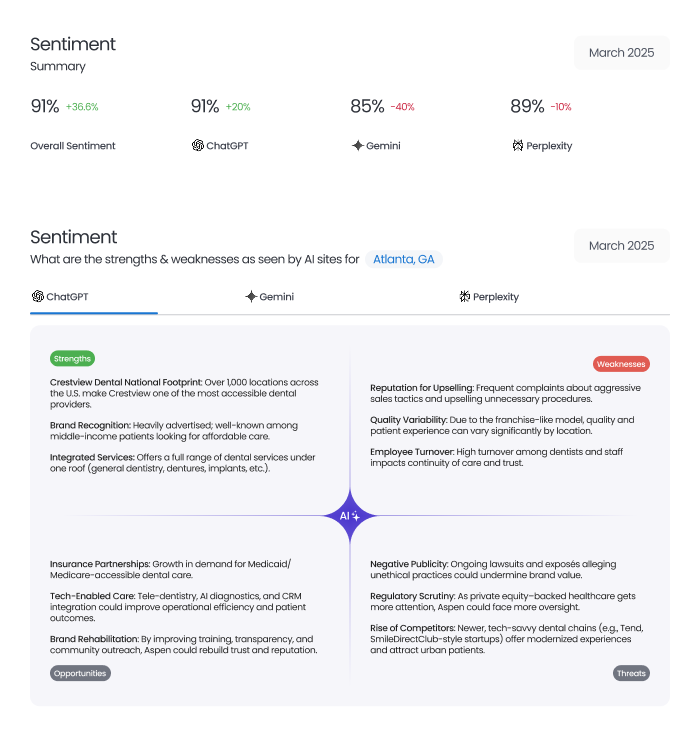
- Evaluate how AI describes your brand — sentiment, strengths, missing context, and errors in how AI summarizes your business.
- Fix issues continuously with AI agents — listings optimization, profile corrections, citation updates, market-by-market cleanups.
- Prioritize the markets that matter — location-level dashboards showing where competitors outrank you in AI visibility.
This is where your GEO strategy becomes real: you’re not guessing what ChatGPT might say—you’re seeing it, fixing it, and using AI agents to keep your brand selected more often.
Birdeye’s GenAI tools work together with your GEO strategy
GEO only works when the data layer, the reputation layer, and the visibility layer move in sync. Birdeye’s platform is built to support that system end-to-end: each tool reinforces the accuracy, trust, and visibility signals that AI uses to decide whether your brand belongs on the shortlist.
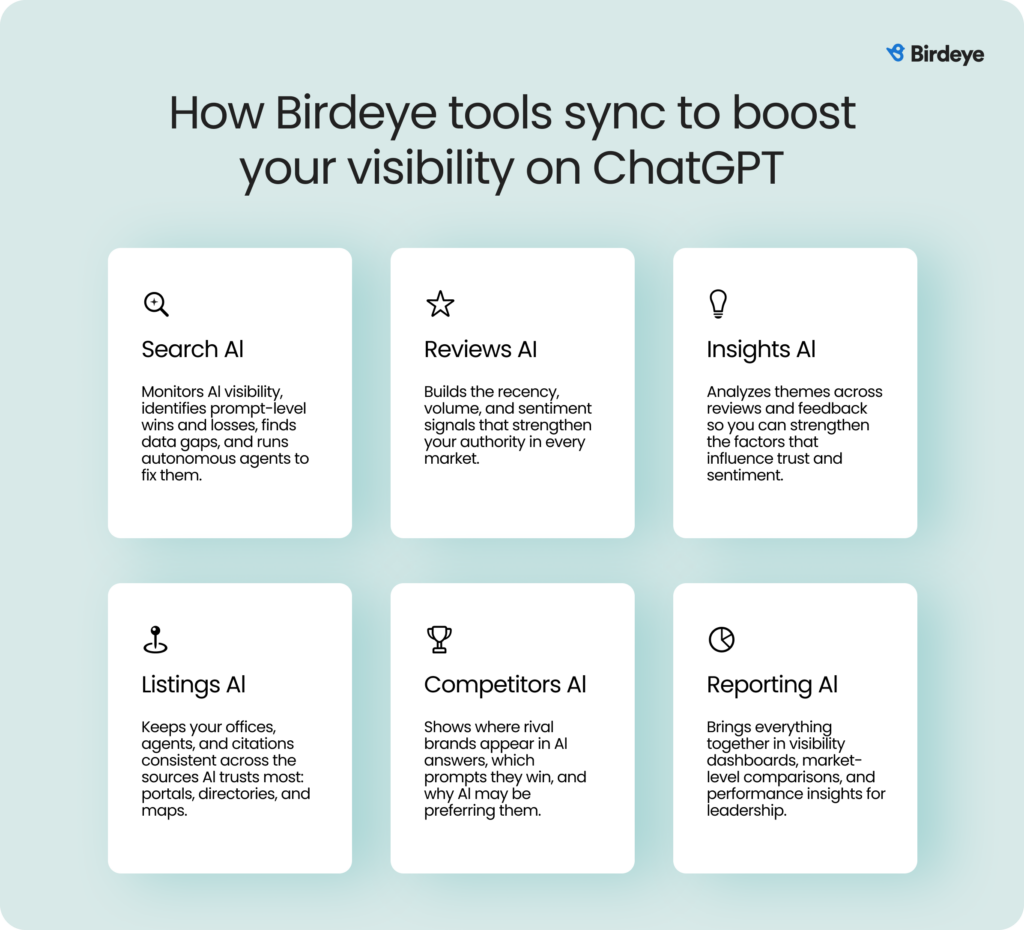
What Birdeye tools + your GEO strategy stack looks like in practice
- Search AI → Monitors AI visibility, identifies prompt-level wins and losses, finds data gaps, and runs autonomous agents to fix them.
- Listings AI → Keeps your offices, agents, and citations consistent across the sources AI trusts most: portals, directories, and maps.
- Reviews AI → Builds the recency, volume, and sentiment signals that strengthen your authority in every market.
- Competitors AI → Shows where rival brands appear in AI answers, which prompts they win, and why AI may be preferring them.
- Insights AI → Analyzes themes across reviews and feedback so you can strengthen the factors that influence trust and sentiment.
- Reporting AI → Brings everything together in visibility dashboards, market-level comparisons, and performance insights for leadership.
These tools don’t operate in isolation. Together, they create an environment that AI models rely on. When listings are clean, reviews are strong, citations are consistent, and visibility signals are continuously monitored, you become the brand AI can safely recommend — in every city, across every prompt, at scale.
FAQs on how real estate brands show up in ChatGPT answers
Most teams start by manually testing prompts like “best realtor near me” or “property managers in [city]” and seeing which brands ChatGPT names. The problem is that this is slow, subjective, and hard to track over time. A better approach is to use an AI visibility tool like Birdeye Search AI that systematically checks your presence across ChatGPT, Gemini, and Perplexity. It shows where your brand, locations, and agents appear—or are entirely missing.
You don’t throw away SEO, but you do need to expand your playbook. Traditional SEO still matters because it shapes your website, local pages, and some of the platforms AI pulls from. The shift is that GEO—generative engine optimization—focuses on accuracy, consistency, and trust signals across platforms like Zillow, Realtor.com, Homes.com, Google Business Profiles, and Yelp, so AI engines feel safe recommending you in answers, not just ranking you in search results.
Yes, especially at the local level. ChatGPT is not inherently biased toward the most prominent logo; it is biased toward the cleanest data, most consistent citations, and strongest, most recent proof. A smaller brokerage with tight listings, strong reviews, and clean profiles in a specific city can absolutely beat a national brand that has messy, outdated, or fragmented information in that market.
You can see early wins in a few weeks by fixing obvious issues like missing profiles, duplicate listings, wrong categories, and weak reviews in key markets. More durable gains—consistently appearing in ChatGPT shortlists across many cities and prompts—come from running GEO as an ongoing rhythm over a few months, where you monitor, fix, and reinforce your presence instead of treating it as a one-off project.
Birdeye’s AI agents can continuously scan for visibility gaps and data issues, flag where your brand is missing or misrepresented, and then help update listings, profiles, categories, and citations across locations. They reduce the manual work of chasing insufficient data, so your team can focus on setting priorities and reviewing changes. At the same time, the agents handle the repetitive clean-up that strengthens your GEO foundation.
The shortcut to the shortlist: Birdeye Search AI helps real estate brands show up in ChatGPT answers
This shift isn’t coming — it’s already here. Every month your data stays inconsistent is another month a competitor takes your place in AI-generated answers.
Showing up in those answers isn’t about ranking higher or producing more content — it’s about having cleaner data, stronger citations, fresher listings, and more evident proof than the competitors sitting next to you in a prompt.
The brands that consistently appear in ChatGPT’s recommendations maintain this foundation. Birdeye Search AI gives real estate teams a direct path to that outcome.
Birdeye Search AI gives your brand the data integrity, visibility, and automation needed to stay in the shortlisted answers where high-intent decisions begin.

About the Author

Shruti Dugar
Birdeye
Originally published