How to find your Facebook URL-
- On desktop (computer or laptop): Log in to Facebook → navigate to your profile or business page → copy the URL directly from the browser’s address bar.
- On a mobile browser: Log in at facebook.com → tap the hamburger menu (☰) → go to your profile → tap the three dots (…) → select “Copy link to profile” or “Copy link to Page.”
- In the Facebook app: Open the app → tap your profile picture → tap the three-dot menu (…) on your profile → scroll to “Your profile link” → tap “Copy link.”
Summary
Finding your Facebook URL takes under a minute once you know where to look, but the exact steps vary depending on whether you're on a desktop, in a mobile browser, or in the Facebook app. The interface has also changed a few times over the years, so older guides often lead people to menus that no longer exist.
This blog covers every method to find your Facebook URL, including desktop, mobile browser, and the Facebook app, for both personal profiles and business pages. You’ll also learn how to customize your URL, troubleshoot common issues, and understand what a proper Facebook URL example looks like.
Table of contents
- How to find your Facebook URL on a desktop (Computer or Laptop)
- How to find your Facebook URL on a mobile browser
- How to find someone else’s Facebook URL
- How to customize or change your Facebook URL
- Facebook URL format: What does a Facebook URL look like?
- What are the rules and requirements for Facebook URLs?
- Why can’t I find my Facebook URL? (Troubleshooting)
- 7 benefits of using a custom Facebook URL for your business
- How Birdeye helps enterprise and multi-location brands manage their Facebook presence
- FAQs about Facebook URLs
What is a Facebook URL?
A Facebook URL is the unique web address that points directly to a specific Facebook profile, business page, group, event, or piece of content on the platform. It is how Facebook identifies and distinguishes every single account and page in existence. If someone wants to visit your profile or page without searching for it, your Facebook URL will take them there instantly.
Think of it like a home address, except instead of a street and city, it is a link that lives on the internet and leads people directly to your Facebook presence.
Every Facebook account starts with a default URL that contains a long numeric ID assigned by Facebook. Once you set a custom username, that number is replaced with your chosen name, making your Facebook profile link shorter, cleaner, and far easier to share across emails, websites, business cards, and marketing materials.
According to the Facebook Help Center, you can find or change your username directly from your account settings at any time.
What does a Facebook URL look like?
The standard Facebook URL format is: https://www.facebook.com/username
Here are different types of Facebook URL examples broken down by use case:
- Personal profile URL: https://www.facebook.com/johnsmith. This is what a standard personal Facebook profile link looks like once a custom username has been set.
- Business page URL: https://www.facebook.com/BirdeyeInc. This is a branded business page URL. It matches the page name and is easy to include in marketing materials.
- Default profile URL (before a custom username is set): https://www.facebook.com/profile.php?id=100000XXXXXXX Facebook assigns this automatically. It is harder to remember and looks unprofessional, which is why setting a custom username is always recommended.
- Facebook group URL: https://www.facebook.com/groups/groupname. Groups have their own URL structure and are separate from profile and page links.
- Facebook event URL: https://www.facebook.com/events/eventID. Events get a unique URL that can be shared to invite people directly.
- Facebook post URL: https://www.facebook.com/pagename/posts/postID. Individual posts also have their own shareable URLs, useful for linking to specific announcements or updates.
The custom version of a Facebook URL is always preferred because it is easier to remember, looks more professional, and performs better in search.
Why does your Facebook URL matter?
Here is why Facebook URL matters across different scenarios:
- For individuals/content creators: Your Facebook profile link is often shared in LinkedIn bios, on personal websites, in email signatures, and across networking platforms. A clean, recognizable URL makes it easier for people to find and connect with you.
- For small businesses, local and enterprise brands: Your Facebook business page URL is frequently listed on Google Business Profiles, review sites, and local directories. A consistent, branded URL builds trust and improves local search visibility.
- For marketers and social media managers: A Facebook URL is essential for campaign tracking, client reporting, and adding the correct links to ad copy or social bios.
Facebook also provides official guidelines for creating a custom username, which governs what your Facebook URL can and cannot contain. For business pages specifically, the Facebook Help Center page on changing your Page username outlines the admin requirements and rules you need to follow before setting or updating your page URL.
Understanding what a Facebook URL is and how it is structured makes it much easier to find, copy, and share the right link, whether you are looking for your own or someone else’s.
How to find your Facebook URL on a desktop (Computer or Laptop)
Whether you are looking for your personal Facebook profile link or your business page URL, the steps differ slightly. Both are covered below with updated steps for 2026.
How to find your Facebook Business Page URL on desktop
- Log in to your Facebook account at facebook.com.
- Click on your business page from the left-side navigation bar.
- Once the page loads, look at the browser address bar at the top of your screen.
- The URL displayed in the address bar is your Facebook business page URL.
- Click on the address bar, select the full URL, and copy it.
You can now paste this Facebook page link into your marketing copy, email signature, Google Business Profile, or wherever it is needed.
Pro tip: If you cannot see your business page in the left-side navigation bar, click your profile picture in the top-right corner and select your page from the dropdown menu. You can also search for the page directly using the Facebook search bar.
The URL for your Facebook business page will appear in this format: https://www.facebook.com/YourPageName
Where “YourPageName” is the custom username you have set for your business page. Note that you must be a page admin to create or update a username for your business page.
To find the Facebook URL of a business page you do not manage:
- Log in to your Facebook account.
- Type the business page name into the Facebook search bar.
- Select the correct page from the search results and click to open it.
- Copy the URL directly from the browser address bar.
How to find your personal Facebook Profile URL on desktop
- Log in to your Facebook account at facebook.com.
- Click on your profile picture in the top right corner of the screen.
- Select your personal profile from the dropdown menu.
- Once your profile page loads, look at the browser address bar at the top.
- The URL shown in the address bar is your personal Facebook profile link.
- Click on the address bar, select the full URL, and copy it.
Your personal Facebook profile link will appear in one of these two formats:
https://www.facebook.com/yourname
or if no custom username has been set yet:
https://www.facebook.com/profile.php?id=XXXXXXXXXX
According to the Facebook Help Center on usernames and user IDs, both your username and numeric user ID are part of your public Facebook profile. However, a custom username always makes your Facebook profile link cleaner and easier to share.
If your URL still shows a numeric ID instead of a name, it means you have not yet set a custom username. You can do this in your account settings by following the steps on Facebook’s “Find or change your username” Help Center page. You can also jump to the How to Customize Your Facebook URL section of this guide for step-by-step instructions.
To find the Facebook profile URL of someone else on a desktop:
- Log in to your Facebook account.
- Search for the person’s name using the Facebook search bar.
- Click on their profile to open it.
- Copy the URL from the browser address bar.
How to find your Facebook URL on a mobile browser
The steps differ slightly between iPhone and Android, so both are covered separately below with updated steps for 2026.
How to find your Facebook URL on iPhone (Safari or Chrome)
Finding your Facebook profile link on an iPhone using Safari or Chrome follows the same general process since both browsers display a standard address bar.
To find your personal Facebook profile link on iPhone:
- Open Safari or Chrome on your iPhone.
- Go to facebook.com and log in to your account.
- Tap the hamburger menu (three horizontal lines ☰ ) in the top right corner of the Facebook homepage.
- Tap on “View your profile.”
- Once your profile loads, tap the address bar at the top of your browser.
- The full URL displayed is your Facebook profile link.
- Tap and hold the URL, then select “Copy” to copy it.
To find your Facebook business page URL on iPhone:
- Open Safari or Chrome and go to facebook.com.
- Log in to your account and tap the hamburger menu (three horizontal lines).
- Tap on “Pages” and select your business page.
- Once the page loads, tap the three dots (…) below the cover photo.
- Scroll down and tap “Copy link to Page.”
Pro tip: If the address bar is hidden on Safari, scroll up slightly on the page, and it will reappear at the top of your screen.
How to find your Facebook URL on Android (Chrome)
The process of finding your Facebook URL on Android using Chrome is very similar to that on iPhone, though the browser displays the address bar slightly differently.
To find your personal Facebook profile link on Android:
- Open Chrome on your Android device.
- Go to facebook.com and log in to your account.
- Tap the hamburger menu (three horizontal lines ☰ ) in the top right corner.
- Tap “View your profile.”
- Once your profile page loads, tap the address bar at the top of the Chrome browser.
- The URL shown is your personal Facebook profile link.
- Tap and hold the URL, then tap “Copy” to save it.
To find your Facebook business page URL on Android:
- Open Chrome and go to facebook.com.
- Log in and tap the hamburger menu (three horizontal lines).
- Tap “Pages” and select your business page.
- Tap the three dots (…) below the cover photo on the page.
- Scroll down and tap “Copy link to Page.”
Pro tip: If you are having trouble finding your page in the hamburger menu, use the Facebook search bar to find it directly. Once the page is open, follow steps 4 and 5 to copy the link.
What does a Facebook URL look like on a mobile browser?
Whether you are on iPhone or Android, your Facebook profile link will appear in one of these formats once you locate it in the address bar:
https://www.facebook.com/yourusername
or if no custom username has been set:
https://www.facebook.com/profile.php?id=XXXXXXXXXX
How to find someone else’s Facebook URL
There are many valid reasons to find someone’s Facebook URL, whether to tag a collaborator, reference a public figure, add a business to a directory, or share a profile. The process is simple on both desktop and mobile.
How to find someone else’s Facebook profile link on desktop
- Log in to your Facebook account at facebook.com.
- Type the person’s name into the Facebook search bar at the top of the page.
- Click on “People” from the filter options to narrow down the results.
- Select the correct profile from the search results and click to open it.
- Once the profile loads, look at the browser address bar at the top of your screen.
- The URL displayed is that person’s Facebook profile link.
- Click on the address bar, select the full URL, and copy it.
Now, how to find someone else’s Facebook page URL on desktop
- Log in to your Facebook account at facebook.com.
- Type the business or page name into the Facebook search bar.
- Click on “Pages” from the filter options to narrow the results.
- Select the correct page and click to open it.
- Copy the URL directly from the browser address bar.
How to find someone else’s Facebook URL on a mobile browser
- Open facebook.com in your mobile browser and log in.
- Tap the search icon and type the person’s name or page name.
- Tap on the correct result to open their profile or page.
- Tap the address bar at the top of the browser.
- The URL displayed is their Facebook profile link or page URL.
- Tap and hold the URL, then tap “Copy.”
Looking for someone else’s Facebook URL in the app?
- Open the Facebook app on your iPhone or Android device.
- Tap the search icon at the top of the screen.
- Type the person’s name or page name in the search bar.
- Tap on the correct profile or page from the results to open it.
- Tap the three dots (…) below their cover photo.
- Tap “Copy link” or “Copy link to Page” from the options that appear.
A few things to keep in mind
Finding and sharing someone else’s Facebook URL is only possible for public profiles and published pages. If a profile is set to private or a page is unpublished, the URL will either not appear in search results or be inaccessible when opened. Facebook’s Names and Usernames Help Center provides further context on how public usernames work across profiles and pages, which can be useful if you are having trouble locating someone through search.
How to customize or change your Facebook URL
By default, Facebook assigns every new account a URL that contains a long string of numbers. Setting a custom username replaces that numeric ID with a name of your choice, giving you a Facebook profile link that looks like this:
https://www.facebook.com/yourbrandname
This section covers how to change your Facebook URL on desktop, mobile browser, and the Facebook app, for both personal profiles and business pages.
How to change your Facebook URL on desktop (personal profile)
- Log in to your Facebook account at facebook.com.
- Click on your profile picture in the top right corner and select your personal profile.
- Click “Edit profile” on your profile page.
- Scroll down and click on “Edit your about info.”
- Under the “General” section, look for “Username.”
- Click on “Username” and type your desired custom username.
- Facebook will confirm whether the username is available.
- Once confirmed, click “Save changes.”
Your Facebook profile link will instantly update to reflect your new custom username.
How to change your Facebook page URL on desktop (business page)
- Log in to Facebook and navigate to your business page.
- Click “Page settings” from the left-side navigation menu.
- Click on “Page setup” and then select “Name.”
- Click on “Username” to edit it.
- Type your desired custom username for the page.
- Facebook will verify whether the username is available and meets the requirements.
- Click “Create username” to confirm and save.
Note that you must be a page admin to change your Facebook business page URL. If you do not have admin access, you will need to request it from the current page admin before proceeding.
How to change your Facebook URL in the app (personal profile)
- Open the Facebook app on your iPhone or Android device.
- Tap the hamburger menu (three horizontal lines) and tap on your name to open your profile.
- Tap “Edit profile.”
- Scroll down and tap “Edit your about info.”
- Tap “Username” under the General section.
- Enter your new custom username and tap “Save.”
How to change your Facebook page URL in the app (business page)
- Open the Facebook app and tap the hamburger menu.
- Tap “Pages” and select the business page you want to update.
- Tap “Edit” or the three dots (…) below the cover photo.
- Tap “Edit page info.”
- Tap “Username” and enter your new custom page username.
- Tap “Save” to confirm the change.
Important things to know before you change your Facebook URL
Before you update your Facebook profile link or page URL, there are a few key points to be aware of:
- You can only change your username a limited number of times: Facebook restricts how often you can update it, so choose carefully before confirming the change. Facebook’s official Help Center page on reasons why you cannot change your name on Facebook explains the restrictions that apply and what to do if your change request is blocked.
- Your old URL will stop working: Once you update your username, your previous Facebook URL will no longer direct people to your profile or page. Anyone who saved or shared your old link will need the updated one. Make sure you update your Facebook profile link everywhere it appears, including your website, email signature, Google Business Profile, and any other directories.
- Your username must meet Facebook’s requirements: It must be at least five characters long, contain only letters, numbers, or periods, and must not already be in use by another account. Full details on what is and is not allowed are covered in the Facebook URL rules and requirements section of this guide.
- Business pages have additional eligibility requirements: According to Facebook’s official Help Center page on creating a username for your Facebook page, certain pages may need to meet minimum activity or follower thresholds before a custom username becomes available.
Why changing your Facebook URL matters
A custom Facebook URL is not just about aesthetics. Here is why it makes a real difference:
- It makes your Facebook profile link far easier to share verbally, in print, and across digital platforms.
- It strengthens your personal or business brand by keeping your name consistent across the web.
- It improves the chances of your Facebook page appearing in search results when someone searches for your name or business directly.
- It reduces the risk of people landing on the wrong profile because your URL is now distinct and specific to you.
According to Gartner’s research on social media best practices for B2B businesses, as many as 46% of B2B buyers turn to social media at the very start of their buying journeys. A clean, branded Facebook URL ensures that when those buyers search for you, they land on the right page without any friction.
If you have not yet set a custom username for your profile or page, doing so is one of the simplest and most impactful steps you can take to improve how your Facebook presence looks and performs online.
Facebook URL format: What does a Facebook URL look like?
According to Statista, Facebook remains the world’s largest social media platform with 3.065 billion monthly active users as of Q1 2025. With billions of profiles, pages, groups, posts, photos, and videos on the Facebook platform, every piece of content has its own unique URL. Understanding the format helps you quickly identify and work with the right ones.
The standard format is:
https://www.facebook.com/username
The anatomy of a Facebook URL
Every Facebook URL is built from the same core components. Here is how each part breaks down:
| Component | Example | What it means |
| Protocol | https:// | Confirms a secure connection. All Facebook URLs use HTTPS. |
| Domain | www.facebook.com | The root domain. Always the same for every Facebook URL. |
| Path | /yourusername | Identifies the specific profile, page, group, or content. |
| Query string (if present) | ?id=XXXXXXXXXX | Appears in default URLs when no custom username has been set. |
Facebook URL formats for photos and videos
Two URL formats that are less commonly discussed but frequently encountered are photo and video URLs. These come up regularly when sharing specific pieces of content rather than an entire profile or page.
Facebook photo URL: https://www.facebook.com/photo/?fbid=XXXXXXXXX
Facebook video URL: https://www.facebook.com/watch/?v=XXXXXXXXX
Both use numeric IDs rather than custom usernames since individual pieces of content cannot be given custom names. These URLs are generated automatically by Facebook and can be shared directly from the photo or video itself.
Facebook URL parameters for tracking and advertising
If you run Facebook ads or track campaign performance, you may encounter Facebook URLs with additional parameters appended. These are used to pass tracking data and are a standard part of digital marketing workflows.
A tracked Facebook URL might look like this:
https://www.facebook.com/YourPage?utm_source=facebook&utm_medium=social
Facebook also supports its own dynamic URL parameters for ad tracking purposes. These allow advertisers to automatically populate campaign data into destination URLs. Full documentation on how these work is available on Facebook’s official Business Help Center page on URL dynamic parameters, which is particularly useful for anyone running paid campaigns or tracking link performance at scale.
How to quickly verify a Facebook URL is legitimate
- A legitimate Facebook URL always starts with https://www.facebook.com/
- It never contains extra subdomains like login.facebook.com.someotherdomain.com
- The path after the domain should be a recognizable username, a known path like /groups/ or /events/, or a numeric ID
- If the domain is anything other than facebook.com, the link is not a real Facebook URL
This is especially important for businesses verifying supplier pages, social media managers checking client links, or anyone reviewing URLs before publishing them publicly.
What are the rules and requirements for Facebook URLs?
Before you set or update your Facebook URL, it is important to understand the rules Facebook enforces for usernames. If your chosen username doesn’t meet these requirements, Facebook won’t allow you to save it.
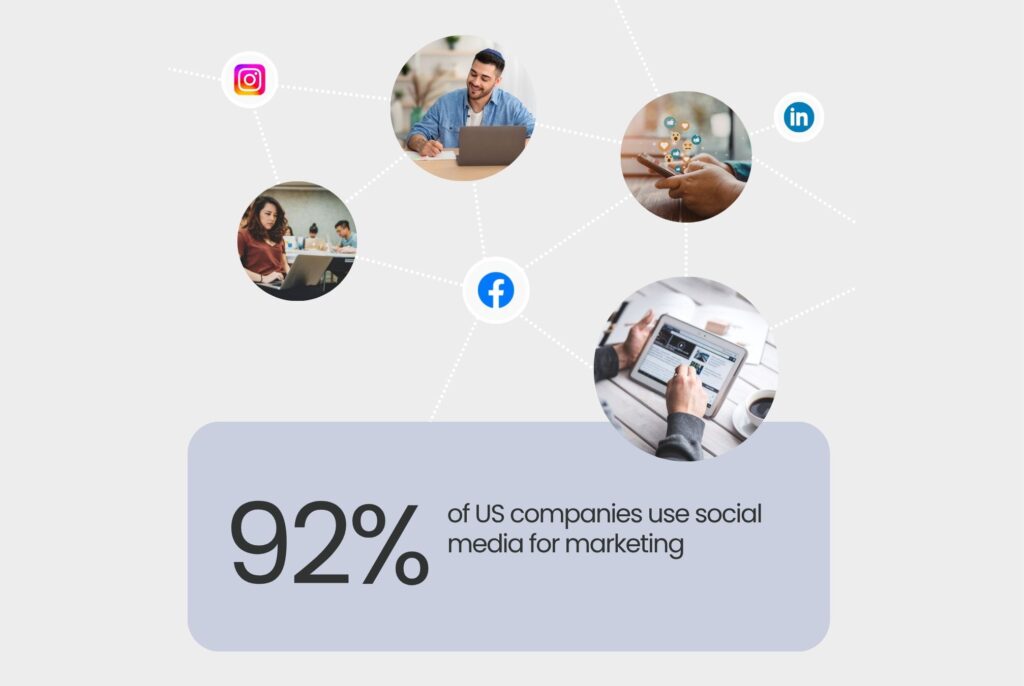
For businesses, getting this right matters. According to McKinsey, about 92 percent of US companies use social media for marketing, and with an estimated 4.9 billion users worldwide, social media has become a critical tool for growth.
At the same time, Forrester’s 2026 research on social media in B2B buying found that social media has become the second most meaningful source of information for buyers, just behind generative AI search tools, with Facebook leading among platforms. A clear, compliant Facebook URL ensures your Page is easy to find, trust, and share across these touchpoints.
The official Facebook username rules
Facebook’s rules for creating a valid username are outlined in the official Guidelines for creating a custom username on Facebook Help Center page.
Here is a complete breakdown of every rule you need to follow:
1. Minimum character length
Your Facebook username must be at least five characters long. Usernames shorter than five characters are not permitted.
2. Maximum character length
Your username can be a maximum of 50 characters long. Anything beyond 50 characters will not be accepted.
3. Allowed characters only
Facebook usernames can only contain alphanumeric characters (letters A to Z and numbers 0 to 9) and periods (full stops). No other special characters, symbols, underscores, hyphens, or spaces are permitted.
4. Periods do not create unique usernames
Adding or removing a period does not make a username different in Facebook’s system. For example, john.smith and johnsmith are treated as identical. You cannot use a period to claim a variation of an already taken username.
5. Capitalization does not create unique usernames
Facebook usernames are not case-sensitive. JohnSmith and johnsmith are considered the same. Capitalization cannot be used to distinguish your username from an existing one.
6. No generic terms or web extensions
Your username cannot include generic terms or domain extensions such as .com, .net, .org, or similar suffixes.
7. No impersonation
Your username must not be created in an attempt to impersonate another person, brand, or organization. Facebook actively enforces this rule and may remove usernames that violate it.
8. Must comply with Facebook’s Community Standards
All usernames must adhere to Facebook’s Community Standards. Usernames that violate these standards will be rejected or removed.
9. Usernames must be unique
No two accounts can share the same username. If the username you want is already in use, you will need to choose an alternative.
10. One username per profile or page
Each personal profile and each business page can only have one username at a time. You cannot assign multiple usernames to the same account.
Additional rules for Facebook business page URLs
Business pages have a few additional requirements in addition to the standard username rules. These are detailed in Facebook’s official Help Center page on guidelines for Facebook page names:
- Your page name must clearly represent the entity the page is about.
- Page names cannot include misleading terms, excessive punctuation, or all-caps formatting.
- Pages cannot include the word “official” unless the page is verified as the official presence of a brand, public figure, or organization.
- Slogans and descriptions belong in the “About” section of your page, not in the page name or username.
Facebook also provides a separate Help Center page covering names allowed on Facebook, which applies to both personal profiles and pages, and outlines additional naming restrictions worth reviewing before making any changes.
Why can’t I find my Facebook URL? (Troubleshooting)
Below are the most common reasons and exactly what to do to fix each one.
1. You are looking in the wrong place
The location of your Facebook profile link depends entirely on the device and method you use.
- On a desktop or laptop, your Facebook URL appears in the browser address bar when you are on your profile or page.
- On a mobile browser, your Facebook profile link is in the address bar at the top of the screen, but you may need to scroll up for it to appear.
- In the Facebook app, your URL is not displayed in the address bar. Tap the three dots (…) on your profile, then select the “Copy link” option.
2. Your Facebook URL still shows a numeric ID instead of a name
If your Facebook profile link looks like https://www.facebook.com/profile.php?id=100000XXXXXXX instead of a clean username-based URL, it simply means you have not yet set a custom username for your account.
This is not an error. It is the default URL Facebook assigns to every new account. To fix this, you need to set a custom username through your account settings. Once set, your Facebook profile link will update automatically to the cleaner format.
3. Your account has been temporarily locked
If you cannot access your profile at all and therefore cannot locate your Facebook URL, your account may be temporarily locked. This can happen if Facebook detects unusual activity or if you have failed too many login attempts.
Facebook’s official Help Center page on unlocking your Facebook account covers exactly what to do in this situation, including how to confirm your identity and regain access to your account.
4. Your account has been disabled or suspended
If your Facebook account has been disabled, you will not be able to access your profile or locate your Facebook URL until the issue is resolved. According to the Facebook Help Center, if your account has been disabled, you will see a disabled message when you try to log in.
If this has happened to your account, Facebook provides two dedicated Help Center pages to help you resolve it. The first covers why your account was disabled and outlines the most common reasons Facebook disables accounts. The second covers how to recover a disabled personal Facebook account and walks you through submitting a review request.
5. Your Facebook page has been unpublished
If you are trying to find the URL of a Facebook business page and it is not appearing in search results or is returning an error when opened, the page may have been unpublished. Unpublished pages are not visible to the public, and their URLs cannot be accessed by anyone who is not a page admin.
To check whether your page has been unpublished, log in as a page admin and navigate to the page. If it is unpublished, you will see a notification at the top of the page giving you the option to republish it. Once the page is published, its Facebook URL will become publicly accessible again.
6. You are not logged in to Facebook
Some Facebook profile links and page URLs are only fully accessible when you are logged in to a Facebook account. If you try to open a Facebook URL while logged out, you may be redirected to the Facebook login page or see a limited version of the profile.
Always make sure you are logged in to your Facebook account before attempting to find, copy, or verify a Facebook profile link or page URL.
7. Your profile privacy settings are restricting visibility
If your personal Facebook profile is set to private, other users may not be able to find or access your profile through search, even with your direct Facebook URL. While the URL itself still exists, the content it leads to may be restricted based on your privacy settings.
To review and update your privacy settings, Facebook’s official Help Center page on troubleshooting your account on the login identify page is a useful starting point. For a broader review of your privacy controls, Facebook’s account recovery and access Hub covers all the key settings you can adjust.
8. The username was recently changed
If you recently changed your Facebook URL and your old link is no longer working, it is because Facebook does not automatically redirect old usernames to new ones. Anyone who has saved or bookmarked your previous Facebook profile link will need the updated URL.
Make sure you update your Facebook profile link everywhere it is currently published, including your website, email signature, Google Business Profile, social media bios, and any online directories where your page is listed.
9. You are looking for someone else’s Facebook URL, but their profile is private
If you are trying to find someone else’s Facebook profile link and cannot locate it through search, their profile may be set to private, or their account may no longer be active. Facebook’s privacy settings allow users to limit how visible their profile is in search results, which can make their URL effectively unsearchable.
In this case, the only way to access their Facebook profile link is for them to share it with you directly.
7 benefits of using a custom Facebook URL for your business
Using Facebook URLs, specific to Facebook pages, groups, or content, helps businesses be more efficient in their efforts. Here are a few benefits of using your business’s Facebook URL:
- Ease of access: Facebook URLs provide a direct way to reach specific profiles, pages, or content, simplifying user access.
- Shareability: Facebook URLs are easily shareable, facilitating marketing, networking, and engagement.
- Branding and marketing: Customized URLs enhance brand strategy by increasing recognition and facilitating customer connection.
- SEO: Optimized URLs improve search engine rankings and local business SEO visibility.
- Convenience: Facebook URLs are concise and memorable, making content easier to access.
- Cross-platform sharing: Facebook URLs can be used to share across various digital platforms for promotion and connection.
- Analytics and tracking: Tools like Facebook Insights track URL performance, enhancing marketing effectiveness.
As your number of pages grows, tracking performance manually becomes difficult. Centralized visibility helps you understand what’s actually working.
How Birdeye helps enterprise and multi-location brands manage their Facebook presence
Getting your Facebook business page URL right is the starting point. But for enterprise and multi-location brands, the real challenge is what comes after: keeping every Facebook page across every location accurate, active, and engaging without creating unsustainable operational overhead.
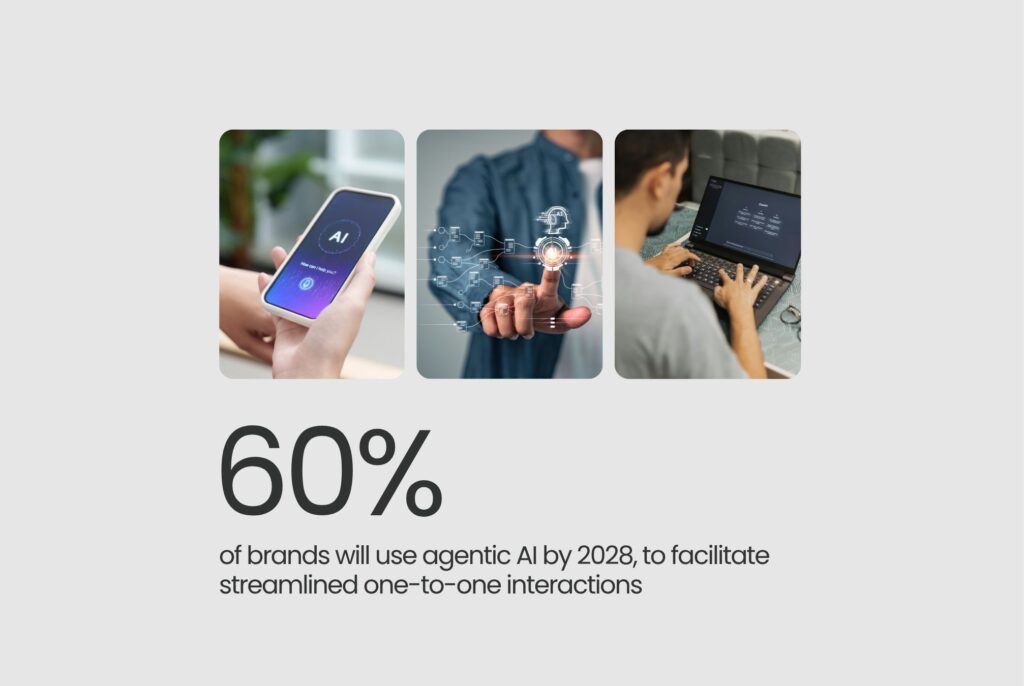
The pressure to solve this through AI is growing fast. According to Gartner, by 2028, 60% of brands will use agentic AI to facilitate streamlined one-to-one interactions, marking the end of channel-based marketing as we know it. Enterprise brands that delay building this capability risk falling behind competitors who are already deploying it.
Gartner also predicts that 40% of enterprise applications will be integrated with task-specific AI agents by the end of 2026, up from less than 5% in 2025. For marketing leaders, the window to adopt governed, scalable AI execution is narrowing.
Birdeye is purpose-built for this reality. As the #1 agentic marketing platform, it helps enterprise brands manage everything from 100 to 10,000+ locations through a coordinated system of AI agents that handle reputation management, social engagement, listing accuracy, and AI search visibility, all from a single platform.
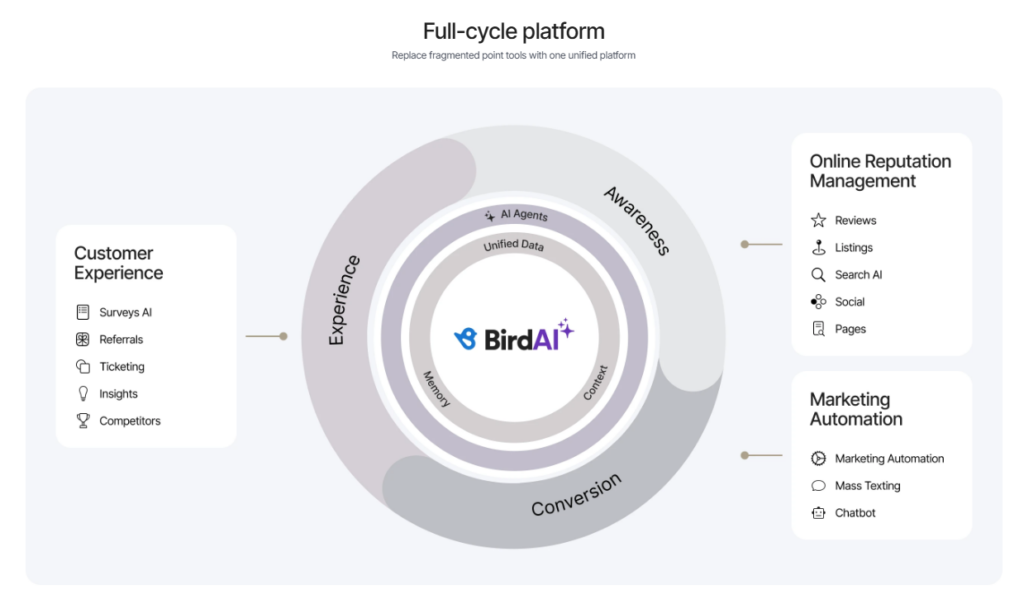
How Birdeye approaches enterprise scale
Birdeye organizes its platform around three operational pillars that work together continuously rather than as separate tools.
Consolidate: Unify data across every location
- Brings together over 3,000 integrations into one centralized platform, including Salesforce, HubSpot, CRM, POS, and scheduling tools
- Unifies customer data, location information, reviews, listings, and channel interactions across every touchpoint
- Eliminates fragmented tools and gives enterprise teams a single, reliable source of truth across all locations
Think: Turn data into context-aware decisions
- Birdeye’s AI operates with brand context and location-level memory
- Every recommendation, response, and insight stays on-brand while adapting to the specific nuances of each location
- Enterprise brands maintain consistency at scale without losing the local relevance that drives real customer engagement
Act: Execute continuously across every touchpoint
- AI agents run continuously across the entire marketing flywheel
- Handles review requests, customer feedback responses, listings updates, competitor monitoring, and search visibility optimization
- All execution happens around the clock without adding operational overhead to enterprise marketing teams
Social AI agents for enterprise Facebook management
For enterprise brands, Facebook is not simply a page with a URL. It is an active discovery and engagement channel operating simultaneously across hundreds or thousands of local pages. Birdeye’s Social AI agents are designed to manage that complexity at scale.
Social Publishing Agent
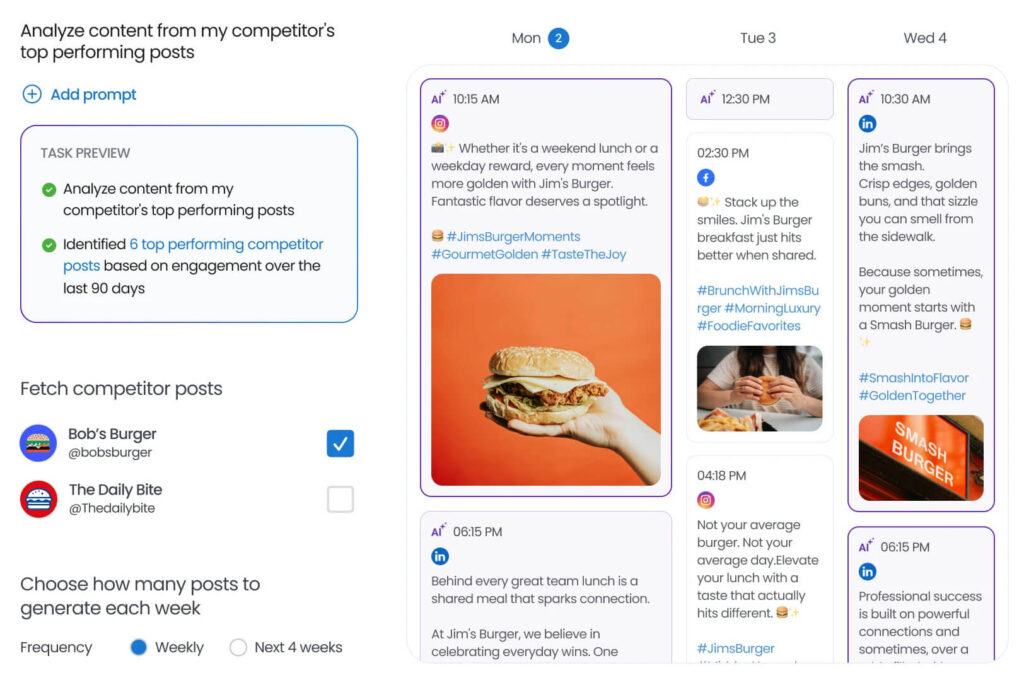
Birdeye Social Publishing Agent auto-generates and auto-schedules brand-aligned content across all locations for weeks, before you even log in, drawing on insights from top-performing posts, industry-specific content, competitor social activity, and upcoming local holidays and events.
- Every Facebook page across every location stays active and locally relevant without requiring a dedicated social media manager at each site
- Birdeye’s BrandAI technology ensures that automation does not mean generic output, with every post shaped by the brand’s voice, tone, and industry context
- Content is informed by competitor activity, trending topics, and location-specific events, keeping each page fresh and strategically aligned
Social Engagement Agent
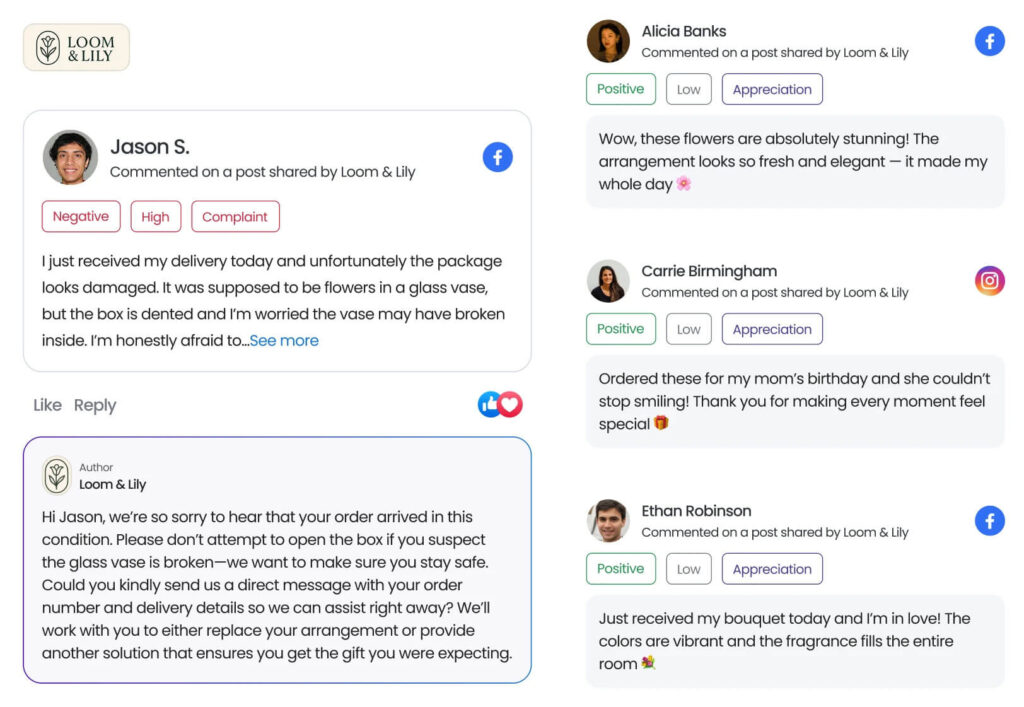
The Birdeye Social Engagement Agent instantly detects sentiment, intent, and priority in every comment, even if it is just an image, filters out spam, and responds in a brand-compliant way that strengthens customer trust.
- Monitors every comment, direct message, and wall post across all Facebook pages simultaneously
- Routes interactions to the right team based on intent and priority
- Ensures no customer interaction goes unaddressed at any location
Social Reporting Agent
The Birdeye Social Reporting Agent:
- Tracks content performance, audience growth, engagement trends, and response patterns by location or region
- Surfaces competitor social performance, including publishing patterns and audience growth
- Gives enterprise teams the insight needed to refine strategy continuously rather than reviewing performance in quarterly retrospectives

Birdeye does not just manage an enterprise brand’s Facebook presence. It actively strengthens it, keeping every location accurate, responsive, and visible while giving teams back the time to focus on strategy and customer experience. Explore Birdeye for enterprise brands. Watch a free demo now, get a 30-day trial today.
FAQs about Facebook URLs
A Facebook URL is the unique web address that links directly to a Facebook profile, business page, group, or piece of content. It follows the format https://www.facebook.com/username and is how anyone can find and visit your Facebook presence without searching for it.
On desktop: Go to your profile or page and copy the URL from the browser address bar.
On mobile browser: Navigate to your profile, tap the three dots (…), and select “Copy link.”
In the Facebook app: Tap your profile, tap the three dots (…), and tap “Copy link” or “Your profile link.”
A Facebook URL is the public-facing web address for your profile or page, such as facebook.com/yourbusiness. A Facebook page ID is a numeric identifier used for ad setup and API integrations. Your URL is for sharing and discovery, while your page ID is for back-end technical use.
Yes. A custom Facebook URL that includes your business name makes your page easier to index and surface in Google search results. It also strengthens brand consistency across directories and citation sources, which contributes to local SEO performance over time.
Yes, if your Facebook page is public, has a custom URL, and contains consistent, accurate information. AI search tools pull from publicly indexed content. So a clean, complete Facebook business page with a branded Facebook profile link is more likely to be cited or surfaced in AI-generated responses than a page with a default numeric URL or incomplete profile information.
Your old Facebook URL stops working immediately after you update your username. Facebook does not automatically redirect the old link to the new one. Update your Facebook profile link across your website, email signature, Google Business Profile, and all directories as soon as you make the change.
About the Author

Shruti Dugar
Birdeye
Originally published

![[Feature image]The best time to post on LinkedIn](https://birdeye.com/blog/wp-content/uploads/Feature-imageThe-best-time-to-post-on-LinkedIn-375x195.jpg)