Local franchise marketing is the strategy of promoting a franchise brand while helping each location attract customers in its local market. It combines national marketing, led by the franchisor, with local marketing, executed by individual franchisees.
Summary – As franchise businesses and multi-location local businesses expand, balancing brand consistency with local flexibility becomes more challenging. Enterprise teams need governance to protect the brand, while franchisees need the freedom to reach local audiences effectively.
In this guide, you’ll learn what franchise marketing is, why it matters, and how enterprise brands can use local SEO, reviews, AI search, and agentic marketing to grow consistently across hundreds or even thousands of locations.
Table of contents
- What is local franchise marketing?
- How is local franchise marketing different from national franchise marketing?
- How do you build a local franchise marketing strategy that scales for all locations?
- How do local SEO and Google Business Profile improve franchise visibility?
- How can franchise locations use community marketing to attract local customers?
- How can franchise brands localize social media for every location?
- Why are reviews a critical part of local franchise marketing?
- How is AI search changing local franchise marketing?
- Frequently asked questions about local franchise marketing
- Birdeye helps franchise brands grow consistently across every location
What is local franchise marketing?
Local franchise marketing helps franchise brands and local businesses grow across multiple locations without losing what makes them recognizable. While every franchise location serves a different community, customers still expect the same brand experience wherever they go.
Think of a McDonald’s location. Customers expect the same recognizable brand experience whether they visit a restaurant in New York or Los Angeles. But each location also serves a specific community, with different local competitors, customer preferences, events, and demand patterns.
Local franchise marketing connects these two needs: the strength and consistency of the national brand with marketing that helps each location stay relevant in its own market.
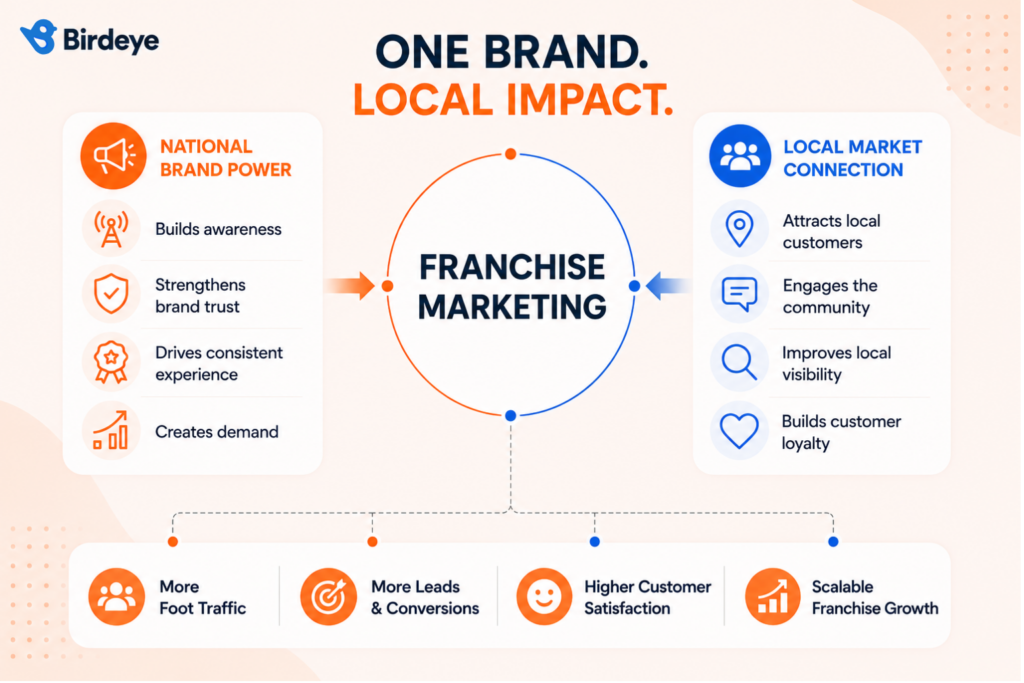
That balance matters at scale. The International Franchise Association projected 821,589 franchise establishments operating in the U.S. in 2024, an increase of 1.9% from the previous year. For franchise brands managing large networks, local marketing cannot operate separately from the national brand. It needs a structure that keeps the customer experience recognizable while giving individual locations room to respond to their markets.
Who owns local franchise marketing: the franchisor or the franchisee?
Local franchise marketing is a shared responsibility. The franchisor sets the overall brand strategy, standards, approved assets, and marketing guardrails, while franchisees execute locally within those standards.
This local execution is often referred to as Local Store Marketing (LSM), the location-level marketing activities used to reach customers in a specific community. LSM can include local promotions, community partnerships, events, social content, and other market-specific campaigns. The goal is not to create a different brand at every location. It is to make the same brand locally relevant.
In most franchise businesses, responsibilities are divided this way:
- Franchisors develop the overall brand strategy, create national campaigns, define brand guidelines, and provide marketing resources for franchisees.
- Franchisees execute local marketing initiatives, manage their online presence, engage with customers, and build relationships within their communities while following brand standards.
This shared approach helps franchise brands scale efficiently. National campaigns build awareness and strengthen brand recognition, while local marketing drives foot traffic, leads, and customer loyalty for individual locations.
As franchise networks grow from dozens to hundreds or even thousands of locations, maintaining that balance becomes more challenging. Successful local franchise marketing depends on repeatable systems that give corporate teams control over the brand while giving franchisees enough flexibility to respond to local customer needs.
How is local franchise marketing different from national franchise marketing?
National franchise marketing builds awareness and consistency for the brand as a whole, while local franchise marketing helps individual locations attract customers in their specific markets.
The two should work together, but they differ in four important ways: who they target, what they say, where they reach customers, and how much they adapt to local conditions.
1. Audience
National franchise marketing speaks to a broad audience across multiple markets. Local franchise marketing focuses on customers around a specific location, where buying decisions are shaped by proximity, local competition, community needs, and customer preferences.
2. Messaging
National campaigns establish the brand’s core message, positioning, and identity. Local marketing adapts that foundation to what matters in a particular community. A promotion that performs well in one city may not have the same relevance in another.
3. Channels
National marketing often relies on broad-reach channels and brand-level campaigns. Local franchise marketing puts more emphasis on location-specific channels such as Google Business Profile, local search, online reviews, local social media, community partnerships, and location pages.
4. Flexibility
National marketing prioritizes consistency across the franchise network. Local marketing requires more flexibility. Franchisees need enough room to respond to local events, seasonal demand, competitors, and customer preferences while operating within corporate brand guidelines.
The strongest franchise marketing strategies connect both levels. National marketing gives customers a brand they recognize. Local franchise marketing gives them a relevant reason to choose the location in their market.
How do national and local franchise marketing work together in practice?
McDonald’s shows how national and local franchise marketing can work together. A national promotion, such as its Monopoly campaign, gives participating restaurants shared creative, messaging, and promotional mechanics, creating a recognizable campaign across markets.
Local execution turns that national demand into customer activity. Franchisees and restaurant teams bring the campaign to life in their markets through in-store execution and customer engagement while maintaining the broader brand experience.
The principle applies beyond a single campaign. National marketing creates recognition and consistency. Local franchise marketing translates brand strength into local relevance and demand.
What challenges do franchise marketers face as they scale?
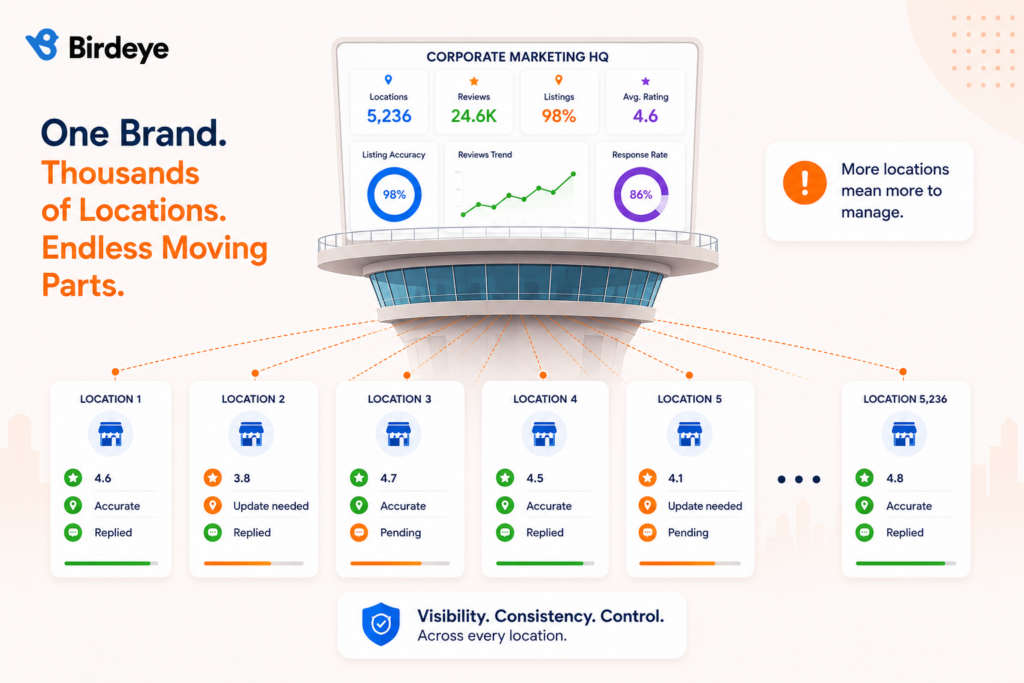
Balancing national and local marketing becomes much harder as franchise networks and multi-location brands grow. Managing 20 locations is very different from managing 500 or 5,000. Corporate marketing teams need visibility into every location, while franchisees need the flexibility to execute locally within brand guidelines.
As brands scale, they often face challenges such as:
- Maintaining consistent branding across every location
- Keeping business listings accurate and up to date across search engines, maps, and online directories
- Generating and responding to customer reviews consistently
- Improving local search and AI search visibility
- Measuring marketing performance across hundreds of locations
- Reducing manual work for both corporate and franchise teams through automation and centralized management
The brands that solve these challenges don’t rely on more spreadsheets, more approvals, or more manual effort. They build repeatable systems that combine centralized governance with localized execution, making it easier for every location to market effectively while protecting the brand.
That’s the foundation of a franchise marketing strategy that scales.
How do you build a local franchise marketing strategy that scales for all locations?
A scalable local franchise marketing strategy gives every location a clear plan for reaching local customers without pulling the brand in different directions. It defines what corporate controls, where franchisees have flexibility, which channels matter, and how performance is measured.
The strongest franchise marketing strategies define six things upfront: goals, local audiences, brand guardrails, channels, content, and measurement.
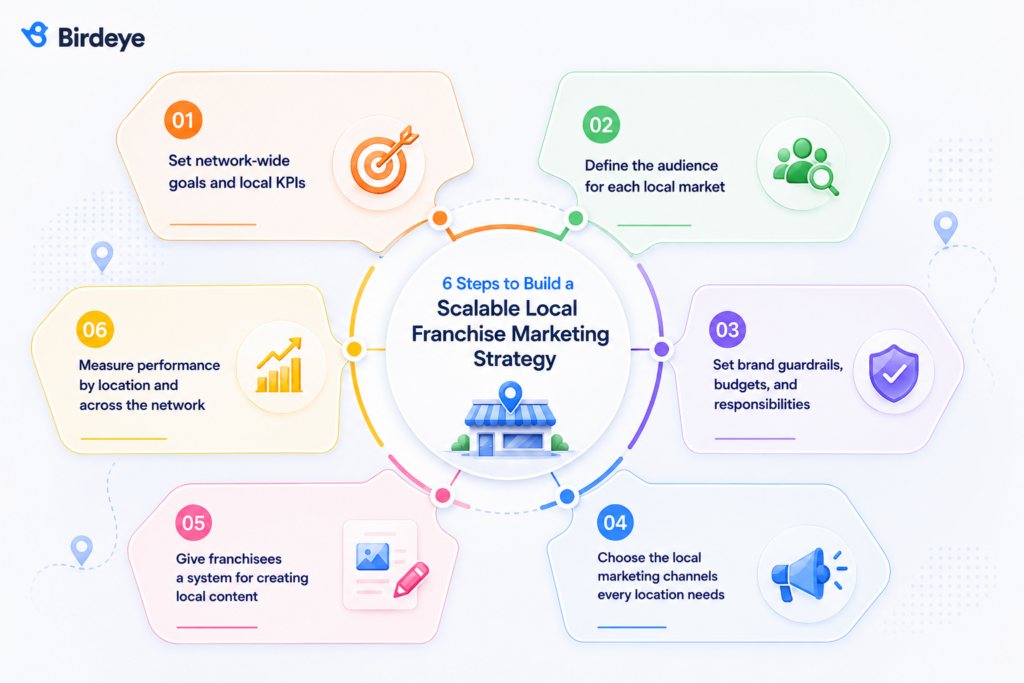
Here is how to build a local marketing strategy that can scale across a franchise network:
1. Set network-wide goals and local KPIs
Start with shared business goals, then define what success looks like at the location level. Depending on the campaign, track metrics such as:
- Local search visibility
- Leads, appointments, or foot traffic
- Review volume and sentiment
- Website traffic and conversions
This gives corporate teams a common measurement framework without assuming every location starts from the same position.
2. Define the audience for each local market
A national customer profile provides the foundation, but local demand varies. Before building campaigns, account for differences in:
- Customer needs and seasonal demand
- Local competitors
- Community preferences and behaviors
The goal isn’t to create a different strategy for every location. It’s to identify the local differences that should influence execution.
3. Set brand guardrails, budgets, and responsibilities
Make it clear what corporate controls and what franchisees can adapt. Your franchise marketing toolkit should define:
- Brand and messaging guidelines
- Approved templates and creative assets
- Corporate vs. local marketing budgets
- Franchisee customization rights
- Approval requirements
Clear guardrails give franchisees room to market locally without making brand consistency harder to manage.
4. Choose the local marketing channels every location needs
Build the channel mix around how customers discover, evaluate, and choose each location. Depending on the market, that can include:
- Google Business Profile and local search
- Location pages and business listings
- Online reviews
- Local social media
- Email and messaging
- Paid and community campaigns
Not every location needs the exact same channel mix. Establish the core channels every location needs, then allow teams to adapt based on local demand.
5. Give franchisees a system for creating local content
Corporate teams shouldn’t have to create every social post or promotion. Give franchisees approved assets and clear rules for localization so they can create content around:
- Local teams and customer stories
- Community events and partnerships
- Location-specific promotions
- Seasonal or neighborhood trends
This creates a practical middle ground: content can feel hyper-local without becoming off-brand.
6. Measure performance by location and across the network
Network-wide averages can hide weak locations. Track performance at both levels so teams can:
- Identify high-performing locations
- Spot underperformance early
- Compare results across markets
- Replicate successful franchise marketing strategies
A scalable measurement system should tell you both how the franchise brand is performing overall and where individual locations need attention.
Once the goals, guardrails, channels, content, and measurement are in place, the next challenge is execution, starting with making sure every franchise location can actually be found when local customers search.
How do local SEO and Google Business Profile improve franchise visibility?
Local SEO helps each franchise location appear when nearby customers search for businesses, services, or products in their area. Google Business Profile (GBP), accurate business listings, and location-specific pages give search engines the information they need to understand where each location is, what it offers, and when it is relevant to a local search.
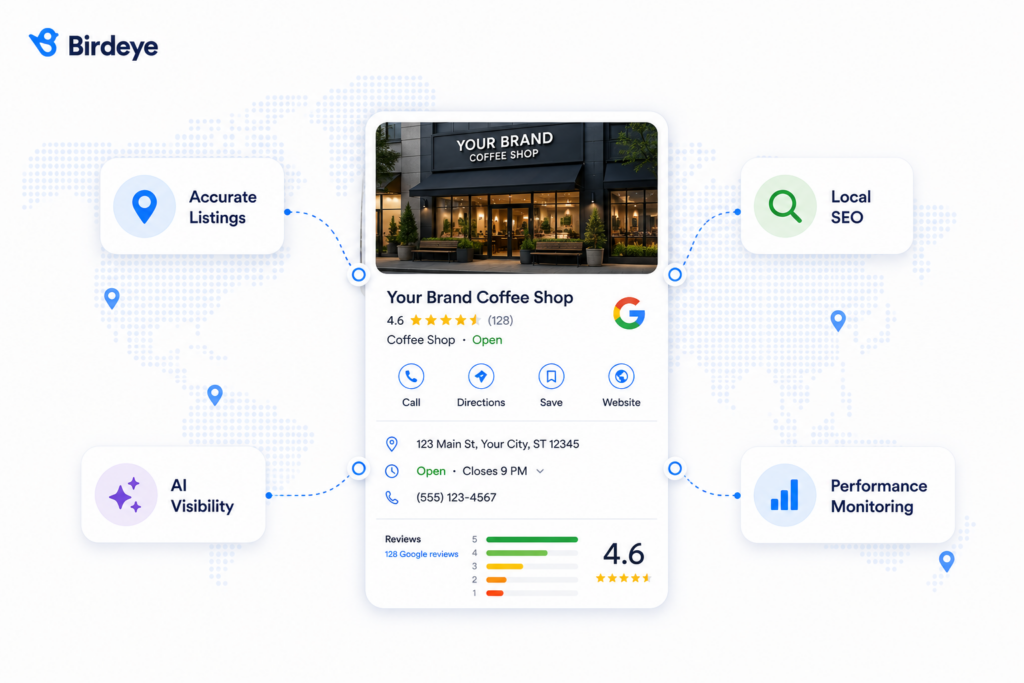
When someone searches for “coffee shop near me,” “best dentist nearby,” or “pizza delivery,” they’re usually looking for a nearby location, not a corporate homepage. That’s why a franchise digital marketing strategy needs to optimize every location individually while keeping business information consistent across the network.
Why does NAP consistency matter for franchise locations?
NAP consistency means keeping each location’s name, address, and phone number accurate and consistent to your online presence looks balanced. Hours, website URLs, categories, and other location details should also stay up to date.
For a franchise with hundreds of locations, small data errors can multiply quickly. An outdated phone number, an incorrect address, or an inconsistent business name can confuse customers and make it harder for search platforms to determine which location information is reliable.
Centralizing location data makes it easier to keep business information accurate across search engines, maps, directories, and other discovery platforms as the franchise network grows.
How should franchises optimize Google Business Profile for each location
Every franchise location should have a complete and accurate Google Business Profile that reflects that specific market. Keep core information up to date, including the business name, address, phone number, hours, categories, website, and other relevant location details.
Local optimization should go beyond basic information. Add high-quality location photos, maintain location-specific landing pages, use relevant local content, and keep profiles updated as hours, services, or other business details change.
Corporate teams can establish standards for profile quality and accuracy, while location-level information keeps each profile relevant to the customers it serves.
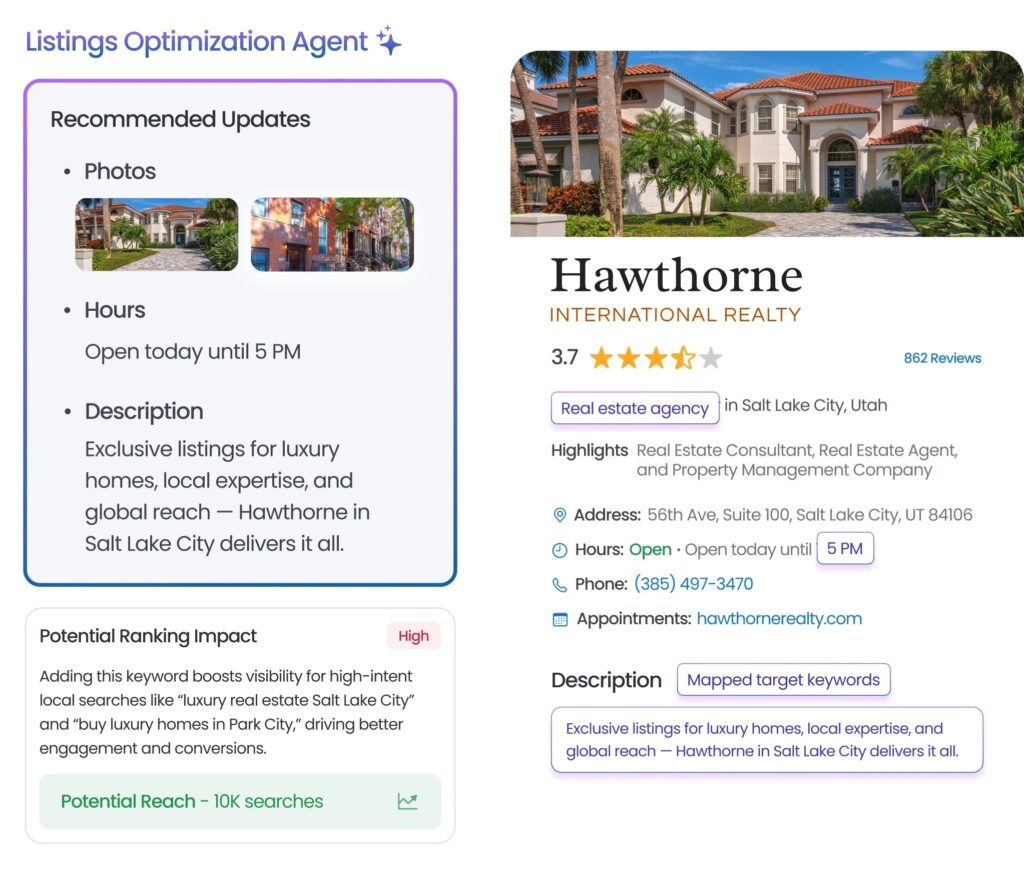
For franchise networks, the challenge isn’t optimizing one Google Business Profile. It’s maintaining accurate, locally relevant information across hundreds or thousands of locations. Centralized monitoring helps corporate teams spot listing errors, outdated information, and visibility gaps without manually checking every location.
Birdeye Listings helps multi-location brands manage location information from a centralized system, while the Listings Optimization Agent supports listing accuracy and data consistency across locations. For franchise teams, this reduces the manual work required to keep location information current as the network grows.
How can franchise locations use community marketing to attract local customers?
Community marketing helps franchise locations build relevance beyond search results and national campaigns. The strongest programs give franchisees room to participate in the communities they serve while keeping the brand, messaging, and customer experience consistent.
Local opportunities will vary by market, but franchisees can build visibility through:
- Local sponsorships: Support school teams, youth sports leagues, neighborhood organizations, or community programs that align with the brand.
- Community events: Participate in farmers’ markets, festivals, business events, or other gatherings where local customers already spend time.
- Charity initiatives: Partner with local nonprofits, organize donation drives, or support causes that matter to the community.
- Local partnerships: Work with complementary businesses or organizations on events, promotions, or referral opportunities.
At scale, corporate teams don’t need to choose every sponsorship or event. They need to define the guardrails. Approved assets, clear partnership criteria, and brand guidelines can give franchisees a framework for making local decisions without creating a different brand experience at every location.
The result is local marketing that feels connected to the community rather than copied from a corporate campaign.
How can franchise brands localize social media for every location?
Franchise brands can localize their social media by combining corporate content with hyper-local posts tailored to individual markets. Corporate teams provide the brand foundation, while location-level content gives customers a reason to follow and engage with the franchise in their own community.
A national social feed might feature brand campaigns, product launches, or company announcements. Local franchise content can bring that story closer to home through:
- Local teams: Introduce employees, celebrate milestones, or show the people behind a specific location.
- Community involvement: Share local events, sponsorships, partnerships, and charitable initiatives.
- Local promotions: Highlight offers or events relevant to customers in that market.
- Customer stories: Feature local experiences and customer moments when appropriate and permitted.
- Market-specific content: Respond to local seasons, events, or community interests rather than publishing identical posts everywhere.
The goal isn’t to replace corporate content with hundreds of disconnected local feeds. It’s to create a repeatable system where the brand stays recognizable while the content feels relevant to the people each location serves.
For large franchise networks, approved templates, content libraries, publishing permissions, and clear brand guidelines can help teams scale hyper-local content without requiring corporate marketers to create every post themselves.
Why are reviews a critical part of local franchise marketing?
Reviews shape local franchise marketing in two ways: they influence how customers evaluate individual locations and create a public record of the customer experience at each one. For franchise brands, that means reputation can’t be managed only at the corporate level. Every location needs a consistent process for generating reviews, responding to feedback, and learning from what customers say.
Why does every franchise location need its own review strategy?
A strong national reputation can introduce customers to the brand, but customers still evaluate the location they’re considering. One franchise location may have a strong rating and a steady stream of recent feedback, while another nearby location has fewer reviews or recurring complaints.
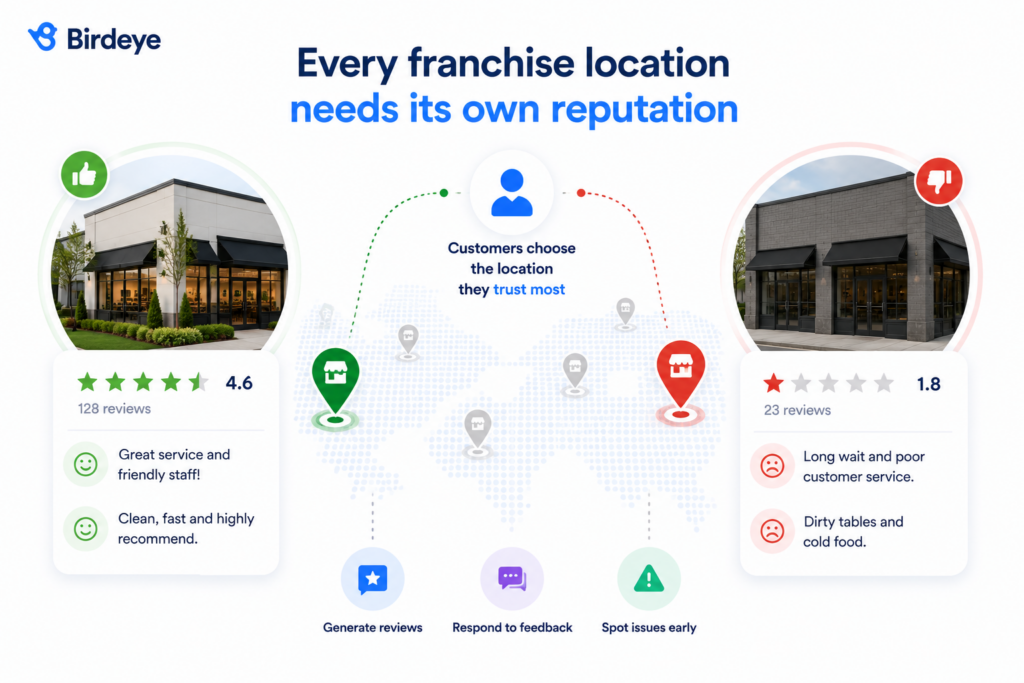
That’s why reputation needs to be managed at both the corporate and location levels. Each location should consistently generate reviews, respond to customer feedback, and identify recurring issues that could affect the customer experience.
How do reviews influence local visibility and customer decisions?
Reviews give prospective customers useful signals about a location before they visit, including the volume, recency, and sentiment of customer feedback. They also contribute to the broader set of signals associated with local search visibility.
For franchise marketers, the opportunity goes beyond earning a higher star rating. A steady flow of authentic feedback helps locations build a more current reputation while giving corporate teams insight into what customers are experiencing across the network.
How can franchise brands manage reviews at scale?
For a franchise with hundreds or thousands of locations, manually requesting reviews, responding to every customer, and tracking sentiment quickly become overwhelming.
Birdeye Reviews helps multi-location brands manage that work at scale. Jay, Birdeye’s AI coworker for marketing, coordinates specialized agents including:
- Review Generation Agent encourages more customers to leave reviews through automated, personalized requests.
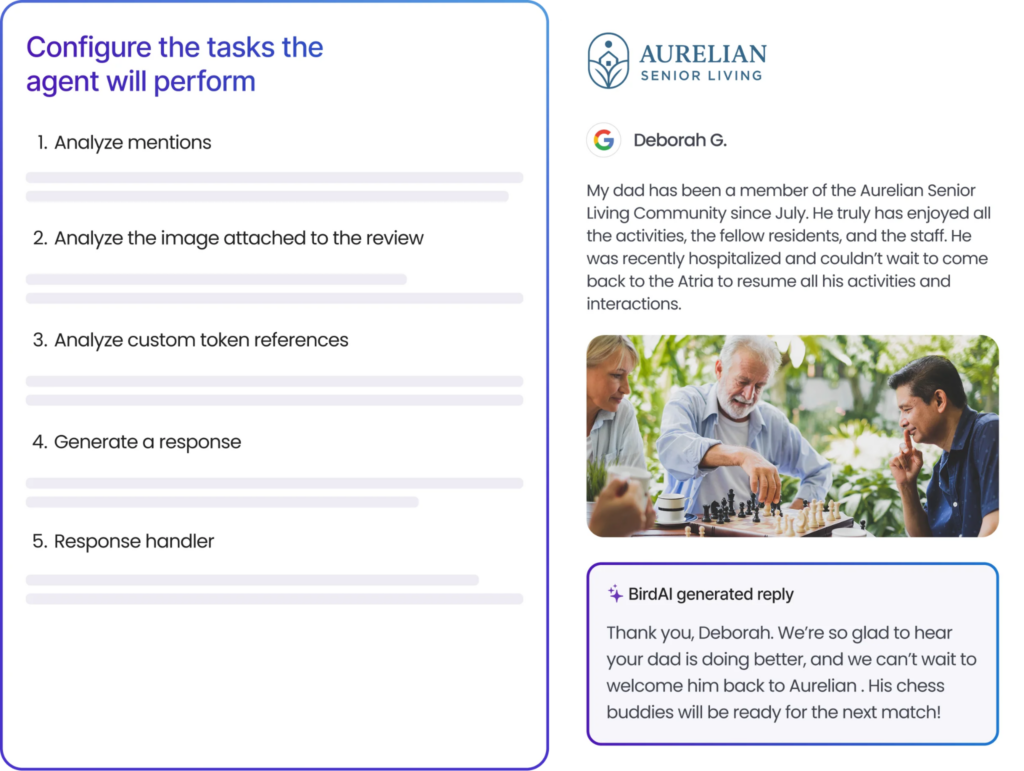
- Review Response Agent drafts context-aware responses that reflect your brand’s voice and can be reviewed or published at scale.
Aspen Dental shows what this looks like at scale. The network has more than 1,000 dental practices across the U.S. After implementing Birdeye Reviews, Aspen Dental increased patient review volume across Google and Facebook within three months.
Its nationwide average rating improved from 3.8 to 4.0 stars across more than 38,000 reviews, while patient feedback gave teams additional insight into opportunities to improve the patient experience.
At franchise scale, reviews are more than individual customer interactions. They create a location-level feedback system that helps teams strengthen trust, identify recurring experience gaps, and understand how reputation differs across the network.
How is AI search changing local franchise marketing?
AI search is changing local discovery from a list of links into a recommendation experience. Customers can now ask ChatGPT, Gemini, or Perplexity questions such as “What’s the best family dentist near me?” or “Which pizza place nearby has strong reviews?” and receive a synthesized answer rather than evaluating search results one by one.
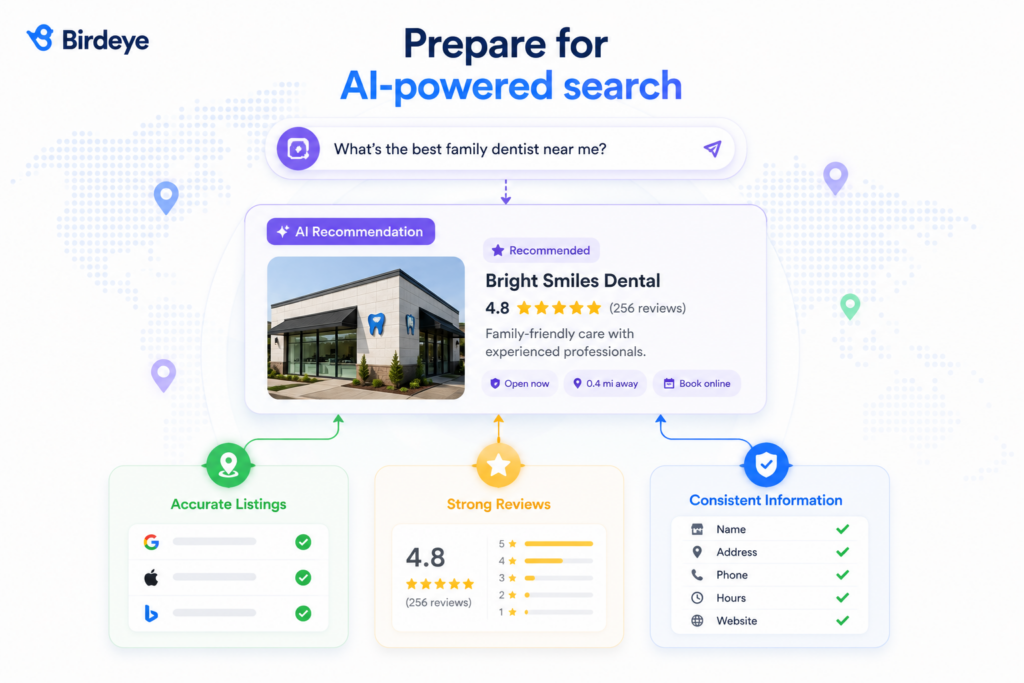
For franchise brands, that changes what local visibility requires. AI systems can draw on business information, website content, reviews, and other signals available across the web to understand and compare locations. A strong national brand alone doesn’t guarantee that every franchise location will be represented equally in AI-generated answers.
What helps franchise locations appear in AI search?
The same location-level fundamentals that support local discovery become important inputs for AI visibility:
- Accurate business information: Keep location details consistent and current across relevant sources.
- Complete local profiles: Give search and AI systems enough information to understand each location.
- Fresh customer reviews: Maintain a current body of authentic customer feedback.
- Location-specific content: Clearly describe the services, products, and market context relevant to each location.
- Consistent brand information: Reduce conflicting information that can make individual locations harder to understand.
The challenge for franchise marketers is visibility across the network. One location may appear frequently in AI-generated answers while another may barely surface, even under the same brand.
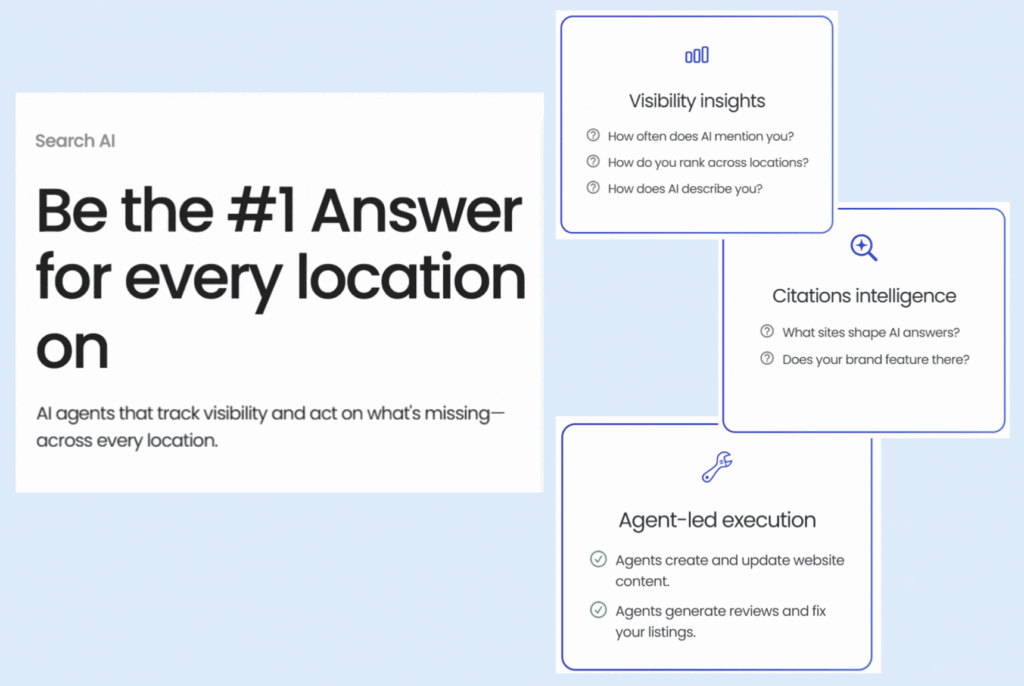
Birdeye’s Search AI helps multi-location brands monitor how locations appear across AI search, while Jay’s Listings Optimization Agent helps teams identify and address location-data issues at scale. Together, these capabilities give franchise marketers a clearer view of where locations are visible and where information gaps may be limiting discovery.
What local franchise marketing mistakes make scaling harder?
Local franchise marketing becomes harder to scale when brands centralize too much, give locations too little structure, or rely on network-wide averages that hide local problems. The goal is to create enough consistency to protect the brand while giving each location the data, tools, and flexibility to respond to its market.
| Common mistake | Why it creates problems at scale | What to do instead |
| Giving every location the same marketing | Identical campaigns can overlook differences in local customers, competitors, events, and demand. | Set corporate brand guardrails, then give franchisees approved ways to adapt campaigns, promotions, and content for their markets. |
| Letting location information drift | Hours, phone numbers, addresses, categories, and other business information can become inconsistent as the network grows. | Establish a central source of truth for location data and clear ownership for keeping listings and profiles accurate. |
| Treating reputation as a brand-level metric | Network-wide ratings can hide locations with fewer recent reviews, recurring complaints, or weaker customer sentiment. | Track reviews and customer feedback by location, then compare results across the network to identify patterns that need attention. |
| Publishing the same corporate content everywhere | A national content calendar protects consistency but can make local channels feel disconnected from the communities they serve. | Combine corporate campaigns with hyper-local content featuring local teams, events, partnerships, promotions, and community stories. |
| Measuring only network-wide performance | Franchise-wide averages can hide which locations are gaining visibility, generating demand, or falling behind. | Measure performance at both levels. Use network-wide KPIs for overall progress and location-level metrics to find gaps and replicate what works. |
What technology helps enterprise franchise brands scale local marketing?
The right technology for enterprise franchise marketing should do more than centralize tasks. It should connect location data, customer signals, governance, and local execution so corporate and franchise teams can work from a single system without manually managing every action.
That’s the role Birdeye’s AI agents fulfill for multi-location brands
Instead of adding more disconnected tools as the franchise network grows, enterprise brands can add AI staff at every location to help teams execute consistently while maintaining corporate control.
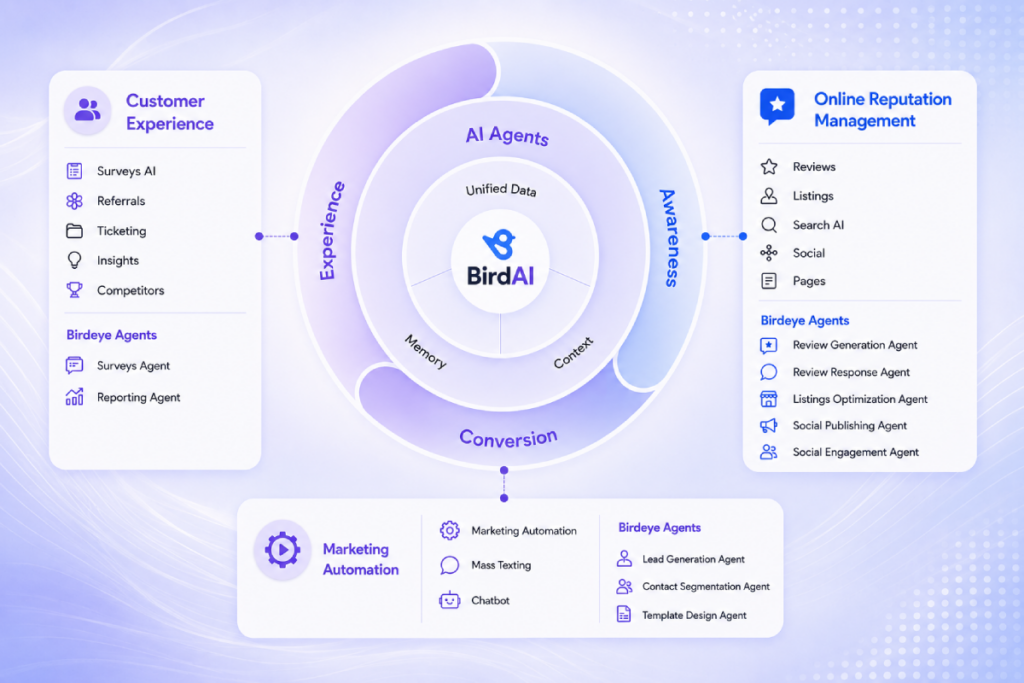
Birdeye’s three AI coworkers work across the customer journey:
- Jay handles marketing
- Robin handles operations
- Myna handles customer experience
Rather than operating in separate silos, they share context across locations and work together to turn customer and business signals into action.
Through 3,000+ integrations with core CRMs like Salesforce, POS networks, and practice management tools, our agents run a continuous operational loop:
- Consolidate: Bring customer and location signals, including reviews, listings, social engagement, messages, and surveys, into a shared view.
- Reason: Interpret those signals in the context of the brand, the location, and the customer interaction.
- Act: Help teams take the next appropriate action within predefined brand and operational guardrails.
This shared context matters for franchise brands because a signal in one area can inform action in another. A customer review can surface an experience issue, a listing problem can affect local discovery, and an unanswered inquiry can become an operational follow-up.
Corporate teams need control over brand standards, permissions, and workflows, while local teams need enough access to act in their markets. Birdeye supports this model with capabilities such as Single Sign-On (SSO), Role-Based Access Control (RBAC), and tiered approvals, helping corporate teams spread across 100 – 10,000+ locations set guardrails around how work gets executed across locations.
Enterprise brands including Sutter Health, Sun Auto, Caesars Entertainment, and Aspen Dental use Birdeye across multi-location operations, demonstrating how this approach can support complex organizations at scale.
Frequently asked questions about local franchise marketing
The best local franchise marketing platform should combine centralized control with location-level execution across listings, reviews, social, customer engagement, reporting, and emerging discovery channels. Birdeye builds AI agents for multi-location businesses, with AI coworkers that help franchise teams coordinate marketing, operations, and customer experience across networks ranging from 100 to 10,000+ locations.
Franchise brands can scale review management by standardizing how locations request reviews, respond to feedback, and monitor reputation. Birdeye’s Review Generation Agent automates personalized review requests, while the Review Response Agent drafts context-aware responses aligned with brand guidelines. This helps corporate teams maintain a consistent review process without requiring every location to manage it manually.
Start with the signals AI search engines can use to understand individual locations: accurate business information, complete local profiles, fresh reviews, relevant location content, and consistent information across the web. Birdeye Search AI helps multi-location brands monitor their visibility across AI search, while the Listings Optimization Agent helps teams identify and address location-data issues at scale.
Start with consistent NAP information, complete Google Business Profiles, accurate business listings, and location-specific landing pages. Keep each location’s hours, categories, photos, website information, and other relevant details current. For large franchise networks, centralizing location data makes it easier to maintain accuracy across hundreds or thousands of profiles.
National franchise marketing builds brand awareness and consistency across markets, while local franchise marketing helps individual locations attract customers in their communities. They differ mainly in audience, messaging, channels, and flexibility: national marketing establishes the brand foundation, while local marketing adapts execution to the needs of each market.
Birdeye helps franchise brands grow consistently across every location
Scaling local franchise marketing comes down to one balance: protecting the brand while giving every location enough flexibility to stay relevant in its market. That gets harder as a franchise grows from hundreds to thousands of locations.
Birdeye builds AI agents for multi-location businesses. Jay for marketing, Robin for operations, and Myna for customer experience work together to help franchise teams turn local signals into action within corporate guardrails.
For brands managing 100 to 10,000+ locations, Birdeye makes it easier to scale local execution while maintaining the consistency, visibility, and control the broader brand needs.

About the Author

Shruti Dugar
Birdeye
Originally published


![[Feature image] The Best Marketing Platforms for Multi-Location Brands](https://birdeye.com/blog/wp-content/uploads/Feature-image-The-Best-Marketing-Platforms-for-Multi-Location-Brands-375x195.png)