Car dealership reviews strongly influence where customers choose to shop, which dealerships they trust, and how confidently they make purchase decisions. Before visiting a showroom, most buyers now compare ratings, read recent reviews, and evaluate customer experiences across Google and automotive review platforms
Summary – Search behavior is also changing quickly. Modern search engines and AI assistants increasingly summarize dealerships based on reviews, ratings, listings, and customer sentiment rather than simply showing a list of websites.

According to Birdeye’s State of AI Search 2026, found that consumers are increasingly shifting from traditional keyword searches to AI assistants that generate summarized answers using trusted reviews, citations, and structured business data.
This guide explains why dealership reviews matter, where customers research dealerships, how AI search is changing automotive discovery, and how dealerships can strengthen reputation signals across search and review platforms.
Table of contents
- Why are car dealership reviews important in 2026?
- Where do customers look for car dealership reviews?
- Why do Google reviews matter for car dealerships?
- What do customers mention most in car dealership reviews?
- Why should car dealerships respond to reviews?
- How is AI search changing dealership reputation management?
- What should dealerships look for in a review management platform?
- How does Birdeye help car dealers manage reviews at scale?
- FAQs about car dealership reviews and ratings
- Birdeye helps dealerships strengthen reviews and visibility
Why are car dealership reviews important in 2026?
Car dealership reviews help customers decide which dealerships they trust before visiting a showroom or contacting a sales team. Reviews influence how buyers compare pricing, customer service, inventory quality, financing experiences, and dealership credibility.
Birdeye’s State of Online Reviews 2026 found that Google now accounts for 79.4% of reviews per location, making Google reviews one of the most influential trust signals for local businesses, including automotive retailers.
For auto dealerships, this means online reputation directly affects customer discovery and purchase decisions. Strong car dealership reviews help:
- Improve customer trust
- Increase local search visibility
- Influence dealership comparisons
- Strengthen Google Business Profile performance
- Increase showroom visits and leads
- Build dealership reputation across search platforms
Reviews also play a growing role in AI-powered search experiences. AI assistants and AI-generated search results increasingly summarize dealerships using publicly available reviews, ratings, and customer feedback.
This means dealerships with recent, detailed, and consistently positive reviews are more likely to appear trustworthy across both search engines and AI-generated recommendations.
Where do customers look for car dealership reviews?
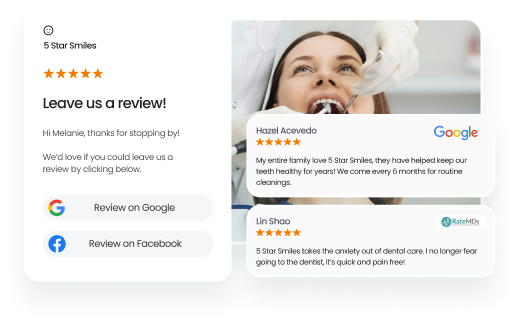
Most customers research dealerships online before visiting a showroom. They compare ratings, read recent customer experiences, and evaluate dealership reputations across Google and other automotive review platforms.
Different review platforms influence different parts of the dealership buying journey. Some help customers quickly compare local dealerships, while others provide more detailed insights into financing, service, vehicle quality, inventory, and customer experience.
The most trusted automotive dealer review platforms include:
- Google reviews
- DealerRater
- Cars.com
- Edmunds
- CarGurus
- CARFAX
For dealership groups managing multiple rooftops, maintaining a consistent reputation across platforms becomes increasingly important. Customers often compare dealerships across several review sites before making a purchase decision.
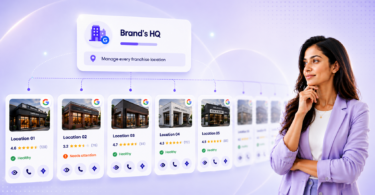
This is why many brands use an automotive reputation management platform like Birdeye to monitor reviews, respond faster, maintain listing consistency, and manage their dealership reputation across locations from a single dashboard.
Why do Google reviews matter for car dealerships?
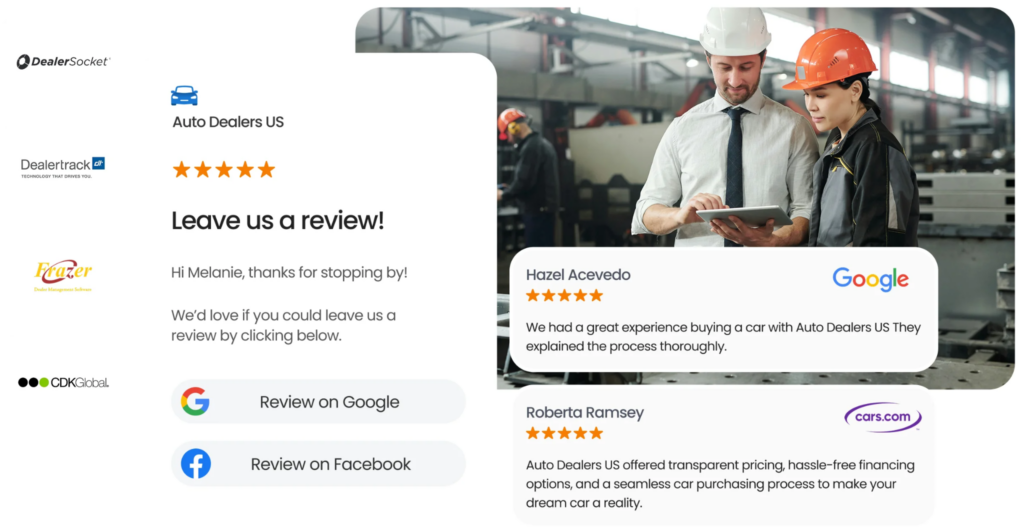
Google reviews directly influence how dealerships appear in Google Search, Google Maps, and local dealership searches. When customers search for nearby dealerships or compare brands, Google often surfaces ratings and review snippets before users visit a dealership website.
Birdeye’s State of Google Business Profile 2026 found that 86% of Google Business Profile impressions now come from non-branded discovery searches rather than searches for a specific business name.
For dealerships, Google reviews affect:
- Local search visibility
- Google Maps rankings
- Click-through rates
- Lead generation
- Showroom traffic
- Customer conversion rates
Google reviews also influence discovery-based searches, such as:
- “best Toyota dealership near me”
- “top-rated used car dealership”
- “Honda dealer with good reviews”
In these searches, review quality and response activity can strongly influence which dealerships customers contact first.
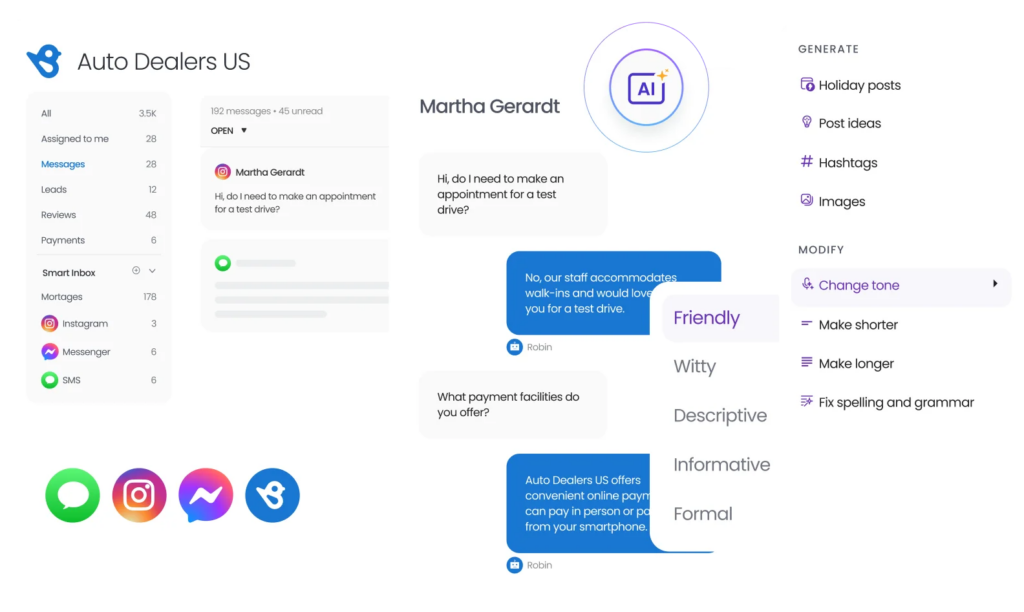
For multi-location dealership groups, maintaining review consistency across locations is critical. Weak review engagement at a few locations can reduce local visibility and create inconsistent customer experiences across the brand.
An agentic marketing platform like Birdeye helps dealership groups centralize Google review monitoring, automate review requests, and manage responses across locations on a single platform. This helps teams maintain stronger dealership reputation signals while improving operational consistency across stores.
What do customers mention most in car dealership reviews?
Customers use dealership reviews to describe specific parts of the buying and ownership experience. These reviews help future buyers understand what working with a dealership actually feels like beyond pricing or inventory listings.
The most common themes in automotive dealer reviews include:
- Inventory availability and vehicle selection
- Pricing and negotiations
- Financing and trade-in experience
- Time spent at the dealership
- Customer service and communication
- Recommendations and repeat business
Let’s dive a bit deeper into some examples of auto buying reviews.
1. Inventory availability and vehicle selection
Many customers mention whether the dealership had the exact make, model, trim, or vehicle condition they were looking for. Reviews often highlight how accurately online inventory matched what was available on-site.
Positive inventory-related reviews help dealerships build trust before customers visit the showroom.
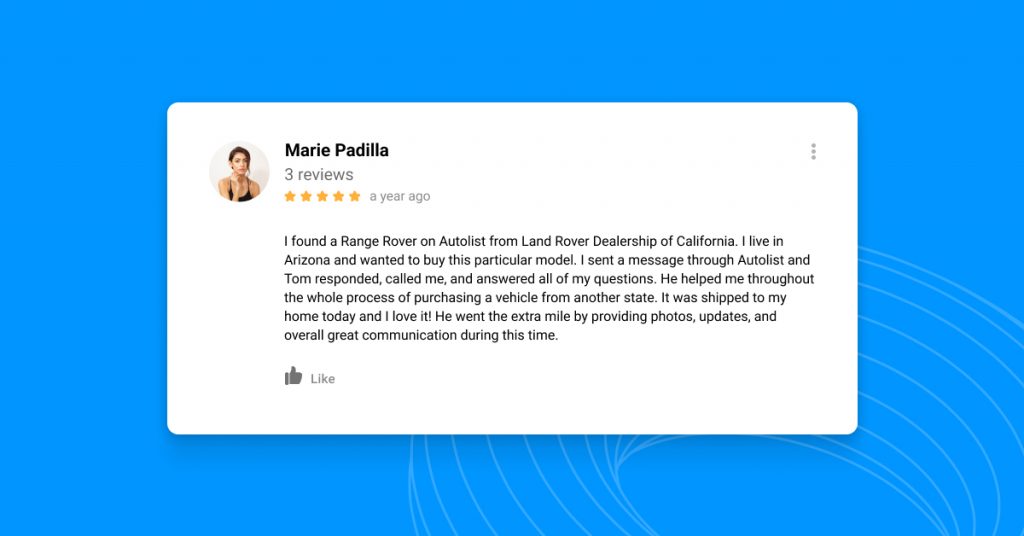
2. Pricing and negotiations
Customers frequently describe whether the pricing process felt transparent and straightforward or overly aggressive and time-consuming.
Reviews that mention fair pricing, clear financing explanations, and low-pressure negotiations often influence future buyers more than promotional messaging.
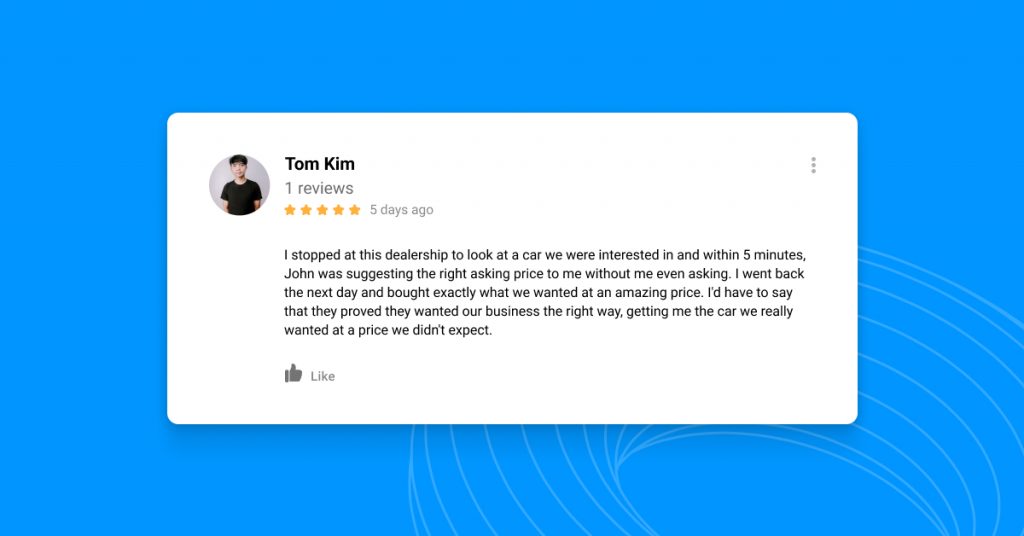
3. Financing and trade-in experience
Financing remains one of the most discussed parts of the dealership experience. Customers often review how clearly financing options, monthly payments, warranties, and trade-in values were explained during the purchase process.
Smooth financing and fair trade-in experiences can significantly improve customer satisfaction and review sentiment.
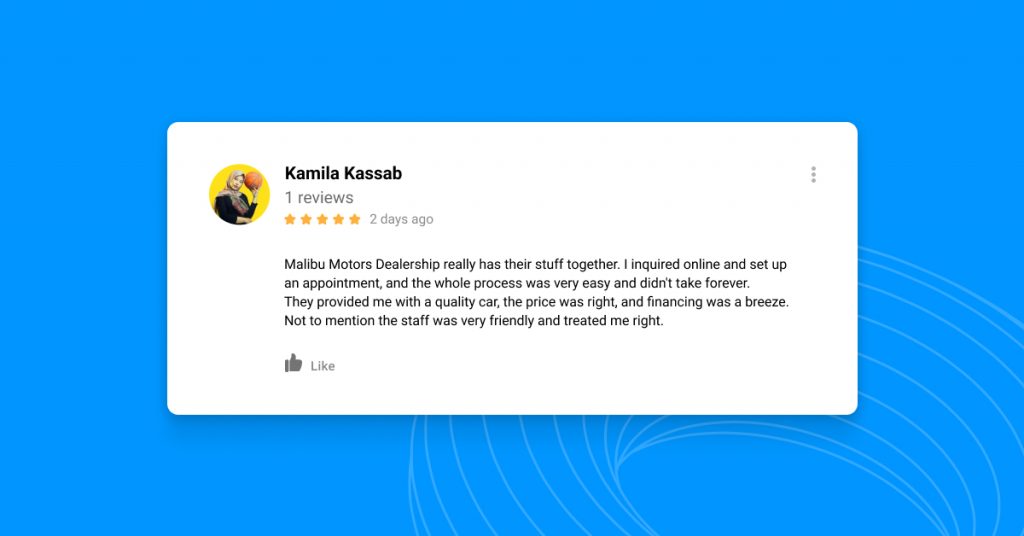
4. Time spent at the dealership
Long wait times remain one of the most common frustrations in dealership reviews. Buyers often mention how quickly paperwork, financing, trade-ins, and delivery processes were completed.
Efficient dealership operations can directly influence review quality and customer satisfaction.
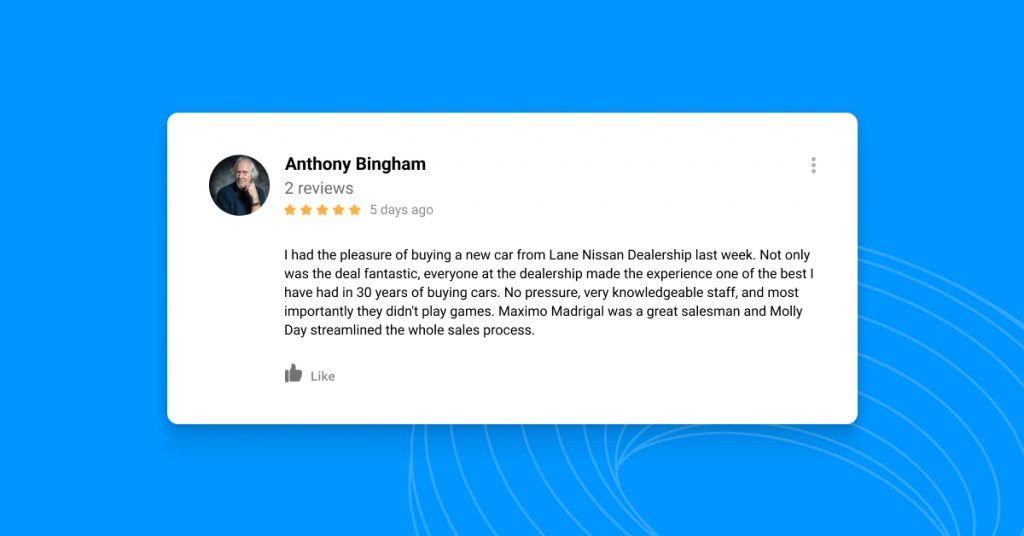
5. Customer service and communication
Customers regularly describe how sales teams, finance managers, and service advisors treated them throughout the process.
Reviews often highlight:
- Responsiveness
- Professionalism
- Communication quality
- Follow-up support
- Problem resolution
These customers’ expectations strongly influence dealership reputation across review platforms.
6. Recommendations and repeat business
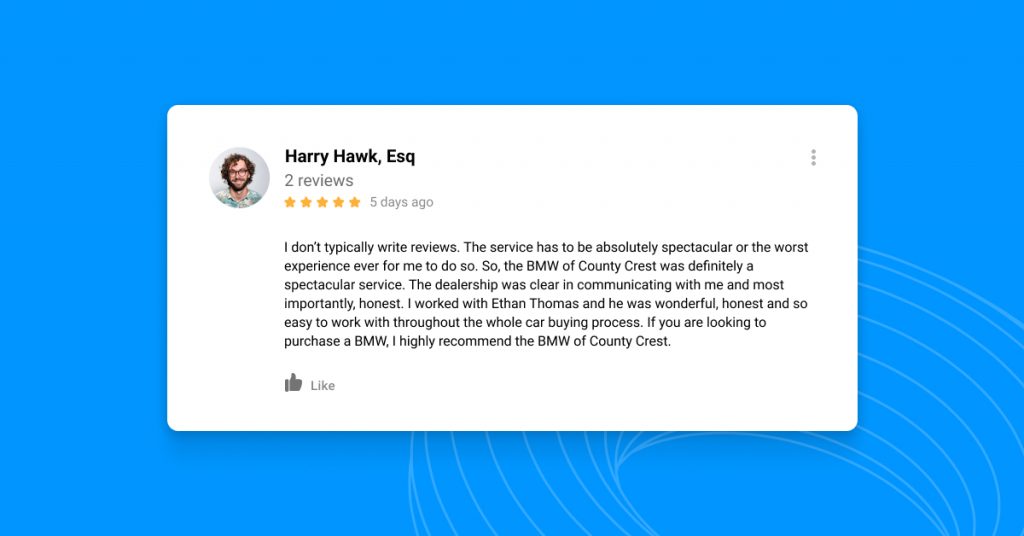
Many customers end reviews by stating whether they would recommend the dealership to others or return for future purchases and service visits.
Positive recommendations help dealerships strengthen customer trust, improve referral activity, and reinforce long-term reputation across automotive review platforms.
Why should car dealerships respond to reviews?
Responding to reviews shows customers that the dealership actively listens to feedback and values customer experience. It also gives dealerships an opportunity to address concerns, reinforce positive experiences, and improve public perception across review platforms.
Ignoring reviews can create the impression that customer feedback is not being monitored or prioritized.
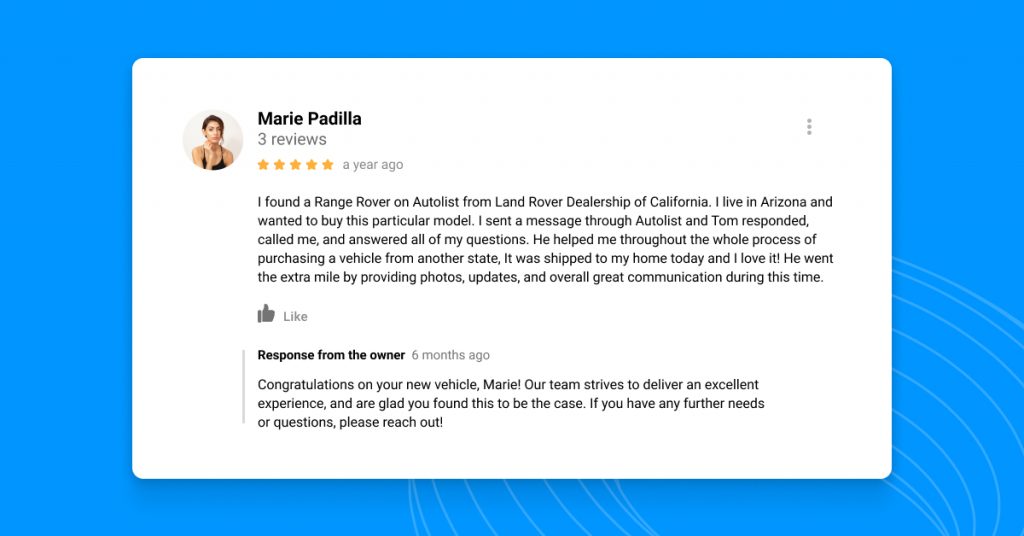
Dealerships should actively respond to positive reviews, negative feedback, service department complaints, financing concerns, and post-purchase communication issues. Consistent engagement helps demonstrate accountability and improves trust throughout the customer journey.
Strong review responses are typically:
- Personalized
- Timely
- Professional
- Solution-oriented
- Consistent across locations
For negative customer reviews, the goal should not be to argue publicly. Instead, dealerships should acknowledge the issue, provide a clear next step, and move sensitive conversations offline when necessary.

For positive reviews, thoughtful responses help reinforce customer relationships and encourage repeat business.
Review engagement can also support dealership visibility across local search platforms and AI-generated business summaries, where customer sentiment and responsiveness increasingly influence how businesses are presented online.
For multi-location dealership groups, maintaining consistent response quality across hundreds of reviews and multiple rooftops can quickly become operationally difficult. Many dealership groups now use centralized reputation management platforms to standardize review workflows, monitor customer sentiment, maintain response consistency, and improve visibility across search and AI-driven search experiences.
How is AI search changing dealership reputation management?
AI search visibility for automotive dealerships is changing because instead of browsing multiple websites, buyers increasingly rely on summarized answers that combine reviews, ratings, listings, and customer sentiment into a single recommendation.
When customers search for:
- “best Ford dealership near me”
- “top-rated Toyota service center”
- “trusted used car dealer”
AI-generated search experiences may summarize dealerships using publicly available reputation signals across Google, automotive review platforms, listings, and social channels. This makes reputation management for car dealerships more important than traditional rankings alone.
According to Birdeye’s State of AI Search 2026, while 80% of brands appear at least once in AI-generated search results, only 15% secure the top cited position.
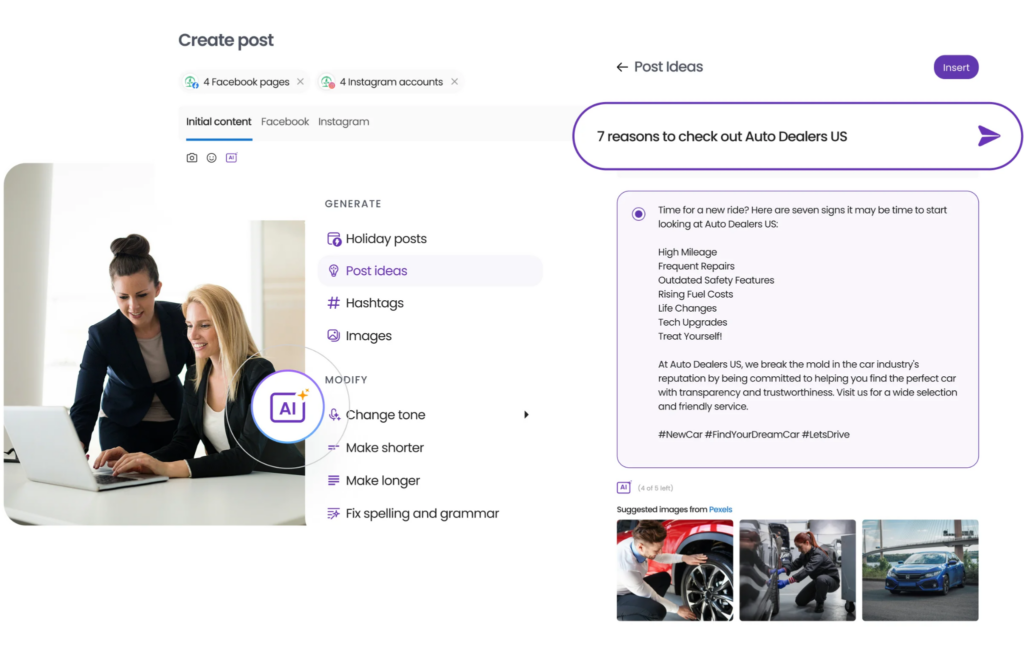
AI search visibility is increasingly influenced by:
- Review recency
- Review quality
- Response consistency
- Listing accuracy
- Customer sentiment
- Reputation consistency across locations
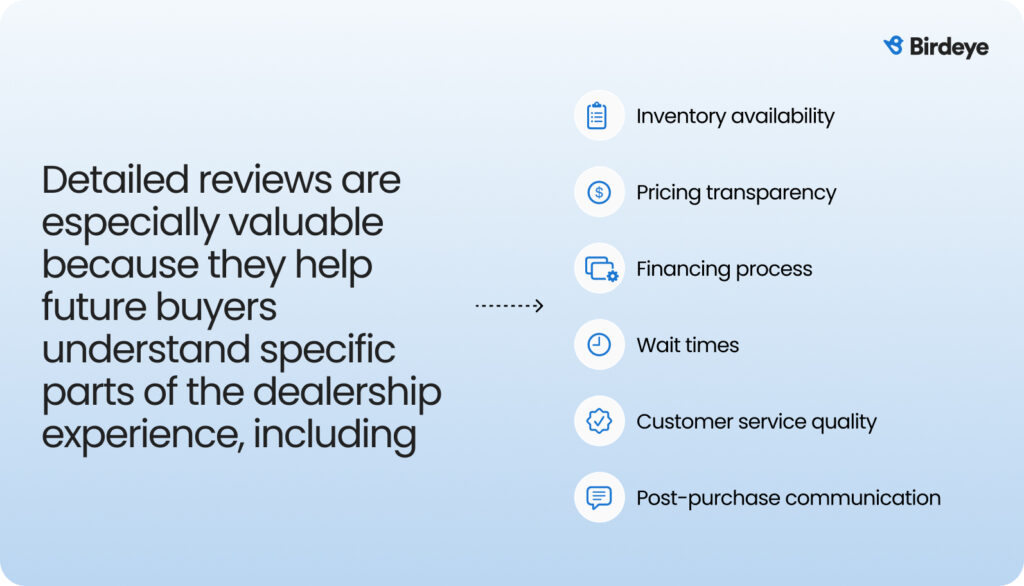
Detailed customer reviews are especially valuable because they help AI search engines better understand dealership experiences related to pricing, service quality, communication, financing, and inventory.
For dealership groups, inconsistent reviews or outdated listings across locations can create conflicting signals that affect both search visibility and customer trust across AI-generated recommendations.
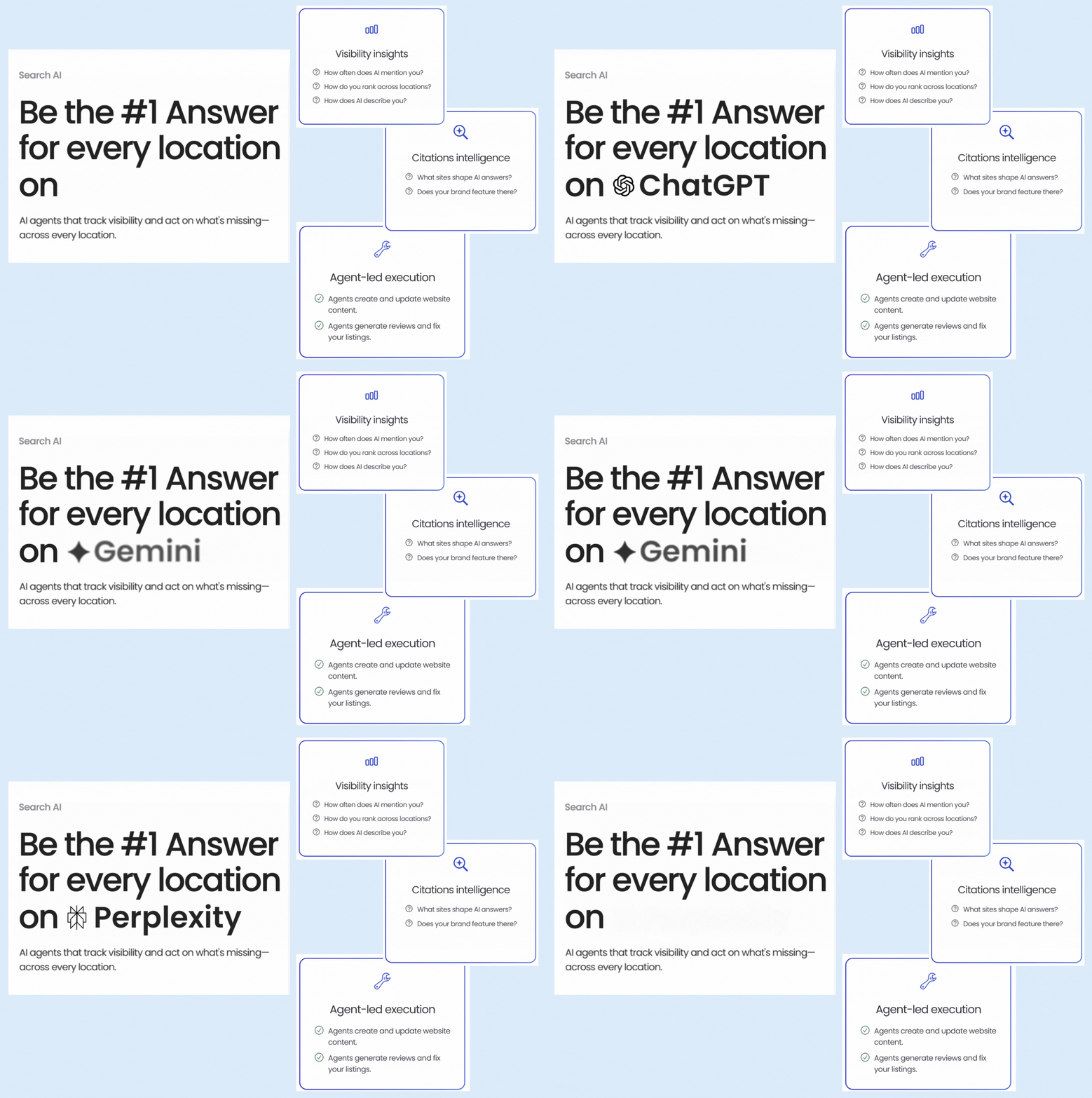
As AI search becomes more influential in dealership discovery, many automotive groups are also seeking better ways to track how their locations appear in AI-generated search experiences. Tools like Birdeye Search AI help dealerships monitor AI search visibility, identify reputation gaps across locations, and understand how customer reviews, listings, and sentiment influence dealership recommendations across modern search engines and AI assistants.
What should dealerships look for in a review management platform?
Managing dealership reviews across Google, car review sites, service departments, and multiple rooftops can quickly become difficult without centralized workflows.
A strong automotive review management platform should help dealerships:
- Monitor reviews across platforms
- Respond faster to customer feedback
- Maintain consistent responses across locations
- Track dealership reputation trends
- Manage car dealerships’ Google Business Profiles at scale
- Improve operational visibility across stores
For multi-location dealership groups, scalability is especially important. Different rooftops, departments, and regional teams often manage reviews differently, leading to inconsistent customer experiences and fragmented reporting.
Dealerships should look for platforms that support:
- Centralized dashboards
- Role-based permissions
- Multi-location reporting
- Automated review requests
- Agentic response workflows
- Listings management
- Sentiment tracking
- CRM and DMS integrations
Automotive integrations also matter. Many dealership groups rely on systems like:
- Reynolds & Reynolds
- CDK
- DealerSocket
- VinSolutions

Platforms that integrate directly with dealership workflows can reduce manual work and improve response speed across sales and service operations.
As dealership reputation management becomes more operationally complex, many automotive groups are also moving toward agentic marketing platforms like Birdeye that integrate reviews, listings, messaging, social engagement, and AI search visibility into a single centralized workflow.
How does Birdeye help car dealers manage reviews at scale?
Birdeye is the #1 Agentic Marketing Platform for multi-location brands. For dealership groups, it replaces fragmented point tools with a full-cycle platform that unifies customer data and deploys AI agents to drive real business outcomes.
While legacy software just shows you data, Birdeye’s agentic approach follows a three-step process to ensure your dealerships win locally:
- Consolidate: We stitch together signals from your CRM, DMS (like Reynolds & Reynolds or CDK), and every review site into a unified customer profile.
- Think: Our local intelligence understands the nuance of every rooftop, knowing which location has a 5-star service department and which one needs more lead volume.
- Act: AI agents trained on your brand voice autonomously handle the heavy lifting.
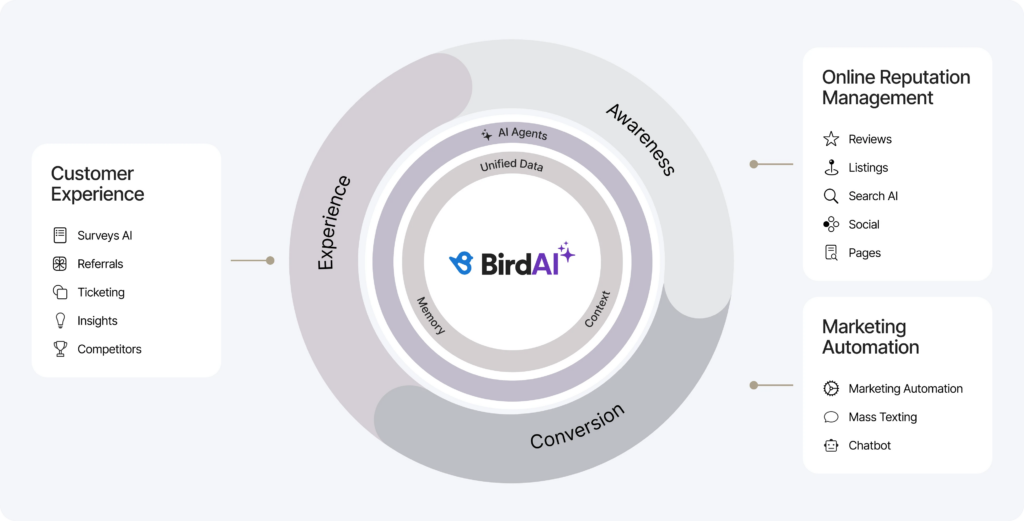
Birdeye’s AI agents help streamline dealership reputation management workflows:
- Review Generation Agent helps dealerships send automated review requests after purchases and service visits.
- Listings Optimization Agent helps maintain accurate dealership information across 100+ directories and search platforms.
- Messaging AI helps teams manage customer conversations across SMS, webchat, Google, and social channels from one inbox.
- Social AI helps dealership groups manage localized social engagement and customer interactions across locations.
- Search AI helps brands monitor AI search visibility and understand how dealerships appear across AI-generated search experiences.
Why leading auto brands choose Birdeye?
Trusted by global enterprise brands such as BMW, CarZone USA, Sherwood Auto Repair, and DriveTime Birdeye is purpose-built for the complexity of multi-location operations and helps dealerships:
- Generate more customer reviews automatically
- Monitor reviews across 200+ review sites
- Respond faster across 100-10,000+ locations
- Maintain listing accuracy
- Track dealership sentiment trends
- Improve visibility across search and AI-driven search experiences
FAQs about car dealership reviews and ratings
Car dealership reviews help customers evaluate trust, customer service quality, pricing transparency, and the overall buying experience before visiting a dealership. Reviews also influence local search visibility and dealership discovery across Google and automotive review platforms.
Google Reviews remains the most visible review source for dealerships because reviews appear directly in Google Search and Google Maps. Automotive platforms like DealerRater, Cars.com, Edmunds, CarGurus, and CARFAX also influence customer research and dealership comparisons.
Google reviews influence local search rankings, Google Maps visibility, click-through rates, and customer trust. Detailed and recent reviews can also improve dealership visibility across AI-generated search experiences.
Yes. Responding professionally to negative reviews shows customers that the dealership takes feedback seriously and actively works to resolve concerns. Timely responses can also help strengthen customer trust and dealership reputation.
Dealerships typically generate more reviews by requesting feedback immediately after sales or service experiences through SMS, email, or automated workflows. Consistent review requests usually improve review volume over time.
Birdeye helps dealerships strengthen reviews and visibility
Car dealership reviews now influence far more than customer feedback. They shape dealership discovery, Google visibility, customer trust, and the way dealerships appear in AI-driven search experiences.
For multi-location automotive groups, maintaining a strong reputation signals across every rooftop requires consistent review generation, faster response workflows, accurate listings, and centralized operational visibility. As search behavior continues shifting toward AI-generated recommendations and discovery-based searches, dealerships that actively manage reputation signals across platforms will be better positioned to strengthen visibility, customer trust, and long-term growth.
Birdeye’s agentic marketing platform helps dealerships manage reviews, listings, messaging, social engagement, and AI search visibility from one centralized system.

About the Author

Shruti Dugar
Birdeye
Originally published