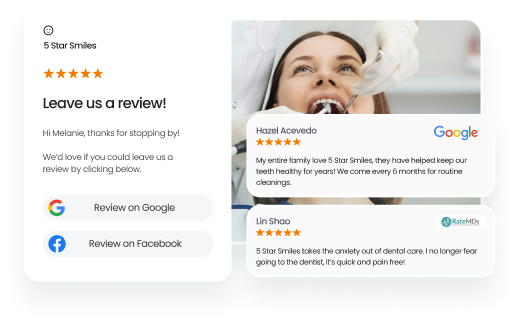
SEO reputation management determines how your brand ranks, appears, and is trusted across search and AI platforms. Most brands treat SEO and reputation as separate problems, but search engines don’t. They use the same signals, reviews, listings, and brand mentions to decide who gets seen and who gets skipped.
Summary
Search visibility now depends on how consistently your reputation signals hold up across every location. Reviews, listings, and brand mentions don’t just influence rankings; they shape how search engines and AI engines interpret and present your brand.
This guide breaks down seven practical strategies to strengthen those signals, close gaps across locations, and turn everyday customer interactions into sustained visibility.
Table of contents
- What is SEO reputation management?
- Why SEO reputation management matters for your business?
- How SEO and online reputation management work together?
- What are the 7 SEO reputation management strategies that work?
- What are the five review signals that drive AI search visibility in SEO reputation management?
- How Birdeye helps multi-location brands manage SEO reputation at scale
- FAQs on SEO reputation management
- Supercharge your SEO reputation management with Birdeye
What is SEO reputation management?
SEO reputation management is the practice of shaping how your brand appears in search by improving the signals search engines rely on: reviews, listings, and brand mentions.
At a surface level, this sounds similar to SEO. But the difference is control. Traditional SEO focuses on your website. SEO reputation management focuses on everything that appears when someone searches for your brand.
That includes:
- Your Google Business Profiles across locations
- Reviews on Google and third-party platforms
- Directory listings and aggregators
- News mentions, social profiles, and citations
Search engines don’t treat these as separate systems. They connect them to answer one core question: Can this brand be trusted in this location for this service?
This question is becoming more data-driven each year, according to Birdeye’s State of Online Reviews 2025: online review volume grew by 13% year-over-year, increasing the weight of customer feedback in how search engines evaluate trust and relevance.

This is where most brands lose ground. They optimize their website but ignore inconsistent listings. Or they invest in content but leave reviews unmanaged. The result is fragmented signals. Search engines see uncertainty, and rankings suffer.
Now layer in AI search. AI engines like Google’s AI Overviews and ChatGPT don’t just pull data from your website. They synthesize your reputation across sources, including structured business data, reviews, and listings.
For example, based on Birdeye’s State of Google Business Profile 2025, Google’s AI-driven search experiences now rely on structured business data, including hours, services, and reviews, directly from Google Business Profiles, making data accuracy a prerequisite for visibility.
So SEO reputation management becomes a control system. It ensures you:
- Data is accurate everywhere
- Reviews reflect real customer experience
- Brand narrative stays consistent across platforms
When these signals align, search engines and AI search engines interpret your brand with confidence. That confidence translates into better rankings, stronger visibility, and higher conversion.
Maximize Credibility with Proven SEO Reputation Management Strategies
Want to see the impact of Birdeye on your business? Watch the Free Demo Now.
Why SEO reputation management matters for your business?
SEO reputation management matters because ranking high doesn’t guarantee results anymore. Customers don’t choose the first result. They choose the most credible one based on reviews, consistency, and what shows up around your name.
What’s changed is how quickly that judgment happens and what it’s based on.
Search no longer presents your brand as a single link. It presents a cluster of signal ratings, recent reviews, listings, photos, and now AI summaries. Customers scan that cluster and decide within seconds if you’re worth considering.
That shift creates three pressures:
1. Trust is front-loaded
Customers don’t dig deep. They scan. If your ratings are low, reviews are outdated, or listings look inconsistent, trust drops instantly. You don’t get a second chance because most users never go beyond what’s visible upfront.
2. Visibility is compressed
Attention is limited to a few options. In local search, that’s the map pack. In AI search, it may be a single summarized answer. If your reputation signals aren’t strong enough to compete in that narrow space, you’re excluded early.
3. Perception is now automated
AI search engines interpret your brand before the customer does. They pull from reviews, listings, and third-party content to summarize what you’re known for. If those signals are inconsistent or weak, the summary works against you, and you lose control of the narrative.

Once you see search this way, the impact becomes obvious.
- Strong, consistent signals reinforce each other. You rank higher, look credible at a glance, and convert more of the traffic you earn.
- Weak or fragmented signals do the opposite. You either don’t show up, or you show up and get skipped.
For multi-location brands, this compounds. One poorly managed location introduces doubt into the system. Enough inconsistency, and the brand starts to look unreliable overall.
SEO reputation management solves this by bringing those signals under control. It aligns what search engines see with what customers should experience, so when someone searches your brand, the impression is clear, consistent, and strong enough to win the click.
How SEO and online reputation management work together?
SEO and online reputation management are often treated as separate functions. One drives traffic. The other manages perception.
In reality, they operate on the same inputs.
Search engines use shared signals to decide:
- Who ranks
- Who gets featured
- Who gets ignored
Let’s break that down.
Reviews
They influence local rankings, but also click-through rates. A high rating with strong recent reviews increases both visibility and conversion. A low rating does the opposite.
Listings
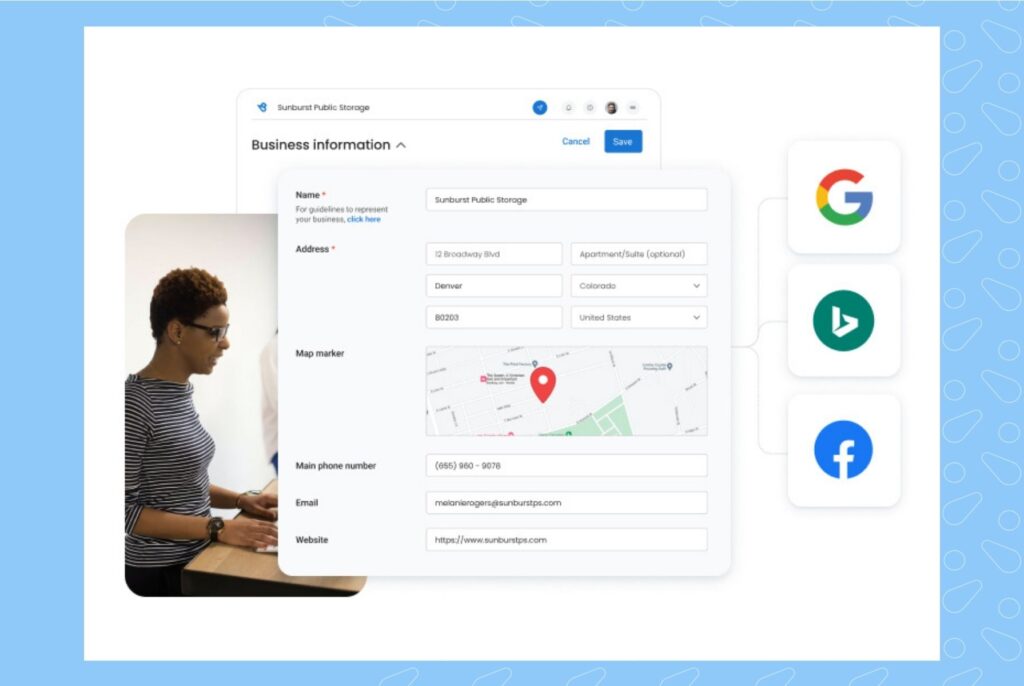
Accurate, consistent listings help search engines trust your data. If your business name, address, or hours vary across platforms, it creates doubt. That doubt impacts rankings.
Brand mentions and citations
When your brand is mentioned consistently across trusted sources, it builds authority. When mentions are sparse or inconsistent, your credibility weakens.
Traditional local SEO focuses heavily on your website: keywords, content, and backlinks. That still matters. But without strong reputation signals, your website alone can’t carry performance.
On the flip side, reputation management without SEO, limits reach. You may have great reviews, but if your site isn’t optimized, you won’t show up in search results.
The real leverage comes from alignment.
When SEO and reputation management work together:
- Your content reinforces what the reviews are saying
- Your listings support your rankings
- Your brand appears consistent across every touchpoint
This creates a feedback loop. Better signals improve rankings. Better rankings drive more traffic. More traffic generates more reviews. And the cycle continues.
Break that loop, and performance stalls. Strengthen it, and growth compounds.
What are the 7 SEO reputation management strategies that work?
These strategies are not standalone tactics. They operate as a system. Each one strengthens a different signal, but the impact comes from how they reinforce each other.
1. Optimize your Google Business Profile
Your Google Business Profile is often the first and most influential touchpoint. It feeds directly into local rankings, map visibility, and customer perception.
You need to:
- Keep business information accurate across all locations
- Update hours, services, and attributes regularly
- Add fresh, high-quality photos
- Use descriptions that reflect real search behavior
Many brands treat this as a checklist. That’s a mistake. Search engines look for activity and consistency over time. For multi-location brands, the challenge is scale. Each location must be accurate, but also aligned with brand standards. Without centralized control, inconsistencies creep in.
The payoff is significant. A well-managed profile improves:
- Visibility in the local pack
- Click-through rates
- Customer trust before the first interaction
2. Generate and respond to customer reviews
Reviews are one of the strongest reputation signals. But volume alone isn’t enough. What matters is consistency, recency, and engagement.
Most customers won’t leave a positive review unless prompted. And when they do, negative experiences are more likely to surface. That creates bias unless you actively manage it.
Effective review management includes:
- Asking for reviews at the right moment
- Making the process simple and fast
- Responding to every review, positive or negative
Responses matter more than most brands realize. They signal that your brand is active and accountable. They also influence how future customers interpret feedback.
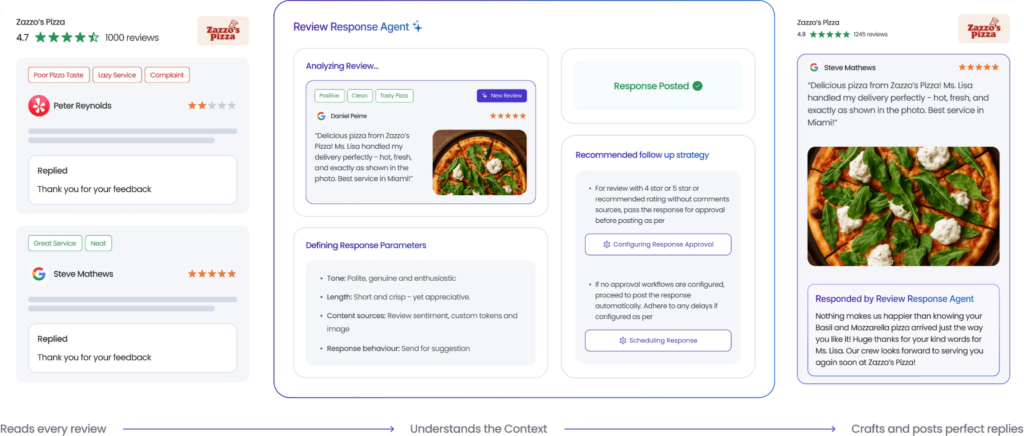
At scale, this becomes operational. You need:
- Defined response timelines
- Clear tone guidelines
- Visibility into trends across locations
When done right, reviews do more than build trust. They:
- Improve local rankings
- Provide insight into customer experience
- Influence how AI search engines interpret your brand
3. Build a strong content presence across search
Your website remains your most controlled asset. But it only works if it reflects real-world signals.
Generic content doesn’t help. It creates a disconnect. Instead, focus on:
- Location-specific pages with unique content
- Clear service descriptions aligned with customer language
- Structured data that helps search engines interpret your content
- Internal links that connect related topics and locations
The goal is alignment. What your website says should match what your reviews and listings reinforce.
Content also plays a role in AI visibility. AI search engines look for clear, structured, and consistent information. If your content is vague or inconsistent, it’s less likely to be used.
For multi-location brands, this requires discipline. You can’t duplicate pages across locations. Each one needs relevance and context.

4. Claim and optimize social and directory profiles
Your brand doesn’t exist in one place. It exists across dozens of platforms.
Search engines pull data from:
- Social profiles
- Industry directories
- Aggregators
If your information varies across these sources, it creates conflicting signals.
Consistency is critical:
- Same name, address, and phone number everywhere
- Updated business descriptions
- Active profiles with recent content
Many brands ignore this layer because it feels secondary. But for search engines, it’s validation. Consistent data across multiple sources increases trust.
For multi-location brands, the complexity increases. Each location must be accurate across every platform. Manual management doesn’t scale.
5. Use local SEO to strengthen reputation in every market
Reputation is not built at the brand level alone. It’s built at the location level.
Each market has:
- Different competition
- Different customer expectations
- Different search behavior
That means each location needs its own marketing strategy.
Key focus areas:
- Local keywords in content and listings
- Location-specific reviews
- Community relevance through content and mentions
Many brands try to centralize everything. That creates generic experiences. Customers notice.
The better approach is controlled localization. Maintain brand standards, but allow location-level relevance.
6. Monitor brand mentions and SERP signals
Reputation is dynamic. It changes constantly.
New reviews, social mentions, and content updates can shift how your brand appears in search within days.
Without monitoring, you’re reacting late.
You need visibility into:
- Review trends across platforms
- Changes in ratings and sentiment
- New mentions or negative signals
- Shifts in search result composition
This isn’t just about damage control. It’s about opportunity.
If a location sees a spike in positive reviews, you can amplify it. If negative sentiment appears, you can address it before it spreads.
For multi-location brands, this requires centralized reporting with location-level insights.
When monitoring is in place:
- You catch issues early
- You act faster than your competitors
- You maintain consistent performance
7. Optimize for AI search and generative overviews
This is the shift redefining SEO reputation management. AI search engines don’t rank results the same way traditional search does. They summarize. They recommend. They filter.
Generative Engine Optimization (GEO) sits at the center of this change. It focuses on shaping how AI systems construct a narrative about your brand by pulling from multiple signals across the web. That means your visibility now depends on consistency and clarity across every touchpoint.
To optimize for this:
- Ensure reviews are detailed, specific, and reflect real customer experiences
- Maintain accurate, consistent business information across all platforms
- Provide clear, structured content, and intent-driven content on your website
- Align messaging across locations, listings, and content
AI search engines look for patterns. They prioritize brands with:
- Consistent sentiment across reviews
- Reliable business data
- Clear positioning and expertise
If your signals are aligned, AI represents your brand accurately and confidently. If they’re fragmented, two things happen:
- Your visibility drops in generative results
- Or worse, your brand is misrepresented
This is where most multi-location brands are unprepared. They’re still optimizing for rankings, not interpretation.
The shift is simple: You’re no longer just competing for position. You’re competing for how your brand is described.

What are the five review signals that drive AI search visibility in SEO reputation management?
AI engines don’t read reviews the way humans do. They analyze patterns across them to decide which brands are credible enough to rank, be summarized, and be recommended.
In SEO reputation management, these review signals directly influence:
- Local rankings
- Click-through rates
- How AI describes your brand
Here are the five signals that matter most:
| Signal | What does it mean in SEO reputation management | What good looks like | Why it matters for rankings and AI search |
| Volume | Total review coverage across all locations | Consistent weekly review flow across locations | Higher volume strengthens ranking signals and gives AI enough data to confidently surface your brand |
| Recency | Freshness of customer feedback | Reviews within the last 7–30 days for each location | Search engines and AI prioritize active, up-to-date brands over stagnant ones |
| Content specificity | Keywords and context within reviews | Mentions of services, locations, and real experiences | Reinforces SEO relevance and helps AI understand what your brand should rank for |
| Response rate | Brand engagement with customer feedback | 90%+ responses with fast turnaround | Signals trust, improves local rankings, and shows AI that your brand is actively managed |
| Rating stability | Consistency of ratings over time and across locations | Stable ratings with minimal fluctuations | Reduces uncertainty, making your brand more reliable for both search rankings and AI recommendations |
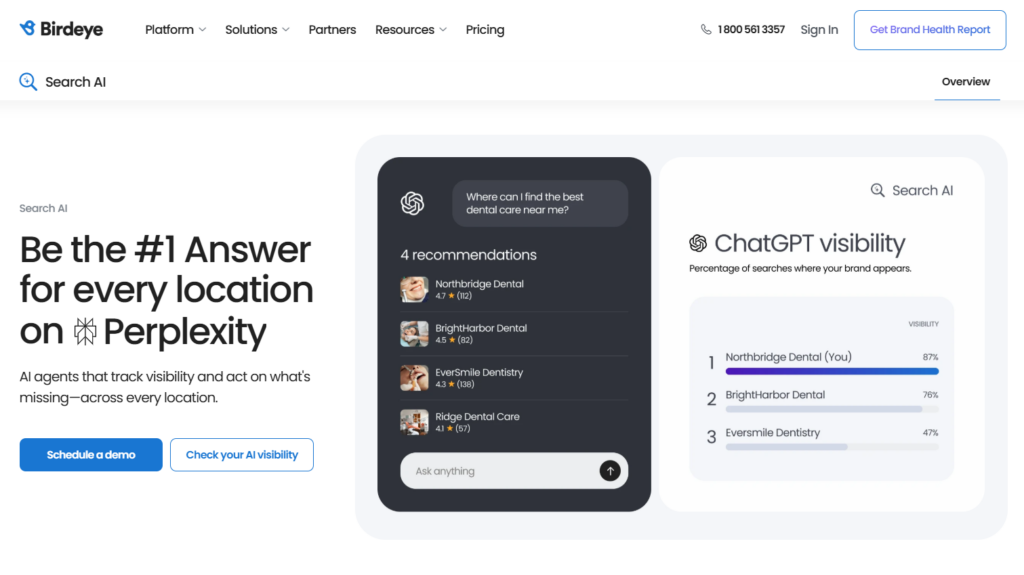
Birdeye Search AI helps multi-location brands understand how they appear in AI-generated answers by analyzing reviews, listing accuracy, and brand sentiment across the web. This ensures customers see accurate, trustworthy information when AI tools recommend businesses, not outdated or incomplete details.
How Birdeye helps multi-location brands manage SEO reputation at scale
Managing a reputation across 100-10,000+ locations isn’t just an SEO task, it’s an operational one. Birdeye is the #1 Agentic Marketing Platform for multi-location brands, purpose-built to handle the complexity of local search and AI discovery at scale.
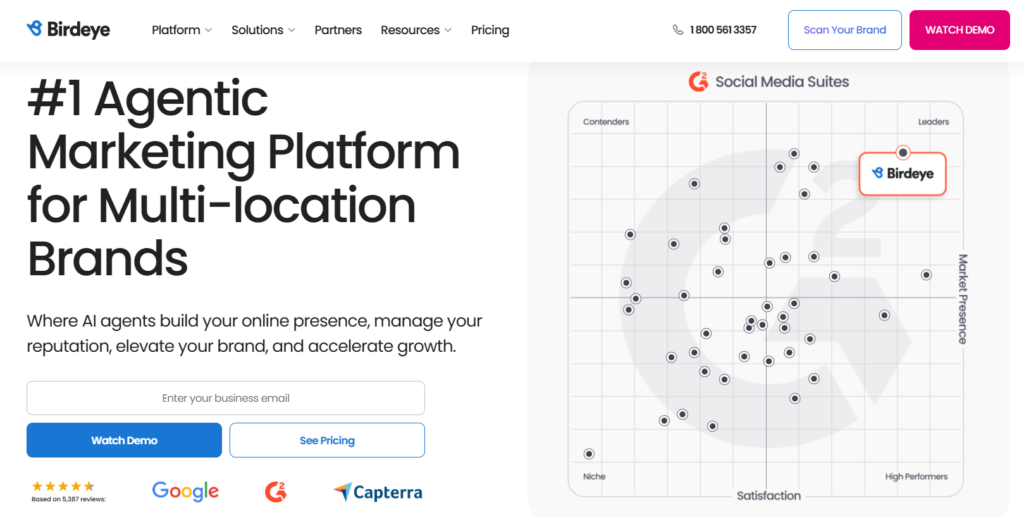
While traditional tools provide data, Birdeye deploys AI agents that autonomously execute the work required to protect your brand and improve your rankings.
The Birdeye Agentic AI advantage
Birdeye’s agentic approach follows a unique “Consolidate, Think, Act” framework:
- Consolidate: We unify customer and location data from 3,000+ integrations into a single CDP.
- Think: Our AI uses local intelligence to understand sentiment, intent, and context for every specific location.
- Act: AI agents, trained on your brand voice, handle the execution across the entire marketing flywheel.
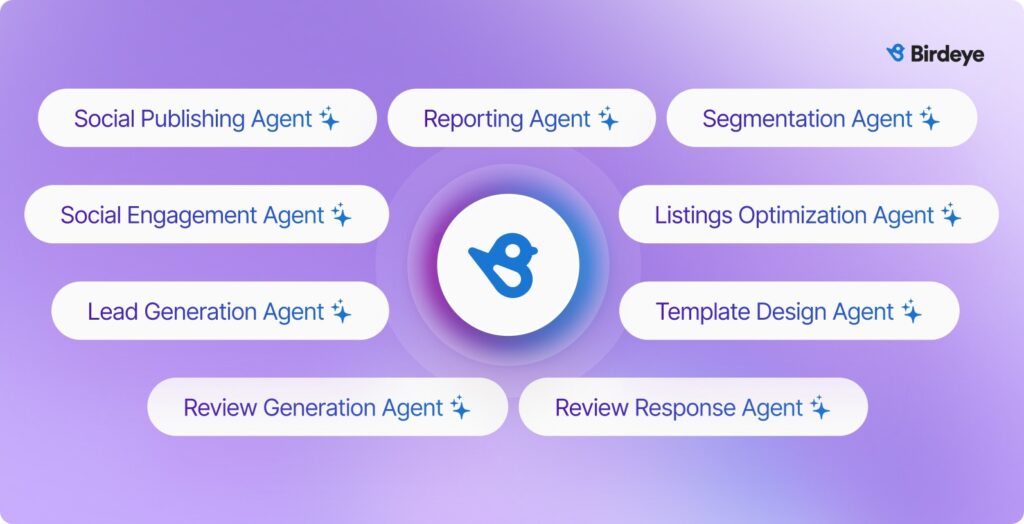
| AI Agent | Role: What it does | Outcome: Why it matters |
| Listings Optimization Agent | Continuously monitors and syncs your business data across 200+ search engines and directories. | Foundation of Trust: Eliminates fragmented signals so search engines (and AI) confidently rank your brand. |
| Review Generation Agent | Autonomously identifies the “best moment” to request feedback based on customer engagement history. | Freshness at Scale: Ensures a steady flow of recent, high-volume reviews to dominate local search results. |
| Review Response Agent | Drafts empathetic, brand-aligned responses to every review using local sentiment analysis. | Accountability: Signals to search algorithms that your brand is active, improving conversion and local rankings. |
| Search Optimization Agent | Analyzes how AI search engines (like ChatGPT/SGE) interpret your brand across the web. | GEO Performance: Identifies and closes reputation gaps to ensure your brand is the “recommended” answer. |
| Social Publishing Agent | Orchestrates localized content and responses across all location-specific social profiles. | Brand Narrative: Maintains a consistent, active presence that reinforces your authority in every market. |
| Reporting Agent | Deep-dives into sentiment trends and performance across hundreds or thousands of locations. | Actionable Intelligence: Turns raw feedback into clear, prioritized growth strategies for the entire brand. |
FAQs on SEO reputation management
You can’t remove negative reviews with SEO or any other method. You can make negative reviews less relevant by increasing positive reviews. An SEO reputation management strategy can help.
The best practices for SEO content in reputation management increase the profile of positive content. It also seeks to bury negative content. Ways to do this include optimizing your site and pages you have control over.
Any new SEO strategy will take three months to a year to work. That’s why you must work on your SEO reputation management strategy now. Don’t wait until negative content or news damages your reputation.
Search engines use reviews, listings, and sentiment as “trust signals.” High ratings and consistent data across locations prove your brand is reliable, directly boosting your visibility in local map packs and organic search results.
You cannot “delete” honest reviews, but you can suppress their impact. Birdeye helps you generate a high volume of positive feedback and use AI agents to respond professionally, shifting the narrative and improving your overall sentiment.
Absolutely. AI engines like ChatGPT and Google Gemini prioritize brands with clear, consistent reputation signals. Without active management, AI may misinterpret or omit your brand entirely from summarized search results.
Supercharge your SEO reputation management with Birdeye
In 2026, ranking isn’t enough; you must be the chosen answer. Birdeye is the only Agentic Marketing Platform that combines local intelligence with autonomous execution to protect your brand at scale.
By deploying AI agents that think locally and act globally, Birdeye ensures your signals are consistent, your reputation is bulletproof, and your locations are visible exactly where modern search decisions are made.
Don’t just manage your reputation; master the new search landscape with the #1 platform for multi-location brands.

About the Author

Shruti Dugar
Birdeye
Originally published

![[Feature image] Buy Google reviews UK- The truth behind quick fixes and smarter reputation solutions](https://birdeye.com/blog/wp-content/uploads/Feature-image-Buy-Google-reviews-UK-The-truth-behind-quick-fixes-and-smarter-reputation-solutions-375x195.jpg)