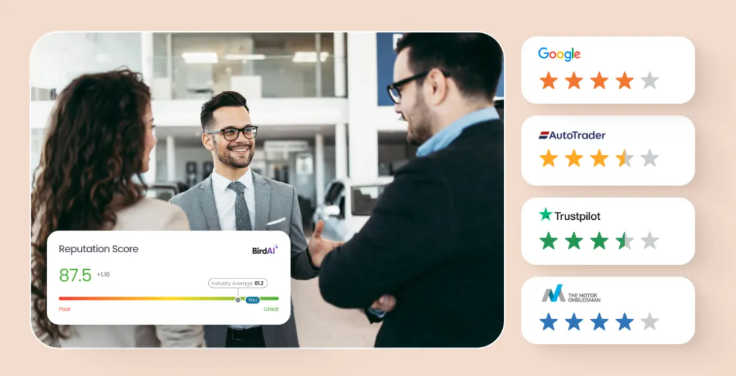
Reputation management for UK car dealers is the process of building and protecting customer trust across platforms such as AutoTrader, Google, Trustpilot, and Motor Ombudsman profiles. It includes generating authentic reviews, responding to feedback, managing dealership information, and appropriately handling sensitive complaints.
Summary
Car buyers often compare dealer ratings, recent reviews, complaint responses, and local profiles before sending an enquiry or visiting a showroom. As vehicle purchases involve significant financial commitment and can involve regulated motor finance, used-car rights, and formal dispute processes, UK dealerships need a more structured approach than simply replying to reviews as they appear.

Effective reputation management brings review generation, monitoring, response, escalation, and reporting into one process. It helps single-site dealers and multi-location groups strengthen local visibility, identify recurring customer issues, and maintain consistent standards across sales, service, finance, and aftersales.
This blog explains the platforms, regulations, workflows, response practices, AI capabilities, and reputation management options UK car dealers should consider in 2026.
Table of contents
- Summary
- Why is reputation management different for UK car dealers?
- Which UK rules affect car dealer reputation management?
- Where UK car buyers leave and read dealer reviews
- What are the four elements of car dealer reputation management?
- How should UK dealers respond to negative car dealer reviews?
- How can AI improve car dealer reputation management?
- Comparing UK car dealer reputation management software
- Frequently asked questions about car dealer reputation management
- How can Birdeye help UK car dealer groups manage reputation across locations
Why is reputation management different for UK car dealers?
Buying a car involves a significant financial commitment, so customers tend to research dealerships carefully before making contact. Ratings, recent Google reviews, and the way a dealer responds to complaints can influence whether a buyer sends an enquiry, books a test drive, or chooses another retailer.
That reputation is formed across several touchpoints. A customer may assess a vehicle and dealer on AutoTrader, check the local branch on Google, read group-level feedback on Trustpilot, and search for unresolved complaints before making a decision. For dealer groups, these signals can vary considerably between locations.
The customer journey also spans several departments. Feedback may relate to the sales experience, vehicle handover, finance, servicing, repairs, or aftersales support. A strong sales review does not offset repeated service complaints, and an unresolved issue at one branch can affect confidence in the wider group.
Some reviews require particular care. Concerns about motor finance, vehicle faults, refunds, online purchases, or misleading descriptions may involve formal complaint procedures, consumer rights, or regulated activity. These issues need to be identified and routed correctly rather than handled as routine public feedback.
For multi-location dealerships in the UK, effective reputation management therefore depends on consistency. Teams need a reliable way to request reviews, monitor feedback, respond appropriately, and identify recurring issues across branches and departments.
When done well, reputation management in the UK helps dealerships strengthen local visibility, improve the customer experience, and give prospective buyers greater confidence at the point of enquiry.
Which UK rules affect car dealer reputation management?
UK car dealers must manage reviews alongside the rules governing vehicle sales, motor finance, advertising, repairs, and consumer complaints. When feedback raises a regulated or legally sensitive issue, the dealership’s public response should remain consistent with its formal complaint process.
How do the Motor Ombudsman codes affect dealers?
The Motor Ombudsman operates several industry codes relevant to automotive businesses:
- Vehicle Sales Code
- Service and Repair Code
- New Car Code
- Vehicle Warranty Products Code
For dealers, the Vehicle Sales Code and Service and Repair Code are usually the most directly relevant. They cover the vehicle purchase process and the work carried out by participating service and repair businesses. The New Car Code primarily covers manufacturers’ obligations, while the Vehicle Warranty Products Code applies to participating warranty providers.
Customers of businesses accredited under the relevant code may be able to take an unresolved complaint to The Motor Ombudsman. Dealers should therefore keep public responses, customer records, and formal complaint communications consistent, particularly when reviews mention repeated faults, repairs, warranties, or vehicle rejection.
How does FCA Consumer Duty affect finance reviews?
Where a dealership carries out regulated activity, such as arranging motor finance as a credit broker, Consumer Duty requires it to focus on delivering good customer outcomes.
Reviews mentioning affordability, commission, disclosure, interest rates, or monthly payments should be referred to the dealership’s finance or compliance team. The public response should acknowledge the concern without debating the agreement, disclosing personal information, or reaching a conclusion before the complaint has been investigated.
An eligible unresolved motor finance complaint may be referred to the Financial Ombudsman Service. This is different from The Motor Ombudsman, which deals with eligible disputes involving vehicle sales, servicing, repairs, and warranty products.
Consumer protection in vehicle sales
Under the Consumer Rights Act 2015, vehicles sold by traders must be of satisfactory quality, fit for purpose, and as described. Dealers should therefore avoid dismissive responses such as “sold as seen” when a customer reports a fault or says a vehicle did not match its description.
Online and distance sales may also involve requirements concerning the information given before purchase, cancellation, and returns. Complaints involving these issues should be investigated before the dealership gives a detailed public response.
What rules apply to reviews and advertising claims?
The Digital Markets, Competition and Consumers Act 2024 introduced specific banned practices relating to fake and misleading consumer reviews. Dealers must not submit or commission fake reviews, publish incentivised reviews without making the incentive clear, distort the overall picture by suppressing genuine negative feedback, or selectively request reviews in a way that misleads consumers.
Review requests should be neutral and ask for honest feedback.
The ASA also requires testimonials used in advertising to be genuine and supported by evidence. Objective claims such as “the UK’s most trusted dealer” or “rated number one” must be current, accurate, and capable of substantiation. A rating earned by one location should not be used to support a wider group claim unless the evidence justifies it.
Key takeaway: Local teams may handle routine feedback, but complaints involving finance, vehicle rejection, safety, legal action, consumer rights, or formal dispute resolution should follow an approved escalation process.
Where UK car buyers leave and read dealer reviews
UK car buyers rarely rely on a single review source. They form an opinion by comparing dealership profiles, customer feedback, vehicle listings, and search results across several platforms.
AutoTrader
AutoTrader is closely connected to the vehicle-search journey. Buyers can assess stock, pricing, location, and dealer feedback before deciding whether to enquire.
For dealerships, this means reputation can influence conversion at the same moment a customer is comparing vehicles. Recent reviews, a credible rating, and clear dealer information can help reduce hesitation and support the next step in the buying journey.
Google Business Profile
Google Business Profile plays a major role in local discovery. Reviews can appear when buyers search for a dealership by name, look for a specific franchise nearby, or use queries such as “used car dealer near me”.
Each branch of a dealer group may have its own profile, rating, and review history. Maintaining accurate information and responding consistently at the location level is therefore important for both local visibility and buyer confidence.
Trustpilot
Trustpilot is more likely to influence broader brand perception, particularly for larger dealer groups. Buyers may encounter it when searching for a company name or researching the overall customer experience before contacting a branch.
Feedback on Trustpilot can also reveal group-wide patterns involving delivery, communication, finance, after-sales, or complaint handling.
Automotive marketplaces
Platforms such as Cazoo, heycar, and Carwow can shape expectations during the research and comparison process, depending on where a dealer lists vehicles or receives enquiries.
Dealers should ensure that vehicle information, dealership details, and customer-facing claims remain consistent across marketplace listings, local profiles, and their own website.
Other places UK buyers research a car dealership
Some buyers look beyond mainstream review platforms before making a decision. Facebook groups, local communities, and automotive forums such as PistonHeads and HonestJohn can influence perception, particularly when customers discuss used-car experiences, servicing, or unresolved complaints.
Motor Ombudsman profiles may also form part of this deeper research, especially when a buyer is checking accreditation or looking into a dealership’s complaint-handling credentials.
For most UK dealers, the priority is clear: AutoTrader influences vehicle-level consideration, Google supports local discovery, Trustpilot shapes wider brand perception, and forums or specialist profiles influence deeper research.
What are the four elements of car dealer reputation management?
The four elements of reputation management are review generation, review monitoring, review response, and insight reporting. Together, they give dealerships a repeatable way to manage feedback across sales, service, finance, and aftersales.
When should dealers request reviews?
The most effective review requests are sent after a clear customer milestone, while the experience is still fresh.
For most dealerships, the two main trigger points are:
- After a vehicle sale, once the customer has collected the car;
- After a service, repair, or MOT visit, once the work is complete.
Requests should use neutral language and ask for honest feedback. Dealers should avoid selecting only customers likely to leave a positive rating.
Connecting review requests with dealer systems
Manual follow-up becomes difficult as review volume and location count increase. Connecting review requests to customer and location data helps dealers send requests consistently, reduce duplication and track performance by branch or department.
Many UK dealerships use dealer management systems such as Keyloop, Pinewood, Gemini and Dragon2000. Before selecting a reputation management platform, dealers should confirm that it supports their existing systems and customer workflows.
Monitoring and routing reviews
Dealer groups need a central view of reputation activity across locations. This should show:
- New reviews by platform and branch;
- Reviews awaiting a response;
- Low-rated reviews requiring attention;
- Response times;
- Recurring issues by location or department.
Giving marketing and operations teams access to the same information makes it easier to maintain consistent standards and identify where support is needed.
Positive feedback and straightforward service comments may be handled locally. Reviews involving finance, vehicle rejection, safety, discrimination, legal action or formal disputes should be referred to the appropriate specialist team.
Reputation metrics to track
Average rating alone does not provide enough operational insight. Dealer groups should also monitor:
- Review volume;
- Response rate;
- Response time;
- Sentiment by branch and department;
- Recurring complaint themes;
- Review source;
- Location-level performance.
These measures can reveal patterns that headline ratings miss. One branch may receive strong sales feedback but repeated complaints about delayed callbacks, while another may perform well in service but receive weaker feedback about vehicle handovers.
A strong review management workflow does more than generate feedback. It gives dealership teams a consistent way to act on it.
How should UK dealers respond to negative car dealer reviews?
Customers should normally contact the dealership first and give it an opportunity to investigate before escalating an unresolved complaint to the relevant finance provider, ombudsman, or consumer authority.
For dealerships, the purpose of a public response is not to resolve every detail online. It is to acknowledge the concern, explain the next step, and move the issue into the appropriate complaints process.
How to respond to post-sale complaints
Post-sale complaints may involve vehicle condition, handover, delivery, missing documents, refunds, or whether the vehicle matched its description.
Avoid debating the facts publicly or using dismissive phrases such as “sold as seen”. Instead, ask the customer to provide the details needed for a proper investigation.
<Preformat>
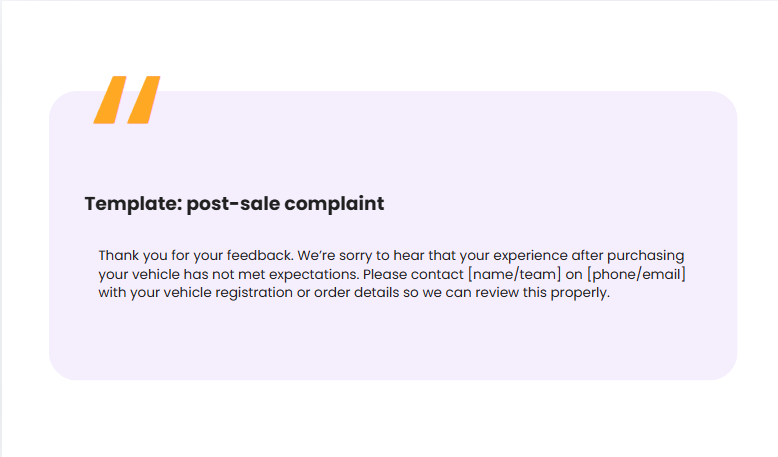
Template: post-sale complaint
Thank you for your feedback. We’re sorry to hear that your experience after purchasing your vehicle has not met expectations. Please contact [name/team] on [phone/email] with your vehicle registration or other details so we can review this properly.
How to respond to post-service complaints
Post-service complaints often relate to delays, communication, repair quality, pricing or repeat visits. The response should recognise the customer’s concern without accepting responsibility before the booking and service record have been reviewed.
<Preformat>
Template: post-service complaint
Thank you for bringing this to our attention. We’re sorry to hear that you were unhappy with your recent service experience. Please contact [name/team] on [phone/email] with your vehicle registration and service data so we can look into this further.
How to respond to finance-related complaints
Finance-related reviews require additional care. Comments about affordability, commission, disclosure, interest rates, monthly payments or finance agreements should be referred to the dealership’s trained finance or compliance team.
The response should not interpret the agreement, challenge the customer’s account or promise an outcome before the complaint has been investigated.
<Preformat>
Template: finance-related complaint
Thank you for your feedback. We’re sorry to hear about your concerns. As this relates to finance, it needs to be reviewed through the appropriate complaints process. Please contact [finance complaints/contact team] on [phone/email] with your agreement or vehicle details so the matter can be logged and reviewed by the relevant team.
Note: This template should be reviewed by the dealership’s compliance or legal team before use.
When should a review be escalated internally?
A review should be referred to a specialist or senior team when it mentions:
- Motor finance or commission;
- Vehicle rejection or refund requests;
- Unresolved or repeated faults;
- Safety concerns;
- Discrimination;
- Legal action;
- Personal data;
- Trading Standards;
- The Motor Ombudsman or Financial Ombudsman Service.
Reviews that may become formal disputes should also be linked to the customer’s internal complaint record. This helps keep the public response, private correspondence, and formal case history consistent.
What to avoid in negative review responses
Dealers should avoid language that sounds dismissive, confrontational, or final before the issue has been investigated. Examples include:
- “You are wrong.”
- “The vehicle was sold as seen.”
- “There is nothing we can do.”
- “This is not our responsibility.”
- “You agreed to everything at the time.”
- “Remove this review, and we’ll help you.”
Responses like these can undermine trust and make an unresolved complaint harder to manage.
Should dealers threaten legal action over a review?
Dealers should be cautious about threatening defamation action in a public response. Under the Defamation Act 2013, a statement must generally have caused, or be likely to cause, serious harm to reputation before it meets the relevant threshold in England and Wales.
If a review appears false, abusive, or contains personal information, preserve the evidence, use the platform’s reporting process, and seek legal advice where necessary.
This is general information, not legal advice.
A professional response cannot undo a poor customer experience, but it can show prospective buyers that the dealership listens, investigates concerns, and takes complaint handling seriously.
Optimise reputation management efforts for your UK car dealership business
Want to see the impact of Birdeye on your business? Watch the Free Demo Now.
How can AI improve car dealer reputation management?
AI can help dealer groups analyse large volumes of customer feedback, identify emerging issues, and prioritise reviews that need human attention. Its main value is not replacing dealership teams, but helping them act faster and with greater consistency across locations.
Identify customer sentiment and risk
AI can group reviews by topic and sentiment, helping teams see why customer perception is changing. Common themes may include:
- Sales experience;
- Vehicle handover;
- Service delays;
- Repair quality;
- Finance communication;
- Delivery issues;
- Staff mentions.
It can also flag potentially sensitive reviews that mention affordability, commission, monthly payments, vehicle rejection, or repeated faults. These alerts can help dealerships identify complaints that may need to be routed to finance, compliance, or senior customer service teams.
Draft review responses
AI can prepare response drafts based on the review’s tone, subject, and urgency. This can reduce response times and help dealer groups maintain a consistent brand voice across locations.
Every response should still be reviewed before publication. Feedback involving motor finance, consumer rights, legal action, or an existing formal complaint requires particular care. AI should support approved processes, not make legal, regulatory, or complaint decisions.
Strengthen visibility in AI search
Car buyers increasingly use conversational queries such as “best used car dealer near me” or “best Ford dealer in Manchester”. AI search platforms may draw on publicly available signals, including reviews, ratings, business profiles, and local relevance, when generating recommendations.
Dealers cannot guarantee inclusion in an AI-generated answer. They can, however, improve the quality and consistency of the information available by maintaining accurate location profiles, generating recent customer feedback, and responding regularly across relevant platforms.
Compare performance across locations
For multi-location groups, AI can compare feedback across branches, departments, or customer journey stages. It may show, for example, that one location receives strong sales feedback but recurring complaints about service communication.
These insights give operations teams a clearer view of where processes, training, or customer communication need attention. They also provide more context than average star ratings alone.
AI delivers the most value when it operates within clear ownership, approval, and escalation processes.
Comparing UK car dealer reputation management software
UK car dealers can manage reputation manually, use an automotive-specific provider, or adopt a multi-location platform. The right option should support the dealership’s existing systems, customer journey, approval processes, and level of central control.
Software | UK auto platform coverage | DMS integrations/ workflow support | Multi-location fit | Best suited for |
| Birdeye | Combines review management, listings, customer insights and AI search visibility within one agentic marketing platform. Built for multi-location brands that need to manage reputation and local visibility across locations. | Supports automated review-request workflows across multiple system setups. Dealers should assess workflow fit based on their existing DMS, CRM, and customer data processes. | Designed for multi-location brands that need central oversight, brand controls, and location-level performance insights. | Dealer groups and large independents (100-10,000+ locations) that want review management, listings, sentiment, and reporting in one platform. |
| eDynamix | Built for automotive retail, with products covering customer engagement and dealership workflows. Platform and DMS compatibility should be checked against the dealer’s existing systems. | Automotive-focused system compatibility may vary by dealer setup and should be checked against existing DMS and CRM workflows. | Suitable for dealers seeking an automotive-specific provider. | Dealerships that prioritise automotive-focused communications and customer retention. |
| Marketing Delivery | Focuses on automotive marketing, customer communications, and retention activity. | Works closely with dealer CRM and customer communication workflows, depending on the systems used by the dealership. | Can support dealership groups that want centrally managed customer campaigns. | Dealers looking to connect reputation activity with CRM-led marketing and follow-up. |
| GForces Centra | Supports automotive digital retail and dealership website experiences. The available reputation capabilities may depend on the products selected. | Best suited to dealers already using or evaluating the wider GForces ecosystem. Integration needs should be assessed against the group’s existing retail and website stack. | Relevant to groups already using the wider GForces ecosystem. | Dealers focused on website performance, digital retail, and online enquiry journeys. |
| DealerRater | Primarily associated with the North American automotive review market and less central to UK car-buying journeys than AutoTrader, Google or Trustpilot. | DMS relevance for UK dealer groups is limited and should be assessed only where DealerRater is part of the dealership’s existing workflow. | Limited relevance for a UK-first reputation management strategy. | Dealers with a specific operational need for DealerRater, especially where North American review coverage is relevant. |
What affects the cost of reputation management?
A single-site dealership may only need basic review monitoring and response management. Larger dealer groups are more likely to require automated review workflows, centralized governance, location-level permissions, sentiment analysis, and cross-branch reporting.
When comparing providers, dealers should assess:
- Coverage of the review and discovery platforms that their customers use;
- Compatibility with existing DMS and CRM systems;
- Multi-location governance and permissions;
- Complaint-routing and approval workflows;
- AI capabilities for reviews, listings, insights, and search visibility;
- Location- and department-level reporting;
- Implementation, training, and ongoing support.
For multi-location dealer groups, Birdeye stands out because it brings review management, listings, customer insights, and AI search visibility into one connected platform, giving central teams the governance they need while helping each location manage reputation more consistently
Frequently asked questions about car dealer reputation management
Yes. Dealers can ask customers to leave an honest AutoTrader review after a genuine transaction. Requests should be neutral and must not pressure customers to leave a positive rating. Dealers should also check AutoTrader’s current review rules before offering any incentive.
Yes. The Motor Ombudsman publishes information about its dispute-resolution process and anonymised case studies, and consumers can check whether a business is accredited. Dealers should confirm separately whether any business-specific case or outcome information is publicly associated with their profile.
FCA Consumer Duty makes finance-related review responses more sensitive. If a review mentions affordability, commission, disclosure, monthly payments, or a finance agreement, the dealer should route the customer to the formal complaints process rather than debating the issue publicly.
Reputation management costs vary depending on the number of locations, review platforms, automation needs, reporting requirements, and integrations. A small dealer may use a basic tool, while a dealer group usually needs a multi-location platform with reviews, listings, response workflows, and analytics.
Dealer management system costs vary by dealership size, number of locations, selected modules, users, support and integration requirements, and most UK providers supply pricing through a tailored quotation.
A customer should usually contact the dealer first, explain the issue clearly, and give the business a chance to resolve it. If the issue remains unresolved, they may escalate it to the relevant finance provider, the Motor Ombudsman, Trading Standards or another appropriate body.
How can Birdeye help UK car dealer groups manage reputation across locations
Multi-location UK car dealer groups need a consistent way to manage reviews, listings, customer feedback and local visibility across branches. Managing 100-10,000+ showrooms across separate sales, finance, and after-sales departments requires a centralised system built for enterprise governance and local execution.
Birdeye builds AI agents purpose-built for multi-location brands. Powered by a unified customer data platform (CDP) and local intelligence, these brand-trained AI agents help teams understand customer signals, take faster action, and drive measurable business outcomes.
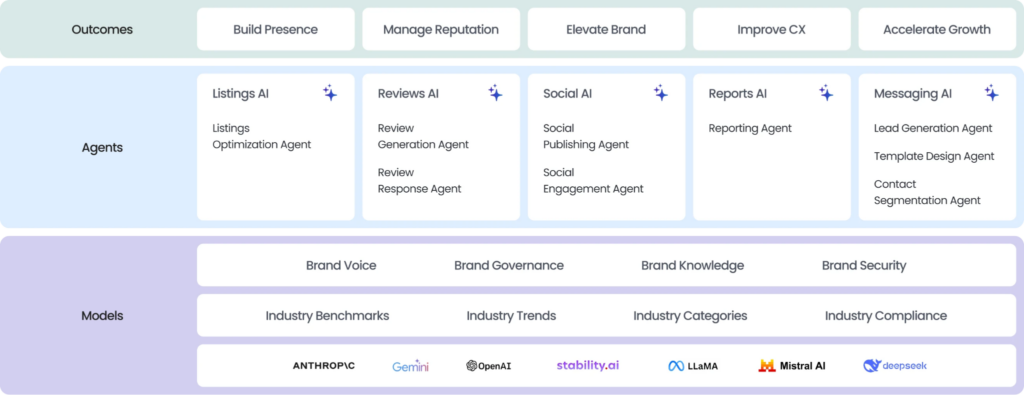
For enterprise dealer networks, Birdeye brings key reputation and local-visibility workflows into a single connected platform.
Review Response Agent
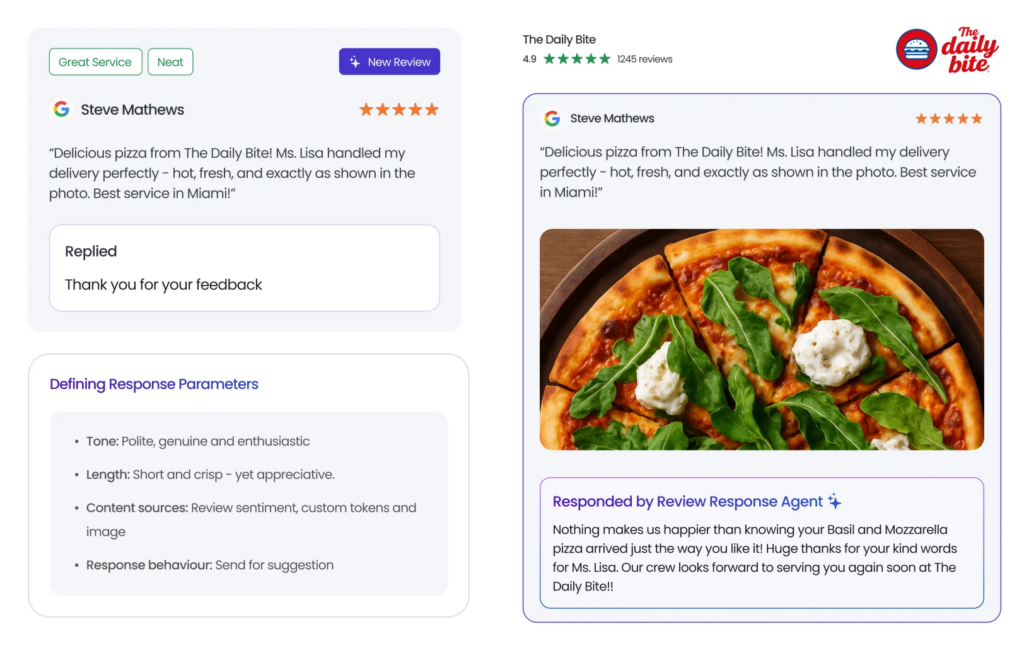
The Review Response Agent analyses the content, sentiment, and context of customer reviews to prepare relevant responses in the dealer group’s brand voice. Approval workflows allow teams to review sensitive replies before publication and maintain appropriate oversight across locations.
Review Generation Agent
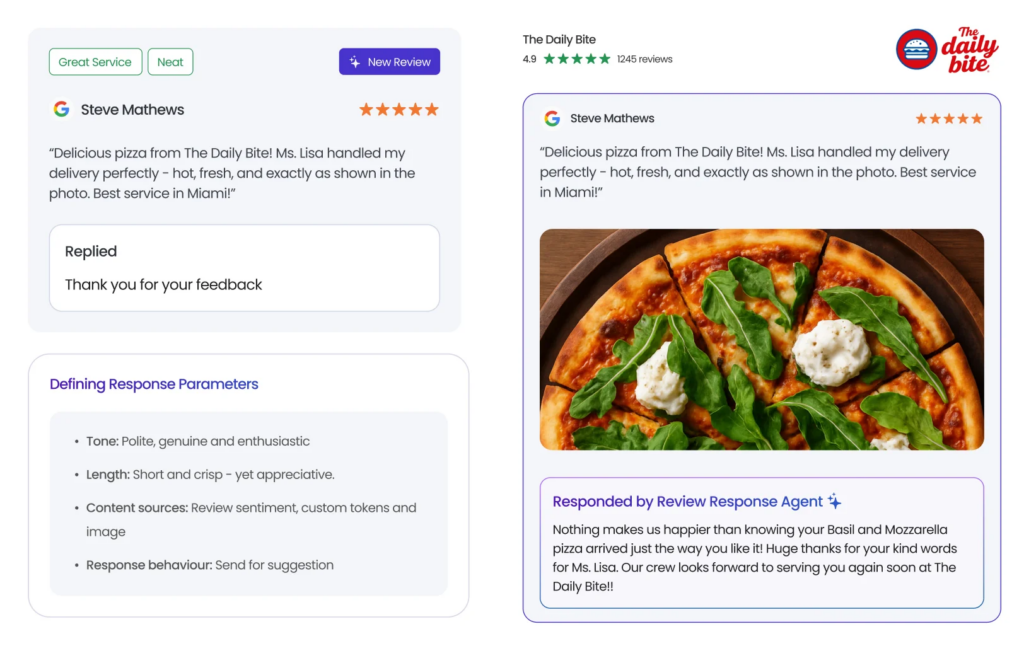
The Review Generation Agent helps brands request feedback at relevant points in the customer journey. It can detect new customers, choose the appropriate review channel, and send review requests at the right time.
For dealership groups, this can support review-request workflows after important moments such as vehicle handover or completion of a service visit, while still allowing teams to use neutral language that asks customers for honest feedback.
Listings Optimisation Agent
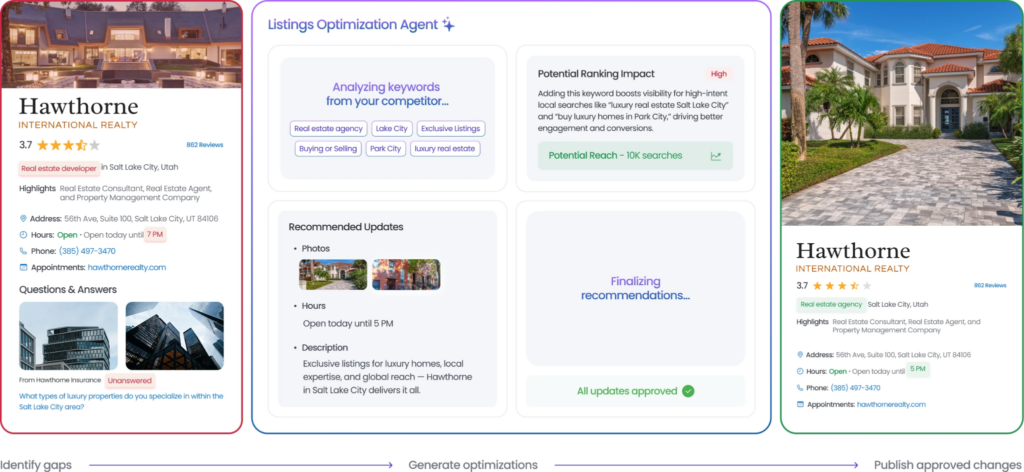
The Listings Optimisation Agent helps keep business information accurate and complete across supported platforms such as Google, Apple, Facebook, Yelp, and local business directories. It can scan profiles, identify gaps or errors, and recommend updates that improve profile quality and local visibility.
For dealerships, this helps central teams manage important branch details such as opening hours, services, contact information, and location attributes more consistently.
Search AI Agents
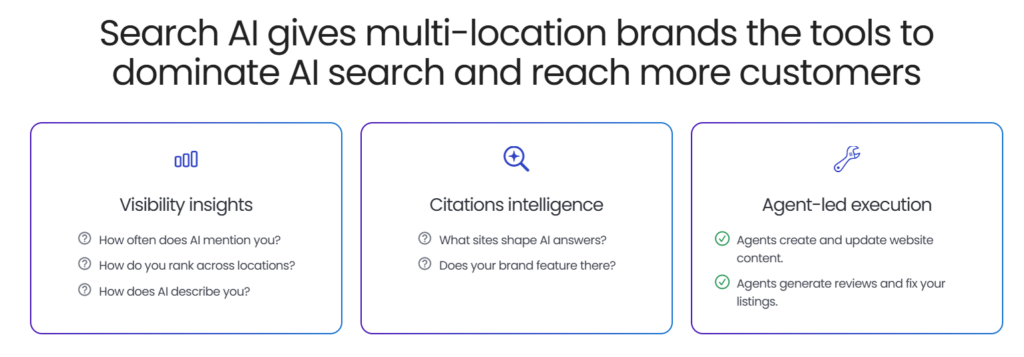
Search AI shows how dealership brands and locations appear across AI-led discovery journeys. It tracks your localised citation strength, uncovers trending query prompts, and helps teams understand how their brand and locations appear across AI-led search experiences such as ChatGPT, Perplexity, Gemini, Claude, Grok, DeepSeek, and Google AI Overviews when buyers ask questions like “best used car dealer near me”.
Social Publishing Agent
The Social Publishing Agent helps teams create and schedule on-brand social posts across locations and channels. It supports location-relevant content while giving central teams a way to maintain brand consistency.
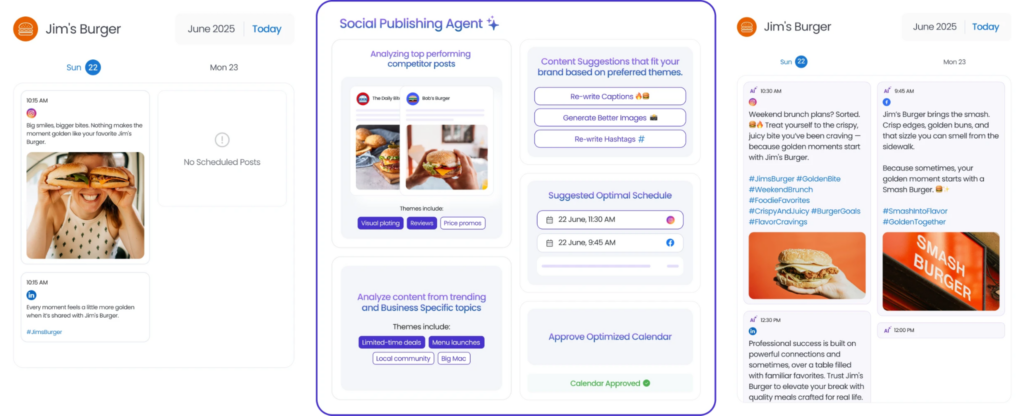
For dealer groups, this can help support local content related to dealership updates, service reminders, community activities, and customer trust signals.
Social Engagement Agent
The Social Engagement Agent helps teams monitor comments, direct messages and wall posts across social channels. It can detect message intent, route interactions to the right team and draft on-brand replies.
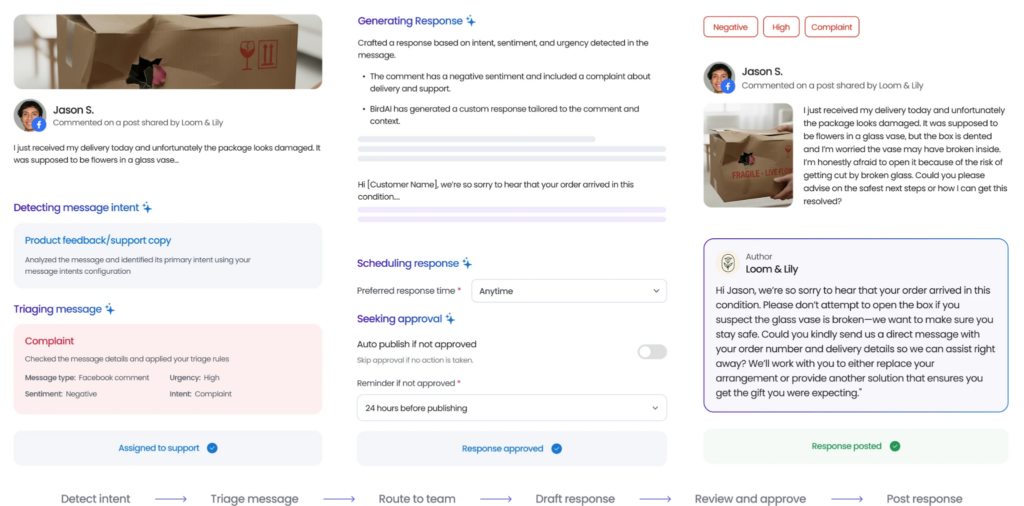
This helps dealership teams manage social interactions more consistently, especially when buyers or customers contact the brand through local social pages.
Insights AI
Insights AI brings sentiment, reviews and listings health into a clearer performance view. Birdeye Score helps teams understand overall location performance, while recommendations help identify what to improve first.
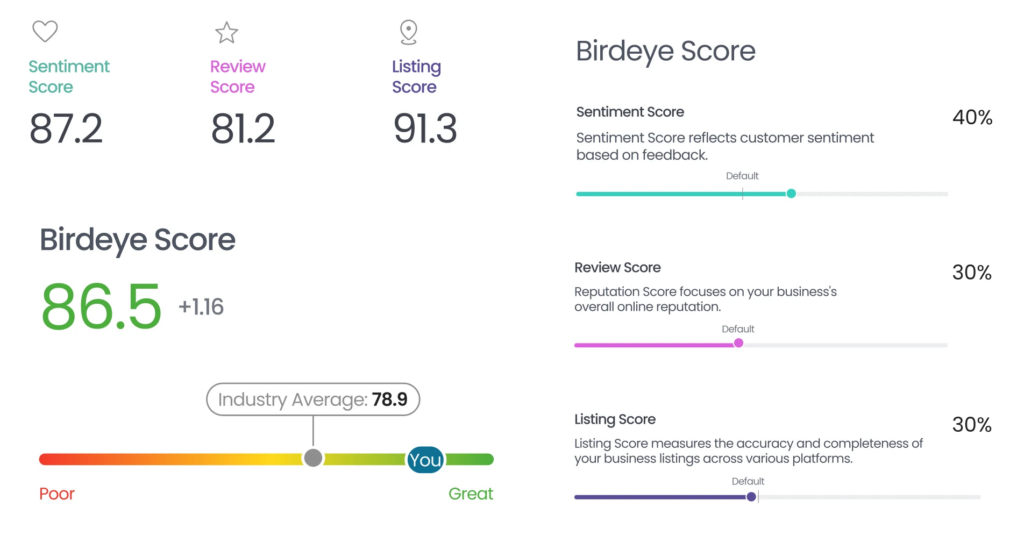
For dealer groups, these insights can help compare locations, identify recurring customer experience themes and prioritise action across sales, service and aftersales.
With reviews, listings, social, insights and AI search visibility connected in one platform, Birdeye helps UK dealer groups move beyond monitoring reputation to acting on customer signals across locations.
Ready to elevate your dealer group’s local presence, consolidate your marketing stack, and turn online search visibility into showroom revenue? Watch a free demo today.

About the Author

Somya Yesodharan
Originally published