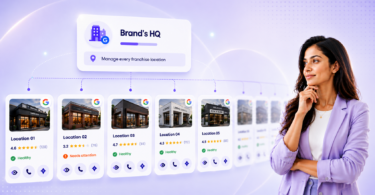
Enterprise listing management in the UK helps multi-location brands control, update and monitor location information across search engines, maps and business directories from one central platform. Enterprise solutions such as Birdeye combine bulk updates, listing synchronisation, role-based access, approval workflows and location-level reporting. These capabilities help organisations manage hundreds or thousands of locations while maintaining accurate business information and consistent brand standards.
Summary
For UK businesses, listing management is a commercial responsibility. Every incorrect address, missing service, or outdated opening time can create a gap between local search demand and customer visits. Managing these risks requires more than synchronising directories. Brands need clear data ownership, controlled updates, and reporting that connects online discovery with customer actions.
This article covers the challenges, benefits, enterprise capabilities, and practical strategies for managing UK listings, with results from Timpson’s 6,000+ location rollout.
Table of contents
- Summary
- Why is enterprise listing management challenging for UK businesses?
- What are the benefits of centralised listing management for UK enterprises?
- What are the best enterprise listing management providers in the UK?
- What features should enterprise listing management include?
- How can UK enterprises build an effective listing management strategy?
- What should enterprises check before changing listing management providers?
- How does Birdeye support enterprise listing management in the UK?
- FAQs about enterprise listing management in the UK
- What does successful enterprise listing management look like in the UK?
Why is enterprise listing management challenging for UK businesses?
For UK enterprises, listing management becomes more complex as the number of branches, brands and operational teams increases.
According to Ofcom’s Online Nation report, 82% of UK online adults used Google Search, and 78% used Google Maps. These platforms connect customers with individual business locations. An inaccurate address, missing service, or incorrect opening time can disrupt that journey.
Several UK-specific challenges make centralised management important.
1. Different trading hours across UK regions
England, Scotland, Wales and Northern Ireland do not share identical bank holiday calendars. Scotland observes St Andrew’s Day, while Northern Ireland observes St Patrick’s Day and the Battle of the Boyne holiday.
For a retailer operating branches across all four nations, applying one national holiday schedule can produce incorrect opening hours. Enterprise systems need location-specific schedules and the ability to update regional groups without changing unaffected branches.
2. Frequent changes across complex location networks
UK retail, hospitality and service groups may operate shops, concessions, service-area businesses and self-service locations. Each location type can have different listing eligibility requirements and customer information.
Acquisitions and relocations add further complexity. A newly acquired chain may bring duplicate Google profiles, outdated telephone numbers and inconsistent trading names. Without centralised records, these errors can remain across multiple platforms.
3. Conflicting information across departments
Property teams manage addresses, operations teams control opening hours, and marketing teams manage online profiles.
When these teams work from separate records, an approved branch relocation may not reach every listing. Enterprise businesses need one authoritative location record, clearly assigned data owners, and approval processes that prevent conflicting updates.
4. Limited visibility into local performance
A national business may have strong overall search visibility while individual branches remain difficult to find.
Brand-level reporting can hide incorrect categories, incomplete profiles, or declining customer actions at specific locations. Enterprises need reporting by branch, region and brand to identify these gaps.
What are the benefits of centralised listing management for UK enterprises?
Centralised listing management helps businesses address these challenges through shared data, automation and consistent controls.
| Benefit | How it helps UK businesses |
| Consistent location information | Maintains approved addresses, postcodes, services and opening hours across connected platforms |
| Less manual work | Applies bulk updates and approved AI-generated corrections without editing each profile separately |
| Greater brand control | Restricts changes through permissions, approval workflows and audit trails |
| Improved local discovery | Helps search engines access complete and relevant location information |
| Faster operational changes | Supports coordinated updates during bank holidays, relocations and closures |
| Measurable performance | Compares calls, website visits and direction requests across locations |
What are the best enterprise listing management providers in the UK?
Several established providers support multi-location listing management. Their capabilities differ in data distribution, governance, automation, and reporting.
| Providers | Key capabilities | Best suited for |
| Birdeye | Agentic listings optimisation, centralised updates, duplicate management, enterprise governance and location-level reporting | Multi-location enterprise brands seeking automated listings and connected visibility management |
| Yext | Centralised location knowledge, publisher distribution and structured content management | Organisations managing complex location information across digital channels |
| Uberall SOCi | Location data management, listings synchronisation and multi-brand location hierarchies Multi-location marketing, listings and AI-enabled workflows | Retail and service businesses managing large location networks Brands managing local marketing centrally |
| BrightLocal | Citation building, active listings synchronisation, audits and bulk workflows | Agencies and businesses focused on citations and local SEO |
Businesses should evaluate providers against their own UK location networks, rather than selecting based on the total number of directories advertised. For a detailed breakdown of relevant publishers, read Birdeye’s UK local business directories article.
What features should enterprise listing management include?
Enterprise listing management should help UK businesses maintain accurate location data, automate updates and control changes across hundreds or thousands of locations. Here are six capabilities to prioritise.
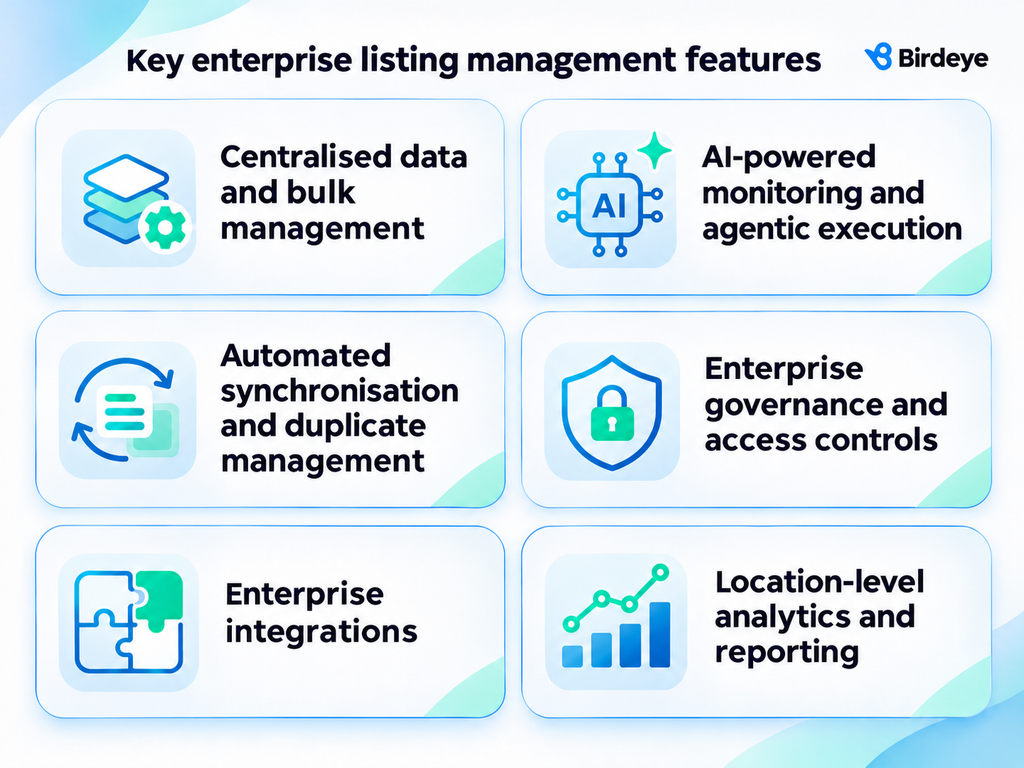
1. Centralised data and bulk management
A single platform should manage addresses, opening hours, services and business categories across all locations. Bulk editing lets teams update selected branches, regions, or brands at once, reducing manual work and inconsistencies.
2. AI-powered monitoring and agentic execution
Traditional tools identify listing errors but often leave teams to fix them manually. Agentic AI goes further by continuously detecting inaccuracies, recommending improvements, and executing approved corrections.
3. Automated synchronisation and duplicate management
Accurate information must reach every relevant platform. Enterprise tools should synchronise updates across Google Business Profile, Apple Maps, Bing Places and supported UK directories. It should also detect duplicate profiles, outdated addresses and failed updates, particularly during relocations, acquisitions and rebrands.
4. Enterprise governance and access controls
Multiple teams need access to location information without compromising brand consistency. Essential controls include:
- Role-based access: Restricts users to authorised locations and actions.
- Approval workflows: Ensure sensitive changes receive approval before publication.
- Audit trails: Track changes and maintain accountability.
- Single sign-on (SSO): Centralises secure user authentication.
These controls let local teams manage operational changes while headquarters maintains oversight.
5. Enterprise integrations
Listing management should connect with existing property, operational, and CRM systems. When a branch relocates or closes, connected workflows can trigger listing updates, reducing duplicate data entry and keeping information consistent.
6. Location-level analytics and reporting
Enterprises need visibility into performance across branches, regions and brands. Reporting should track listing accuracy, search impressions, website clicks, calls and direction requests. These insights help teams identify underperforming locations, prioritise improvements and measure the business impact of listing management.
How can UK enterprises build an effective listing management strategy?
An enterprise listing management strategy should establish one reliable source of location data, automate routine work and measure results across the full network.
The following five steps provide a practical approach.
1. Audit listings across the UK estate
Begin by identifying active, relocated, temporarily closed and duplicate locations.
Compare existing profiles against approved business records, including trading names, postcodes, opening hours, telephone numbers and services. Prioritise inaccuracies that could send customers to the wrong location or prevent them from contacting a branch.
2. Organise locations by region and business type
Group locations by brand, region and business type to manage updates accurately. Account for these UK-specific requirements:
- Regional opening hours: Bank holidays differ across England, Scotland, Wales and Northern Ireland. Use the GOV.UK bank holiday calendar to update location-specific hours.
- Regulatory information: Healthcare, financial and legal businesses should keep relevant records accurate with the CQC, FCA and SRA through their respective processes.
- Location eligibility: Shops, service-area businesses and self-service locations may have different listing requirements across platforms.
This structure prevents businesses from applying the same information or publishing rules to every location.
3. Define ownership, permission, and approval responsibilities
Assign responsibility for each category of location information.
| Information | Recommended owner |
| Trading names and brand categories | Central marketing |
| Addresses, openings and closures | Property or operations |
| Local opening hours and services | Regional operations |
| Platform permissions and SSO | IT and security |
| Listing accuracy and reporting | Marketing operations |
Use role-based access, approval workflows and audit trails to control changes across teams.
UK GDPR considerations: When listings contain personal data, such as individual contact details, organisations must take reasonable steps to keep it accurate under the ICO's accuracy principle. Access controls and audit trails can support accountability.
4. Automate monitoring and approved corrections
Continuous monitoring should identify inaccurate fields, missing descriptions, outdated photographs, and other listing gaps. AI agents can recommend improvements based on location-specific information and relevant search terms.
Teams can then approve and execute changes across eligible locations instead of repeating the same task for every branch. Publisher verification requirements and unsupported updates should remain visible as exceptions.
5. Measure visibility and business outcomes
Track performance at the location level rather than relying only on national totals. Useful measurements include:
- Accuracy: Percentage of listings with correct information.
- Discovery: Search impressions and location visibility.
- Engagement: Calls, website clicks and direction requests.
- Commercial outcomes: Bookings, footfall and sales where measurable.
Compare results across similar locations and periods to identify improvements while accounting for seasonality and promotions. A continuous audit, approval and measurement process keeps the strategy effective as locations change.
What should enterprises check before changing listing management providers?
Migrating thousands of locations requires more than transferring a spreadsheet. Before changing providers, enterprises should verify:
- Profile ownership: Confirm access to Google Business Profile and other important publisher accounts.
- Location records: Check addresses, identifiers, categories and duplicate profiles before importing data.
- Integration compatibility: Understand which systems and publishers support automated updates.
- Migration stages: Test representative branches before moving the complete estate.
- Post-migration checks: Monitor publishing errors, verification issues and location-level performance.
A phased migration helps identify problems before they affect the wider network.
How does Birdeye support enterprise listing management in the UK?
Birdeye Listings helps UK enterprises manage and optimise listings across thousands of locations. Jay, Birdeye’s marketing AI coworker, continuously detects inaccuracies, recommends improvements, and executes approved fixes without manual updates to individual profiles.
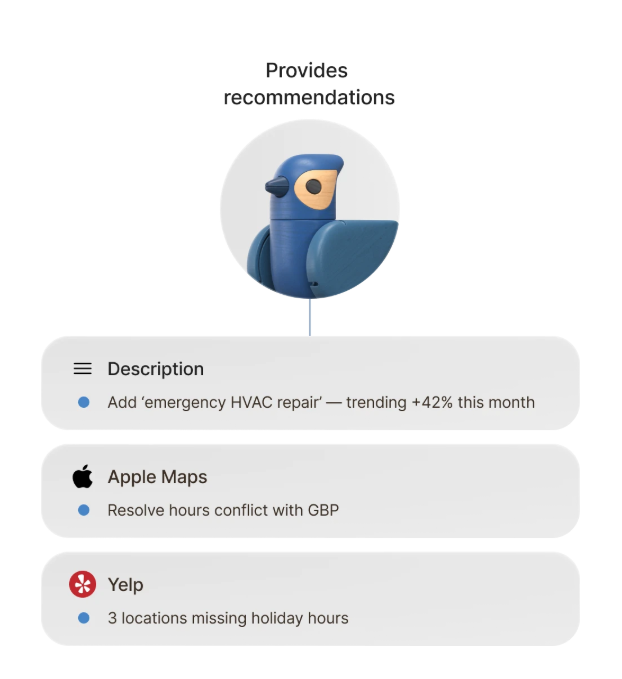
Key capabilities include:
- Continuous monitoring: Jay, works with the Listings Optimisation Agent to detect outdated information, missing fields, and listing inconsistencies.
- AI-powered optimisation: Uses live search data, competitor insights, and custom keyword rules to recommend location-specific improvements.
- Agentic execution: Applies approved fixes across relevant locations and directories with one click.
- Native integrations: Connects directly with Google, Apple, Bing, Facebook and Yelp.
- Enterprise governance: Supports role-based access, approval workflows, audit trails and SSO.
- AI visibility optimisation: Coordinates with the AI Search Optimisation Agent to identify and resolve listing-related visibility gaps.
How did Timpson manage listings across 6,000+ UK locations using Birdeye?
Timpson Group is a leading UK retail and consumer services group operating 6,000+ shops, vending machines and self-service locations.
Challenge: Timpson needed to migrate thousands of business listings from a previous provider while maintaining accurate location information, consistent local search visibility and uninterrupted daily operations.
Solution: With Birdeye Listings, Timpson centralised location data and completed a phased migration. Over 2,000 retail locations went live within four weeks, followed by 3,800+ vending and self-service locations the next month. Birdeye also connected listings, reviews, and performance insights in one platform.
Impact: Timpson achieved a 6% increase in Google Business Profile conversion, 112% growth in review volume, and an improvement in average ratings from 4.3 to 4.6. One vending business also recorded 60% year-on-year growth.
“Birdeye has had a direct impact on our top line. By making it easier for customers to find our shops, vending machines and services across the Timpson Group, and by giving every part of the business a single view of how we’re performing, we’ve seen better footfall, stronger reviews and a measurable contribution to sales growth.”
Will Lankston
Managing Director, Timpson Direct
FAQs about enterprise listing management in the UK
Birdeye Listings helps UK enterprises manage and optimise business listings across thousands of locations. Jay, Birdeye’s marketing AI coworker works with Listing Optimisation Agent to monitor listings, identify inaccuracies and execute approved corrections with one click. With native integrations, role-based access, approval workflows and location-level reporting, Birdeye helps multi-location brands maintain accurate information and improve local visibility.
Enterprise listing management costs depend on the number of locations, integrations, automation capabilities, and support requirements. Providers may offer per-location subscriptions or custom enterprise agreements. UK businesses should evaluate the total cost of ownership, including migration, ongoing management, and the manual work eliminated through AI-powered optimisation.
Yes. Enterprise platforms such as Birdeye support centralised management across brands, regions and franchise locations. Role-based access, approval workflows and single sign-on help organisations maintain control while allowing local teams to manage authorised changes.
Enterprise listing management supports AI search visibility by keeping location information accurate, complete and relevant. Birdeye connects its AI Search Optimisation Agent with the Listings Optimisation Agent to identify listing issues contributing to visibility gaps and recommend corrections. However, accurate listings alone do not guarantee recommendations from ChatGPT, Gemini or other AI platforms.
What does successful enterprise listing management look like in the UK?
Successful enterprise listing management combines accurate location data, centralised governance and measurable customer outcomes. The right platform should help businesses maintain information across relevant UK channels, control changes through defined permissions and identify locations that need attention.
Timpson’s implementation shows how these capabilities can support a network exceeding 6,000 locations while connecting improved digital visibility with customer engagement and commercial performance.
For UK enterprises, the priority is not managing the most listings. It is managing every relevant location accurately, consistently, and with clear accountability.
Book a demo now to explore Birdeye Listings for UK enterprises.

About the Author

Somya Yesodharan
Originally published