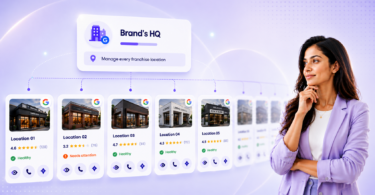
Managing listings across hundreds of UK locations is not just a data-entry task. A single incorrect address, outdated opening time or unauthorised edit can send customers to the wrong place or prevent them from contacting a branch.
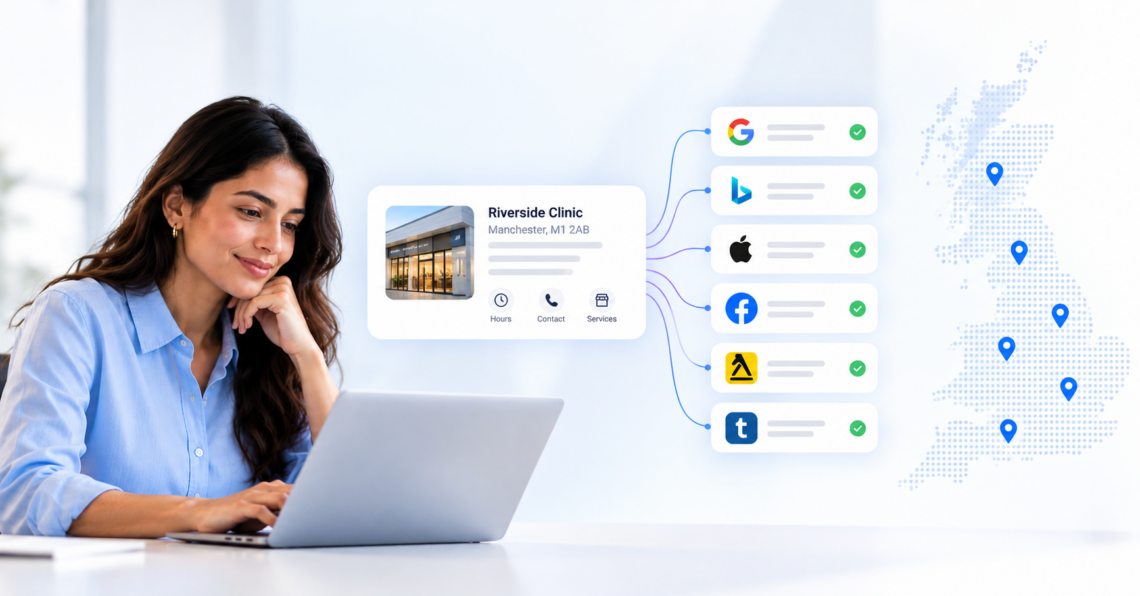
Take, for example, a brand with 300 UK branches that changes its Christmas opening hours. Each branch has a profile on six platforms: Google Business Profile, Bing Places, Apple Business, Facebook, Yell and Thomson Local. That is 1,800 profiles to update. One missed record sends a customer to a closed site, and the customer blames the brand, not the directory.
For multi-location brands, the challenge is not simply updating listings. Head office must control brand information, local managers must verify branch details, and someone must confirm changes have reached the right platforms.
This matters because customers often discover a location through an unbranded search. Birdeye’s State of Google Business Profile 2026 found that 86% of Google Business Profile impressions came from category-based searches rather than branded searches. Accurate location information matters when customers search for a service nearby without knowing which brand they want.
This guide explains how to manage listings at scale, from bulk updates and monitoring unauthorised changes to access permissions and accuracy audits across hundreds of sites.
Table of contents
- Why is multi-location listings management harder in the UK?
- How can brands update hundreds of listings at once?
- How do you prevent unauthorised changes to business listings?
- How should head office and local managers share listing permissions?
- How do you audit listing accuracy across hundreds of UK sites?
- How should brands measure listing accuracy and operational performance?
- How Birdeye helps multi-location brands manage listings at scale
- FAQs from UK marketers about multi-location listings
- Manage multi-location listings easily with Birdeye
Why is multi-location listings management harder in the UK?
Each location has its own business profile, address, telephone number, opening hours, services and local requirements. That information may appear on the UK’s top business listing directories and relevant industry platforms.
The information can become inconsistent for three reasons.
- Data is fragmented. Marketing, operations and local teams may maintain different records without a shared source of truth.
- Changes do not always reach every platform. A team may update its internal database without confirming that the live profiles have changed.
- Listings can change after publication. User-suggested edits, account access issues and duplicate profiles can introduce discrepancies that require investigation.
Consider a healthcare group with 150 clinics, similar to the multi-location dental groups covered in dental review management in the UK. Head office changes the approved telephone number, but several clinic profiles still display the old number. The central record is correct, yet patients who find those profiles may call the wrong number.
The solution is to manage the full process: approve the change, publish it, verify the result and investigate any discrepancy.
This matters for local SEO services in the UK, because customers often discover a location through an unbranded search.
How should brands establish a single source of truth for location data?
Multi-location brands need one authoritative record for each branch. It should identify the location, the owner of its information and the date the details were last verified.
At a minimum, maintain these fields:
- Business name, address and telephone number.
- Standard opening hours, bank holiday hours and temporary closures.
- Primary and secondary categories, services and relevant attributes.
- Website, appointment and booking links.
- Location-specific details, such as accessibility information where applicable.
- Profile identifiers, verification status and the platforms where the location is listed.
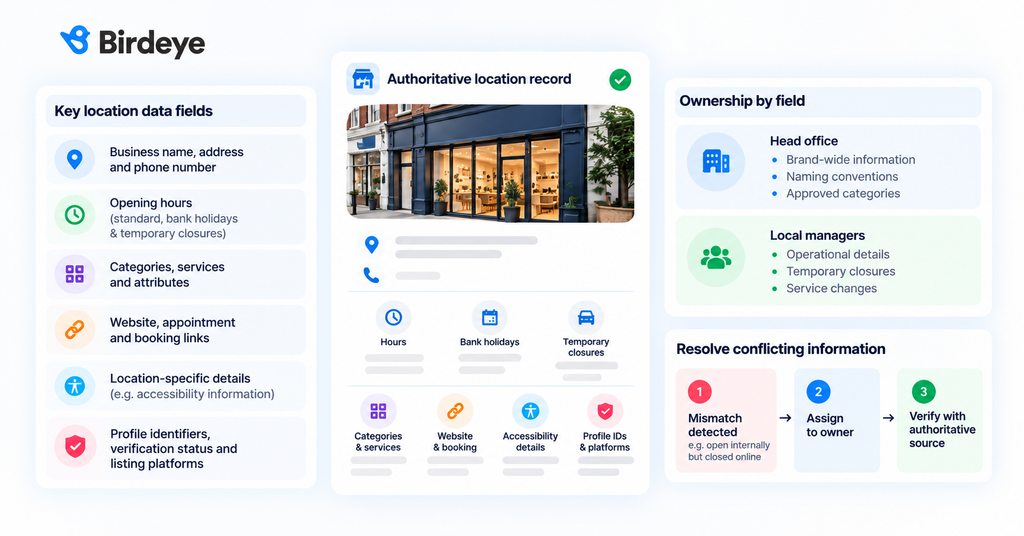
Assign ownership by field. Head office should control brand-wide information, naming conventions and approved categories. Local managers should confirm operational details, such as temporary closures or service changes.
Set rules for resolving conflicting information. If the internal record says a branch is open, but its published profile says it is closed, assign the discrepancy to an owner and check it against an authoritative source.
Do not force every location to use identical information. The objective is consistency where information should match and accuracy where branches differ- the balance behind a local SEO strategy for multi-location businesses.
How can brands update hundreds of listings at once?
Bulk updates, a core feature of local listing management tools, reduce the need to edit each profile manually. They are useful when a brand changes its website address, updates standard opening hours, or revises approved information across multiple branches.
A controlled bulk-update process has five steps:
- Identify the change. Define the fields being updated and select the affected locations.
- Validate the data. Check the proposed information against the source of truth and flag missing or conflicting values.
- Approve the change. Apply the organisation’s approval rules, particularly for business names, addresses and other high-impact fields.
- Publish the update. Send the approved changes to the relevant connected platforms.
- Verify publication. Check which updates succeeded, which remain pending and which failed.
For example, if 120 branches need the same approved website URL, the team can prepare one controlled update for those locations rather than manually editing 120 profiles.
However, submitting a bulk update does not guarantee that every platform has published it. Each publisher has its own processing and verification requirements. The team must track outstanding changes and confirm the live information.
Measure the process using the percentage of updates successfully published, the number of unresolved failures and the time between approval and verified publication.
How do you prevent unauthorised changes to business listings?
A centrally managed listing can still become inaccurate after publication. Platforms may allow users to suggest edits, while duplicate profiles or access granted to the wrong account can create further problems.
Google Business Profile should be a priority for monitoring, alongside Google reviews management UK processes, because reviews and listing details sit on the same profile. Brands should also check their profiles on Apple Business Connect, Bing Places and other important platforms.
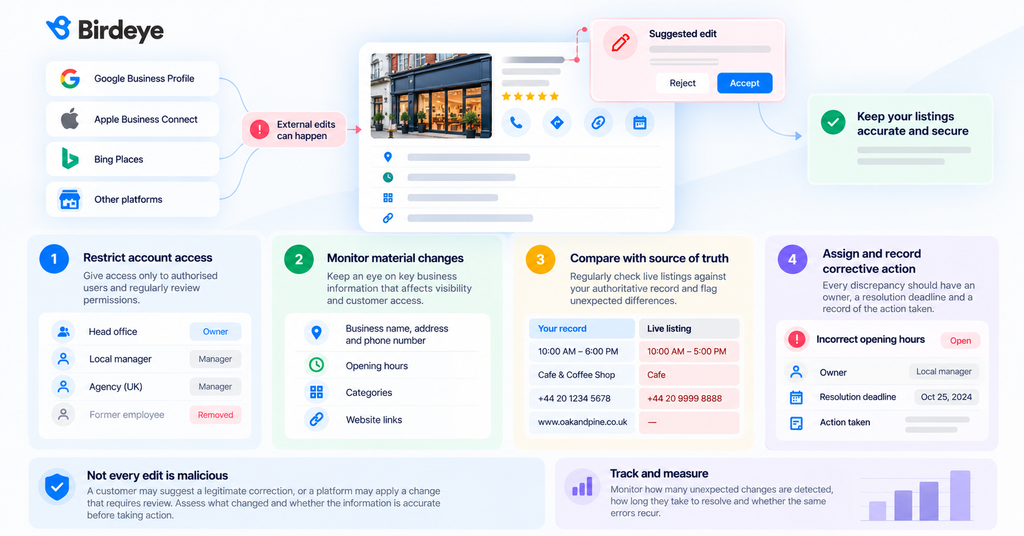
Use four controls to reduce the risk:
- Restrict account access. Give access only to authorised users, and check ownership and verification for each profile. Review who can manage each location and remove access when employees or agencies no longer need it.
- Monitor material changes. Prioritise business names, addresses, telephone numbers, opening hours, categories and website links. These fields can affect whether customers reach the correct location.
- Compare live information with the source of truth. Flag unexpected differences rather than assuming that published information remains correct after an update.
- Assign and record corrective action. Every discrepancy should have an owner, a resolution deadline and a record of the action taken.
Not every external edit is malicious or incorrect. A customer may suggest a legitimate correction, while a platform may apply a change that requires review. The response should depend on what changed and whether the information is accurate.
Track how many unexpected changes are detected, how long they take to resolve and whether the same errors recur.
How should head office and local managers share listing permissions?
Head office needs control over brand standards. Local managers need enough access to keep their branches accurate. Unrestricted editing rights create risk; routing every minor change through head office can slow local updates.
A clear division of responsibilities helps both teams work effectively, as it does in listings management for franchises:
| Listing activity | Head office responsibility | Local manager responsibility |
| Business name and brand categories | Set standards and approve changes | Report discrepancies |
| Address and telephone number | Validate material changes and maintain records | Confirm local details |
| Standard opening hours | Define the policy | Verify branch hours |
| Temporary closures and holiday hours | Set rules and escalation routes | Submit or confirm local changes |
| Bulk updates | Authorise and monitor network-wide changes | Flag affected locations |
| Accuracy audits | Set reporting standards and prioritise risk | Investigate assigned discrepancies |
Keep individual staff names and direct lines off listings. They are personal data under UK GDPR, which the ICO enforces.
Where the platform supports it, use role-based access and approval workflows- the same controls to check when comparing review management software in the UK.
For example, a local manager may be allowed to submit a change to holiday opening hours, while head office approves changes to the brand name or primary category.
The exact permissions available depend on the platform. The governance principle remains the same: head office controls standards and high-risk changes, while local teams provide accurate, timely information about their branches.
How do you audit listing accuracy across hundreds of UK sites?
A listings audit should compare the authoritative location record with the information customers can actually see. A one-time audit will not catch errors introduced by later updates, so brands need a recurring process.
1. Check coverage and ownership
Confirm that every active location has the expected profiles on Google Business Profile, Apple Business Connect and Bing Places. Check relevant sources such as Yell and Thomson Local, and the best review sites in the UK for your sector, where they matter to the business and its customers.
Record missing profiles, duplicate listings, unverified profiles and locations with unclear ownership.
2. Compare critical fields
Check each profile against the source of truth. Prioritise:
- Business name, address and telephone number.
- Opening hours and temporary closures.
- Categories and services.
- Website and booking links.
- Location-specific details that affect customer decisions.
A wrong address or telephone number should normally take priority over a missing, lower-impact profile attribute.
3. Score discrepancies by risk
Assign each issue a severity level, an owner and a deadline. For example, a closed branch shown as open needs faster attention than a minor completeness issue.
Use a consistent record that includes the location, platform, incorrect field, expected value, severity, owner, and resolution status.
4. Repeat the audit at a defined cadence
A practical starting point is to monitor material changes continuously where tools allow it, review urgent exceptions weekly and conduct a full-estate audit monthly or quarterly. Adjust the frequency to the number of locations, how often their details change and the risks associated with inaccurate information.
Birdeye’s The Location Blind Spot in AI Search 2026 report illustrates why checking the information that AI presents to customers is a separate requirement. In its study of 16,240 locations, only 98 returned fully accurate details across the fields ChatGPT assessed. ChatGPT got operating hours wrong in 97% of responses. These findings describe AI-generated answers in a US-weighted sample, not the accuracy of the underlying business listings. They reinforce the need to check both published business data and how external systems represent it.
Measure audit pass rates, errors per location, unresolved critical discrepancies, duplicate profiles and median resolution time. These measures show whether the process is improving, rather than simply counting how many profiles have been checked.
How should brands measure listing accuracy and operational performance?
Senior marketing and operations leaders need to know whether location data is correct and whether the organisation can keep it that way, which forms part of customer experience management in the UK.
Use three groups of metrics.
- Data quality: Percentage of profiles passing an audit, profile coverage, duplicate rate and field-level accuracy.
- Operational performance: Bulk-update success rate, time from approval to verified publication, number of unexpected changes and time to resolve discrepancies.
- Customer actions: Calls, website visits and direction requests, where platforms provide these measures.
Birdeye’s State of Google Business Profile 2026 report found that website visits accounted for 47% of measured Google Business Profile engagement, direction requests for 38% and phone calls for 15%. The report also found that impressions per location fell by 53.8% between 2023 and 2025, while customer actions declined by about 5%. These findings show why leaders should monitor customer actions alongside visibility metrics. They do not establish that listing accuracy alone caused those outcomes.
How Birdeye helps multi-location brands manage listings at scale
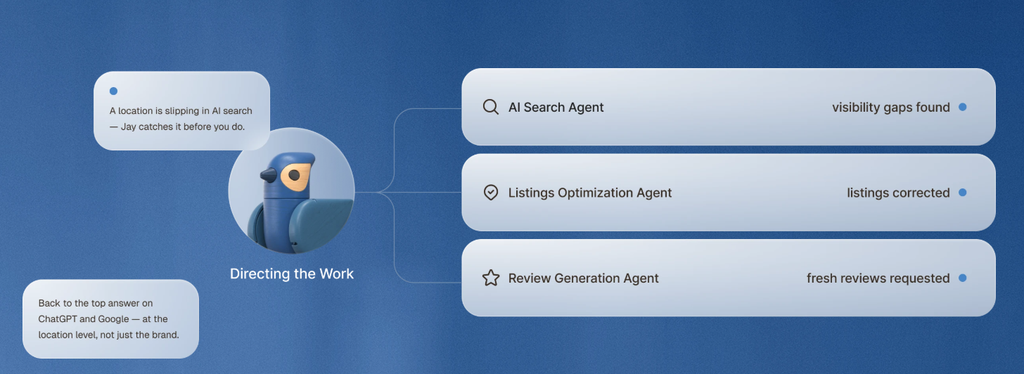
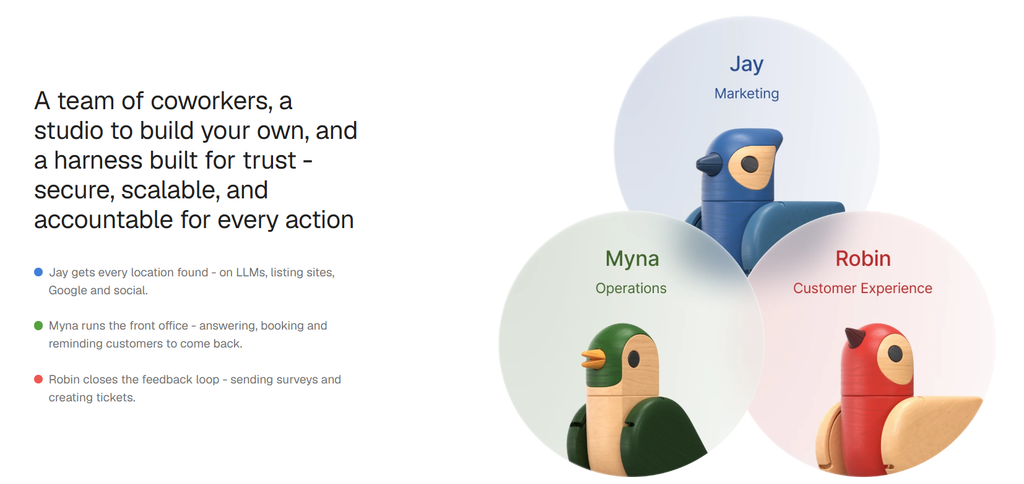
Birdeye builds AI coworkers for multi-location brands. Jay for marketing, Myna for operations and Robin for customer experience orchestrate AI agents across relevant workflows. For listings management, the focus is on keeping location information consistent and giving teams a clearer way to manage work across the estate.
Jay runs marketing, including listings, reviews, social and AI visibility. On listings, Jay gives head office one place to scan, approve and apply changes at every site.
Jay’s Listings Optimisation Agent scans Google, Facebook, Apple, Yelp, and Bing, recommends fixes for inaccurate or incomplete information, and applies approved updates across every location. One approval can cover every location a fix belongs to, and each recommendation shows the field and the reason. Every location is scanned and tracked independently, so one site’s errors don’t disappear into a brand average.
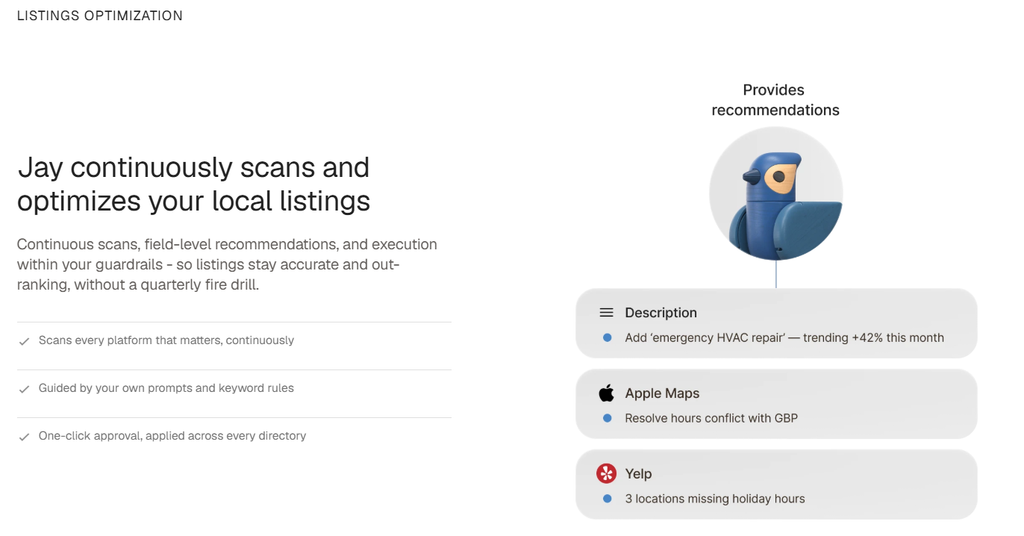
Controls match the model above: role-based access, tiered approvals, location-level reporting and audit logging, with SOC 2 Type II and GDPR compliance, and the checks to run on any of the reputation management companies UK brands shortlist. The Listings dashboard counts synced, submitted, and not-connected listings, plus listings needing updates, and reports can be scheduled from daily to quarterly. Teams can approve or reject Google suggestions inside Listings and compare data across core listing sites with the Listings Verifier.
Birdeye uses native integrations with the platforms that drive visibility and calls, not a padded directory count. For sources outside those integrations, the diagnosis still shows where the error starts, and the fix goes through that source. Jay runs on BirdAI, the Agent OS, built on 13 years of multi-location data infrastructure and 3,000+ integrations, which are covered in Birdeye integration capabilities.
How Timpson managed listings across more than 6,000 locations
Timpson Group operates approximately 2,150 shops and 4,000 vending and self-service locations across the UK. Customers search for individual services, such as shoe repairs, key cutting and passport photographs, often with a specific location in mind. Keeping information accurate across this estate is a substantial operational task.
After working with a previous provider, Timpson chose Birdeye to bring listings, reviews and performance insights into one platform. The migration had to move thousands of locations without disrupting day-to-day trading.
The rollout took place in two phases:
- Phase 1: More than 2,000 retail locations went live within four weeks.
- Phase 2: More than 3,800 vending and self-service locations followed the next month.
Timpson also introduced QR codes across its physical locations, giving customers a direct route to leave reviews. The company reported an increase of around 1,000 in average review volume within the first month.
What results did Timpson achieve?
Since going live with Birdeye, Timpson has reported the following results:
- 112% increase in review volume since go-live.
- Average review rating increased from 4.3 to 4.6 across the estate.
- 26% increase in review response rate.
- 6% increase in Google Business Profile conversions.
- 60% year-on-year growth in one vending business.
For marketing and operations leaders, the practical lesson is to treat listings as an ongoing operational responsibility, like multi-location reputation management. Establish a source of truth, control who can change information, verify that updates reach live profiles and use location-level reporting to identify issues. Birdeye provides a platform for coordinating this work across a large estate.
FAQs from UK marketers about multi-location listings
Hold a master record, publish from it in bulk, restrict who can change core fields and audit live listings against it.
Yes, for businesses with 10 or more locations, through bulk upload with a unique business code for each location.
No. You can verify the profile, route alerts to a monitored mailbox, review pending edits and reverse changes.
Daily for material fields, weekly for open exceptions and quarterly for the full estate, adjusted to how often your data changes.
Lock the master record, remove stale access and run a first audit. Fix critical errors at the worst 20% of locations, then set up the bulk update workflow with approvals.
Manage multi-location listings easily with Birdeye
permissions that separate head office from local managers, bulk updates that are verified live, and recurring audits that catch drift and unauthorised edits. A brand with hundreds of locations cannot run those controls by hand across thousands of profiles.
Birdeye helps multi-location brands manage listings at scale, coordinate updates and monitor location-level performance from one platform. Jay’s Listings Optimisation Agent scans the listing directories, recommends field-level fixes, and applies approved changes across every location from a single approval. Role-based access and tiered approvals keep core fields with head office. Location-level reporting shows which branches need attention first.
For marketing and operations leaders, the priority is to make every location easy to find and contact. With Birdeye, teams can bring greater consistency to listings management while identifying locations that need attention.
To see how Birdeye manages multi-location listings across your UK estate, book a demo.

About the Author

Shruti Dugar
Birdeye
Originally published