AI in multi-location marketing helps brands manage local marketing across hundreds or thousands of locations in a structured, consistent way, without increasing operational complexity.
Summary:

As the number of locations grows, so do the gaps across data, execution, and customer experience. AI in multi-location marketing centralizes data, automates execution, and adapts campaigns to local context in real time. The result is faster decision-making, stronger visibility in search (including AI-generated results), and more consistent customer experiences at every location.

This blog explains where AI fits in, what it actually improves, and how multi-location brands can apply it across reviews, listings, social, and messaging without losing control.
Table of contents
- What is AI in multi-location marketing?
- How does AI improve multi-location marketing performance?
- What are the hidden risks of generic AI for multi-location brands?
- What are some ethical implementations of AI in multi-location marketing
- What does the future of AI look like in multi-location marketing?
- Conclusion
- Frequently asked questions on AI in multi-location marketing
- Master multi-location marketing with Birdeye’s purpose-built AI Agents
What is AI in multi-location marketing?
AI in multi-location marketing refers to using AI systems to manage and optimize marketing across multiple business locations from a single platform.
It helps standardize data, automate repetitive tasks, and improve performance across search, reviews, social, and customer interactions.
For multi-location brands, this means fewer manual processes and better control over how each location shows up online.
What challenges do multi-location brands face without AI?
Managing marketing across multiple locations creates three core challenges:
1. Inconsistent brand experience
Each location serves a different audience, but inconsistent messaging, outdated listings, or uneven review responses can weaken brand trust. This can lead to lower conversion rates and missed revenue opportunities in high-intent local searches.
2. Fragmented data and systems
Customer data, reviews, and performance insights often live across different tools and platforms. This makes it hard to get a clear view of what’s working at each location, ultimately impacting local search visibility and marketing ROI.
3. Slow, manual execution
Tasks like updating listings, responding to reviews, or creating local content take time. At scale, this leads to delays and missed opportunities. It also limits a brand’s ability to capitalize on demand in real time, affecting both customer experience and revenue growth.
Without a structured system, these gaps grow as the number of locations increases.
“Birdeye’s AI-powered tools have streamlined our operations and enhanced the customer experience across our portfolio. From improving responses to addressing trends proactively, we’ve seen a noticeable difference in efficiency and resident satisfaction.”
Allison Ross, Senior Marketing Specialist, Fairlawn Real Estate
Gain a competitive advantage with AI in multi-location marketing
Want to see the impact of Birdeye on your business? Watch the Free Demo Now.
How does AI improve multi-location marketing performance?
Managing marketing across multiple locations breaks down in predictable ways. Data sits in different tools. Teams react late. Execution varies by location.
AI works when it connects these gaps into a single system, so teams can see what’s happening, understand why it’s happening, and act on it without delay.
Here’s how that plays out in practice:
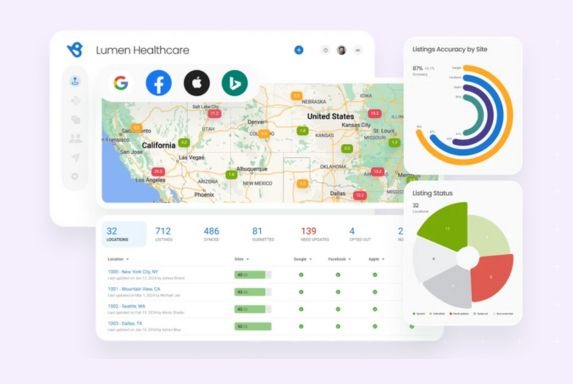
1. Brings all location data into one place
Reviews, listings, social activity, and customer interactions often live in separate systems. AI pulls this data together so every location can be viewed and managed from a single platform.
Instead of checking performance on a location-by-location basis, teams get a clear, unified view. This way, you reduce blind spots. Decisions are based on complete data, not fragments.
“Birdeye helps us get more granular with our strategic decisions. It ensures we’re spending effectively, not wasting resources where they’re unnecessary, and identifying which offices could benefit most from additional investment.”
Tim Belter, Director of Marketing Strategy, D4C Dental Brands
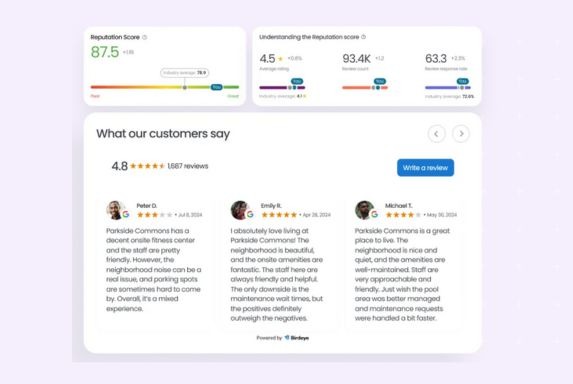
2. Shows what’s actually happening at each location
AI analyzes customer feedback, search performance, and engagement patterns to highlight what’s changing at a local level.
You’re not scanning dashboards. You’re seeing patterns, what’s improving, what’s slipping, and where attention is needed. You move from reacting late to responding early. Issues get addressed before they scale.
3. Standardizes execution without slowing teams down
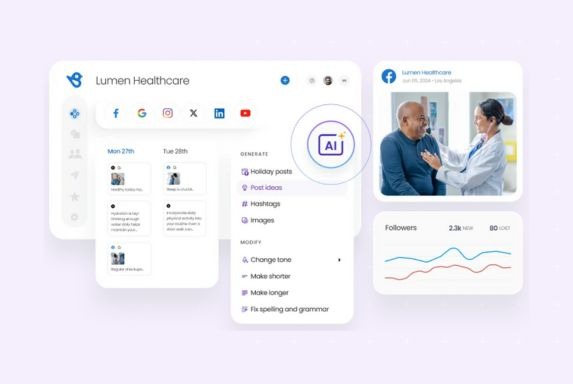
Tasks like responding to reviews, updating listings, or publishing local content are repetitive, but critical.
AI agents handle these workflows across locations, while teams review and approve what goes out.
Each location stays consistent with the brand, but still reflects local context. You maintain quality across hundreds of locations without increasing workload or losing control.
4. Connects insight to action
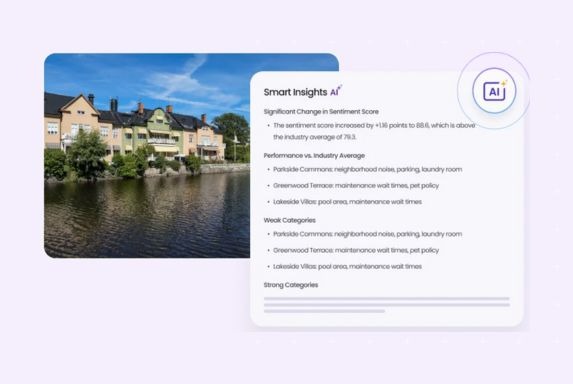
Most teams already have data. The problem is acting on it fast enough.
AI closes that gap. When a trend appears—like a drop in ratings or a spike in certain complaints, AI can surface it and help trigger the next step, whether that’s a response, an update, or a campaign. You don’t just see problems. You fix them faster.
How AI improve reputation management for multi-location brands

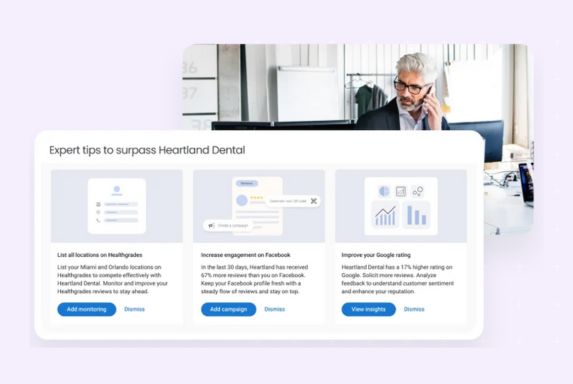
For instance, a national restaurant chain collect online reviews across multiple locations. However, they can significantly improve reputation management with AI solutions like Birdeye.

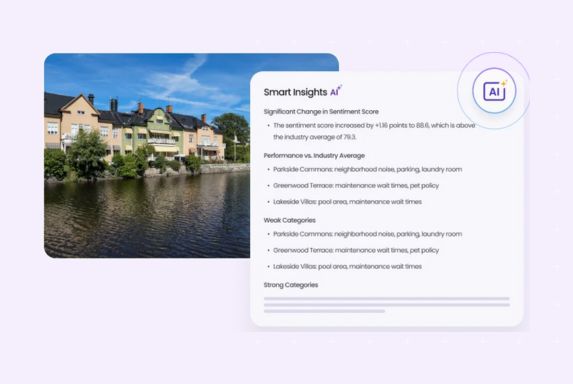
AI can help franchisees or multi-location chains monitor online reviews at each of its locations. The AI tool can scan customer feedback in real-time and flags negative reviews, prompting location managers to respond quickly, which enhances customer satisfaction and strengthens the brand’s reputation.
What are the hidden risks of generic AI for multi-location brands?
Most AI tools are “location-blind” and “compliance-deaf.” For a brand managing hundreds of sites, using generic AI isn’t just inefficient; it’s a liability. Here is where the “band-aid” approach breaks down:
- It lacks “location memory”: Generic AI can’t distinguish between Location A (4.8★, 2-minute wait) and Location B (3.2★, 45-minute wait). It delivers the same “thank you” to everyone, missing the critical local context that drives customer loyalty.
- It violates industry compliance: Without guardrails, generic AI often hallucinates. It might suggest medical treatments (violating HIPAA), guarantee financial returns (violating FINRA), or promise unrealistic outcomes (violating FTC guidelines).
- It creates “brand drift”: Standard models aren’t trained on your specific brand voice, guidelines, or interaction history. The result is a disjointed customer experience that feels robotic and off-brand.
How does an agentic marketing platform transform multi-location performance?
Managing marketing for hundreds of locations usually breaks down in predictable ways: Data is siloed, teams react too late, and execution is inconsistent.
Birdeye’s POV is simple: You don’t need more tools; you need an Agentic Marketing Platform that works for you. This moves your team from manual labor to high-level oversight by following a three-step transformation:
1. Consolidate: Turn fragmented data into a local truth
Reviews, listings, social activity, and customer interactions shouldn’t live in separate systems.
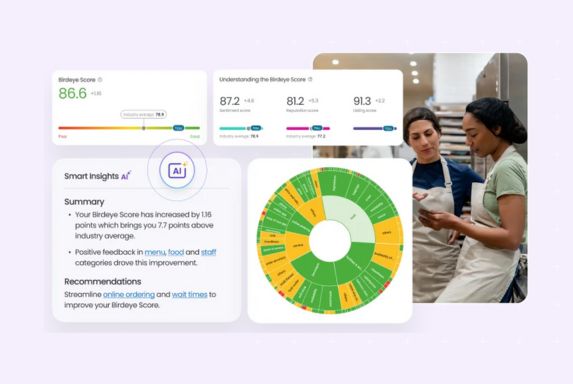
The Birdeye way: It pulls every signal into a single full-cycle platform. This eliminates the “data tax” your team pays by jumping between tabs. Instead of fragments, you get a unified view of every location, reducing blind spots and ensuring decisions are based on complete local data.
2. Think: AI agents provide local Intelligence
Most AI fails because it doesn’t have context. It doesn’t know that Location A is a top-performer while Location B is struggling with staff shortages.
The Birdeye way: The agents have “Location Memory.” They analyze customer feedback, search patterns, and sentiment to show you why performance is changing. You aren’t just scanning dashboards; you’re getting prioritized action plans. This allows you to address issues at one location before they scale into brand-wide problems.
3. Act: Execute at scale with brand-trained AI Agents
The biggest bottleneck in multi-location marketing is the sheer volume of “micro-tasks”—responding to every review, updating holiday hours, or posting local social content.
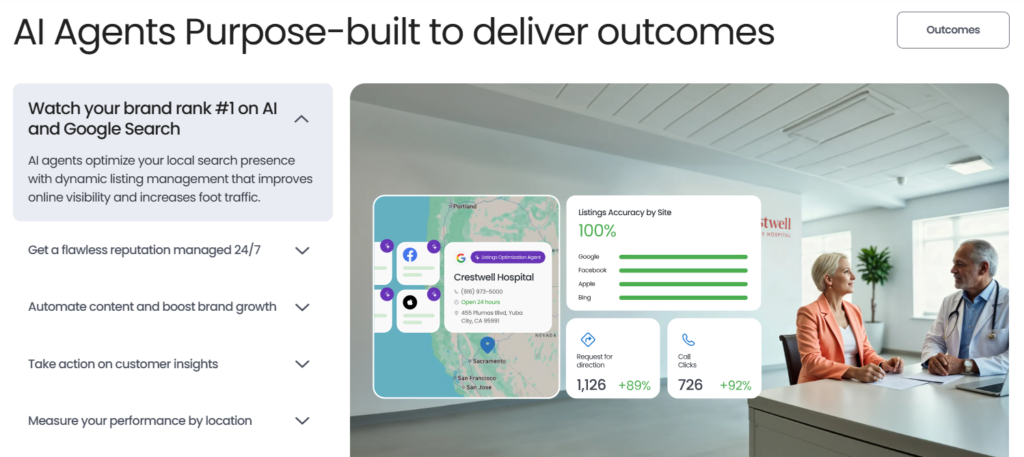
The Birdeye way: It deploys brand-trained AI agents to do the heavy lifting. These agents draft responses and create content that is contextually accurate for every specific location.
Human-in-the-loop: You maintain 100% control. The agents recommend, and your team approves. This allows you to 10x your marketing capacity without adding a single person to your headcount.
Where Birdeye fits into this
Birdeye is the only platform built specifically for the complexity of multi-location brands. While others offer generic AI features, Birdeye provides a unified data layer paired with autonomous agents across Reviews, Listings, Social, and Messaging.
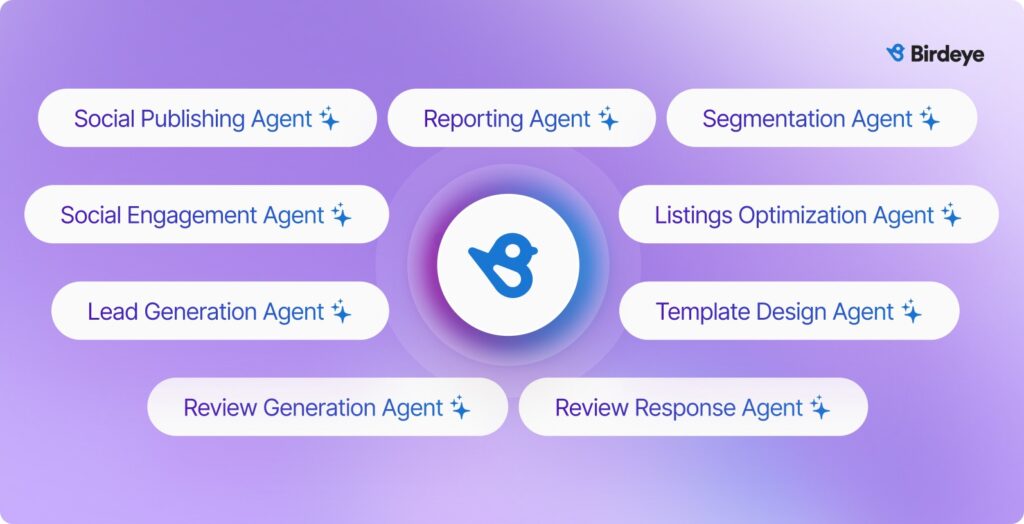
| Agent | Core marketing job | Key outcome |
| Review Generation | Identifies the best moment to send review requests based on past engagement. | Increased review volume. |
| Review Response | Analyzes sentiment and images to craft on-brand replies to every review. | 100% response rate. |
| Listings Optimization | Scans profiles for gaps and updates keywords to match industry trends. | Higher local SEO rankings. |
| Social Publishing | Unearths trending themes and generates a ready-to-publish local content calendar. | Increased brand reach. |
| Social Engagement | Triage and respond to comments; filter spam and escalate sensitive issues. | Improved response times. |
| Lead Generation | Engages website visitors 24/7 to qualify and route leads to the right location. | More conversions. |
| Reporting | Analyzes performance trends across locations via a natural language chat interface. | Faster actionable insights. |
| Segmentation | Dynamically builds audience lists for campaigns using chat commands. | Precision targeting. |
| Template Design | Instantly generates brand-aligned emails, texts, and landing pages. | Consistent brand voice. |
The Birdeye difference: Purpose-built for complexity
Birdeye’s agents are “multi-location aware.” This means they can distinguish between Location A (a high-performing site with a 2-minute wait) and Location B (a struggling site with a 45-minute wait) and adjust their marketing responses accordingly. They also come with built-in Industry compliance, ensuring AI doesn’t accidentally violate HIPAA or FTC regulations.
Birdeye’s agentic marketing platform is engineered specifically for the multi-location enterprise:
- Location-aware intelligence: Our agents use unified signals from your CDP—including local competitive insights and specific store performance to make every communication feel hyper-local.
- Governance built in: We provide enterprise-grade controls, including role-based access control (RBAC), tiered approvals, and audit logs. Your corporate team sets the strategy; the agents execute, but a human-in-the-loop always has the final sign-off.
- Enterprise-grade security: Birdeye is the only platform in our category that is SOC 2 Type II certified, HIPAA-ready with a BAA available, and fully GDPR/CCPA compliant.
Awards & recognition
Birdeye isn’t just self-proclaimed; it is the most-awarded and highest-rated platform for multi-location brands.
Birdeye is consistently ranked as a Leader in G2’s Enterprise reports for Agentic AI, Reputation Management, Local SEO, and Customer Service.
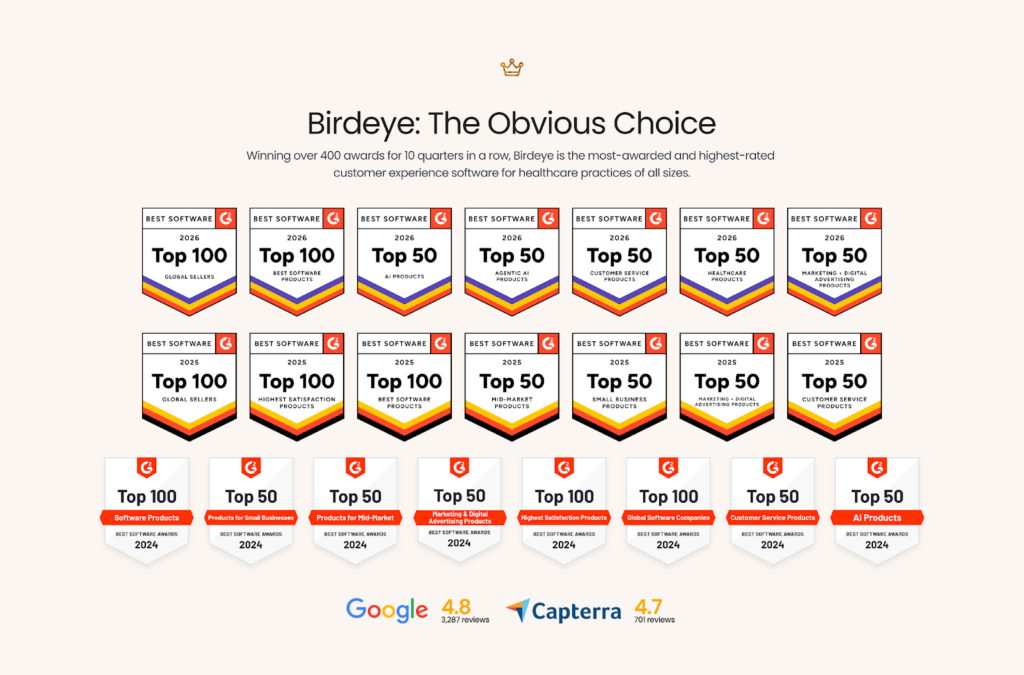
Capterra & Software Advice: Consistently rated 4.7/5 stars. Birdeye is frequently cited as the top choice for multi-location brands due to its Local Intelligence and ease of use.
Google Premier Partner Program: Recognized for enhancing brands’ local search performance.
Unlike point solutions that focus on a single niche, Birdeye is consistently recognized across both enterprise software and AI product categories.
"Earning a Leader position in a G2 Report is highly competitive and rooted in verified customer reviews. Congratulations to Birdeye for achieving this distinction." — Godard Abel, CEO of G2
What are some ethical implementations of AI in multi-location marketing
While AI brings immense value to multi-location marketing, it is essential to implement it ethically. Here are some key considerations:
1. Transparency in data usage
Be transparent with customers about how their data is being used to personalize marketing efforts. Ensure compliance with privacy regulations such as the GDPR or the CCPA.
2. Bias-free algorithms
AI models can sometimes reflect biases present in the data they are trained on. Regularly audit your AI tools for biases that could unfairly impact certain customer segments or geographic areas.
3. Avoiding over-automation
While AI can automate many aspects of marketing, it’s essential not to over-rely on it for customer interactions. Maintain a balance between automation and human engagement to ensure your brand feels authentic.
4. Ethical data collection
Ensure that customer data is collected ethically, with their consent, and used responsibly. Avoid using AI in ways that might feel intrusive or manipulative to customers.
What does the future of AI look like in multi-location marketing?
AI will continue to advance in areas like predictive analytics, hyper-personalization, and voice search optimization. The future of AI in multi-location management includes deeper insights, automated decision-making, and more integrated platforms for seamless marketing workflows.
Conclusion
AI in multi-location marketing isn’t just a trend; it’s a transformative tool that enhances local search optimization, reputation management, social media engagement, and customer experience across all your locations.
AI offers new opportunities to scale marketing strategies, improve customer support, and make data-driven decisions. However, it’s essential to implement AI ethically, ensuring transparency and fairness in how data is used and how customers are engaged.
Ultimately, AI provides the power to revolutionize multi-location marketing, making it more efficient, effective, and customer-centric.
Frequently asked questions on AI in multi-location marketing
AI enhances local search by automating the optimization of business listings, updating location-specific SEO strategies, and analyzing local search trends. This ensures higher visibility and better search rankings for each location without manual intervention.
AI helps businesses monitor and manage reviews across all locations, automate responses, and analyze customer feedback for sentiment. This reduces the time spent on manual reputation management and improves overall customer satisfaction by addressing issues promptly.
To implement AI ethically, businesses must ensure transparency in data usage, prevent bias in AI algorithms, and maintain a balance between automation and human interaction. AI tools should comply with privacy laws like GDPR and CCPA, ensuring responsible data handling.
Unlike generic AI, Birdeye agents are “brand-trained.” You feed the platform your brand guidelines, tone of voice, and approved terminology. The agents then draft local content—like review responses or social posts within those guardrails. With human-in-the-loop workflows, your corporate team maintains 100% oversight, approving or editing drafts before they ever go live.
Assistive AI (like a basic chatbot or ChatGPT) requires you to do the work—you write the prompt, you copy-paste the data, and you hit send. An agentic platform like Birdeye uses autonomous agents to complete the “marketing job” end-to-end. It identifies a gap (such as a missing listing or an unanswered review), drafts the solution, and handles execution.
Yes. Birdeye is purpose-built for regulated industries. Our agents are governed by enterprise-grade security and compliance filters that prevent the “hallucinations” common in generic models. We are SOC 2 Type II certified and HIPAA-ready, ensuring that every automated interaction meets strict legal and brand standards.
Master multi-location marketing with Birdeye’s purpose-built AI Agents
Managing hundreds of locations shouldn’t mean managing hundreds of manual tasks. Operational silos and inconsistent execution are the “complexity tax” that stalls your growth.
Birdeye’s agentic marketing platform is the ultimate solution for turning that complexity into a competitive advantage. By consolidating your data and deploying brand-trained marketing agents, you move from a reactive stance to a proactive growth strategy:
- Reputation & search: Agents automate review collection and optimize local SEO in real-time.
- Social & engagement: Agents unearth local trends and generate contextually accurate social calendars.
- Insights & action: Agents perform root-cause analysis across your entire footprint to show you exactly where to invest next.
The result: A centralized, agentic approach that simplifies operations, amplifies engagement, and drives 10x marketing capacity across all locations. With Birdeye, you don’t just keep up with the shift to AI—you lead the category.

About the Author

Avtar Madan
Avtar Madan
Originally published

![[Feature image] Customer success vs customer experience- The high-stakes difference businesses must master in 2025](https://birdeye.com/blog/wp-content/uploads/Feature-image-Customer-success-vs-customer-experience-The-high-stakes-difference-businesses-must-master-in-2025-375x195.png)