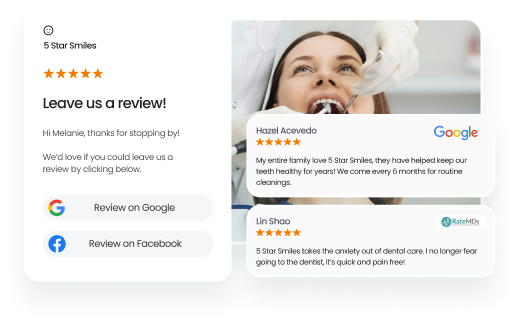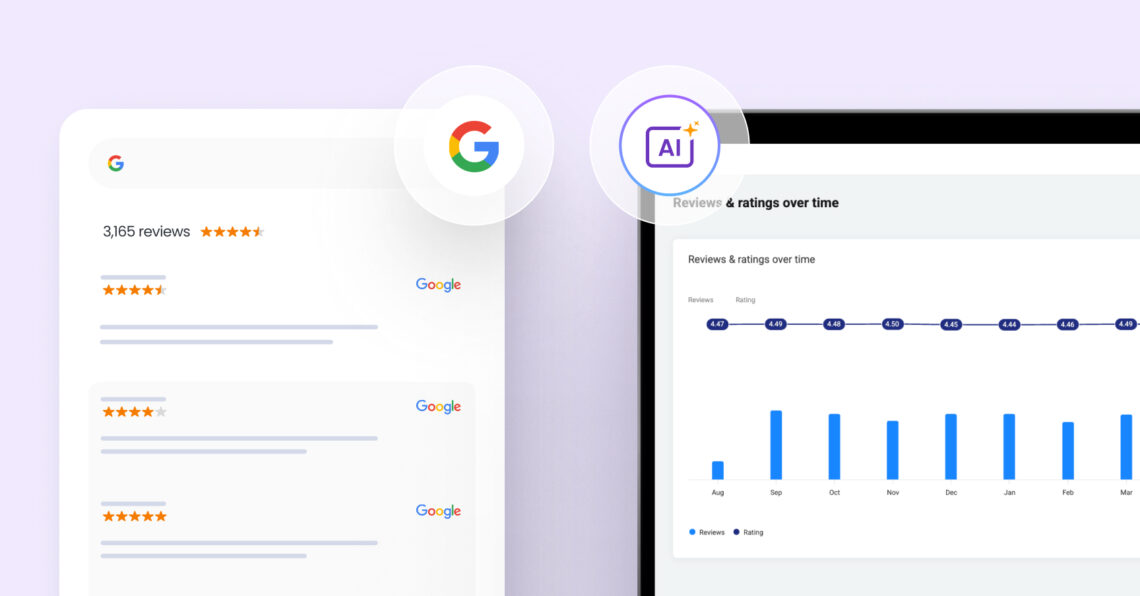
Google review management software helps businesses collect feedback, respond efficiently, and monitor reputation across locations. Platforms with automation and analytics enable companies to handle large review volumes while ensuring consistency and compliance.
Summary
The review management software market is projected to nearly double from $3.77 billion in 2025 to $7.75 billion by 2034, reflecting growing reliance on technology-driven insights. Businesses leverage these platforms to analyze sentiment trends, identify recurring issues, compare performance across locations, and integrate customer feedback into decision-making. Modern systems transform unstructured reviews into actionable guidance, helping marketing and leadership teams prioritize initiatives and fine-tune strategies for measurable impact.
In this blog post, we examine the top Google review management software platforms in 2026, highlight their automation and analytics features, and provide guidance to evaluate ROI for smarter reputation management and business growth.
Table of contents
- Why do Google reviews matter for revenue and local visibility?
- Top Google Review Management Software compared
- 7 best Google Review Management Tools in 2026
- What to look for in Google Review Management Software in 2026?
- Case study: How Moss & Company scaled review management across 300+ locations with Birdeye Reviews AI
- FAQs about Google review software management solution
- Conclusion
Why do Google reviews matter for revenue and local visibility?
Google reviews have moved far beyond social proof; they are now a direct driver of revenue growth. A consistent stream of reviews improves local search visibility and encourages more people to engage with your brand. According to Birdeye’s State of Online Reviews 2025 report, 81% of all reviews appear on Google, making it the most influential review platform for local businesses. The report also highlights that the average review response rate is 73%, and reminder nudges increase review responses by 9%, demonstrating how consistent review engagement can amplify feedback volume.
Reviews are also gaining importance in emerging discovery experiences. As AI-generated summaries become more prominent in search results, reputation signals such as star ratings, review sentiment, and response activity increasingly influence what information appears in these summaries. In fact, 60% of consumers click on AI-generated overviews in Google Search that often incorporate reputation signals like ratings and reviews.
Key business impacts include:
- Local SEO lift: Google reviews directly affect visibility in the local map pack
- Trust and credibility: Star ratings instantly shape customer perception
- Conversion impact: More reviews = higher purchase confidence
For multi-location brands, scaling review generation across locations often leads to stronger visibility and increased customer acquisition.
Impact on local search ranking
Beyond influencing customer perception, Google explicitly factors reviews into its ranking algorithm under the principle of prominence. Businesses with more, fresher, and higher-quality reviews often outrank competitors.
Ranking factors include:
- Average rating (higher is better)
- Review velocity – the speed at which new reviews appear
- Keyword usage in reviews (e.g., “best dentist near me”)
- Review recency (fresh feedback carries weight)
- Review volume (higher is better)
Together, these signals combine to enhance local pack visibility, providing businesses with a tangible competitive advantage.
Influence on customer trust and conversions
Beyond algorithms, reviews shape human decision-making. Star ratings serve as instant indicators of trust and significantly influence purchasing decisions. Research reveals that 92% of consumers hesitate to buy from businesses with ratings below 4 stars, underscoring the significant impact of Google review software management solutions on conversions.
Top Google Review Management Software compared
Understanding platform differences through side-by-side comparison saves research time and ensures you select the best Google review management software for your specific needs.
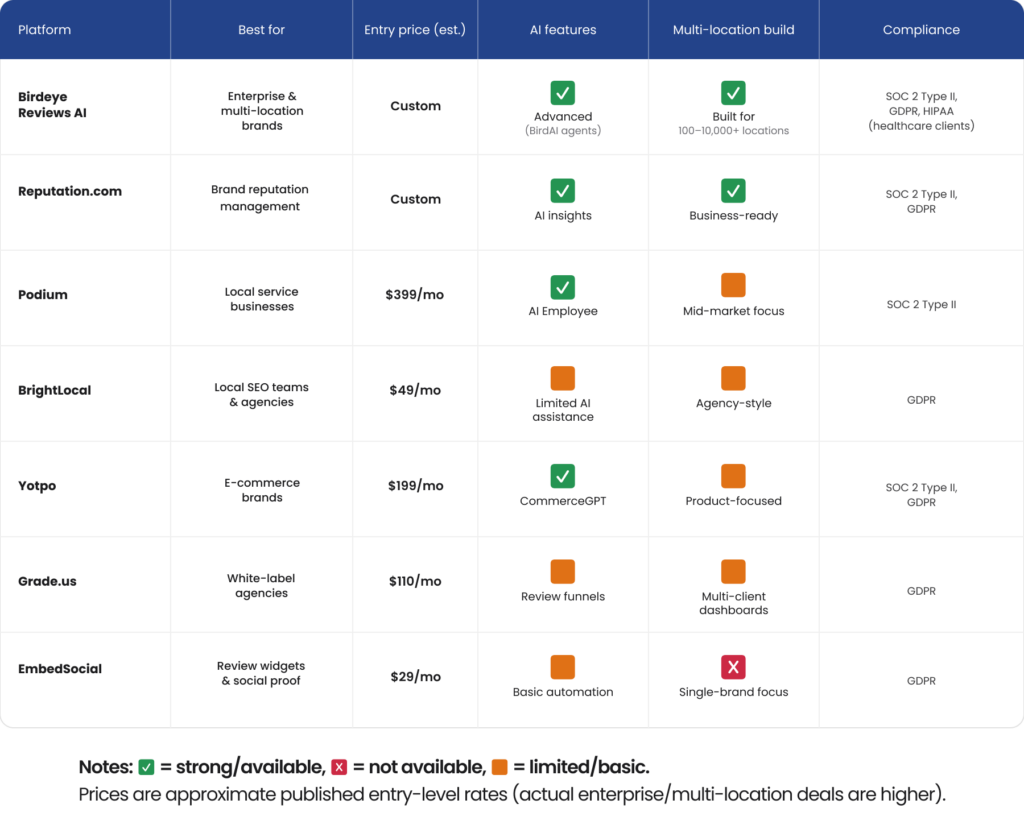
Notes:
✅ = strong/available, ❌ = not available, 🟧 = limited/basic.
Prices are approximate published entry-level rates (actual enterprise/multi-location deals are higher).
7 best Google Review Management Tools in 2026
Google review management platforms now do far more than monitor feedback. They help brands generate reviews, respond to customers at scale, analyze sentiment trends, and maintain a consistent reputation across locations.
The following tools help brands streamline review collection, manage responses, and convert customer feedback into insights that improve visibility and customer experience.
1. Birdeye Reviews AI
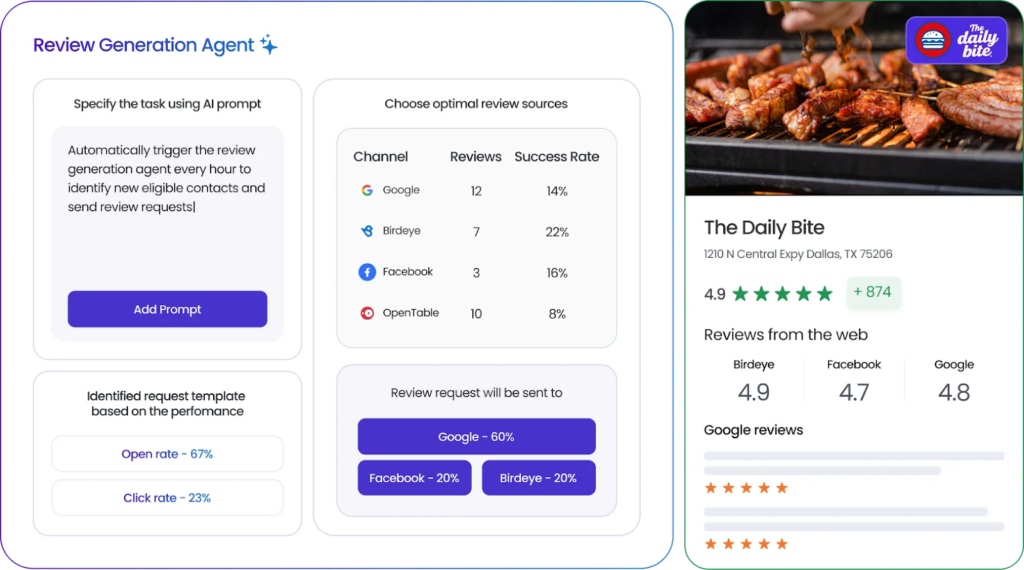
Birdeye is the #1 agentic marketing platform for multi-location brands. Birdeye helps you consolidate feedback, think locally, and act with AI agents to manage reviews at scale. As the leading agentic marketing platform, Birdeye deploys brand-trained AI agents to help multi-location enterprises generate, manage, and respond to reviews autonomously.
Built for multi-location brands, Birdeye Reviews AI helps brands generate, manage, and respond to customer reviews at scale using agentic AI. The platform automates review requests, monitors feedback across sites, and enables consistent responses from a centralized dashboard. Global brands in healthcare, automotive, retail, property management, and home services use Birdeye to standardize review management and enhance visibility across 100-10,000+ locations.
Features:
- Review Generation Agent: Automatically sends review requests through SMS, email, or integrated workflows at the right moment in the customer journey. The agent selects the most effective review channel and message to increase response rates and maintain a steady flow of customer feedback.
- Review Response Agent: Generates personalized, on-brand responses by analyzing review sentiment, urgency, and context. Brands can create thoughtful replies while maintaining a consistent voice across thousands of locations.
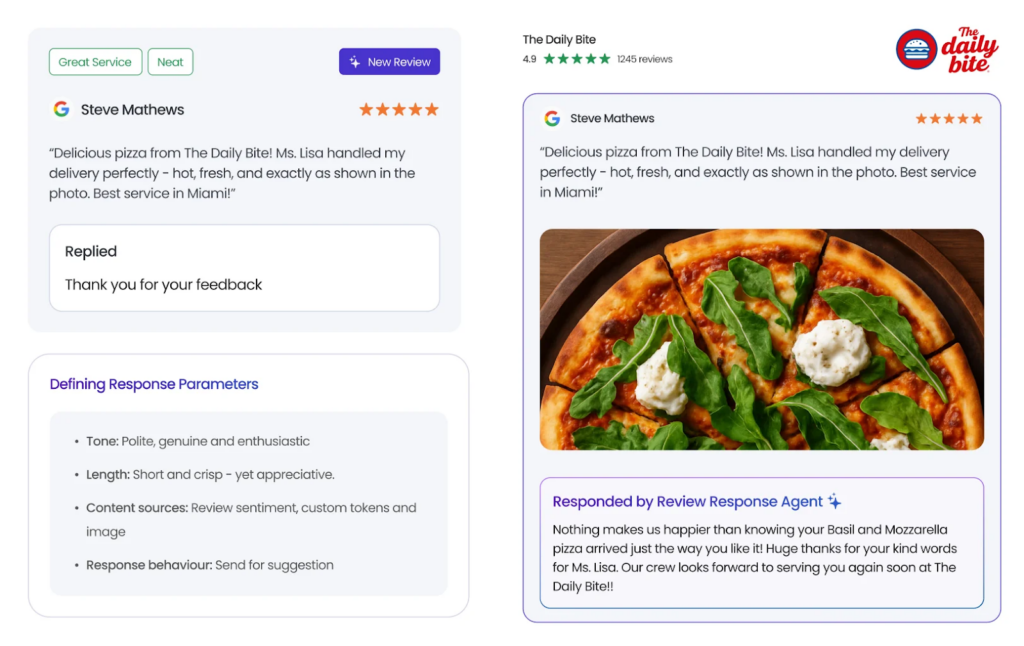
- Review Reporting Agent: Turns review data into clear insights by identifying trends, highlighting recurring issues, and tracking performance across locations. Teams can quickly understand what customers appreciate and where improvements are needed.
- Review monitoring: Tracks reviews across 200+ review platforms from a centralized dashboard, helping brands monitor feedback and maintain a consistent reputation wherever customers search.
- Review widgets: Displays top reviews on brand websites using customizable widgets and summarized highlights, giving visitors a clear snapshot of customer experiences.
- Social sharing for reviews: Converts positive reviews into ready-to-share social media posts using customizable templates, helping brands promote authentic customer feedback.
- Reputation score tracking: Provides a unified reputation score across locations by analyzing star ratings, review volume, and response activity to measure brand perception over time.
- Competitive benchmarking: Analyzes competitor reviews and ratings to help brands compare reputation performance and identify opportunities to strengthen their online presence.
Pros
- Built specifically for multi-location brands
- Advanced AI agents for review generation, responses, and reporting
- Centralized monitoring across hundreds of review platforms
- Strong analytics and competitive benchmarking
Cons
- Birdeye offers a wide range of AI tools for reviews, messaging, and social media management on one platform. New users may need some time to explore all the features. However, the intuitive dashboard and onboarding resources help teams get up to speed quickly and manage daily tasks efficiently.
Best for: Enterprise and multi-location brands that need centralized review management, automated feedback collection, and reputation insights across thousands of locations.
Pricing: Custom enterprise pricing based on locations and features.
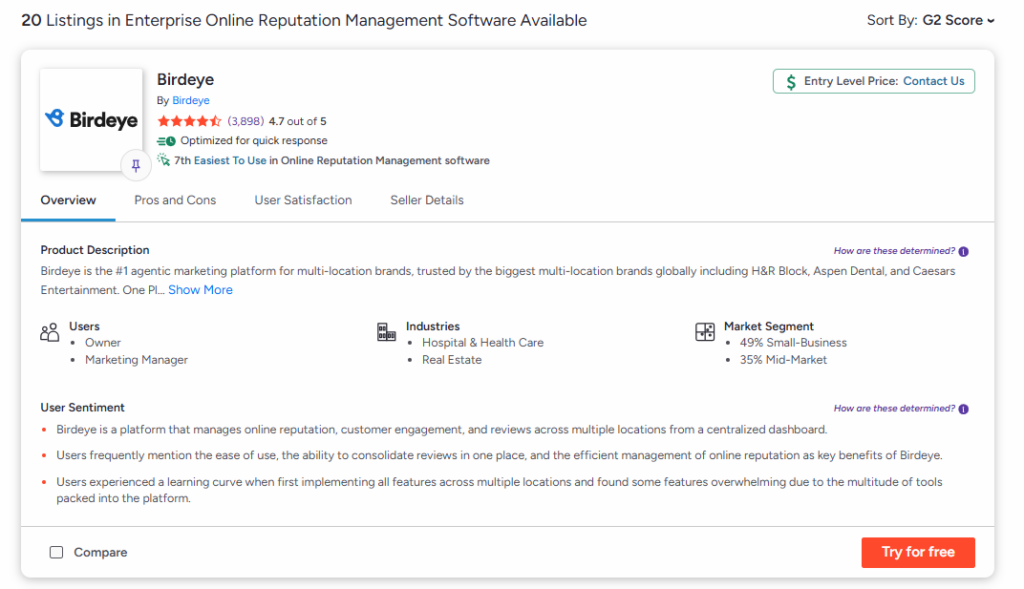
As per G2, Birdeye is No. 1 Enterprise Online Reputation Management Software. 4.7/5 with 3,860+ reviews
2. EmbedSocial
EmbedSocial helps businesses collect and display customer reviews and social media content on their websites. The platform connects to sources like Google, Facebook, and Instagram to automatically aggregate reviews and user-generated content. Brands use EmbedSocial to showcase customer experiences through customizable widgets that add social proof to landing pages and websites. This makes it easier to highlight authentic feedback and strengthen visitor trust.
Features:
- Review aggregation: Collects reviews from Google, Facebook, and other platforms into a centralized dashboard.
- Website review widgets: Display reviews with customizable layouts, including carousels, grids, and sliders.
- Content moderation: Allows brands to filter and approve which reviews appear on their website.
- Social media feeds: Embeds Instagram and other social content alongside reviews on web pages.
- Schema markup: Adds structured data that helps star ratings appear in Google search results.
Pros
- Offers the most diverse and visually appealing templates (sliders, grids, pop-ups) for displaying reviews.
- Easily pulls in content from Google, Facebook, Instagram, and TikTok in one feed.
- Optimized for page speed, ensuring that social proof widgets don’t hurt website performance.
Cons
- Primarily a display tool; its management and response-automation features are less robust than those of full-service platforms.
- Not designed to provide deep sentiment analytics or complex “roll-up” reporting for large brands.
Best for: Brands that want to display Google reviews and social proof directly on their website using customizable widgets.
Pricing: Starts at approximately $29 per month.
G2 reviews & ratings: 4.9/5 with 100+ reviews
3. Podium
Podium is a customer communication and lead-conversion platform built on AI-powered automation. The platform uses its “AI Employee” to respond to leads, manage conversations, and request reviews across channels such as SMS, web chat, and messaging platforms. Many local service brands use Podium to increase review volume by requesting feedback immediately after customer interactions through text messaging.
Features:
- Review requests: Sends automated SMS invitations encouraging customers to leave reviews on Google and other platforms.
- Unified inbox: Consolidates conversations from text messages, website chat, and review platforms into one dashboard.
- Response suggestions: Provides reply recommendations that help teams respond to reviews and messages quickly.
- Customer messaging: Enables communication with customers through SMS, web chat, and social messaging channels.
- Performance reporting: Tracks review volume, response rates, and customer engagement metrics.
Pros
- Effective at handling after-hours leads and automatically requesting reviews via high-conversion SMS.
- Mobile app allows field technicians or floor staff to manage reviews and messages on the go.
- Seamlessly connects the initial inquiry to the final review request in one continuous text thread.
Cons
- Pricing can feel steep for small businesses as they add more “AI Employee” seats.
- Some users report that leaving the platform can be difficult due to strict contract terms.
Best for: Local service businesses that want AI-driven messaging, lead response automation, and review collection within one communication platform.
Pricing: Starts at approximately $399 per month.
G2 reviews & ratings: 4.6/5 with 1800+ reviews
4. BrightLocal
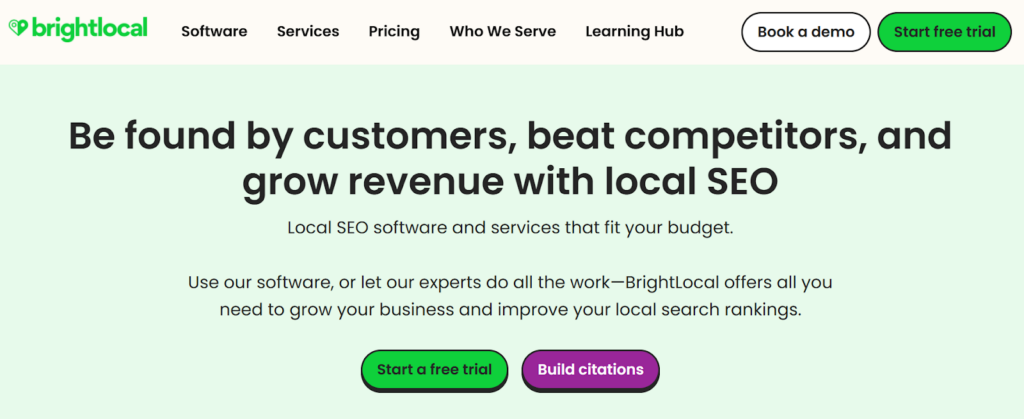
BrightLocal provides local SEO and reputation management software that helps brands monitor reviews, track search rankings, and manage directory citations. The platform is widely used by marketing teams and agencies focused on improving local search visibility. Brands use BrightLocal to understand how their locations appear in Google Maps and identify opportunities to improve search performance.
Features:
- Review monitoring: Tracks reviews across Google and other major platforms and alerts teams when new feedback appears.
- Review generation campaigns: Send automated email and SMS requests encouraging customers to leave reviews.
- Local rank tracking: Measures search rankings for location-based keywords across geographic areas.
- Citation management: Audits and updates directory listings to maintain accurate location information.
- SEO reporting: Generates detailed reports that track local search and reputation performance.
Pros
- Unrivaled citation tracking and local rank monitoring that shows exactly where you appear in the “Map Pack.”
- Flexible plans allow agencies to manage dozens of small clients cost-effectively.
- Clean, professional reports that can be fully rebranded for client presentations.
Cons
- While adding more AI in 2026, it still functions more as a “tool for SEOs” than a fully autonomous agent.
- Running deep manual reports across many locations can be slower than on high-tier platforms.
Best for: Marketing teams and agencies focused on improving local SEO performance and managing reviews across multiple locations.
Pricing: Starts at approximately $49–$60 per month, depending on plan and features.
G2 reviews & ratings: 4.6/5 with 200+ reviews.
5. Yotpo
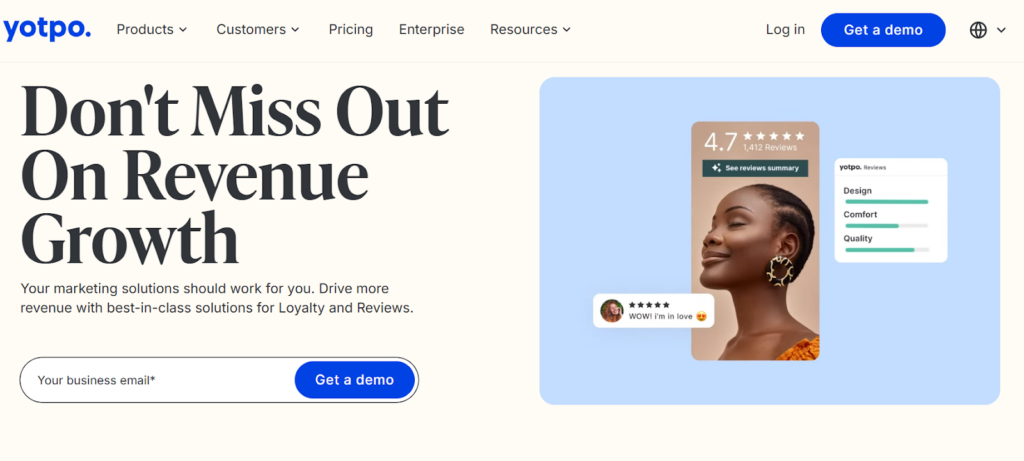
Yotpo provides a customer content and retention platform built primarily for e-commerce brands. It helps businesses collect product reviews, ratings, photos, and videos that support purchase decisions and build trust with shoppers. Brands use Yotpo to display customer feedback across product pages, websites, and marketing campaigns. While its core focus is product reviews, Yotpo also includes SMS marketing, loyalty programs, and customer engagement tools to strengthen relationships and encourage repeat purchases.
Features:
- Product review collection: Automatically sends post-purchase emails and SMS requests inviting customers to leave product reviews.
- Review display widgets: Publish ratings and reviews directly on product pages to help shoppers evaluate products.
- User-generated content: Collects customer photos and videos that brands can showcase across websites and marketing campaigns.
- Review syndication: Shares reviews across multiple storefronts and retail partners to extend social proof.
- Loyalty integration: Connects review activity with rewards programs that encourage repeat purchases.
Pros
- “CommerceGPT” helps automate product review collection and display, specifically optimized for online storefronts.
- Exceptional at turning customer-uploaded photos and videos into high-converting gallery widgets.
- Natively rewards customers with points or discounts for leaving reviews, boosting retention.
Cons
- Strong for product reviews, but lacks the features needed to manage Google Business Profiles across physical locations.
- Large widget scripts can sometimes slow down storefronts if not properly optimized.
Best for: E-commerce brands that want to collect product reviews and showcase social proof across online storefronts.
Pricing: Free plan available; paid plans start around $199 per month.
G2 reviews & ratings: 4.3/5 with 250+ reviews
6. Reputation.com
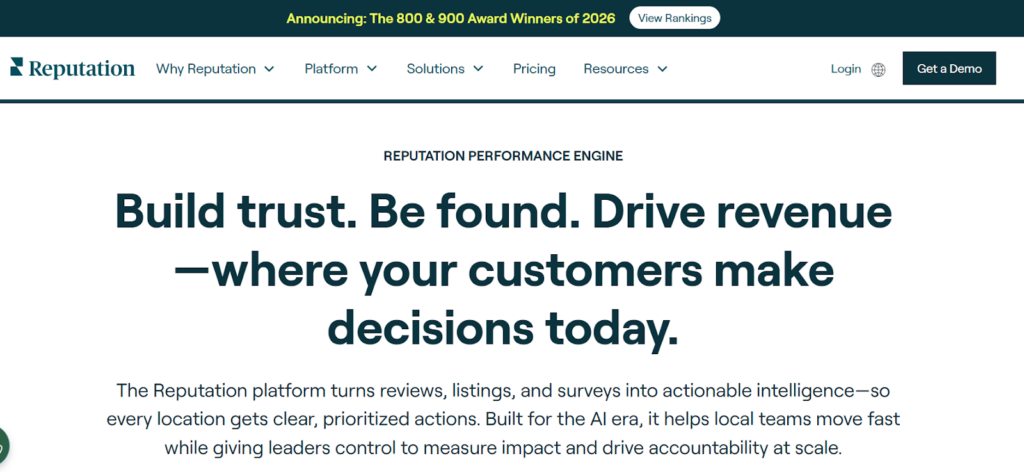
Reputation.com provides reputation management software that combines review monitoring, customer experience analytics, and listings management. The platform enables brands to track reviews across locations and analyze customer sentiment trends. Businesses use it to monitor reputation signals, respond to customer feedback, and understand how reviews impact brand perception and search visibility.
Features:
- Review monitoring: Tracks reviews across major review platforms and enables teams to respond from a centralized dashboard.
- Listings management: Maintains accurate business information across search engines, maps, and online directories.
- Sentiment analysis: Analyzes review content to identify customer experience trends and recurring feedback themes.
- Reputation score tracking: Provides reputation metrics that measure brand perception across locations.
- Performance analytics: Generates reports that highlight review trends, response activity, and customer satisfaction insights.
Pros
- NLP tools that break down review text into specific operational insights across business units.
- Proprietary metric that helps brands benchmark performance against industry competitors.
- Allows teams to customize their dashboard to focus specifically on reviews, listings, or social media.
Cons
- Onboarding and initial configuration often require professional services or extensive internal training.
- Users occasionally report “lag” when navigating deep reporting features or large-scale social scheduling tools.
Best for: Businesses that want a centralized platform to monitor reviews and analyze customer sentiment.
Pricing: Starts at approximately $80 per location per month
G2 reviews & ratings: 4.6/5 with 2397 reviews
7. Grade.us
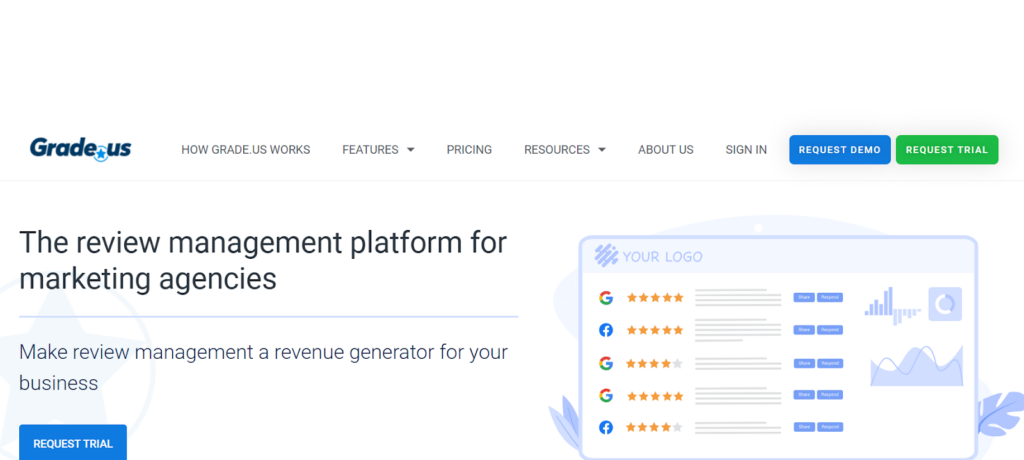
Grade.us provides reputation management software designed primarily for marketing agencies managing reviews for multiple brands. The platform simplifies the process of requesting reviews and guides satisfied customers to public review platforms. Agencies often use Grade.us to manage reputation campaigns for multiple clients through a centralized dashboard.
Features:
- Review funnels: Use customizable landing pages that guide customers through the review submission process.
- Automated review requests: Send email and SMS campaigns encouraging customers to leave reviews.
- White-label platform: Allows agencies to rebrand dashboards, reports, and communications.
- Review monitoring: Tracks feedback across multiple review platforms and aggregates it into a single dashboard.
- Client reporting: Provides reputation performance reports that agencies can share with clients.
Pros
- Uses a unique landing page “funnel” to guide customers through the review process, increasing completion rates.
- Very easy for agencies to put their own logo on the platform and resell it as their own service.
- Good for developers who want to pull review data into custom dashboards.
Cons
- The dashboard interface feels less modern compared to the sleek AI-first designs of newer tools.
- Lacks advanced “Agentic AI” capabilities; it’s more about automated emails than smart, context-aware responses.
Best for: Marketing agencies that manage review campaigns and reputation reporting for multiple brands.
Pricing: Starts at approximately $110 per month.
G2 reviews & ratings: 4.6/5 with 140+ reviews
What to look for in Google Review Management Software in 2026?
Selecting the best Google review platform in 2026 requires evaluating multiple factors that impact both effectiveness and compliance. The right Google ratings tools must combine AI automation, omnichannel review generation, advanced analytics, and built-in compliance safeguards.
Here’s a practical checklist to help evaluate platforms that not only boost your Google ratings but also deliver measurable ROI.
AI automation and smart replies
Modern Google review software management solution leverages natural language processing (NLP) to generate authentic responses that maintain brand voice consistency.
Solutions like Birdeye Reviews AI bring this capability to enterprise and multi-location brands through an Agentic Marketing Platform designed to manage reviews at scale. Agentic AI agents trained on brand guidelines and local context draft nuanced responses that reflect the brand’s voice while accurately addressing customer feedback.
This approach allows large organizations to maintain consistent engagement across hundreds of locations without manual effort. With built-in governance controls and optional human approvals, marketing and operations teams retain oversight while agentic systems manage review responses efficiently and help protect brand trust across every location.
The distinction between basic auto-templates and sophisticated AI is crucial:
- Basic templates: Generic responses that feel robotic
- Advanced AI: Context-aware replies that adapt to sentiment, incorporate review details, and business personality
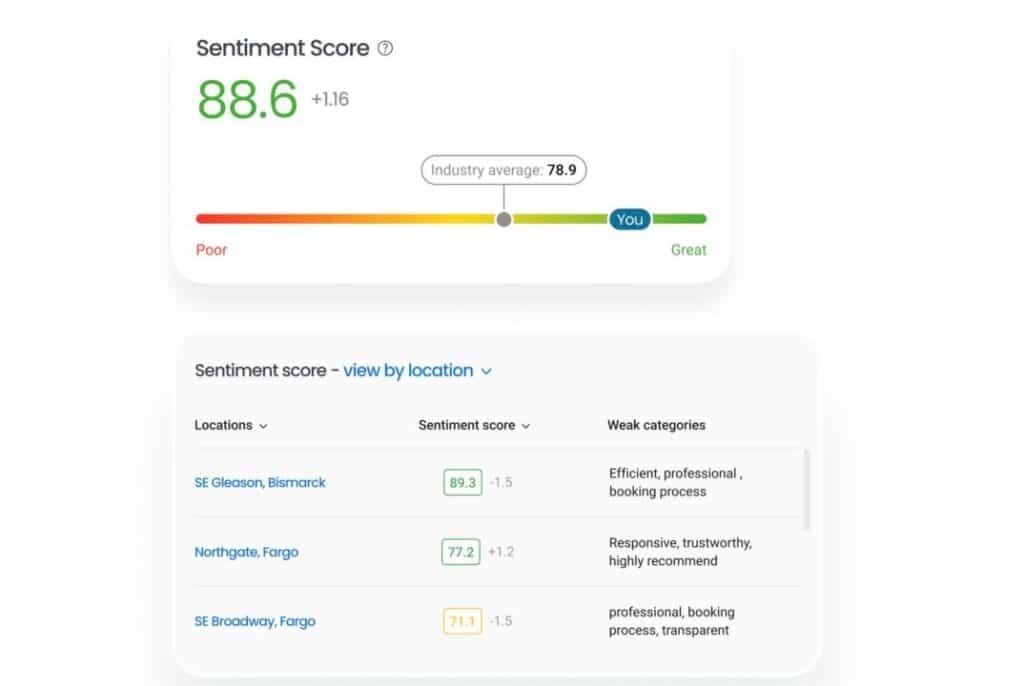
Sentiment analysis plays a vital role here, defined as the process of using NLP to classify opinion as positive, negative, or neutral, enabling appropriate response strategies for different review types. For example, empathetic replies to negative reviews and enthusiastic reinforcement for positive ones.
Pro Tip: As consumer behavior shifts from typing keywords into search engines to asking complex questions on AI platforms, your digital strategy must also evolve. Birdeye Search AI helps multi-location brands track and optimize their visibility on next-generation search engines like ChatGPT, Perplexity, and Gemini. While it is built for AI-driven discovery, it also strengthens the fundamentals that improve local SEO across classic search results.
Review generation and request channels
Maximizing review generation and response rates requires using the proper channels at the right time. The best platforms enable outreach via SMS, email, QR codes, and WhatsApp integration, giving customers multiple ways to leave feedback and increasing the likelihood they’ll respond.
Channel performance varies significantly:
- SMS: 98% open rate, ideal for immediate post-purchase review requests
- Email: 20% open rate, suitable for follow-up sequences
However, compliance is critical. Google’s policy explicitly prohibits incentives for reviews, making organic request strategies essential. Effective platforms like Birdeye ensure request channels follow Google guidelines while maximizing response rates through timing and personalization.
Pro Tip: Send review requests 24–48 hours after purchase, giving customers time to experience your product or service fully before sharing feedback.
Analytics, reporting, and ROI tracking
Comprehensive analytics separate professional-grade platforms from basic tools. Must-have metrics include:
- Star distribution: Breakdown of ratings across 1-5 stars
- Response time: Average time to respond to reviews
- Keyword sentiment: Topics mentioned in positive vs. negative feedback
- Revenue attribution: Connection between review improvements and sales outcomes
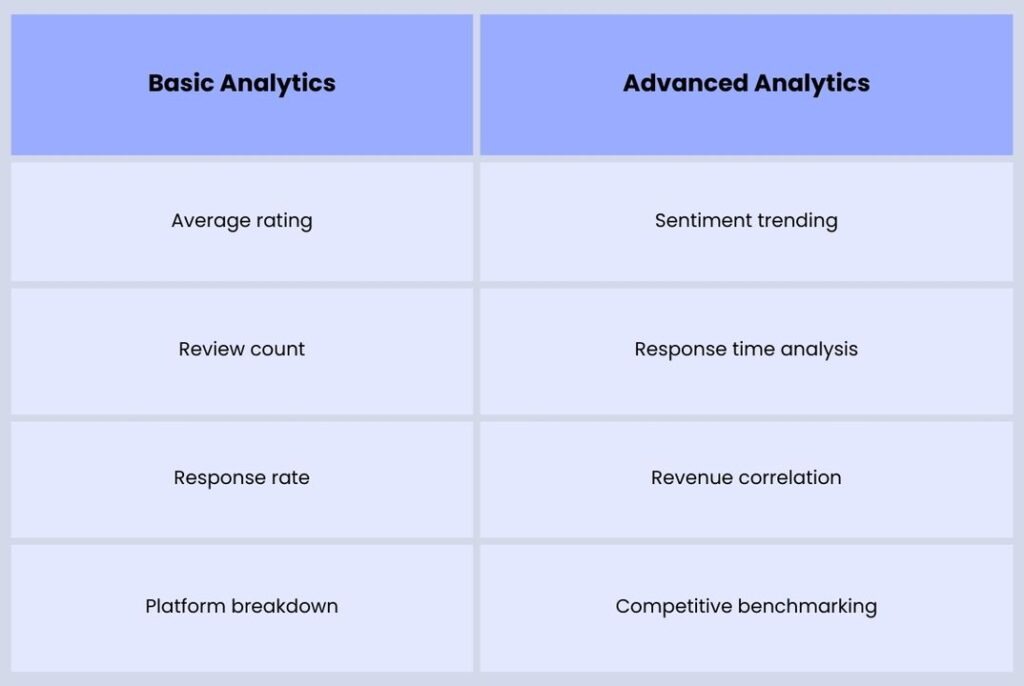
Advanced platforms provide automated alerts for negative reviews and multi-location roll-ups for enterprise users, enabling proactive reputation management across dozens or hundreds of sites.
Compliance with Google policies
Google continuously updates review policies, making compliance features essential. Your chosen platform should actively prevent policy violations through built-in safeguards.
Compliance checklist for review software:
- Flags suspicious review patterns
- Enforces one review request per customer
- Logs proof of legitimate review requests
- Prevents review-gating practices
Do you know? Review gating refers to the prohibited practice of filtering customers before asking for public reviews (e.g., only asking satisfied customers to leave Google reviews). Quality review platforms prevent this automatically.
Case study: How Moss & Company scaled review management across 300+ locations with Birdeye Reviews AI
Moss & Company, a property management firm with over 14,000 apartment units and 300+ locations, struggled with reviews scattered across multiple rating sites and no streamlined process to track or respond. Staff had to manually check platforms, making it hard to manage feedback consistently.
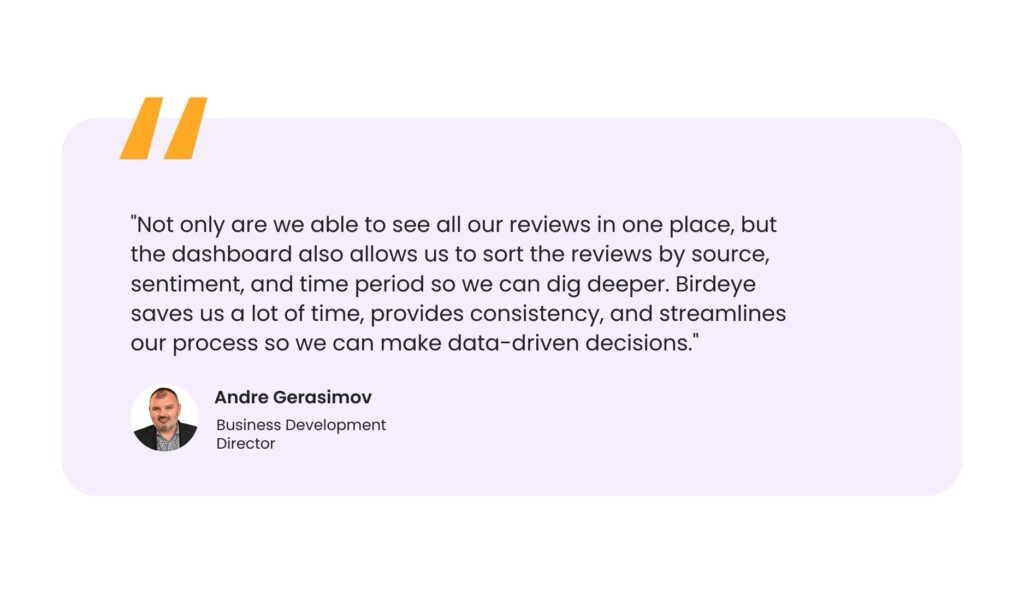
With Birdeye, Moss centralized reviews from every property into one dashboard, enabling the team to monitor, sort, and respond quickly. Automated review requests through Yardi integrations boosted feedback collection at critical touchpoints like move-ins, move-outs, and service requests.
Results with Birdeye:
- 62% increase in new reviews
- 141% more reviews responded to
- Centralized visibility into sentiment and property-level performance
- Actionable insights to guide staff training and improve service quality
Learn more about Birdeye and Moss & Company case study
FAQs about Google review software management solution
Google review management software helps brands collect, monitor, and respond to Google reviews from one platform. It uses automation, analytics, and AI to manage online reputation across multiple locations.
Most review management tools manage reviews across multiple platforms, including Google, Facebook, Yelp, and other industry directories. Brands can track and respond to all reviews from a single dashboard.
Brands manage review responses across languages and locations using centralized dashboards and AI-powered response tools. These platforms generate responses in multiple languages and help teams respond consistently across locations.
Yes. Advanced platforms use LLM-driven sentiment analysis and pattern recognition to flag suspicious or harmful reviews. Birdeye, for example, identifies inconsistencies, highlights reputation risks, and guides businesses on next steps. This proactive detection improves brand accuracy in AI search results and helps prevent negative sentiment from shaping how AI engines describe your business.
Birdeye’s AI agents analyze review sentiment, apply business context, and keep responses on-brand. Staff can review and edit before publishing, ensuring authenticity. The system learns from edits over time, making replies smarter and more natural.
Birdeye, a Google-certified partner, helps you to stay compliant with Google’s review policies. It blocks incentivized requests, logs every invitation, and flags suspicious activity. Staying compliant is simple: never gate reviews or offer discounts for feedback.
The effective platforms combine AI search optimization with review management. The best Google review management software, like Birdeye Reviews AI, not only manages Google reviews but also ensures your brand is cited accurately in AI search results. By unifying reviews, listings, and sentiment tracking, Birdeye helps multi-location brands stay visible and trusted.
Conclusion
The Google review management software landscape in 2026 offers unprecedented opportunities for businesses to automate reputation management while maintaining authenticity and compliance. Thus, managing Google reviews is about converting insights into stronger trust and business growth. Ask yourself:
- Do you know how fast your team’s response time really is?
- Are you acting on every alert when a customer leaves a review?
- Can you easily manage reviews across locations and save time while doing it?
- Do your tools provide real-time notifications so you can respond quickly before issues escalate?
This is where Birdeye makes the difference. With AI-powered automation, certified Google integrations, and enterprise-grade scalability, it equips brandsto stay ahead.
You’ll capture authentic reviews, get smarter customer insights, respond faster, and ultimately drive more revenue from every customer interaction.
The businesses that win in local search tomorrow will be those that automate intelligently, monitor continuously, and optimize every touchpoint today.
Ready to put your review strategy to the test? Watch a Birdeye demo and see how smarter review management helps you save time, respond faster, and grow stronger.

About the Author

Vanjana Sharma
Originally published





![[Feature image] The Best Marketing Platforms for Multi-Location Brands](https://birdeye.com/blog/wp-content/uploads/Feature-image-The-Best-Marketing-Platforms-for-Multi-Location-Brands-375x195.png)