Healthcare reputation management software, including Birdeye, rater8, etc., helps healthcare organizations manage patient feedback, monitor online reviews, and maintain accurate listings. It also improves visibility across search and AI-driven discovery channels that influence patient choice.
Summary
Healthcare reputation management software varies significantly in how it supports review tracking, listings accuracy, and patient engagement across digital touchpoints. Some platforms are designed for focused review management, while others extend into broader workflows across communication, monitoring, and multi-location oversight.
In this blog, you will find a detailed breakdown of the top 10 healthcare reputation management software in 2026, along with how each differs in approach, focus areas, and suitability across healthcare organizations of varying size and complexity.
Table of contents
- What is healthcare reputation management software?
- What are the key criteria for choosing healthcare reputation management software
- What are the 10 best healthcare reputation management software platforms in 2026
- What are the top healthcare reputation management trends in 2026
- How Birdeye helps healthcare providers improve online reputation
- FAQs
- Conclusion
What is healthcare reputation management software?
Healthcare reputation management software helps healthcare providers actively manage their online image by centralizing the collection and review of patient feedback. It enables practices to gather and monitor reviews from platforms such as Google and Healthgrades, analyze patient sentiment to identify trends in care experience, and maintain secure, HIPAA-compliant communication throughout all patient interactions.
How we evaluated these healthcare reputation management platforms (Methodology)

We evaluated healthcare reputation management tools across key operational and compliance factors based on eight critical benchmarks:

HIPAA compliance: Ensured secure handling of patient data and regulatory adherence.
EHR/PMS integration depth: Assessed connectivity with healthcare systems and workflows.
Review automation capability: Evaluated automated review request efficiency via SMS and email.
Multi-location support: Checked scalability across multiple clinics and locations.
Analytics quality: Measured depth of insights, sentiment analysis, and ROI reporting.
Pricing transparency: Reviewed clarity of pricing and presence of hidden costs.
Customer support: Assessed responsiveness and healthcare-specific expertise.
G2/Capterra ratings: Considered verified user reviews and overall satisfaction scores.
What are the key criteria for choosing healthcare reputation management software
Healthcare reputation management software should be evaluated based on compliance, integration depth, and its ability to standardize patient feedback across care settings.
Here is a checklist for selecting healthcare reputation management software:
Compliance & data security
☐ Vendor should provide a signed HIPAA Business Associate Agreement (BAA) before handling any patient data
☐ Full HIPAA compliance is supported across messaging, reviews, and reporting workflows
☐ PHI is protected in all review requests and responses
☐ Encryption is enabled for data in transit and at rest
☐ Audit logs and access controls are available
EHR integration & workflow automation
☐ Native EHR integration is available (Epic, Athenahealth, eClinicalWorks)
☐ Review requests are automatically triggered after patient visits
☐ Manual outreach is not required for routine workflows
Review collection & management
☐ SMS and email review requests are fully automated
☐ Reviews are collected across multiple platforms in one system
☐ Responses can be managed from a single dashboard
Reporting & insights
☐ Multi-location reporting is supported
☐ Feedback can be segmented by provider, department, and location
☐ Enterprise-level reporting is available across all locations
☐ Sentiment analysis is included
☐ Feedback is categorized into operational themes
☐ Insights are usable for operational improvement
Pricing & customer support
☐ Pricing is transparent and predictable
☐ No hidden integration or messaging fees
☐ Healthcare-specific onboarding and support are provided
What are the 10 best healthcare reputation management software platforms in 2026
Finding the right healthcare reputation management platform helps clinics, hospitals, and healthcare groups automate patient reviews, manage online feedback, and improve local visibility.
Before we proceed, here is a comparison of healthcare reputation management tools:
| Tool | Best for | Core Strength | HIPAA / Healthcare Fit | Pricing Model | G2 Rating |
| Birdeye | Enterprise multi-location healthcare organizations | Unified reviews, listings, messaging, AI-driven patient experience at scale | Strong HIPAA-ready workflows with BAA support | Custom (based on locations) | 4.7/5 with 4060 reviews |
| rater8 | Provider reputation growth | Automated review generation + physician-level tracking | Healthcare-native, HIPAA compliant | ~$89/provider/month + custom tiers | 4.9/5 with 116 reviews |
| Solutionreach | Patient communication + engagement | Scheduling + reminders + reviews in one system | HIPAA compliant | Custom pricing | 4.3/ 5 with 169 reviews |
| AdvancedMD | Independent practices | EHR + PMS + basic engagement tools | HIPAA compliant (EHR-grade) | Custom pricing | 3.6/5 with 63 reviews |
| LeapHealth | Patient acquisition + marketing | Reviews + listings + marketing automation | HIPAA-aware workflows | Sales-based pricing | Not widely rated |
| Chatmeter | Multi-location SEO & listings | Local SEO + sentiment + competitive insights | Partial healthcare support | Custom pricing | 4.6/5 with 120 reviews |
| ReviewTrackers | Feedback analytics | Review aggregation + sentiment insights | Limited clinical workflows | Custom pricing | 4.6/5 with 161 reviews |
| Podium | SMS-first patient engagement | Text-based reviews + communication hub | HIPAA-compliant usage when configured appropriately | Custom pricing | 4.6/5 with 2,096 reviews |
| Reputation.com | Large healthcare systems | Enterprise experience management + analytics | Enterprise healthcare support | Custom pricing | 4.6/5 with 2,469 reviews |
| Grade.us | Agencies managing clinics | White-label review generation campaigns | Not healthcare-native (requires caution) | Tiered pricing | 4.6/5 with 144 reviews |
Here are the top 10 healthcare reputation management software platforms in 2026:
1. Birdeye
Best for: Multi-location healthcare organizations managing reputation and patient engagement across 100-10,000+ locations.

Description
Birdeye is the #1 Agentic Marketing Platform for multi-location brands, including healthcare organizations, where its AI agents go beyond showing data to driving real business outcomes by automating the full marketing flywheel across awareness, conversion, and experience.
Powered by BirdAI and a unified data platform, Birdeye replaces fragmented marketing tools with a single platform that manages the customer journey at scale. For healthcare organizations, Birdeye strengthens reputation and patient experience by enabling unified management of patient feedback, online reputation, listings, HIPAA-compliant messaging, and engagement in one system.
Trusted by the largest enterprise brands globally, Birdeye helps organizations grow local presence, manage reputation, and deliver exceptional customer experiences at scale across the U.S., EMEA, and APAC.
The platform is built around three core pillars:
Full-cycle platform (Consolidate)
Birdeye unifies reviews, listings, messaging, surveys, and patient communication workflows into one connected platform. With integrations with healthcare systems such as Epic, Athenahealth, and eClinicalWorks, organizations can manage patient experience data without relying on fragmented tools.
Local Intelligence (Think)
BirdAI analyzes patient feedback, engagement patterns, and location-level signals to generate insights grounded in real patient experiences. This helps healthcare organizations identify operational trends while maintaining consistent patient communication across providers and clinics.
Marketing Agents (Act)
Birdeye’s AI agents help healthcare teams automate review requests, manage listings, draft responses, and support patient engagement workflows from one centralized system. Teams maintain oversight while reducing repetitive manual work across 100-10,000+ locations.

Key features:
Reviews AI
Reviews AI helps healthcare organizations generate more patient reviews, improve provider visibility, and manage online reputation across 200+ review platforms. It automates review generation and response workflows to help practices maintain consistent patient engagement across locations.
- Review Generation Agent identifies the best channels and moments to request patient reviews after appointments, helping healthcare organizations increase review volume and strengthen local visibility.
- Review Response Agent analyzes patient sentiment and context to draft personalized, compliant responses that help healthcare teams respond faster while maintaining consistent communication standards.
Listings AI
Listings AI helps healthcare organizations maintain accurate provider and location information across Google, Healthgrades, Apple Maps, Facebook, and healthcare directories. Consistent listings improve local SEO visibility and help patients find accurate healthcare information online.
- Listings Optimization Agent monitors listing accuracy, updates provider information across 100+ directories, and identifies visibility gaps that may affect patient discovery and local search performance.
Search AI
Search AI helps healthcare organizations monitor how their providers, clinics, and brands appear on AI-driven search platforms such as ChatGPT, Gemini, and Perplexity. It tracks visibility, accuracy, and sentiment in generated responses to help healthcare organizations understand how patients discover and perceive their brand in AI search experiences.
Messaging AI
Messaging AI centralizes patient conversations from text, email, social media, and webchat into a single inbox. Healthcare teams can manage appointment communication, patient inquiries, and follow-ups from a single platform.
“As we continue to grow our business and add locations, having the ability to connect with our current patients is crucial. Learning what we have done well and what needs to be improved allows us to have greater success in implementing our culture of continuous improvement. Birdeye gives us the platform and the tools to react quickly to our customer concerns and improve our performance as a company.”
RICK LEONARD
CHIEF OPERATING OFFICER, TOTAL POINT HEALTHCARE
Chatbot AI
Chatbot AI helps healthcare organizations convert website visitors into patients by answering questions, routing conversations, and supporting appointment booking workflows. The chatbot provides 24/7 patient engagement support across digital channels.
Insights AI
Insights AI analyzes patient feedback, reviews, and survey responses to identify sentiment trends and operational patterns across clinics. Healthcare teams can use these insights to improve patient experience and monitor performance across providers and locations.
Competitors AI
Competitors AI benchmarks ratings, reviews, and patient sentiment against competing healthcare organizations in local markets. This helps healthcare teams identify reputation gaps and monitor competitive positioning across locations.

Pros
- Designed for multi-location healthcare organizations
- Centralizes reviews, listings, messaging, and patient engagement workflows
- Helps healthcare teams automate repetitive engagement tasks
- Strong provider-level and location-level reporting capabilities
Cons
- May offer more functionality than smaller single-location practices require initially
Pricing
Birdeye provides a custom pricing model based on the number of locations, selected products, and business requirements.
G2 rating
4.7/5 (4,052) as of May 2026

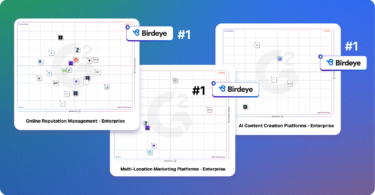
As per G2 & Gartner, Birdeye is No. 1 Online Reputation Management Software.
2. Rater8
Best for: Healthcare organizations focused on provider reputation management and patient review generation.

Description
rater8 is a healthcare-focused reputation management platform designed to help providers improve online visibility, collect patient feedback, and strengthen provider reputation across search and review platforms. The platform helps healthcare organizations automate patient review collection, monitor reputation performance, and improve visibility across Google, healthcare directories, and AI-driven search experiences.
Key features
- Automates patient review requests through integrations with 100+ EHR and practice management systems to increase review generation after appointments.
- Uses the pollin8 algorithm to intelligently distribute patient reviews across Google, Healthgrades, Vitals, WebMD, Facebook, and provider listings based on configurable organizational goals.
- Monitors online reputation activity through a centralized dashboard with AI-supported summaries, reputation scorecards, sentiment analysis, and low-rating alerts.
- Supports patient satisfaction surveys, NPS tracking, benchmarking analytics, and service recovery workflows to help healthcare organizations improve patient experience.
- Provides AI-assisted, HIPAA-compliant review-response workflows with customizable templates and approval controls for healthcare teams.
Pros
- Built specifically for healthcare organizations
- Provider-level review management capabilities
- Supports healthcare directory visibility
- Offers patient satisfaction and survey tools
- HIPAA-compliant workflows
Cons
- More focused on reputation management than broader patient engagement workflows
- Limited all-in-one communication capabilities compared to larger platforms
Pricing
rater8 offers pricing plans starting at $89 per physician per month for rater8 Lite, while large-level plans are priced on a custom basis.
G2 rating
4.9/5 with 116 reviews
3. Solutionreach
Best for: Healthcare practices looking to combine patient communication, appointment engagement, and reputation management.

Description
Solutionreach is a patient engagement platform designed to help healthcare organizations improve patient communication, automate appointment workflows, and strengthen online reputation management. The platform combines reminders, texting, digital intake, online scheduling, surveys, and reputation management into one connected patient engagement system.
Key features
- Automates appointment reminders through text, email, and voice messaging with built-in confirmation, cancellation, and rescheduling capabilities to help practices reduce no-shows.
- Enables HIPAA-compliant two-way texting so staff can communicate with patients in real time from office phone numbers, websites, desktop dashboards, or the mobile app.
- Supports online patient scheduling that integrates directly with practice management and EHR systems, allowing patients to request or book appointments anytime.
- Includes digital intake forms and contactless patient check-in workflows that streamline front-office operations and reduce administrative workload.
- Provides online reputation management tools for collecting, monitoring, benchmarking, and responding to patient reviews across review platforms.
Pros
- Better patient communication and scheduling tools
- Broad EHR and PM integrations
- Helps reduce no-shows and improve retention
- Includes patient engagement and reputation features in one platform
Cons
- Reputation management capabilities may not be as advanced as specialized ORM platforms
- Interface may require onboarding for larger organizations
Pricing
Solutionreach provides custom pricing based on practice size and selected modules.
G2 rating
4.3/ 5 with 169 reviews
4. AdvancedMD
Best for: Independent practices that need an all-in-one EHR and practice management system with basic, bundled patient engagement and review capabilities.

Description
AdvancedMD is a cloud-based healthcare platform that combines EHR, practice management, billing, and patient engagement in a single system. It supports end-to-end clinical and administrative workflows, including scheduling, documentation, and billing. The platform also includes patient communication and feedback tools through its AdvancedPatient module. However, its reputation management features are not standalone and are part of broader engagement bundles.
Key features
- Combines EHR, practice management, billing, and patient engagement tools in a unified cloud-based system for independent practices and groups.
- Automates appointment reminders, recalls, confirmations, and self-scheduling to reduce no-shows and administrative workload.
- Offers patient portal access, digital intake forms, consent forms, telemedicine, and kiosk-based check-in options for streamlined patient flow.
- Provides clinical workflows including charting templates, physician dashboards, task prioritization, ePrescribing, and mobile EHR access.
- Supports interoperability through lab integrations, immunization reporting, care coordination alerts, and continuity-of-care workflows.
Pros
- Comprehensive all-in-one platform covering EHR, billing, and practice management
- Strong clinical documentation and workflow capabilities for independent practices
- Useful for organizations already committed to the AdvancedMD ecosystem
- Centralized patient engagement, scheduling, and administrative operations
Cons
- AdvancedPatient and related features require subscription to the wider AdvancedMD ecosystem or specific bundled packages
- Not a dedicated ORM solution, which limits flexibility for practices primarily focused on reputation management
Pricing
AdvancedMD provides custom pricing based on organization size, products, and implementation requirements.
G2 rating
3.6/5 with 63 reviews
5. LeapHealth
Best for: Healthcare organizations focused on healthcare marketing, patient acquisition, and online visibility.

Description
LeapHealth is a healthcare marketing and patient acquisition platform designed to help healthcare organizations improve digital visibility, patient engagement, and online reputation. The platform focuses on helping providers strengthen healthcare marketing performance while supporting patient communication and review management. Healthcare organizations use LeapHealth to improve local search visibility, increase patient acquisition, and manage online reputation across digital channels.
Key features
- Automates patient review requests through text and email campaigns to help healthcare practices generate consistent feedback across major review platforms.
- Tracks reviews and patient sentiment from more than 200 review sites through a centralized reputation management dashboard with real-time monitoring and alerts.
- Uses AI-powered response generation and sentiment analysis to help healthcare teams create professional, HIPAA-aware review replies aligned with patient feedback.
- Supports business listings management by monitoring and updating practice information across Google, Bing, Facebook, Healthgrades, and other healthcare directories.
- Includes website review widgets and AI-assisted social sharing tools that help practices showcase positive patient experiences across digital channels.
Pros
- Automated review generation after patient visits
- Monitoring reviews across 200+ platforms
- AI-assisted review responses and sentiment handling
- Listings management across major healthcare directories
- Turning reviews into patient acquisition + SEO visibility growth tools
- Integration with EMR/EHR systems and workflows
Cons
- Limited depth beyond reputation and engagement
- Communication tools are not fully unified across workflows
Pricing
Pricing is not publicly disclosed on the official website (sales/demo-based model)
G2 rating
Not enough publicly available reviews on G2 as of May 2026
6. Chatmeter
Best for: Healthcare organizations focused on local SEO, listings, and reputation monitoring.

Description
Chatmeter is a multi-location brand intelligence and reputation management platform used primarily in retail, restaurant, and service industries, with a dedicated healthcare use case. It helps healthcare organizations monitor reviews, manage listings, and track patient sentiment across locations to improve local search visibility. The platform is designed more for brand-level reputation and SEO performance than clinical or patient-care workflows. It relies on APIs and integrations rather than deep native healthcare system connectivity.
Key features
- Provides an AI-powered multi-location intelligence platform for managing reputation, listings, social presence, and customer feedback from a unified dashboard.
- Centralizes review monitoring and response workflows across platforms like Google, Yelp, Facebook, and other major review sites.
- Uses AI-driven sentiment analysis (Pulse AI) to identify themes, trends, and operational issues from patient feedback and reviews.
- Includes listings management to maintain consistent business information across directories such as Google Business Profile, Apple Maps, Bing, and Yelp.
- Supports competitive benchmarking and local brand visibility scoring (LBV) to compare performance across locations and competitors.
Pros
- Local SEO and listing capabilities
- Useful for multi-location healthcare brands
- Centralized visibility reporting
- Good competitive monitoring tools
Cons
- More focused on local SEO than full patient engagement workflows
- Communication tools are less extensive than patient engagement platforms
Pricing
Chatmeter provides custom pricing.
G2 rating
4.5/5 with 350+ reviews
7. ReviewTrackers
Best for: Healthcare organizations focused on patient feedback analysis, review monitoring, and reputation insights.

Description
ReviewTrackers is a reputation management platform that helps healthcare organizations collect, monitor, and analyze patient feedback from multiple review sources. It brings together reviews from platforms such as Google, Facebook, and healthcare directories into a single dashboard for easier tracking. Healthcare teams use it to identify sentiment trends and recurring themes across patient experiences. The tool supports data-driven improvements by turning feedback into actionable operational insights.
Key features
- Centralizes patient reviews from more than 100 review sources into a single dashboard for simplified monitoring.
- Enables sentiment analysis that highlights recurring themes in patient feedback and service experiences.
- Supports unified review response workflows that let teams manage replies from a single inbox.
- Automates review request campaigns to collect patient feedback after visits or treatments.
- Provides benchmarking insights that compare performance across providers and locations.
Pros
- Better review aggregation across multiple platforms
- Useful sentiment analysis for operational insights
- Simple multi-location tracking experience
Cons
- Limited patient communication features beyond reviews and surveys
- Fewer end-to-end engagement workflows compared to all-in-one platforms
Pricing
Custom pricing based on locations and requirements.
G2 rating
4.6/5 with 161 reviews
8. Podium
Best for: Healthcare practices focused on SMS-based patient communication and review generation.

Description
Podium is a messaging-first platform that helps healthcare organizations communicate with patients through SMS, webchat, and other digital channels. It is widely used to improve response times and to make patient communication more direct and accessible. Many clinics rely on it to automatically collect reviews after appointments via text-messaging workflows. It also supports appointment coordination and general patient engagement in a unified communication hub.
Key features
- Sends automated SMS review requests immediately after patient visits to improve feedback collection.
- Consolidates SMS, webchat, and messaging channels into a single unified inbox for staff efficiency.
- Facilitates appointment reminders and follow-ups to improve patient attendance and communication.
- Uses AI-assisted replies to help staff respond to patient messages faster and more consistently.
- Enables Google review collection directly through conversational SMS workflows.
Pros
- Patient engagement through SMS workflows
- Easy adoption for front-desk and reception teams
- Effective review generation through messaging channels
Cons
- Advanced analytics are limited compared to reputation platforms
- Messaging volume can influence overall cost
Pricing
Custom pricing based on usage and number of locations.
G2 rating
4.6/5 with 2095 reviews
9. Reputation
Best for: Large hospital systems and massive integrated delivery networks

Description
Reputation is an experience management platform that helps healthcare organizations track patient feedback, online reviews, and brand perception across multiple channels. It focuses on converting patient sentiment into structured insights that improve service quality and operational outcomes. Large healthcare systems use it to maintain consistent reputation across multiple locations and providers. Its strength lies in combining review monitoring with deep experience analytics and case management workflows.
Key features
- Aggregates reviews from healthcare and consumer platforms into a unified dashboard for monitoring.
- Uses AI-powered sentiment analysis to identify trends in patient experience and service quality.
- Includes case management workflows that help teams resolve patient issues efficiently.
- Maintains business listing accuracy across multiple healthcare directories and platforms.
- Supports patient surveys and NPS tracking to measure satisfaction and experience levels.
Pros
- Large health organization grade analytics and reporting
- Advanced sentiment tracking across large datasets
- Well-suited for multi-location healthcare systems
Cons
- Setup can be complex for smaller practices.
- Requires onboarding to fully utilize advanced features.
Pricing
Custom pricing based on organization size and modules.
G2 rating
4.6/5 with 2469 reviews
10. Grade. us
Best for: Agencies and healthcare marketing teams managing multi-location review campaigns.

Description
Grade.us is a white-label reputation management platform built primarily for agencies that manage review campaigns across multiple clients and locations. It focuses on automated review generation through email and SMS workflows that guide customers or patients toward leaving feedback on selected platforms. In healthcare use cases, it is typically used by marketing agencies rather than clinical teams to manage online reputation at scale. However, it is not a native healthcare or compliance-first system and must be configured carefully when handling patient-related information.
Key features
- Automates email and SMS campaigns that request patient reviews after appointments.
- Provides white-label dashboards that enable agencies to manage multiple healthcare clients from a single interface.
- Tracks reviews across multiple locations and platforms from a centralized reporting system.
- Monitors patient feedback from major review sites to maintain visibility into reputation performance.
- Allows customization of review funnels to improve conversion rates and engagement.
Pros
- White-label capabilities for agencies
- Flexible review funnel and campaign structure
- Easy multi-client and multi-location management
Cons
- Not a healthcare-native platform
- No native HIPAA compliance or default BAA support
- Requires careful handling of patient data to avoid PHI exposure
- Limited beyond review generation and basic reporting
Pricing
Tiered pricing based on the number of locations and campaign volume.
G2 rating
4.6/5 with 144 reviews
The right medical reputation management software plays a key role in helping providers manage patient feedback and online presence more effectively. The right platform helps streamline reviews, insights, and engagement across every patient touchpoint.
Discover Top 10 healthcare reputation management software
Want to see the impact of Birdeye on your business? Watch the Free Demo Now.
What are the top healthcare reputation management trends in 2026
Healthcare reputation management in 2026 sits at the intersection of AI interpretation, patient decision behavior, and operational response systems. Reviews are not just feedback anymore; they are structured inputs that influence search visibility, scheduling flow, and internal service fixes.
Here are the top healthcare reputation management trends in 2026:
AI converts patient feedback into operational tickets
AI answer engines are increasingly being used to convert patient feedback into clear operational categories such as appointment delays, billing confusion, front-desk communication, and follow-up gaps. These insights flow directly into internal task systems assigned to relevant teams for resolution. Reputation data actively supports service correction rather than sitting in static reporting dashboards.
Zero-click search shapes first exposure to providers
Patients often encounter providers through AI-generated summaries inside search engines and voice assistants before visiting any website or listing. These systems combine ratings, reviews, and business details into a single response. Inconsistent listings or incomplete data directly change how a practice appears in that first impression layer. According to Birdeye’s State of AI Search in Healthcare 2026 report, healthgrades.com accounts for 5.73% of healthcare-related citations used by AI answer engines when forming these summaries.
Compliance-safe responses shape patient trust decisions
Patient trust is increasingly influenced by how safely providers respond to public reviews under strict compliance expectations. Healthcare organizations now use AI-assisted response systems with guardrails to prevent accidental exposure of protected health information (PHI) in public replies. Automated redaction, templated responses, and review workflows ensure communication remains consistent, professional, and regulatory-safe at scale.
Real-time feedback systems prevent negative experiences
Patient feedback systems are shifting from post-visit collection to real-time intervention during the care journey. Signals such as wait-time alerts, in-clinic check-ins, and service friction indicators now trigger immediate operational responses while the patient is still on-site. This allows teams to resolve issues before they escalate into dissatisfaction or public reviews.
Healthcare reputation management now operates as a connected system in which AI interpretation, patient feedback, and operational responses continuously influence one another. Strong performance depends on keeping information consistent, responses timely, and experience signals aligned across every patient touchpoint.
How Birdeye helps healthcare providers improve online reputation

Birdeye helps healthcare providers maintain a more reliable, patient-aligned online presence by keeping reputation signals consistent across the platforms patients trust when making decisions. This reduces the gap between actual care experiences and how the practice is perceived online, helping patients build confidence more quickly and with less uncertainty.
It also supports stronger long-term trust by ensuring feedback remains current and reflective of ongoing patient experiences. Over time, this steadiness improves how providers are perceived in search and comparison moments, where even small differences in ratings and sentiment can influence patient choice.
FAQs
The best option is one that offers HIPAA compliance, automated review requests, and simple EHR integration without complex setup. Small practices should prioritize ease of use, affordability, and basic patient sentiment tracking to ensure consistent feedback collection.
Pricing typically depends on the number of providers, locations, and feature depth, ranging from entry-level monthly plans to enterprise contracts. Most platforms follow tiered pricing models based on patient volume, integrations, and automation capabilities.
HIPAA compliance requires encryption, access controls, audit logs, and a signed Business Associate Agreement (BAA) before handling any patient data. The platform must also ensure PHI is never exposed in review requests, responses, or reporting workflows.
Integration happens through APIs or native connections with EHR systems to automatically trigger review requests after appointments or discharge events. This ensures feedback collection is tied directly to real patient encounters without manual effort.
Yes, enterprise healthcare reputation management platforms like Birdeye support multi-location management through centralized dashboards. They provide segmented reporting by clinic, department, and provider, allowing organizations to track performance at each location while maintaining a unified system-wide view.
Conclusion
Around 72% of internet users search for health information online before or alongside consulting a healthcare professional, making online reputation a key factor in patient decision-making. Choosing healthcare reputation management software depends on your organization’s size and needs. For enterprise, multi-location healthcare groups, Birdeye offers an agentic marketing platform for reviews, messaging, and reputation workflows across locations.
Book a demo with Birdeye to see how healthcare teams streamline reviews, communication, and multi-location reputation management.

About the Author

Vanjana Sharma
Originally published