Local SEO for healthcare is now the frontline of patient acquisition — the moment when a clinic, hospital, or medical practice either builds trust or disappears entirely.
 “The One” report   survey shows that 94% of healthcare patients use online reviews to evaluate providers. They use high-intent search terms like “cardiologist near me” or “pediatric clinic that accepts my insurance.” And if your SEO for hospitals, clinics, and medical professionals isn’t built for these high-stakes micro-moments, you’re losing patients before they ever reach your website.

Today, healthcare local SEO is shaped by new ranking factors: review quality, Google Business Profile optimization, medical local SEO schema, AI answer engines, service-page depth, and location authority.

This guide breaks down exactly how local SEO for medical practices works, what actually moves rankings, how multi-location businesses should scale, and healthcare marketing tools like Birdeye streamline the operational load.
Table of contents
- What local SEO really means for healthcare brands
- The core levers of healthcare local SEO
- AI search visibility in healthcare: How clinics and hospitals get chosen in ChatGPT, Perplexity & Google AI Overviews
- Local SEO tips for multi-location healthcare brands
- FAQs about local SEO for healthcare
- Local SEO for healthcare across maps, AI, and reviews — Powered by Birdeye
What local SEO really means for healthcare brands
Local SEO for healthcare isn’t about “being found online.” It’s about showing up at the exact moment a patient needs care — and proving you’re the safest, most reliable option before they ever call, click, or walk in.
For hospitals, clinics, urgent care centers, and specialists, strong local SEO drives:
- Fuller appointment schedules
- Higher provider utilization
- Stronger service-line performance
- Smoother front-office operations
- Fewer missed high-intent searches
Patients compare reviews, check credentials, confirm accepted insurance, and scan availability — in seconds. “Near me,” “open now,” and “same-day appointment” searches carry enormous intent. And inconsistencies across listings, profiles, or provider details quickly erode both trust and visibility.
Layer on HIPAA guidelines constraints, PHI-safe review responses, insurance accuracy requirements, and provider turnover, and healthcare local SEO becomes a specialized discipline.
This guide breaks down the exact steps healthcare brands need to win those moments — in both traditional search and emerging AI engines.
The core levers of healthcare local SEO
Local SEO for healthcare management succeeds when you control the few levers that actually influence patient behavior: visibility, trust, clarity, and convenience. Whether you’re doing seo for hospitals, seo for clinics, or local seo for medical practices, these levers determine whether a patient chooses you or books somewhere else.
Here are the foundational elements of healthcare local SEO that every hospital, clinic, urgent care, dental practice, and specialty provider must execute flawlessly, and how they connect to actual appointment growth.
Google Business Profile: Your digital front door
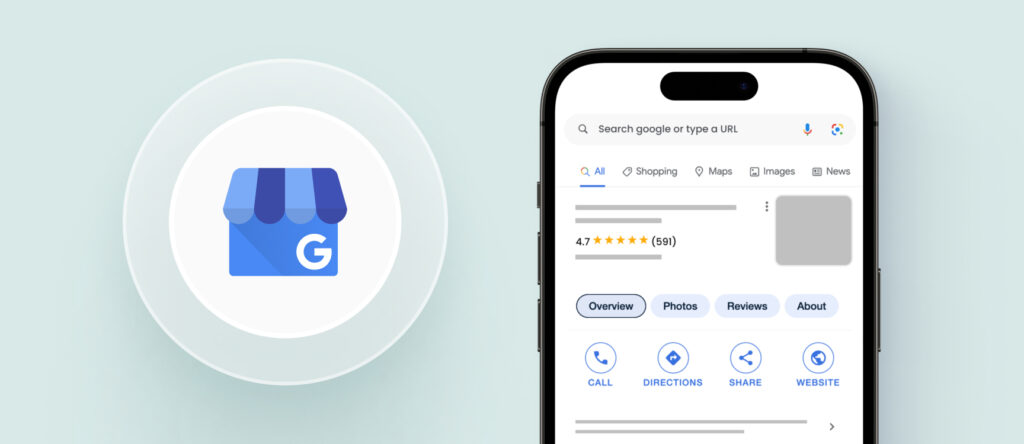
For most patients, your Google Business Profile (formerly Google My Business) is your first impression. It shapes how you appear across Google Search, Maps, and even AI-generated answers — and it’s one of the strongest ranking factors in medical local SEO.
What a high-performing Google Business Profile includes:
To win in healthcare local SEO and local SEO for medical practices, your GBP should be fully built out with:
- Correct primary and secondary categories (e.g., Pediatric Clinic, Orthopedic Surgeon, Urgent Care Center)
- Complete attributes (insurance accepted, wheelchair access, telehealth, women-led, language support)
- Accurate hours + holiday hours + real-time operational updates
- Appointment links & UTM tracking to measure conversions
- Current photos of the facility, exam rooms, providers, and exterior signage
- A consistent “services” list aligned with symptoms and conditions (“knee pain treatment,” “flu tests,” “prenatal care”)
- Short, frequent GBP posts for seasonal spikes (flu season, sports injuries, allergy season), extended-hours announcements, or new providers
- A populated Q&A section with pre-answered common patient questions (insurance, wait times, parking, appointment process)
Healthcare-specific nuance you can’t ignore
- Clinic vs provider profiles:
Patients often search by doctor name, not clinic name, so both matter for SEO for medical professionals. So, create a separate Google My Business profile for doctors. - Department-level profiles for hospitals:
For larger hospital systems doing SEO, create separate GBPs for fully distinct departments (e.g., Emergency, Imaging, Urgent Care), not for every service line. - Insurance accuracy:
Patients frequently filter for clinics that accept their insurance. Inaccurate details here = lost appointments.
How Birdeye’s AI Agents keep GBPs accurate
Managing dozens or hundreds of GBP listings is complex for healthcare groups, especially with provider turnover, insurance changes, or evolving hours. Birdeye’s AI Agents make sure your data stays clean and consistent:
- Search AI monitors how your locations and providers appear across AI engines like ChatGPT, Gemini, and Perplexity — flagging mismatches instantly so you stay accurate everywhere patients search.
- Listings AI pushes correct hours, services, categories, insurance details, and updates across all profiles automatically — reducing manual edits and preventing data drift.
- Reports AI explains WHY your impressions, calls, or direction requests went up or down — giving clarity, not dashboards.
Reviews: The trust signal patients believe first
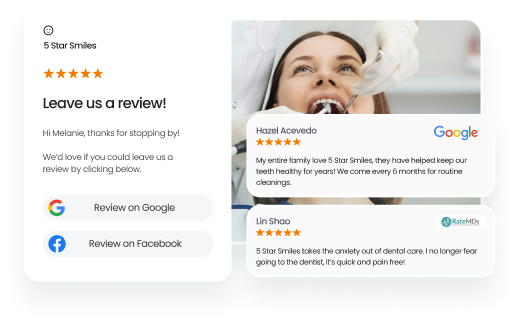
Patients believe reviews more than claims on your website. And Google knows it — which is why review quality, recency, and velocity influence how you appear in map results and AI-generated answers.
Before choosing a hospital, a specialist, or a clinic, people compare bedside manner, staff behavior, wait times, and outcomes. High review volume and strong sentiment are among the most powerful ranking factors in healthcare local SEO.
According to Birdeye’s State of Online Reviews 2024 report, 94% of all healthcare reviews are written on Google, making GBP the single most influential review ecosystem for patient decision-making.

How to build a review engine that wins local search
- Ask at the right moment: after discharge, after a successful visit, or post–telehealth consultation.
- Use short, mobile-friendly flows: keep it to 10–15 seconds.
- Balance platforms: Google first, but specialties may need Healthgrades, Zocdoc, Vitals, or WebMD too.
- Increase review velocity: a slow trickle looks unpredictable; steady reviews build ranking power.
- Monitor sentiment themes: bedside manner, appointment access, communication, wait times.
HIPAA-safe response standards
- Respond within 24–48 hours.
- Acknowledge without confirming treatment (“Thank you for sharing your feedback”).
- Never mention conditions, medications, dates, or clinical details.
- Move specifics offline (“Our team will reach out directly to assist you”).
Reviews are a major ranking factor for medical local SEO as they:
- Influence click-through from the Map Pack.
- Reinforce credibility signals for AI answer engines.
Help Google understand which providers patients prefer.
Strong reviews don’t just improve rankings; they reduce patient hesitation, strengthen conversion, and turn your providers into known, trusted names in the community.
Listings & citations: Keep your facts consistent everywhere
Accurate listings are the backbone of healthcare local SEO, especially when you’re managing multiple clinics, providers, or hospital departments. Search engines and increasingly AI systems rely on consistent data across the web to confirm you’re legitimate, trustworthy, and operational.
Any mismatch in your NAP (Name, Address, Phone), hours, specialties, or provider details can weaken your visibility and confuse patients.
Strong listings directly impact rankings in medical local SEO, hospital SEO, clinic SEO, and medical practice local SEO.
Prioritize the directories that matter for healthcare
General business listing directories still matter, but healthcare requires an expanded footprint where patients actually search:
Essential healthcare directories:
- Healthgrades (key for specialist discovery)
- Zocdoc (appointment-driven)
- Vitals
- WebMD Care
- RateMDs
- Hospital or health system finders
- Insurance provider directories (BlueCross, UnitedHealthcare, Medicare)
General directories:
- Apple Maps
- Bing Places
- Yelp
- Foursquare
- Chamber of Commerce sites
This broader footprint reinforces your authority everywhere patients compare options.

What “clean” listings look like
To strengthen visibility for local seo for medical professionals, ensure every listing has:
- A single, standardized name (no variations like “St. Mary’s Clinic,” “Saint Marys Clinic,” or “St Mary Clinic”)
- The same address formatting
- A uniform phone number — unless using department-specific lines
- Updated hours, holiday hours, and on-call coverage info
- Correct provider names, credentials, and specialties
- Accurate insurance information
- Matching categories and service descriptions across profiles
Even small inconsistencies confuse Google and hurt rankings. When your data is clean everywhere, you reinforce those trust signals across search, maps, and AI-generated answers — giving your clinic or hospital a measurable edge in local visibility.
Your website: Where clicks turn into booked visits
By the time someone reaches your website, they already have intent. They’re looking for confirmation: Is this the right provider? Do they take my insurance? Can I get an appointment soon? A strong website answers these questions fast and removes friction, which boosts both visibility and conversions.
Your site must do two things flawlessly:
(1) Help patients find the right information quickly.
(2) Give search engines structured, trustworthy signals.
Location pages built for clarity
Every location needs its own page with:
- Full address, hours, and phone
- Parking and accessibility details
- Insurance information
- Services available at that location
- Providers who practice there
- One clear action: Call or Book Online
The goal is simple: no guessing, no digging.
Provider pages that build trust
Patients often search for clinicians by name. Make each profile feel human and credible:
- Credentials and specialty focus
- Conditions treated
- Locations served
- A short “how I care” statement
- A professional photo
- A social proof (ratings/review highlights)
Social AI helps you streamline your healthcare social media marketing. Check out the blog to know how.
Service & condition pages built for real patient language
People search for the symptoms they feel, not the terminology you use internally. Create pages that answer practical questions:
- When to seek help
- What to expect during a visit
- Common symptoms and treatment options
- Insurance or prep requirements
These pages also help AI systems understand and surface your expertise.
Technical must-haves
- Fast mobile load times
- Clean heading structure
- Logical internal linking
- Schema for locations, providers, and FAQs
A website that’s fast, clear, and reassuring is often the difference between a booked appointment and a bounce — especially in healthcare.
Supercharge Local SEO for Healthcare Brands
Want to see the impact of Birdeye on your healthcare business? Watch the Free Demo Now.
Publish content that builds authority and answers real patient questions
Good healthcare content isn’t about volume — it’s about clarity, empathy, and relevance. Patients want simple explanations, not medical jargon. Search engines and AI models reward organizations that consistently publish helpful, accurate, and locally relevant information.
Create content around real patient intent
Content built around these questions earns trust and ranks naturally because it reflects real-world language. Start with the questions patients ask every day:
- “Do I need urgent care or the ER?”
- “What symptoms mean I should see a specialist?”
- “How soon should my child be seen for…?”
- “Is this covered by insurance?”
- “What happens during my first visit?”
Build focused content clusters
Create small, connected sets of pages around your most important services or conditions. A simple structure:
- A main service page (e.g., orthopedics)
- Condition pages (e.g., knee pain, sprains, fractures)
- Supporting articles (e.g., injury prevention, recovery tips)
- Internal links to providers and locations
Make expert credibility visible
Patients want reassurance they’re in qualified hands. Strengthen content with:
- Author names (clinicians or medically reviewed by)
- Clear explanations written at a 6th–8th grade reading level
- Visuals: diagrams, photos, simple checklists
- One clear CTA per page
Keep content local
Highlight community events, seasonal trends (flu season, allergy spikes), or local health alerts. Localized content helps clinics stand out in neighborhoods where multiple providers compete for the same searches.s.
Build local credibility through partnerships and community presence
Search engines naturally trust healthcare organizations that are connected to their communities. You don’t need hundreds of backlinks, just a small number of high-quality mentions from relevant, local, or authoritative sources. These signals help validate who you are, where you operate, and what you specialize in.
Focus on partnerships that make sense for healthcare
Instead of chasing generic link-building tactics, invest in relationships that reflect your real-world footprint:
- Local hospitals or health systems you collaborate with
- Universities and medical schools (training sites, residency partnerships)
- Community organizations (senior centers, fitness clubs, wellness programs)
- Local news media covering health events or expert commentary
- Public health departments listing trusted clinics or programs
- Nonprofits you support or sponsor (blood drives, charity runs, screenings)
These are natural, reputation-driven mentions — the kind search engines value.
AI search visibility in healthcare: How clinics and hospitals get chosen in ChatGPT, Perplexity & Google AI Overviews

AI search is now a parallel front door for healthcare discovery. When someone asks a model for “a reliable clinic nearby” or “who to see for persistent knee pain,” the system scans your public data, compares you with local alternatives, and picks the most consistent, authoritative answer.
The rules are different from traditional SEO, and healthcare organizations that adapt early will own this channel.
AI engines reward clarity, not volume
Instead of crawling endless pages, AI tools look for patterns:
- Aligned facts across all sources — hours, services, specialties, provider names
- Structurally clear pages — headings, concise sections, and FAQs
- Expert signals — medically reviewed content, provider bios, and service definitions
- Local specificity — which clinic does what, for whom, and where
If your data is scattered or contradictory, AI systems simply choose a competitor whose information is more coherent.
Elevate the “understandability” of your content
This matters more in AI search than in traditional Google SEO.
Focus on:
- Short, direct explanations of conditions and treatments
- Clear distinctions between services (“urgent care vs. same-day clinic”)
- FAQs written in natural patient language
- Pages that answer a single topic extremely well
AI prefers content that reduces ambiguity.
Structure your healthcare expertise so machines can interpret it
Schema isn’t optional anymore. Mark up:
- Locations
- Providers
- Services
- Insurance accepted
- FAQs
This helps AI recognize the relationships between your clinics, departments, and medical professionals — a major advantage for local SEO for medical practices and multi-specialty groups.
The outcome? Healthcare AI search visibility will soon become as critical as Map Pack visibility. The clinics and hospitals that invest in structure and clarity now will be the ones AI tools surface at the exact moment patients ask for help.
Local SEO tips for multi-location healthcare brands
Multi-location healthcare groups don’t lose rankings because of “bad SEO.”
They lose rankings because location data drifts, provider info becomes outdated, and pages start competing with each other.
Fixing that is the core of scalable medical local SEO.
1. Standardize your data first
Before touching content or keywords, lock in a single source of truth for:
- Hours (regular + holiday)
- Phone numbers
- Services offered at each site
- Insurance accepted
- Provider rosters per location
2. Give each location its own “identity”
Every clinic needs:
- A unique location page
- Providers tied only to that location
- Local details (parking, neighborhood cues)
- Services available there
No duplication. No copy-paste pages.
Unique pages = stronger relevance signals.
3. Create a solid SOP
People join, leave, and transfer — and every change impacts rankings.
Your SOP should be:
- Remove old bios within 48 hours
- Update listings the same week
- Redirect old provider URLs when they move
- Add new providers to the correct location pages immediately
Slow updates = lost visibility.
4. Don’t over-create pages
Not every department or service deserves its own page.
Use this rule:
If it has its own entrance, hours, or phone line → it gets its own page and GBP.
If not → keep it consolidated.
How can telehealth compete in local and AI search results?
Telehealth is healthcare delivered through virtual visits — video, phone, or chat — and it competes in the same discovery channels as physical clinics. But unlike in-person care, patients don’t rely on proximity alone; they search for availability, insurance coverage, and condition-specific help.

Telehealth still ties directly into local SEO for healthcare because Google and AI engines treat virtual care as an extension of a physical clinic. And it's an incredible healthcare lead generation strategy. If your location data, service descriptions, and provider info are unclear, AI tools may not surface your virtual options at all.

To show up reliably:

Add telehealth as a service on your location pages
Turn on telehealth attributes in your GBP (virtual care, online appointments).
Create a dedicated “virtual care” page with clear conditions treated
Use schema to mark roles, locations, and virtual visit types

These small signals help search engines understand what you offer — and to whom — even when care isn’t delivered in person.
FAQs about local SEO for healthcare
Birdeye offers a comprehensive platform that helps healthcare practices manage their online presence. This includes optimizing Google Business Profiles, managing patient reviews, building local citations, and crafting locally focused content, all of which contribute to improved local search visibility.
Local SEO involves optimizing your online presence to rank higher in local search results, making it easier for patients in your area to find your healthcare practice. This is especially important in healthcare, where proximity and trust are key factors in a patient’s choice of provider.
Birdeye’s reputation management tools simplify the process of collecting, managing, and responding to patient reviews, helping to enhance your practice’s online reputation, improve patient trust, and boost your local SEO rankings.
Healthcare practices can optimize their Google Business Profile by ensuring all information is accurate and up-to-date, regularly posting updates, encouraging patient reviews, and responding to them. This helps improve visibility in local search results and builds trust with potential patients./.≥≥
Mobile optimization is crucial for ensuring that patients can easily access your smartphone website. Birdeye provides tools to evaluate and improve your website’s mobile performance, boosting your rankings in mobile search results and enhancing user experience.
Patient reviews significantly impact Local SEO as they contribute to your practice’s online reputation and influence search engine rankings. Positive reviews signal to search engines that your practice is trustworthy, which can improve your visibility in local searches and attract more patients.
Local SEO for healthcare across maps, AI, and reviews — Powered by Birdeye
Local SEO for healthcare is no longer just about profiles, reviews, and directories — it’s about keeping every detail accurate, consistent, and AI-readable across Google, Maps, ChatGPT, Gemini, Perplexity, and every place patients ask questions. That’s where Birdeye’s AI Agents make the difference.
Healthcare brands face constant operational changes, new providers, shifting hours, telehealth updates, insurance changes, and seasonal demand.
Here’s how Birdeye’s GenAI tools automate so your clinics and providers stay visible everywhere patients look:
Listings AI: Keep every location and provider accurate
Listings AI monitors your entire footprint and fixes inconsistent hours, addresses, services, and categories across major directories and AI engines. No more manual edits. No more outdated profiles creating confusion.
Reviews AI: Maintain trust at scale
Reviews AI drafts consistent, compliant, on-brand responses and highlights themes patients care about. It keeps your locations active, responsive, and trusted — a major signal for both search engines and AI systems that need reliable sentiment data.
Search AI: Understand how AI engines see your brand
Search AI shows where your clinics appear in AI-generated answers and what information engines like ChatGPT and Perplexity use to describe you. It flags accuracy gaps, identifies missing citations, and guides improvements so you show up in more AI answers.
Reports AI: Turn performance shifts into clear next steps
When calls spike, impressions drop, or reviews surge, Reports AI explains why. It spots anomalies, highlights root causes, and provides leadership with clear reasoning rather than raw dashboards.
Competitors AI: See how you stack up in real time
Competitors’ AI helps healthcare brands spot where they’re winning, where they’re vulnerable, and what to improve next, without manual research. It benchmarks:
- Review volume and ratings vs nearby competitors
- Social engagement and posting patterns
- Reputation strength and sentiment gaps
Insights AI: Turn patient sentiment, reputation, and listings into clear action
What makes Insights AI especially valuable in healthcare is the speed of interpretation. When sentiment drops at one location, or ratings surge after a staffing change, leadership doesn’t need to decode charts — they get a clear explanation of what changed and why.
This turns reputation, reviews, and listings from passive marketing metrics into active operational intelligence — guiding staffing decisions, service improvements, and experience strategy across locations.

About the Author

Shruti Dugar
Birdeye
Originally published



![[Feature image] The Best Marketing Platforms for Multi-Location Brands](https://birdeye.com/blog/wp-content/uploads/Feature-image-The-Best-Marketing-Platforms-for-Multi-Location-Brands-375x195.png)