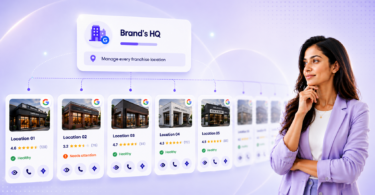
SEO for law firms refers to applying search engine optimization best practices to legal websites and online profiles so they appear more prominently when people search for legal services. It focuses on improving visibility through relevant content, accurate business information, reviews, and technical website performance.
Summary
SEO plays an important role in how potential clients discover and assess law firms online as search engines and listing sites increasingly replace referrals and paid ads as primary discovery channels. By applying proven SEO practices, such as optimizing websites, local listings, and online reputation, law firms can improve visibility, attract high-intent leads, and build trust without relying solely on expensive advertising.
This blog explains how SEO applies to legal websites, the factors that influence search visibility, and practical ways multi-location firms can grow sustainably across markets.
Table of contents
- What is SEO for law firms?
- Does SEO benefit law firms?
- How to implement a law firm SEO strategy for your business?
- 8 law firm SEO techniques for multi-location firms
- Investing in law firm SEO is the key to growth across multiple locations
- Frequently Asked Questions about Law firm SEO
- How Birdeye elevates your law firm’s digital presence
What is SEO for law firms?
SEO for law firms is the process of optimizing a legal practice’s online presence to improve its visibility in search engine results, especially when potential clients search for legal help.
At its core, law firm SEO helps attorneys align their websites and online profiles with what search engines consider relevant and trustworthy. This involves optimizing technical performance, content, and local business listings to match users’ intent.
Unlike general digital marketing, law firm SEO focuses on ranking a law firm’s website higher on Google and other search engines when users search for specific legal practice areas, such as “divorce attorney near me” or “personal injury lawyer in Dallas.”
A successful Attorney SEO strategy includes:

- Enhancing the law firm website structure and speed
- Targeting relevant search queries with precise keyword research
- Building a strong portfolio of client reviews and backlinks
- Maintaining accurate and consistent local listings
- Adhering to SEO best practices and updates to the Google algorithm
When executed correctly, law firm search engine optimization can drive consistent organic traffic, establish authority in the legal industry, and convert visitors into retained clients across all locations.
Does SEO benefit law firms?
Absolutely—SEO benefits law firms in ways that directly impact client acquisition, brand authority, and long-term growth. In fact, most law firms that rank on the first page of search engine results pages tend to dominate their local markets. Why? Because modern legal consumers start their journey with an online search, not a referral or billboard.

Here’s how a solid SEO strategy supports your practice:
- More visibility = more leads: By ranking higher in local search results, your firm appears in front of potential clients at the exact moment they’re searching for legal help. Whether it’s criminal defense or family law, visibility translates to opportunity.
- Trust through top rankings: Appearing on page one of Google search results signals credibility. Users often associate top-ranking law firm websites with competence and professionalism, setting you up for success before the first consultation.
- Better return on investment: Compared to traditional advertising, search engine optimization delivers a compounding return. Once you rank well, ongoing traffic from local SEO comes at a fraction of the cost of paid ads.
- Multi-location advantage: For firms operating in multiple cities or states, local SEO can personalize each region, helping you scale your individual locations without diluting your law firm’s brand.
More visibility means more leads. By ranking higher in local search results, your firm appears in front of potential clients at the exact moment they’re searching for legal help. Effective lawyer lead generation through SEO ensures that visibility translates into a steady stream of high-intent cases.
How to implement a law firm SEO strategy for your business?
A successful law firm SEO strategy isn’t a one-size-fits-all checklist; it’s a structured, long-term approach that aligns your law firm website, local listings, and online authority with how search engines’ algorithms and ranking factors
This is especially important for multi-location law firms looking to compete in different geographic markets. In this section, we’ll walk through three foundational steps to get your strategy off the ground:
Audit your website and local listings
In order to improve, you need to evaluate. A comprehensive local SEO audit helps uncover gaps in your site’s technical setup, mobile usability, content quality, and local listing accuracy. For multi-location law firms, it’s critical to assess how each office location appears in Google search and on other search engines.
What to look for:
- Duplicate or missing listings on Google Business Profile
- Inconsistent NAP (name, address, phone) data across legal directories
- Technical SEO issues like page speed, crawl errors, broken links, and unoptimized metadata
- Missing core web vitals compliance or mobile issues
While you can use tools like Google Search Console, Semrush, or a trusted SEO agency to run your audit, Birdeye’s local SEO audit tool allows you to scan your multiple local listings to spot any inconsistencies, online reputation issues, and more instantly.
Focus on Google’s local ranking factors
Google uses three primary ranking factors for local results: relevance, distance, and prominence. Your law firm’s site must be optimized to signal these clearly.
Here are the SEO ranking factors to focus on:
- Ensure all office locations are verified and optimized on Google Business Profile
- Include location-based keywords on relevant pages (e.g., “Austin immigration lawyer”) to help prospective clients find you more easily
- Add localized content like case studies, testimonials, and news to establish authority in each market
- Encourage client reviews to build online trust and improve search rankings
This step is crucial for improving your visibility in local search and organic search results, especially for firms serving multiple metro areas.
Work with a law firm SEO service provider
While many law firms attempt SEO in-house, most find better results by partnering with a specialized law firm SEO services agency or experienced SEO consultants. These experts understand the nuances of the legal industry, compliance risks, and competitive search behavior.
Why it helps:
- Saves internal time and resources
- Offers access to advanced tools and analytics
- Brings proven experience in ranking law firm websites
- Provides consistent content production, backlink outreach, and technical support
Even with an in-house team, law firms can seamlessly achieve SEO success by using a local presence management tool like Birdeye that understands and integrates well into the legal industry.
“Birdeye has made a tremendous impact on our business through increased online visibility. Our website visitors have vastly increased, and so has our lead generation because of this. The platform’s automated review generation system has been game-changing for our firm. We now effortlessly collect reviews across hundreds of sites, including Google and Facebook, with clients able to leave reviews in just two clicks. This efficiency has allowed our team to focus more on providing quality legal services rather than getting bogged down in administrative tasks.”
Edgar Ramos, Marketing Specialist, Walner Law
8 law firm SEO techniques for multi-location firms
Law firms can ensure a stronger online presence across multiple channels by employing the following search engine optimization strategies:
- Optimization of the law firm website
- Conducting keyword research
- Focusing on technical SEO
- Strengthening local listings
- Generating and managing online reviews
- Building a strong content marketing strategy
- Investing in link building
- Running effective PPC campaigns
Each tactic contributes to better performance in search engine results, higher organic traffic, and stronger brand credibility, no matter how competitive your legal market is.
Let’s break down the techniques that can drive real impact across your firm’s entire network of locations:
Optimize your law firm website
A website is one of the most important assets for improving SEO for lawyers. An ideal website is technically sound, fast, secure, responsive, and tailored for both users and search engines.
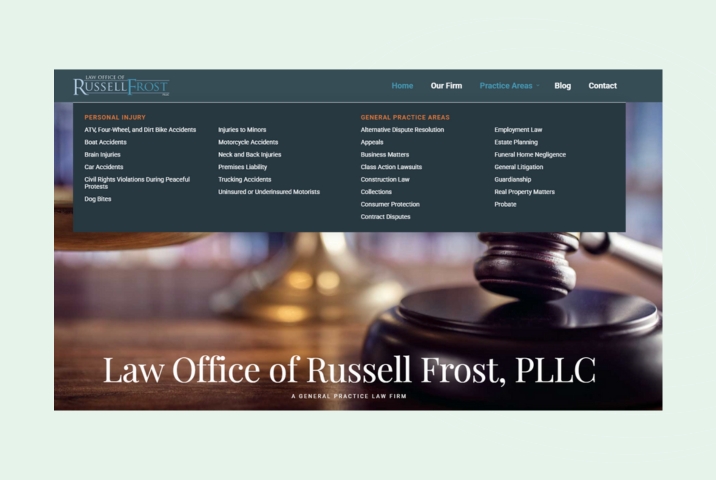
A well-structured site improves user experience, supports on-site SEO, and sends positive signals to search engine algorithms.
Key areas to focus on:
- Mobile-first design that adapts seamlessly across devices
- Schema markup for legal services to help with rich results
- Individual location pages with localized content and contact details
- Clear calls to action (CTAs) like “Schedule a consultation” or “Call now”
Conduct keyword research
Effective keyword research reveals how potential clients search for services like yours—and where the best opportunities lie.
Tips for law firms:
- Target long-tail keywords like “estate planning lawyer in Miami” rather than broad terms like “lawyer”.
- Identify localized keywords by practice area and geography.
- Use tools like Ahrefs, Google Keyword Planner, or Semrush.
- For success on AI search engines, don’t ignore questions and voice-search queries (e.g., “How can I file for bankruptcy in Texas?”).
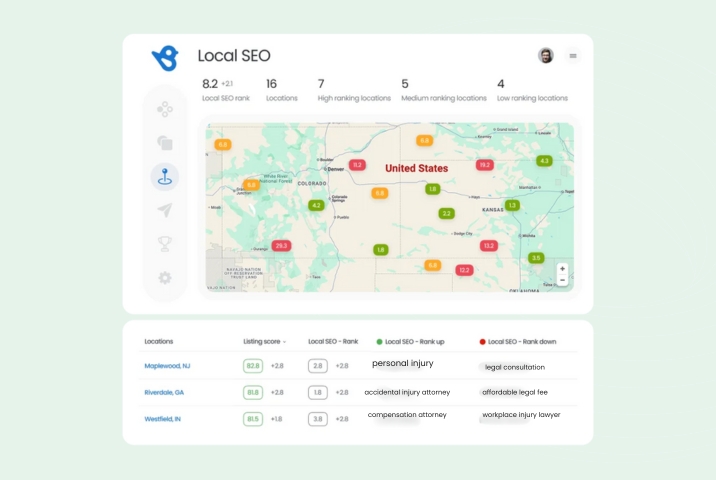
Integrating these terms naturally across your content helps match users’ intent and improves search engine rankings.
For success on AI search engines, don’t ignore questions and voice-search queries. Effective AI search optimization for law firms involves targeting these conversational phrases so that AI assistants like ChatGPT can easily cite your firm as the best answer to a client’s specific legal question.
Focus on technical SEO
Technical SEO is what keeps your law firm’s site fast, crawlable, and structured for Google to read it effectively. Make sure to conduct regular audits to identify issues and fix them before Google notices and alters your local search rankings.
Here is what you should look out for:
- Fix broken links, redirect chains, and slow-loading pages
- Ensure your site is HTTPS-secure and passes core web vitals
- Set up proper XML sitemaps and robots.txt files
- Use canonical tags to avoid duplicate content issues
Strengthen your local listing presence
A strong local listing presence is a primary ranking factor for local visibility, and it’s essential to being found by clients in your service areas, not just in general search results.
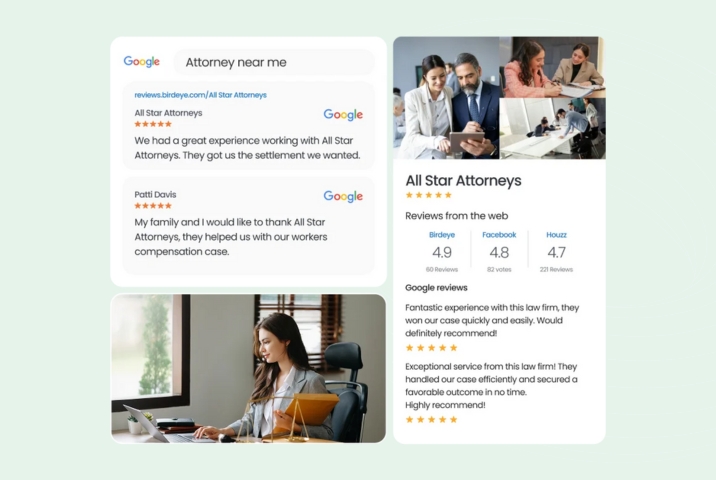
When potential clients search for legal help—whether it’s “divorce lawyer near me” or “DUI attorney in Chicago”—they’re typically served local search results via the Google Map Pack. If your firm doesn’t have optimized and verified local listings for each office, you’ll miss out on high-intent traffic.
What to do:
- Create and verify a Google Business Profile for every location
- Ensure consistency in NAP (name, address, phone) details across all directories
- Add practice area categories, business hours, and professional photos
- Update service descriptions with local keywords and compliance-friendly content
“We have 9 office locations, and before the implementation of Birdeye, I was having to manually update the various online listings we held. This was extremely time-consuming and laborious, so Birdeye has increased productivity in this area.”
Jess Coombes, Marketing Manager, Amicus Law (South West) LLP
Generate, manage, and market online reviews
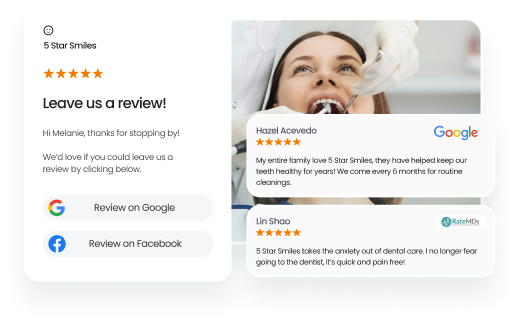
Online reviews are the digital version of word-of-mouth, and in legal services, trust is everything. Positive client reviews on Google and other platforms serve as social proof and directly influence your search engine rankings and conversion rates.
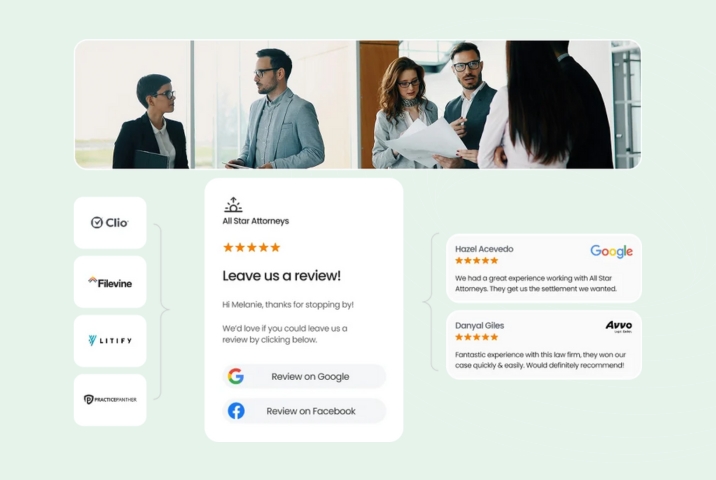
How do online reviews help in SEO for lawyers?
- Reviews boost credibility, especially for high-stakes services like legal counsel
- Google’s algorithm factors in review volume, frequency, and sentiment for local ranking
- Prospective clients rely heavily on star ratings before scheduling consultations
Encourage satisfied clients to leave detailed reviews post-case, and use tools or SEO services to monitor and respond professionally. Reviews can also be repurposed in content or shared on your law firm’s site to enhance trust.
Read more: 4 Examples of Attorneys Responding to Negative Reviews
Grow your law firm across multiple locations
Want to see the impact of Birdeye on your business? Watch the Free Demo Now.
Build a strong content marketing strategy
Content is where SEO for lawyers truly comes to life. But for law firms, content marketing is not just about blog posts or landing pages; your content must reflect your expertise, resonate with your audience, and align with how they search.
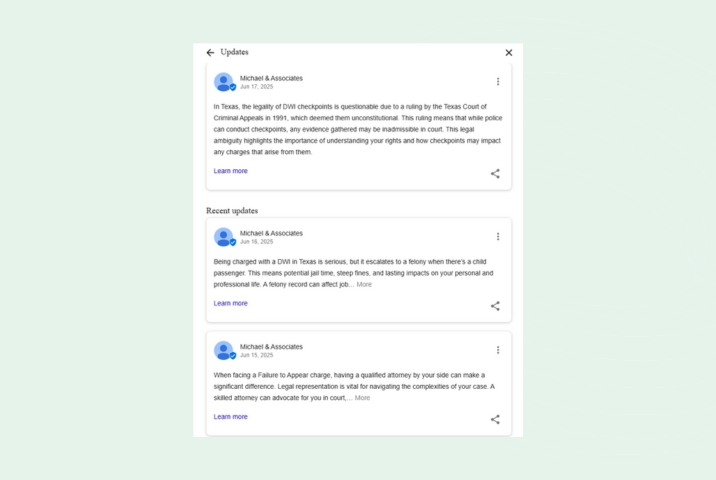
Content types to prioritize:
- FAQ pages answering common legal questions on the website and Google Business Profile
- Location-specific practice area pages (e.g., “Houston real estate litigation”)
- Blog articles optimized for niche search queries (e.g., “how to contest a will in New York”)
- Educational videos and infographics for complex topics
- Location-specific content across social media pages to raise awareness in the right geographical demographic
High-quality content is a cornerstone in law firm marketing. It builds authority, earns backlinks, and improves relevance in search engines’ eyes. It also ensures you meet your audience’s expectations, helping them self-educate before reaching out.
Invest in link building
The legal industry is one of the most competitive online niches, and you need every edge you get. Google views backlinks as endorsements. The more high-authority sites linking to your law firm website, the more trustworthy it appears in search algorithms.
Why it’s critical for law firms:
- High-authority links from bar associations, legal directories, and media sites can drastically improve your search engine rankings
- Link building also helps you rank for broader search queries, not just branded terms
Pro Tip: Avoid spammy tactics—focus on earning links through guest posts, local sponsorships, digital PR, and publishing original legal resources. An experienced law firm SEO agency can help scale this ethically and effectively.
Run effective PPC campaigns
While organic traffic takes time, paid ads offer a faster route to the top of search engine results pages. When integrated with your SEO efforts, pay-per-click (PPC) can fill in the gaps, drive immediate leads, and support long-tail keyword testing.
Best practices:
- Use PPC to promote specific practice areas in high-value locations
- Target branded search terms to prevent competitor poaching
- Analyze conversion data from paid campaigns to inform organic content strategy
For multi-location law firms, geo-targeted PPC ensures each office competes only within its market, maximizing budget efficiency and boosting your presence across both paid and organic search results.
Investing in law firm SEO is the key to growth across multiple locations
In a competitive digital landscape, law firm SEO is the difference between being seen and being overlooked. For multi-location law firms, implementing a scalable, well-structured SEO strategy can drive qualified traffic, improve local visibility, and convert more potential clients. From technical improvements to local listings and content, each tactic plays a vital role in shaping your online presence. The sooner your firm prioritizes SEO, the sooner you’ll see the long-term benefits in trust, traffic, and growth.
Frequently Asked Questions about Law firm SEO
Yes. Law firms, like all other businesses, need to incorporate SEO into their online reputation strategy to gain a larger online presence and reach more clients.
Yes, SEO can have a major impact on law firms. With an effective law firm SEO strategy, you’ll increase your chances of reaching larger clients with higher-profile cases.
Every law firm is different, most budget an average of $7,500 per month on SEO.
You can track your SEO success using tools like Google Search Console, Google Analytics, and third-party platforms like Semrush or Ahrefs. Monitor metrics like search rankings, keyword performance, organic traffic, form submissions, and calls from Google listings. A good SEO agency will also provide reporting dashboards that break this down by location.
AI can assist with keyword research, content generation, technical audits, and competitor analysis. Tools powered by AI help you identify what your audience is searching for, optimize content to match users’ intent, and predict changes in Google’s algorithm. Leading law firms now use AI to scale their SEO operations more efficiently.
How Birdeye elevates your law firm’s digital presence
Birdeye stands as the premier agentic marketing platform built specifically for 100-1000+ multi-location brands. While traditional platforms only report data, Birdeye deploys autonomous AI agents to drive growth by automating marketing workflows across brand awareness, client conversion, and client experience. Powered by BirdAI and a centralized data engine, it unifies fragmented software into one system that supports your client journey.
Our ecosystem operates on three core pillars designed to maximize efficiency:
- Consolidate: Unifies all client interactions, touchpoints, and office locations into a single dashboard.
- Reason: Uses AI to evaluate data with context and historical memory.
- Act: Deploys AI agents that function as digital coworkers to execute tasks and deliver outcomes.
Trusted by leading enterprises globally, Birdeye helps organizations improve local search visibility, strengthen reputation, and deliver consistent client experiences. With global teams spanning the U.S., EMEA, and APAC, Birdeye is reshaping how multi-office law firms compete in local markets.
Here is how Birdeye helps your legal practice attract, engage, and retain more clients:
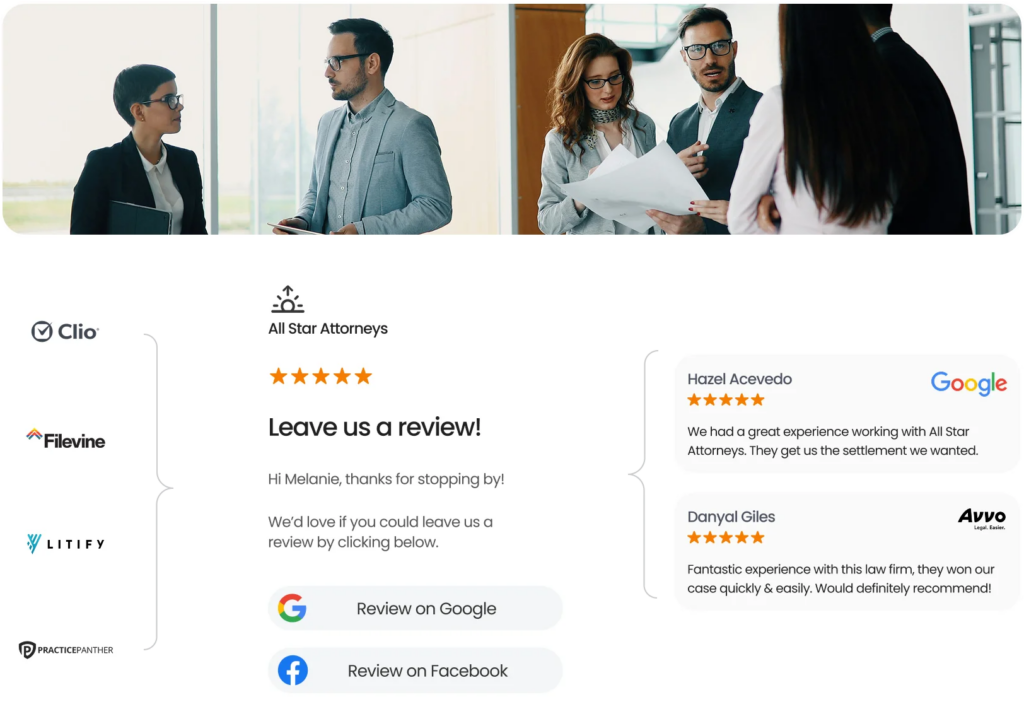
Reviews Agent: Streamlines review generation through automated outreach and manages AI-assisted review responses to maintain consistent, timely, and on-brand engagement that builds local credibility and improves search rankings.
- Review Generation Agent: Sends automated, personalized review requests after key client interactions such as consultations or case milestones, helping increase client feedback across platforms.
- Review Response Agent: Creates timely, tailored responses to client reviews, maintaining consistency in tone while supporting reputation management across all locations.
Listings Agent: Synchronizes and optimizes your firm’s office profiles across authoritative digital directories, ensuring accuracy, consistency, and improved local search visibility.
- Listing Optimization Agent: Keeps firm information accurate across more than 150 directories by updating office details, correcting inconsistencies, and improving visibility in local search results.
Search AI: Evaluates your firm’s visibility in AI-driven search engines like ChatGPT and Perplexity, tracking the reviews and citations that influence your rankings.
Social Agent maintains a consistent brand presence across social channels and locations.
Social Publishing Agent creates, schedules, and publishes AI-generated content tailored to your brand, audience, and posting schedule.
Social Engagement Agent monitors comments and messages, identifies customer intent, and drafts on-brand replies to improve response times.
Insights Agent: Analyzes client feedback from surveys and reviews to identify service gaps and marketing opportunities.
Competitors AI: Benchmarks your firm’s digital presence against local competitors to identify strategic opportunities.
Whether you want to improve search visibility, protect your digital reputation, or manage marketing across multiple offices, Birdeye supports your firm in making informed decisions faster.
Schedule a demo to see how Birdeye supports growth for modern law firms.

About the Author

Avtar Madan
Avtar Madan
Originally published