Hotel review sites shape how travelers decide where to stay and influence perceptions of quality. Hotels that actively engage with feedback and present accurate, up-to-date information encourage more bookings and higher guest satisfaction.
Summary
Choosing the right review sites to monitor can be challenging because each platform attracts different types of travelers and influences different stages of the guest booking journey. Some specialize in verified guest feedback, others focus on travel research, rate comparison, local discovery, or impact overall brand reputation.
This guide examines the 10 most important hotel review sites in 2026, compares their strengths and limitations, and explains where each platform fits within a hotel’s review management strategy.
Table of contents
- What are the top 10 best hotel review sites in 2026
- What is the difference between hotel rating sites and hotel review sites
- What are the best sites for verified hotel reviews (and why it matters)
- Which sites should hotels monitor first?
- How do AI assistants influence hotel visibility and reputation?
- FAQs on hotel review sites
- How to turn hotel reviews into a revenue channel with Birdeye
What are the top 10 best hotel review sites in 2026
Hotel review sites influence search visibility, booking decisions, and guest trust. The strongest channel mix usually includes Google for discovery, OTAs for booking-stage reviews, and independent review platforms for credibility checks.
| Review site | Best for | Primary audience | Key strength |
| Local search visibility | All travelers | Search and Maps visibility | |
| Tripadvisor | Travel research | Vacation planners | Travel-specific reviews |
| Booking.com | Booking decisions | OTA users | Verified-stay reviews |
| Expedia | Travel booking research | Leisure travelers | Large traveler audience |
| Hotels.com | Hotel comparisons | Hotel shoppers | Accommodation-focused reviews |
| Trustpilot | Brand reputation | Direct-booking travelers | Customer trust signals |
| Yelp | Local reputation | North American travelers | Local discovery |
| Oyster | Hotel research | Premium travelers | Professional reviews and photos |
| Trivago | Rate comparison | Price-conscious travelers | Review aggregation |
| Trip.com | International travel | Global travelers | Strong international reach |
Here is a detailed overview:
1. Google
Best for: Hotels aiming to capture high-intent traffic directly from search queries and improve local SEO.
Google remains a key review platform for hospitality businesses, with reviews appearing directly in Google Search and Google Maps. According to Birdeye’s State of Online Reviews 2026 report, Google accounts for 38% of hospitality reviews, while travelers also consult platforms such as Booking.com, Expedia, and TripAdvisor before making reservations.
2. Tripadvisor
Best for: Properties looking to capture guests during the early inspiration and itinerary-building phases.
While Online Travel Agencies (OTAs) handle most transactional booking feedback, Tripadvisor remains a key research hub. Travelers use it to cross-reference hotels with nearby tours, attractions, and dining options. Because reviews here are highly descriptive and cover the holistic travel experience, it is an essential platform for hotels in destination-heavy areas.
3. Booking.com
Best for: Driving high-volume booking conversions through verified guest credibility.
Booking.com hosts some of the most trusted reviews in the industry because its reviews are strictly transactional: a user can only leave feedback after completing a stay. These scores (broken down by comfort, staff, and cleanliness) live directly within the checkout funnel, meaning your rating on this platform correlates directly with your day-to-day occupancy rates.
4. Expedia
Best for: Capturing high-value leisure travelers who prefer bundled vacation packages.
Like Booking.com, Expedia relies entirely on verified-stay feedback. However, because Expedia specializes in bundling hotels with flights and car rentals, its reviewers are frequently long-distance vacationers who spend more money per stay. Maintaining a high score here boosts a hotel’s algorithm ranking within Expedia’s massive marketplace.
5. Hotels.com
Best for: Targeting accommodation-first consumers looking for specific lodging types.
This platform is tailor-made for travelers whose primary focus is comparing room layouts, amenities, and property budgets. Backed by a widely used loyalty program, Hotels.com’s user base consists of frequent travelers who rely on peer-to-peer verified feedback to choose among similar properties in tight markets.
6. Trustpilot
Best for: Hotel chains and hospitality groups managing their overall service and transactional credibility.
Trustpilot does not track room-level details like standard review sites. Instead, it measures a hotel brand’s corporate reputation. Travelers turn to Trustpilot to evaluate how seamlessly a hotel company handles direct-booking customer service, cancellation disputes, tech glitches, and refund processing, which makes it vital to corporate brand integrity.
7. Yelp
Best for: Boutique, independent, or urban hotels operating within North American markets.
Yelp’s relevance is strictly regional, but highly impactful in the US and Canada. Travelers use Yelp to evaluate a hotel as part of a localized neighborhood experience, frequently checking how the property ranks alongside local nightlife, parking, and dining. It is a powerful driver for independent urban hotels.
8. Oyster
Best for: Visual verification and capturing travelers conducting deep-dive property investigations.
Oyster functions as an editorial hybrid rather than a traditional user-generated review site. Known as the “Hotel Tell-All,” it sends professional investigators to document properties with unedited photography to combat misleading marketing. While its review volume is lower than mainstream platforms, it carries immense weight with meticulous researchers who want an unbiased, expert look at a property.
9. Trivago
Best for: Maintaining a consistent, balanced reputation index across the broader internet.
Trivago is a metasearch engine, meaning it does not host native user reviews. Instead, it pulls review data from across the web (including Expedia and Booking.com) and aggregates it into a single centralized score. A hotel’s success on Trivago relies entirely on keeping a strong, balanced rating across all other major online travel agencies.
10. Trip.com
Best for: Attracting global travelers, specifically targeting APAC and cross-border inbound markets.
As a global travel giant, Trip.com is the go-to platform for international and outbound Asian travelers. The reviews left here heavily emphasize factors like multilingual staff support, proximity to transit hubs, and international amenities. For hotels looking to diversify their guest demographics and capture global market share, this platform is indispensable.
What is the difference between hotel rating sites and hotel review sites
Although the terms are often used interchangeably, hotel rating sites and hotel review sites serve different purposes.
Hotel rating sites provide standardized assessments of a property’s quality, amenities, and service levels. Ratings are typically assigned by industry organizations or presented as an aggregated score to help travelers quickly compare hotels.
Hotel review sites focus on guest-generated feedback. Reviews include written experiences, photos, recommendations, and complaints that provide insight into what guests actually experienced during their stay.
Many travel platforms, including Trip.com and Hotels.com, display both ratings and reviews. Travelers often use ratings for an initial comparison and reviews to understand the guest experience behind the score.
Key distinction: AAA (Diamond Listings) and Forbes Travel Guide are hotel rating bodies, not hotel review sites. Their ratings are based on professional inspections and hospitality standards rather than guest-submitted reviews.
What are the best sites for verified hotel reviews (and why it matters)
A verified hotel review usually means the guest completed and paid for a stay through the booking platform before leaving feedback. These reviews carry more weight because the platform can confirm the reviewer actually stayed at the property.
Verified-only sites
Booking.com, Hotels.com, Expedia, and Trip.com generally require a completed reservation before guests can submit reviews. This requirement helps connect feedback to actual stays rather than anonymous opinions.
The verification process also makes these reviews particularly valuable for hotels, as they offer credible insights into operational performance across areas such as cleanliness, service, amenities, check-in experiences, and value for money.
Open review sites
Google, Tripadvisor, Trustpilot, and Yelp allow anyone with an account to post reviews. These platforms often contain larger review volumes and broader traveler perspectives than booking sites.
The tradeoff is that hotels, travelers, and search platforms must rely on moderation systems to identify suspicious content. For this reason, travelers should focus on recurring themes across dozens of reviews rather than isolated comments.
Editorial review sites
Oyster and Frommer’s publish reviews written by travel writers, researchers, and editors rather than hotel guests. Their evaluations focus on room quality, amenities, location, service standards, and overall guest experience.
These sources work best as a complement to guest reviews because they provide an independent assessment of the property.
Now, let us take a look at why verification matters:
Reduce fake reviews
A completed booking creates accountability. Without that requirement, review platforms can attract fabricated complaints, promotional reviews, and content from people who never visited the hotel.
Show the current guest experience
Guests who recently stayed at the property can comment on issues that matter most, such as Wi-Fi reliability, housekeeping standards, breakfast quality, and staff responsiveness.
Help travelers spend with confidence
Review verification helps travelers confirm that a hotel’s rooms, amenities, and service levels match the listing description. This reduces the risk of paying premium prices for a property that fails to meet expectations.
Note: Frommer's has cautioned travelers against relying solely on user-generated reviews as AI-generated content becomes easier to create. The publication specifically recommends comparing guest reviews across multiple sources and using editorial travel reviews as an additional layer of validation. This advice is particularly relevant in large discussion communities, such as Reddit, and high-volume review platforms, such as Tripadvisor.
No review platform is perfect. The strongest approach combines verified guest reviews from booking sites with broader traveler feedback and independent editorial assessments.
Discover Top 10 Hotel Review Sites
Want to see the impact of Birdeye on your business? Watch the Free Demo Now.
Which sites should hotels monitor first?
Hotels don’t need to monitor every review platform equally. For most hotel marketers, the highest-priority review sites are Google, Tripadvisor, Booking.com, Expedia/Hotels.com, and Yelp because they influence hotel discovery, traveler research, and booking decisions.
Monitoring reviews is only the first step. Hotels that use review data to guide improvements in marketing, operations, and guest experience often see stronger results than those that simply track ratings.
1. Generate more Google reviews
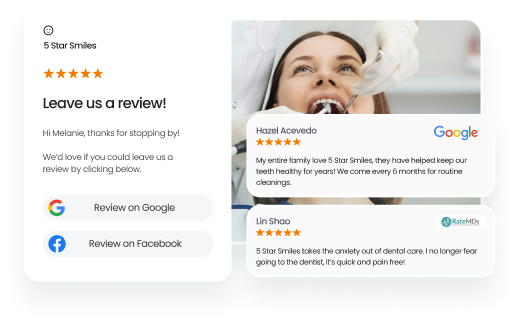
Google reviews influence local search visibility, Google Maps rankings, and direct booking consideration. Encourage guests to leave reviews after checkout so travelers see recent feedback when comparing hotels in your market.
2. Protect your Tripadvisor rank
Many travelers use Tripadvisor to compare hotels before booking. Monitor new reviews regularly, respond to guest concerns, and address recurring complaints that can affect your ranking within destination search results.
3. Improve OTA review scores
Booking.com, Expedia, and Hotels.com display review scores directly within the booking journey. Focus on guest feedback on cleanliness, room comfort, service quality, and value, as these factors often influence booking decisions.
For a property listed on Airbnb specifically, see our ultimate guide to Airbnb reviews.
4. Fix recurring service issues
Review trends often reveal operational problems that internal reports miss. Look for repeated mentions of slow check-in, housekeeping inconsistencies, maintenance concerns, poor Wi-Fi, parking challenges, or breakfast quality issues.
5. Showcase guest feedback
Feature recent reviews on your website, booking pages, and marketing campaigns. Real guest experiences help validate marketing claims and provide social proof for prospective travelers.
6. Benchmark competitors
Review competitor feedback to understand what guests value most in your market. Compare ratings, common complaints, amenities, and service strengths to identify opportunities for improvement and differentiation.
7. Measure review performance
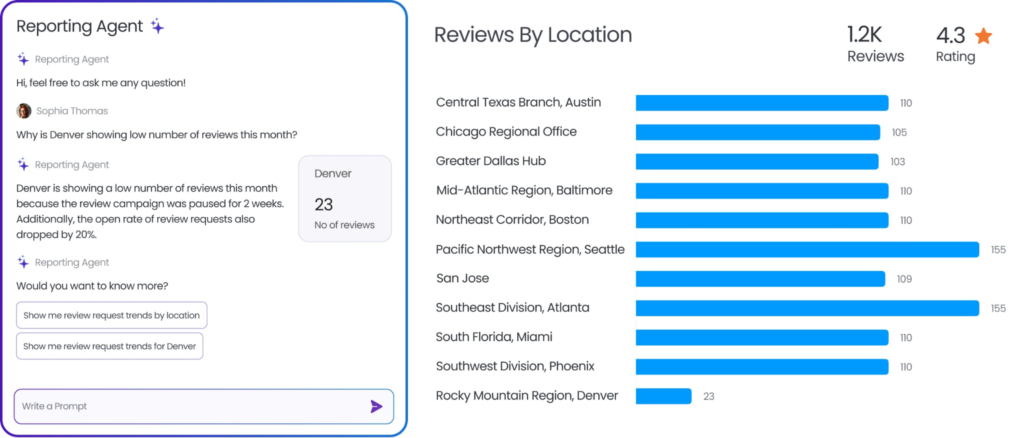
Track review volume, average ratings, response rates, and sentiment trends across properties. Monitoring these metrics helps hotels identify locations that require attention and evaluate the impact of operational changes.
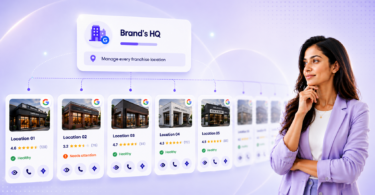
Pro tip: Managing reviews across Google, Tripadvisor, Booking.com, Expedia, Hotels.com, Yelp, and other review sites can quickly become time-consuming, especially for multi-property hotel brands. Birdeye Reviews Agent helps hotels generate more guest reviews, monitor feedback across 200+ review sites, identify recurring guest concerns, benchmark competitors, and create personalized, on-brand review responses from a single dashboard.
How do AI assistants influence hotel visibility and reputation?
AI assistants increasingly cite Oyster, Tripadvisor, Google Reviews, hotel listings, and travel websites when recommending hotels. Monitoring how your property appears in these answers is becoming an important part of hotel reputation management.
Here’s how AI search influences hotel visibility and reputation:
- Summarizes review themes: AI assistants often analyze reviews across multiple sources and describe hotels using recurring themes such as cleanliness, customer service, location, room quality, value, and amenities.
- Matches hotels to traveler requests: When travelers ask for a family-friendly resort, a pet-friendly hotel, a luxury stay, or a business hotel, AI uses review content, listings, and website information to identify relevant properties.
- Highlights strengths and weaknesses: Consistent praise for spacious rooms or frequent complaints about noise, parking, or check-in delays can influence how AI presents your hotel in recommendations.
As travelers increasingly use AI answer engines to research accommodations, hotels need visibility into the information shaping those recommendations.
Birdeye’s Search AI helps you:
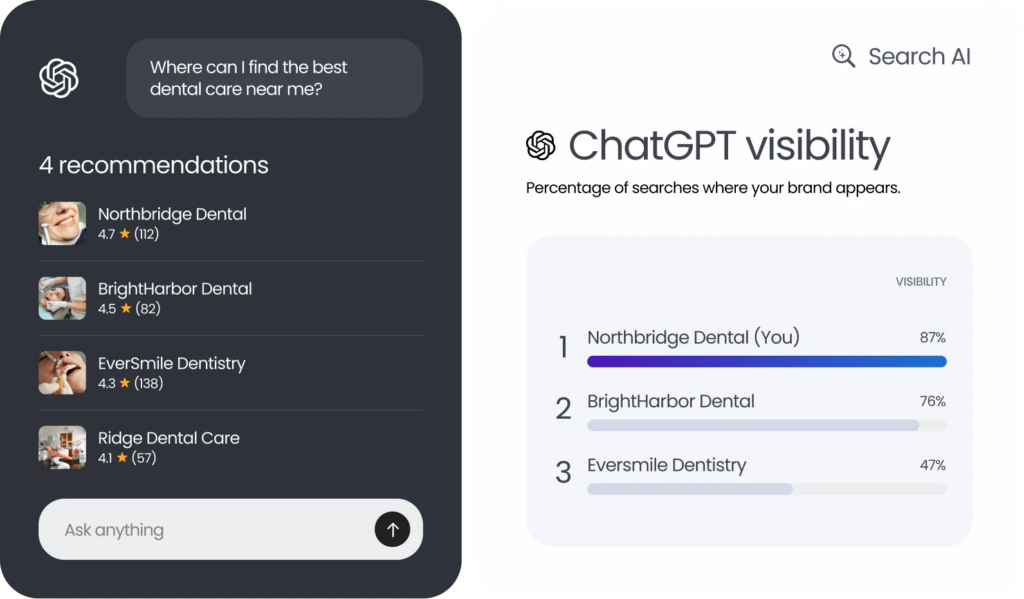
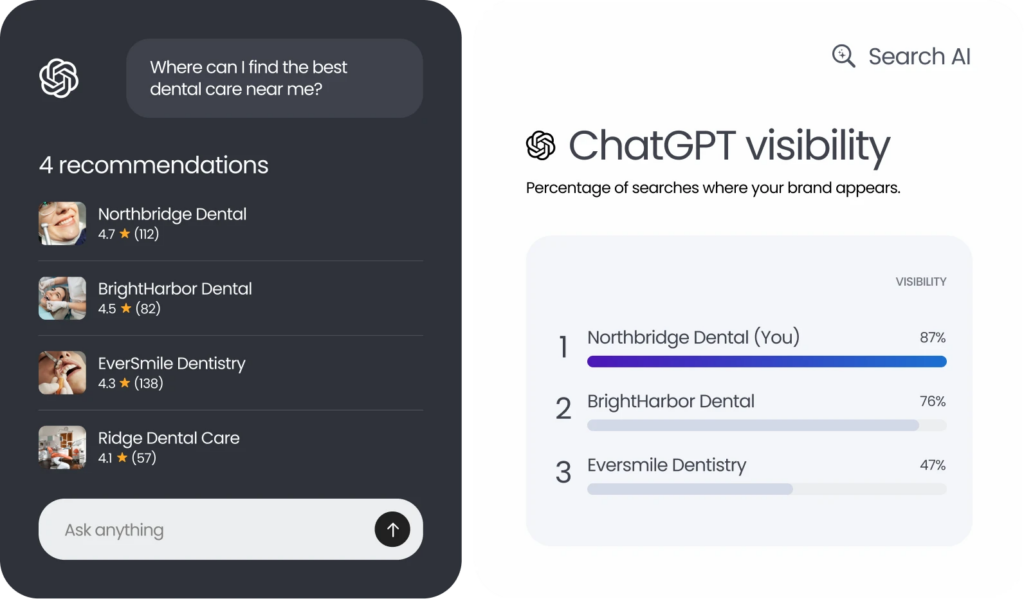
- Track AI visibility: Monitor how your hotel appears on ChatGPT, Gemini, and Perplexity.
- Understand perception: See how AI describes your hotel and the themes associated with your property.
- Identify key sources: Know which reviews, listings, and websites influence AI recommendations.
- Optimize listings: Identify inaccuracies in property information and improve discoverability.
- Maintain accurate information: Keep amenities, contact details, and hotel information consistent across platforms.
Hotels can no longer rely solely on traditional search rankings and review scores. Understanding how AI platforms describe and recommend your property helps you stay visible where more travelers now begin their research.
FAQs on hotel review sites
For sheer review volume + booking impact, Google. For traveler trust in hotel-specific reviews, TripAdvisor. For verified-stay reviews, Booking.com.
Booking.com, Expedia, Hotels.com, and Trip.com accept reviews only from guests who completed a paid stay through their platforms. Google, TripAdvisor, Yelp, and Trustpilot are open.
Most hotels use a review management software like Birdeye that aggregates reviews from Google, TripAdvisor, Booking.com, Expedia, and others into a single dashboard, with response templates and AI-assisted replies.
Yes. AI assistants frequently cite Google, TripAdvisor, Oyster, and Booking.com when answering “best hotel in [city]” queries. Monitoring how your property appears in these answers is the next frontier in reputation.
A rating site (AAA, Forbes Travel Guide, Michelin Keys) issues an editorial classification. A review site collects guest feedback. Both matter; ratings drive premium positioning, and reviews drive bookings.
How to turn hotel reviews into a revenue channel with Birdeye
For multi-location hospitality brands, Birdeye brings guest feedback, reputation signals, and local discovery workflows into one AI-powered platform. As the #1 agentic marketing platform for multi-location brands, Birdeye uses BirdAI and a unified data platform to help teams manage the guest journey at scale, from discovery and booking confidence to post-stay engagement.
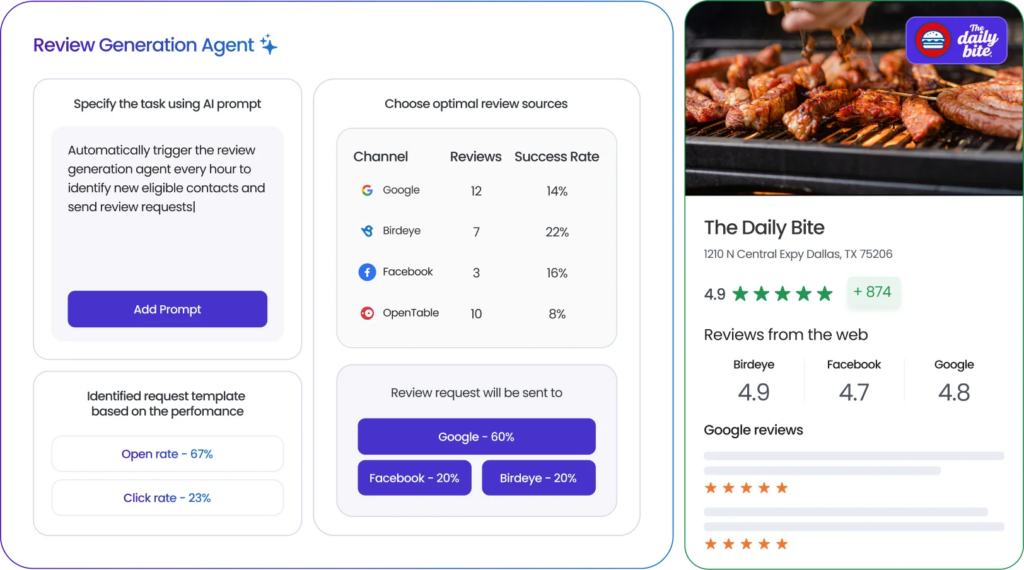
With Birdeye Reviews, teams can generate, monitor, respond to, and analyze guest reviews across supported review sites. The Review Generation Agent supports timely review requests following guest interactions, while the Review Response Agent drafts personalized, on-brand replies based on review sentiment and context.
The Review Reporting Agent helps teams identify recurring themes across properties, departments, and review platforms. Teams can spot patterns around room cleanliness, front desk wait times, breakfast quality, parking, noise, amenities, or service recovery, then use those insights to guide property-level improvements.
As more travelers use AI tools to research where to stay, Birdeye Search AI helps hotel brands understand how their properties appear across AI-generated answers. It tracks AI visibility, citations, sentiment, competitor presence, and business information accuracy, showing which signals may be influencing how properties are represented across platforms such as ChatGPT, Gemini, and Perplexity.
Watch a free demo to see how Birdeye can help your hotel team improve guest trust, reputation, and visibility across properties.

About the Author

Vanjana Sharma
Originally published