The top 10 car review sites include Car and Driver, Edmunds, MotorTrend, Autotrader, J.D. Power, TrueCar, U.S. News Cars, Autoblog, The Car Connection, and CarComplaints. These platforms influence how buyers research vehicles, compare models, and evaluate dealerships. Their reviews and data often appear in Google results and AI-generated answers, shaping decisions early in the buying journey.
Summary

Car review sites influence how dealer groups rank, appear, and get recommended across traditional search and AI-driven search engines. Strong portfolio benchmarks such as high average ratings, continuous review generation, and active responses increase visibility in vehicle comparisons, dealership shortlists, and AI-driven recommendations, leading to higher-intent leads and more showroom visits.
In this blog, you will find the detailed review of the 10 car review sites that matter most in 2026, along with how Birdeye helps dealer groups manage reviews, improve consistency, and strengthen visibility across every location.
Table of contents
- Why car reviews matter for dealer groups in 2026?
- What are the most reliable car review sites for automotive dealer groups?
- How does Birdeye help automotive dealer groups manage reputation across car review sites at scale?
- Frequently asked questions about car review sites
- What automotive dealer groups should do now?
Why car reviews matter for dealer groups in 2026?
Car reviews matter because they are no longer just influencing individual purchase decisions; they are shaping how entire dealer groups perform across markets. According to Forrester, 94% of buyers use AI tools during their buying process, which means reviews are now analyzed, summarized, and surfaced by AI before customers even visit a dealership or website.
In 2026, reviews impact three core outcomes at a portfolio level:
- Search visibility across locations
- Lead conversion rates
- Customer experience consistency across dealerships
Whether someone is looking to buy the latest car, scheduling repairs, or simply exploring options for their next vehicle, reviews act as the first layer of validation. For dealer groups, this means your collective review footprint directly affects how each location competes and how the brand is perceived overall.
Reviews as a portfolio-wide growth lever
Car review sites don’t just impact one dealership; they shape performance across the entire group.
Strong, consistent reviews help dealer groups:
- Build trust at scale across multiple locations
- Reduce performance gaps between top and underperforming dealerships
- Create a consistent brand experience across markets
At a portfolio level, quality, volume, and recency become key benchmarks for growth.
Higher visibility and more qualified leads
Review signals play a major role in how dealerships appear in search and on review platforms.
More high-quality reviews lead to:
- Better local search visibility across thousands of locations
- Higher click-through rates from listings
- More qualified leads who already trust your brand
Customers arriving through review sites are typically further along in their decision-making, making them more likely to convert.
Reviews strengthen AI search visibility and recommendations
AI-driven search experiences now summarize and recommend dealerships based on review data, but these answers are not random. According to State of AI Search 2026, review and social proof layers (customer reviews, ratings, and engagement) are one of the four key layers AI engines rely on to shape local recommendations.
This means:
- Customer sentiment shapes how your brand is described
- Strengths like service quality or pricing get surfaced automatically
- Weak or inconsistent reviews reduce visibility
For dealer groups, strong review coverage improves presence in AI-generated recommendations, not just traditional rankings.
Stronger trust and faster decision-making
Car review sites give customers real-world validation. Detailed, recent reviews help them quickly assess:
- Vehicle performance and buying experience
- Service quality and transparency
- Overall dealership reliability
This reduces hesitation and shortens the path from research to purchase or booking.
What are the most reliable car review sites for automotive dealer groups?

In the automotive industry, nearly 90% of customer reviews are now on Google, according to Birdeye’s State of Online Reviews 2025 report. While this shapes initial perception, buyers often look beyond it to platforms that offer deeper analysis, expert testing, and structured comparisons. That’s where reliable car review sites play a critical role.
As per our experts’ research, these are our recommended top car review websites:
| Platform | Review volume | Platform share (role in ecosystem) | Key features | Source |
| Autoblog | Medium (editorial-heavy) | Automotive media | News coverage, first drives, trends, buyer insights | autoblog.com |
| Car and Driver | High (expert reviews) | Editorial authority | Instrumented testing, comparison tests, long-term reviews | caranddriver.com |
| The Car Connection | Medium (aggregated + editorial) | Review aggregator | Daily reviews, expert scoring, summary ratings | thecarconnection.com |
| Autotrader | High (consumer + dealer reviews) | Marketplace | Listings, dealer ratings, pricing insights | autotrader.com |
| TrueCar | Medium–high (verified buyers) | Pricing + dealer network | Price transparency, certified dealers, buyer reviews | truecar.com |
| J.D. Power | Very high (survey-based data) | Data authority | Owner surveys, dependability studies, and reliability scores | jdpower.com |
| U.S. News & World Report (Cars) | High (aggregated + editorial) | Rankings platform | Composite rankings, safety + reliability scoring | cars.usnews.com |
| CarComplaints.com | High (issue-focused) | Reliability database | Complaint tracking, defect trends, and worst model years | carcomplaints.com |
| Edmunds | Very high (expert + consumer) | Full-funnel platform | Road tests, pricing tools, and cost of ownership data | edmunds.com |
| MotorTrend | High (editorial + video) | Media + awards authority | Car of the Year, expert reviews, video content | motortrend.com |
Each platform plays a distinct role, so understanding their strengths helps automotive dealerships prioritize where to monitor, manage, and improve their presence.
1. Autoblog
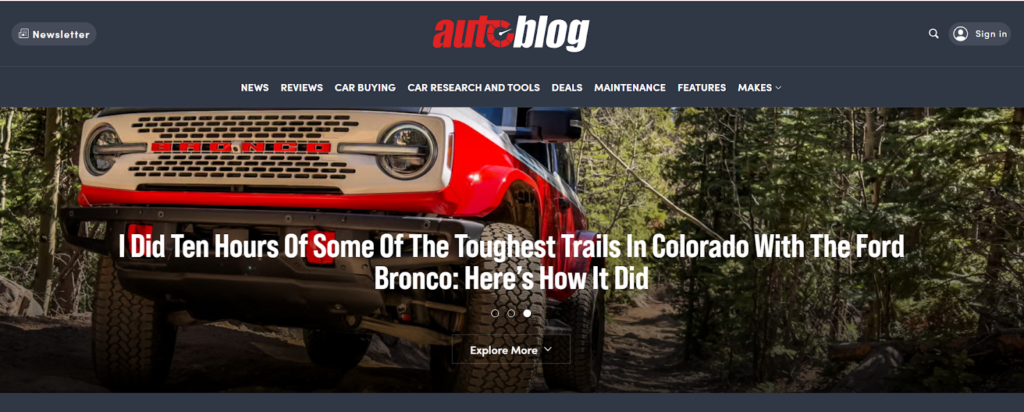
Autoblog is a digital-first automotive publication that delivers news, reviews, and feature content on new vehicles, technology, and mobility trends. Its editorial coverage includes first drives, industry updates, and buying advice written by automotive journalists. The platform focuses on timely reporting rather than standardized scoring, making it a frequent source for discovery and trend-based queries. In 2026, its content continues to surface in news results and AI summaries for early-stage research.
Pros:
- Consistent coverage of automotive news and launches
- Strong visibility in discovery and news-driven search
- Useful for tracking trends and innovations
- Regular publishing cadence
Cons:
- Limited structured ratings or comparisons
- Minimal integration of consumer feedback
2. Car and Driver
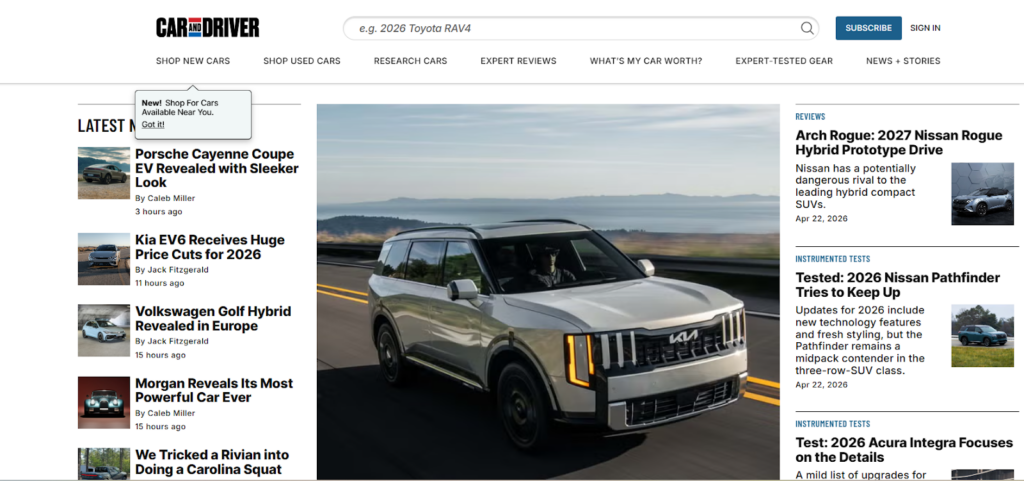
Car and Driver provides in-depth vehicle reviews based on instrumented testing and editorial analysis. Its evaluations include measurable performance data such as acceleration, braking, and handling, along with expert commentary. The platform publishes comparison tests, buying guides, and annual rankings, such as “10Best,” which are widely referenced. As of 2026, it remains a primary source for performance-focused evaluations and editorial authority.
Pros:
- Data-backed, instrumented testing methodology
- Strong reputation in automotive journalism
- Influential comparison tests and rankings
- High citation across search and media
Cons:
- Limited focus on dealership experience
- Minimal user-generated reviews
3. The Car Connection
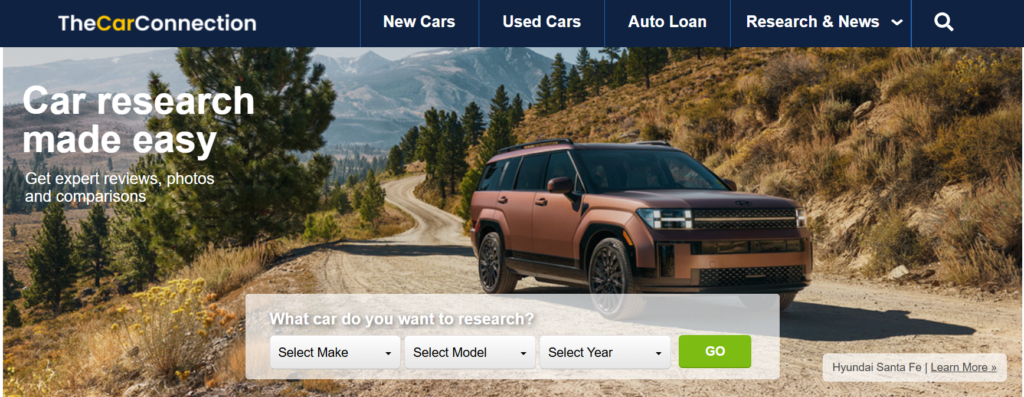
The Car Connection combines original editorial reviews with aggregated data from multiple expert sources to create a unified vehicle score. Reviews are structured into categories such as performance, safety, comfort, and utility, making comparisons across models easy. The platform emphasizes concise summaries alongside detailed breakdowns. In 2026, its structured scoring aligns well with how search engines and AI answer engines present summarized results.
Pros:
- Aggregated scoring simplifies comparisons
- Structured, category-based evaluations
- Easy-to-scan summaries
- Useful for quick research
Cons:
- Limited standalone deep testing
- Relies partly on third-party inputs
4. Autotrader
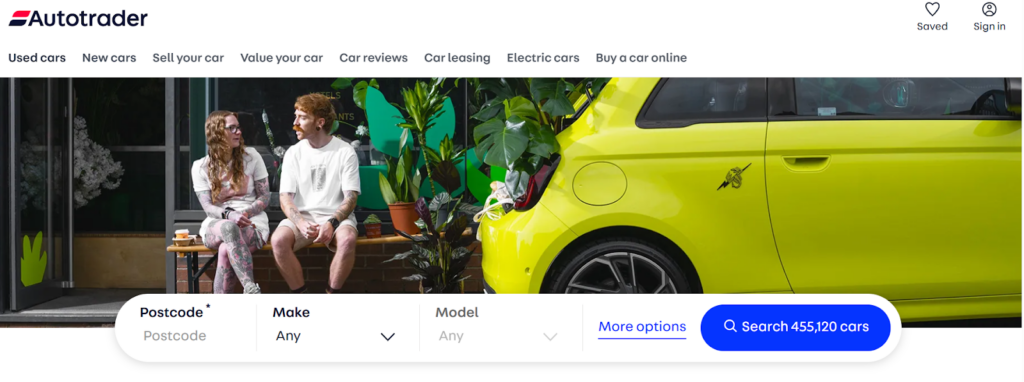
Autotrader is a marketplace that enables users to browse, compare, and purchase new and used vehicles, and provides editorial reviews and dealer ratings. It integrates listings with pricing insights, market data, and consumer feedback. Buyers can evaluate inventory, compare features, and connect directly with dealers. In 2026, it remains a key platform during the active shopping phase due to its combination of research and transaction tools.
Pros:
- Combines vehicle listings with reviews
- High-intent audience of active buyers
- Includes pricing and comparison tools
- Supports dealer visibility and lead generation
Cons:
- Highly competitive listing environment
- Review depth varies by listing
5. TrueCar
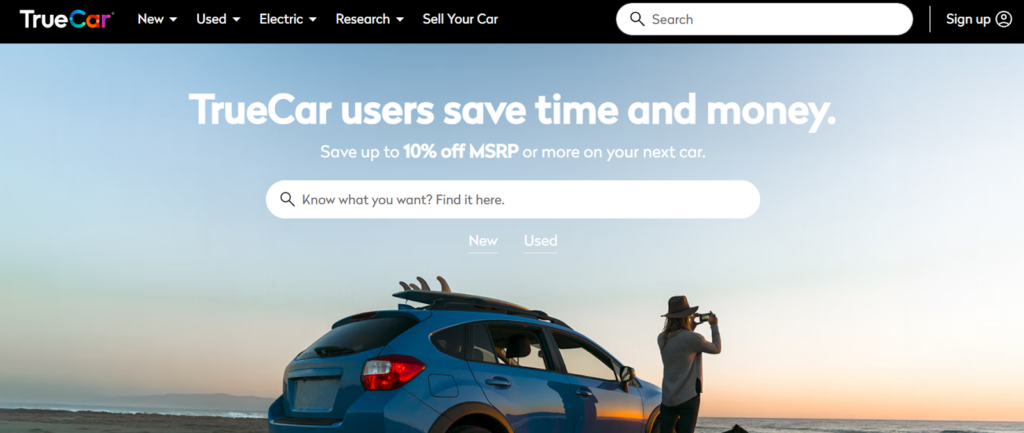
TrueCar focuses on price transparency and connects buyers with a network of certified dealers. It provides data on what other customers paid for similar vehicles, helping users understand fair pricing. The platform includes verified buyer reviews tied to real purchase experiences. In 2026, its emphasis on transaction data and pricing clarity makes it highly relevant in the decision stage.
Pros:
- Transparent, data-driven pricing insights
- Verified purchase-based reviews
- Strong dealer network integration
- Builds trust during purchase decisions
Cons:
- Limited editorial review content
- Less influence in early research stages
6. J.D. Power

J.D. Power is a data analytics company that conducts large-scale surveys to measure vehicle quality, reliability, and customer satisfaction. Its studies, such as Initial Quality and Vehicle Dependability, are based on responses from verified owners. The platform produces standardized scores and rankings used across the automotive industry. In 2026, it remains a key authority for data-driven insights rather than editorial reviews.
Pros:
- Large-scale, survey-based insights
- Trusted authority in automotive data
- Standardized scoring across vehicles
- Widely referenced in industry and media
Cons:
- Limited real-time qualitative feedback
- Not focused on dealer-level experience
7. U.S. News & World Report (Cars)
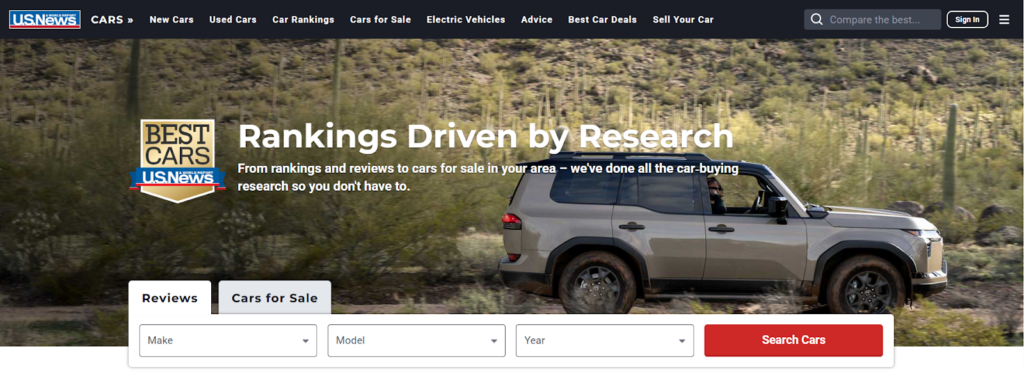
The U.S. News Cars section aggregates expert reviews, safety scores, and reliability data into a single ranking system. It pulls from multiple automotive sources and combines them with its own methodology to rank vehicles. The platform presents information through best-of lists, comparisons, and category rankings. In 2026, it remains widely referenced for its structured, consolidated approach.
Pros:
- Combines multiple trusted data sources
- Clear and structured rankings
- Easy comparison across categories
- High visibility in search
Cons:
- Limited original testing
- Dependent on external review data
8. CarComplaints. com
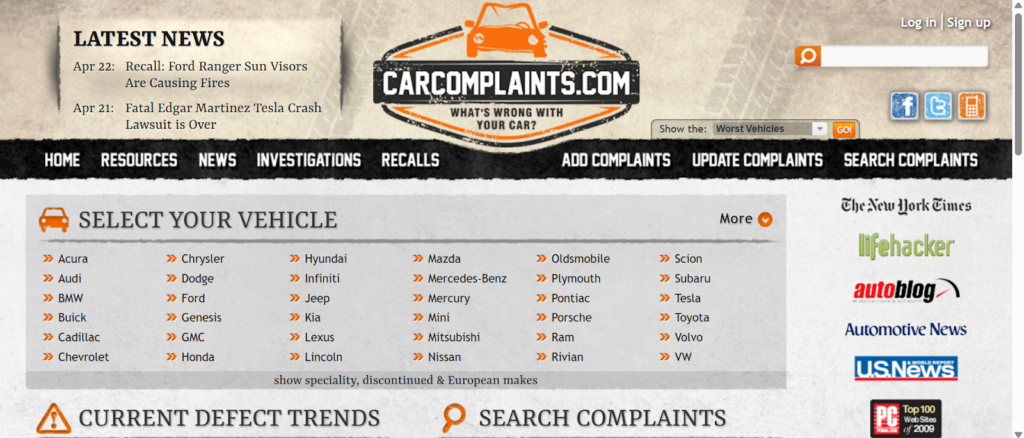
CarComplaints.com is a database that collects and organizes vehicle complaints submitted by owners. It categorizes issues by model, year, and severity, highlighting recurring problems and trends. The platform also identifies best and worst model years based on complaint volume and repair cost. In 2026, it remains a niche but valuable source for reliability-focused research.
Pros:
- Real owner-reported issue tracking
- Clear identification of defect trends
- Helps evaluate long-term reliability
- Useful for risk assessment
Cons:
- Skews toward negative experiences
- Lacks balanced performance reviews
9. Edmunds
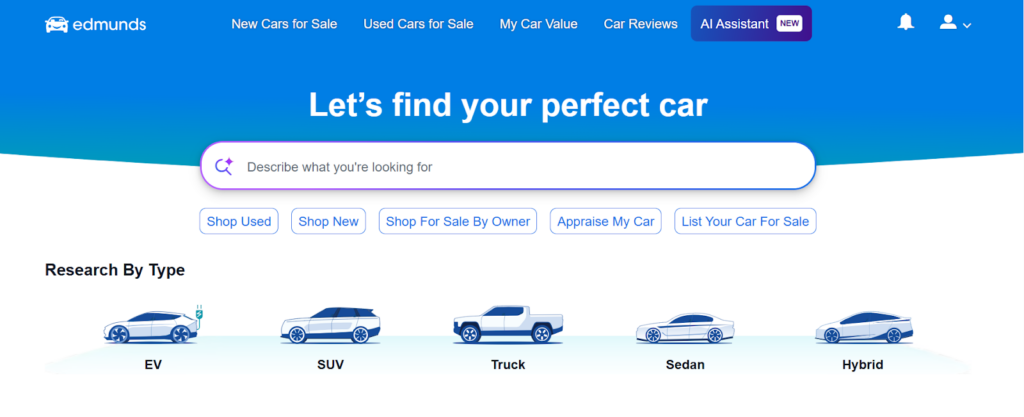
Edmunds provides a combination of expert reviews, consumer ratings, and pricing tools to support the car-buying process. Its editorial team conducts road tests and evaluates vehicles across multiple criteria. The platform also offers tools such as True Market Value (TMV) and cost-to-own estimates. In 2026, it continues to serve as a comprehensive resource across research, comparison, and purchase stages.
Pros:
- Combines expert testing with user reviews
- Detailed pricing and ownership tools
- Covers the full buyer journey
- Strong presence in search results
Cons:
- Commercial elements may affect perception
- Interface complexity for some users
10. MotorTrend
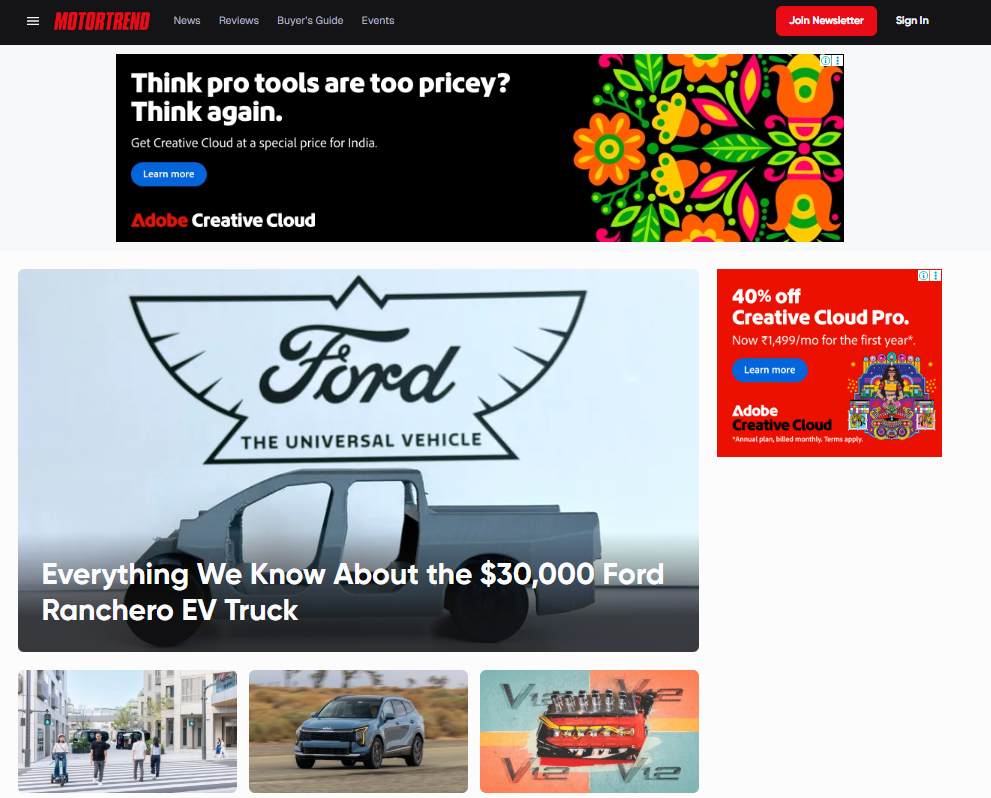
MotorTrend is an automotive media brand that publishes reviews, comparisons, and video content across digital platforms. It is known for awards such as “Car of the Year,” which are based on editorial evaluation. The platform combines written reviews with video and streaming content to reach a broad audience. In 2026, it continues to influence brand perception through its editorial authority and multimedia approach.
Pros:
- Strong editorial and brand authority
- Influential awards and rankings
- High-quality video and digital content
- Broad audience reach
Cons:
- Limited consumer-generated reviews
- Less focus on dealership-level insights
Together, these platforms shape how buyers validate choices beyond Google, offering deeper context through expert reviews, data-backed ratings, and real ownership insights.
Discover Top 10 Car Review Sites
Want to see the impact of Birdeye on your business? Watch the Free Demo Now.
How does Birdeye help automotive dealer groups manage reputation across car review sites at scale?

Managing reviews across multiple car review platforms and locations quickly becomes time-consuming, especially when teams handle large volumes of feedback every day. At the same time, review signals directly influence how dealerships rank on Google and how they appear in AI-generated search results.
Dealer groups need a centralized system that not only manages reviews but also strengthens visibility across search, listings, and customer engagement channels.
This is where Birdeye, the #1 Agentic Marketing Platform, comes in. It helps automotive and dealership groups managing anywhere from 100 to 10,000+ locations bring review management, listing accuracy, and AI search visibility into a single platform.
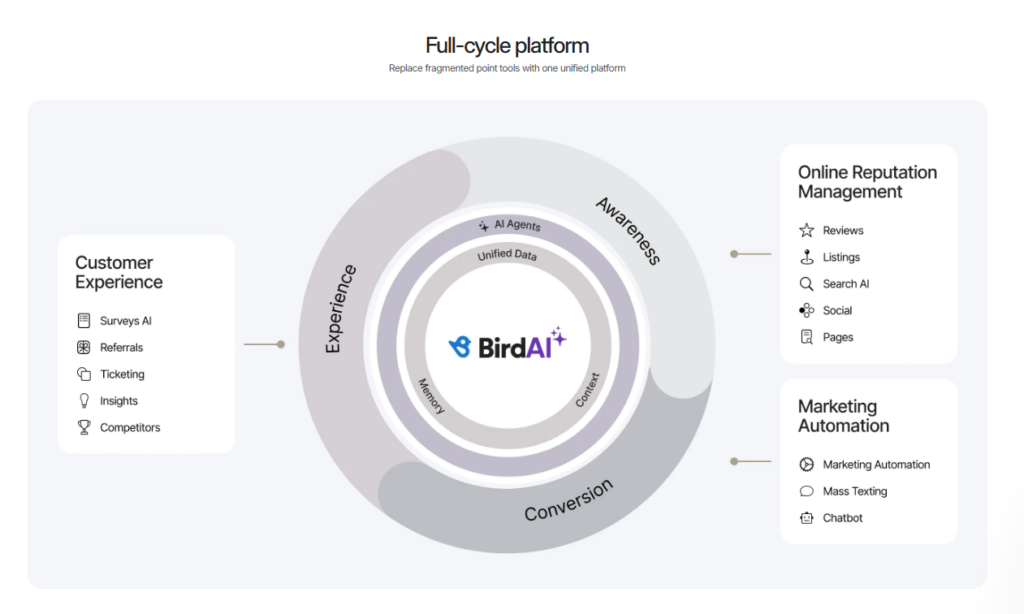
At its core, Birdeye simplifies reputation and review management through three key pillars:
Consolidate: bring your data and systems together
Birdeye connects with your CRM, POS, EHR, and other core platforms to centralize customer and location data. This unified view removes silos and reduces the need to manage multiple tools across dealership locations.
Think: turn data into meaningful insights
BirdAI evaluates feedback and performance data with context and historical understanding. It identifies patterns, monitors trends, and highlights what matters most at both the brand and location level.
Act: automate execution with AI agents
AI agents handle essential workflows across reviews, listings, and customer interactions. From generating reviews to updating listings and responding to customers, execution becomes consistent and scalable with human oversight.
Together, these pillars create a system that enables dealer groups to manage reputation, improve visibility, and respond to customers more efficiently across hundreds or even thousands of locations.
Here’s how Birdeye delivers this in practice:
Reviews AI
- Automatically generate reviews through CRM and post-service workflows to increase review volume
- Respond to customer feedback with personalized, on-brand replies that reflect sentiment and context
- Monitor reviews across Google, Cars.com, DealerRater, and other platforms from one dashboard
- Maintain consistent response rates across all dealership locations
- Improve review recency and engagement, which directly impacts search rankings and buyer trust
Listings AI
- Create, update, and manage dealership listings across directories from one platform
- Ensure accurate business information across all locations to avoid customer confusion
- Eliminate duplicate listings and inconsistencies across review sites
- Strengthen local SEO signals that influence discovery across search and review platforms
- Maintain consistency in dealership data across large, multi-location networks
Search AI
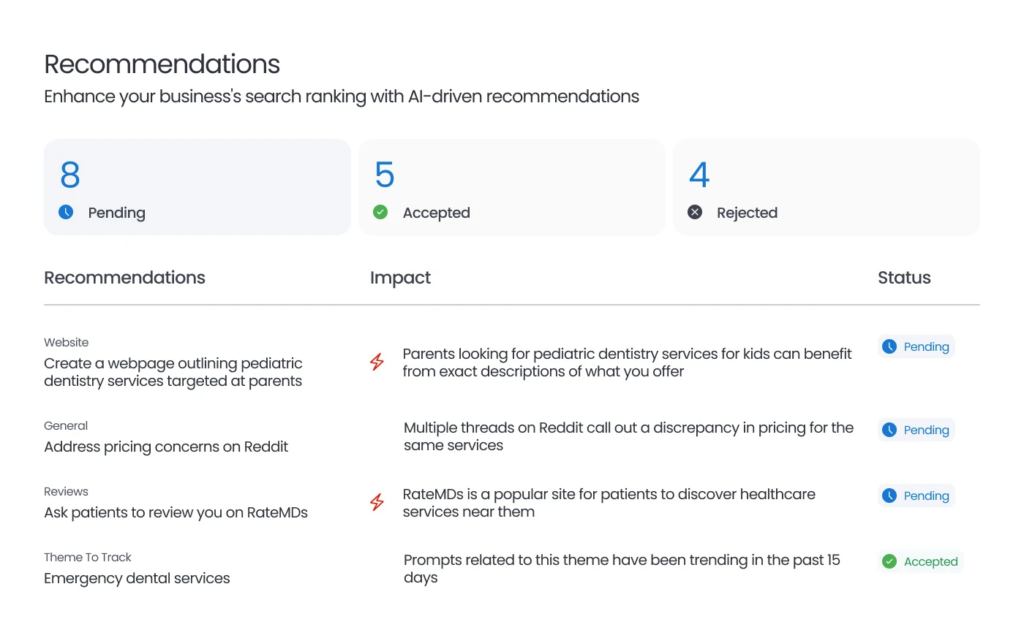
- Birdeye Search AI tracks how often your dealership appears in AI-generated answers across platforms like ChatGPT, Gemini, and Perplexity
- Understand how AI describes your brand, including sentiment, strengths, and gaps
- Identify which review sites and listings influence AI-generated recommendations
- Measure the share of voice across locations and benchmark against competitors
- Improve visibility with insights and recommended actions based on AI search performance
Messaging AI
- Centralize customer conversations across SMS, webchat, email, and social channels in one inbox
- Help teams respond faster and reduce missed inquiries that can impact customer experience
- Maintain consistent communication across all dealership locations
- Support review follow-ups and service-related conversations that lead to more positive reviews
Social AI
- Publish and schedule posts across multiple dealership locations from one platform
- Share positive reviews and customer experiences to reinforce brand trust
- Maintain an active and consistent presence across social channels
- Generate ready-to-use content aligned with dealership campaigns and promotions
- Extend the impact of reviews beyond review sites into social discovery channels
“We’ve dramatically improved our online reputation. We have a direct conduit from our customers to us that we’ve never had before, letting us know where we can improve our process to boost customer retention and customer experience.”
MARK BURSHEARSDIGITAL MARKETING DIRECTOR AT O’BRIEN AUTO GROUP
Birdeye brings all these capabilities together in a single platform, powered by BirdAI. It helps generate responses, analyze sentiment, and summarize feedback trends, so dealer groups can maintain consistency and act faster across all locations.
Frequently asked questions about car review sites
The best platform depends on the need, whether it is expert testing, pricing insights, or reliability data, so buyers typically use multiple sources together.
Edmunds is stronger for expert reviews and testing, while Kelley Blue Book is more focused on vehicle pricing and valuation.
National Automobile Dealers Association website provides industry data, guidelines, and resources for automotive dealerships.
Yes, most trusted platforms combine expert analysis, structured data, and real customer feedback, making them reliable when used together.
The best automotive reputation management software depends on your operational scale, but it should include centralized review monitoring, automation, and multi-platform response management. Birdeye is widely used in the automotive space for exactly this, helping multi-location dealerships consolidate reputation management, track sentiment across 100-10,000+ locations, and respond to reviews at scale.
Birdeye helps improve ratings by generating reviews, managing responses, and providing sentiment insights.
Birdeye automates review requests via CRM integrations, messaging, and post-service workflows to consistently increase review volume.
The leading platforms for up-to-date car reviews in 2026 include Car and Driver, Edmunds, MotorTrend, Autotrader, J.D. Power, TrueCar, U.S. News Cars, Autoblog, The Car Connection, and CarComplaints, as they combine expert testing, consumer feedback, and reliability data to guide purchase decisions.
What automotive dealer groups should do now?
Dealer groups should treat review visibility as a portfolio-level priority, not a location-level task. Success now depends on how consistently your brand shows up across research, comparison, and decision moments, not just where you rank on a single platform. Focus on building a clear, unified brand narrative that AI answer engines can easily interpret and recommend. The dealer groups that want to stay consistent across locations and improve how they appear across search and AI-driven results can rely on platforms like Birdeye to bring everything together in one place.
Get a Birdeye demo to explore how it can help your dealership.

About the Author

Vanjana Sharma
Originally published