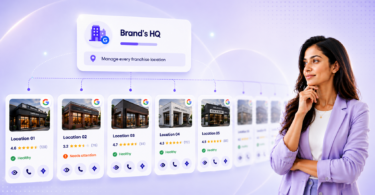
The real difference in Agentic AI vs. AI-assisted marketing is simple: assistants help your team write, brainstorm, and analyze faster, while agentic AI uses purpose-built agents to execute multi-step work in-channel under clear rules. For multi-location brands running 500 to 10,000 locations, that shift isn’t theoretical. It’s the difference between an AI that suggests and an AI that acts like an intelligent coworker.
Summary:
AI-assisted marketing tools speed up drafts and summaries, but they still leave routing, approvals, posting, and reporting to humans. At a multi-location scale, that creates prompt debt: more “ready to ship” work stuck waiting on handoffs. McKinsey’s estimate that agentic AI will drive more than 60% of AI’s incremental marketing and sales value makes the direction clear: enterprises need systems that execute, not just assist. Birdeye is built to provide this level of execution as the #1 Agentic Marketing Platform for large enterprises. It deploys purpose-built AI agents that act autonomously across thousands of locations to drive quantifiable outcomes.
In this blog post, you’ll learn how agentic AI vs. AI-assisted marketing differ in day-to-day multi-location operations. We’ll use Birdeye’s agentic framework to walk through real enterprise workflows, reviews, listings, and social using a clear signal → decision → action → measurement model. Let’s begin.
Table of contents
AI-assisted vs. agentic marketing platform: Which model works better for enterprises?
For enterprise teams, the difference between AI-assisted and agentic marketing comes down to execution. AI-assisted tools act like a smart text box: you prompt, it drafts, and your team still does the operational work. Agentic platforms act more like a governed execution layer: they detect signals, apply context, and complete workflows across connected systems, without waiting for someone to push every button.
That distinction matters because the market is full of what Gartner calls “agent washing”, AI assistants and chatbots being relabeled as agents even when they still depend on human input and do not execute independently.
Here’s the practical difference for enterprise teams evaluating AI-assisted tools vs. agentic platforms:
| Dimension | AI-assisted marketing | Agentic marketing platform |
| Operating style | Reactive (waits for prompts) | Proactive (acts toward a goal) |
| Role in the workflow | Drafts, suggests, summarizes | Executes multi-step workflows |
| Instruction model | Prompt-by-prompt | Goal-driven with triggers and rules |
| Context used | Generic LLM context | Brand, location, industry, and workflow context |
| Measurement | Tracks outputs (drafts, summaries) | Tracks completed actions and business outcomes |
| Human involvement | High (constant prompting + handoffs) | Supervised autonomy with approvals where needed |
| Governance | Often process-dependent | Built-in permissions, approvals, and controls |
The table gives the high-level contrast. The details below show how those differences affect enterprise marketing teams in daily operations.
AI-assisted (the old way)
- Prompt-driven, not workflow-driven: Needs constant human prompting to generate each output (copy, summary, ideas).
- Generic LLM output without local context: Produces content that often lacks location nuance (store history, local offers, recurring issues, regional tone).
- Acts as a “co-pilot,” not an executor: Helps you create, but rarely completes the job end-to-end (no automated routing, no exception handling, no closed-loop outcomes).
- Manual execution still owns the finish line: Your team still routes tasks, runs approvals, schedules posts, publishes responses, and pulls reports, usually across multiple tools.
- Hard to govern consistently at enterprise scale: When execution stays manual, governance depends on people remembering the process, which increases risk across locations, regions, and business units.
Agentic AI (The Birdeye way)
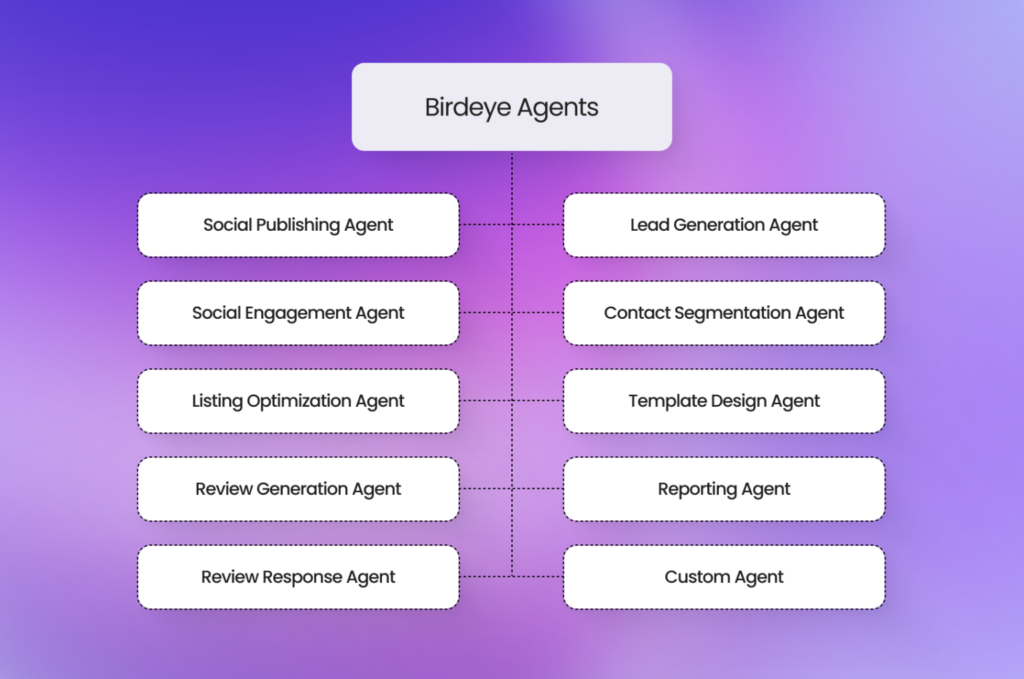
- Purpose-built agents, not one generic chatbot: Uses specialized agents such as Review Generation Agent, Review Response Agent, Social Publishing Agent, Social Engagement Agent, Listings Optimization Agent, and more, built for specific jobs, not just content generation.
- Local intelligence (context + memory): Agentic AI doesn’t just “write.” It uses context and memory to make better decisions and take the right action for each location.
- Autonomous workflow execution across connected systems: Agents can plan, generate, and publish in the actual workflow (for example, Social Publishing Agent filling your calendar and publishing content).
- Enterprise-grade governance: Supports role-based permissions through configurable user roles and controlled access, plus approval workflows so corporate teams can set guardrails while locations move fast.
- Designed for scale without adding headcount: Agentic execution reduces handoffs and repeat work, which helps enterprise teams improve consistency and speed across hundreds or thousands of locations.
For enterprises, the better model is the one that reduces operational work under governance, which is exactly where Birdeye’s agentic AI framework fits.
How global enterprise brands deploy Birdeye’s AI Agents
Birdeye is built for multi-location enterprises, with an agentic framework that completes real marketing workflows at scale.
Each Birdeye agent runs on four building blocks:
- Goals (the outcome)
- Tasks (the steps)
- Tools (the systems it acts in), and
- Triggers (the events that kick off work)
An adaptive intelligence layer trains agents on what “right” looks like for your business, using Brand AI for voice and guardrails, Industry AI for vertical intelligence and compliance needs, and configurable LLMs tuned to your context.
That foundation powers a repeatable operating model: signal → decision → action → measurement. Teams set permissions and approvals, and the agents execute the work, so teams spend less time chasing handoffs and more time driving outcomes.
To show how enterprise brands deploy Birdeye’s AI Agents in practice, here are a few common workflows that illustrate the Birdeye AI Agents in action.
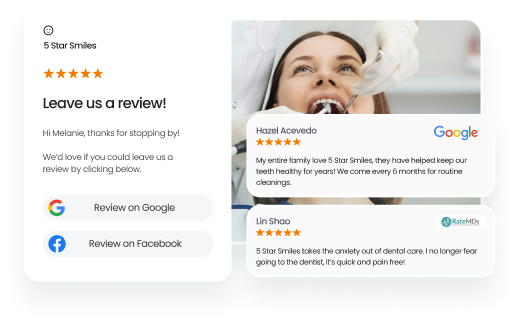
Example 1: Review Generation Agent that standardizes “ask moments”
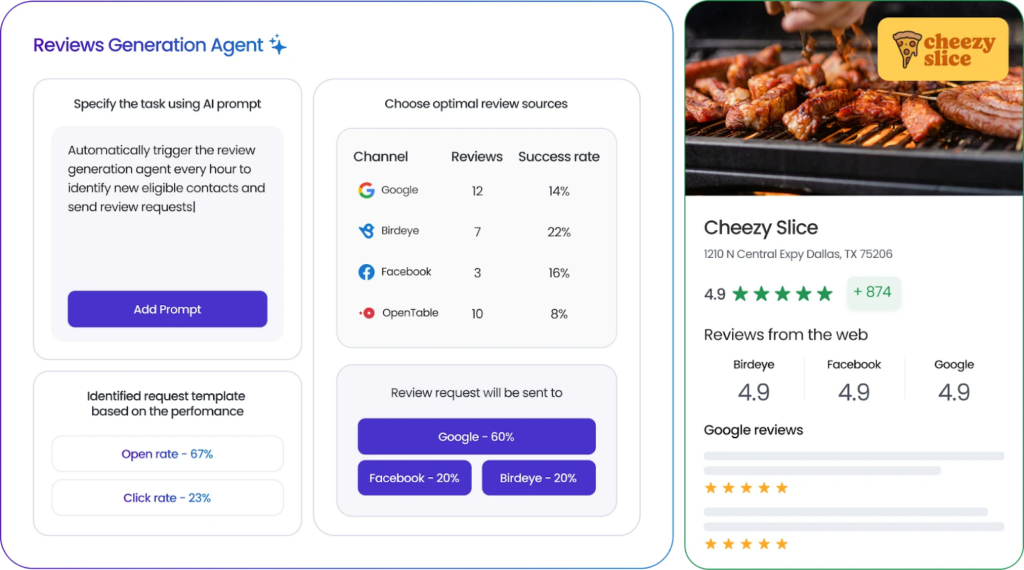
Outcome: Higher review volume on the right sites, with consistent timing and messaging.
- Signal: A customer completes a visit, delivery, or appointment, your “right moment” to ask.
- Decision: The agent selects timing and message patterns built to drive responses (instead of relying on staff to remember).
- Action: It sends requests “at the perfect time” with content designed to get responses and increase review volume on priority platforms.
- Measurement: You can see volume and performance trends across 100-10,000+ locations to identify which branches need workflow fixes.
- In practice:Complete Care automated review generation with Birdeye and reported 29,650+ reviews and a 4.8 average star rating, and cited a 3653% review increase.
Example 2: Review Response Agent that protects brand voice and speed
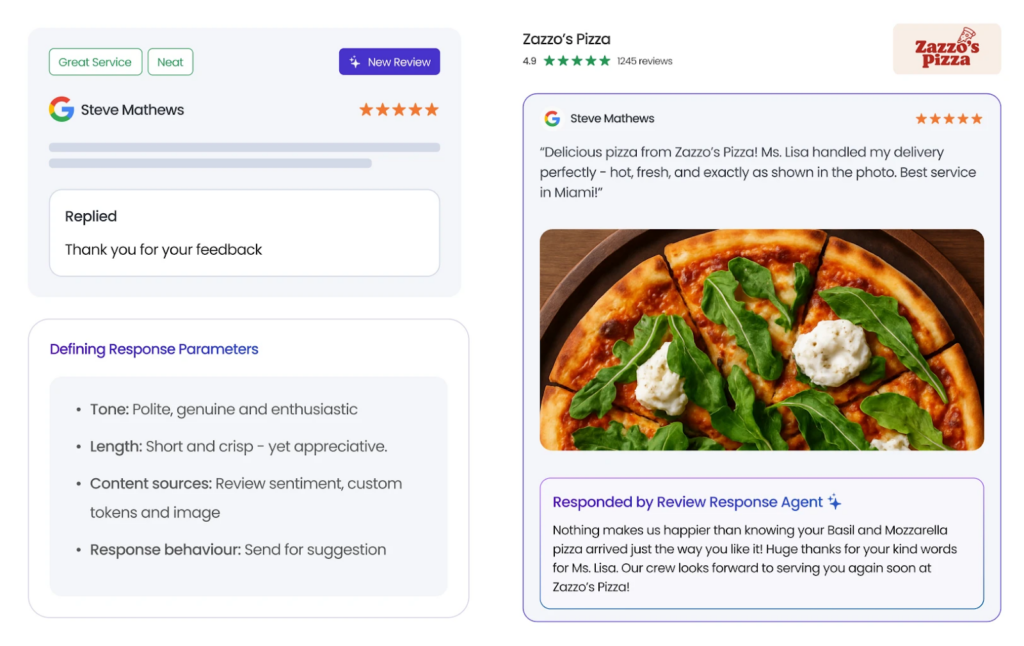
Outcome: Faster response times, consistent brand voice, no missed reviews across locations.
- Signal: A new review lands (often with sentiment cues, keywords, and sometimes images). Birdeye’s Agentic AI model goes beyond “drafting” by detecting opportunities/issues and executing the right action, rather than waiting for prompts.
- Decision: The agent interprets sentiment and context, then generates an on-brand reply that understands tone, images, and context, not a generic template.
- Action: The agent auto-generates replies that teams can edit, schedule, and control, so locations can publish without manually writing every response.
- Governance (conditional approvals): For enterprise controls, teams can route certain responses through approval workflows before anything goes live, so sensitive reviews get oversight while routine reviews can move faster.
- Measurement: You track response coverage, response time, sentiment movement, and location-level reputation impact, so the teams can see who is falling behind and why.
- In practice, Foundation Partners Group managed 10k+ reviews across their network of brands, achieving a 97% response rate. They also replied to 9k+ reviews in two years, using templates and AI tools to save time on empathetic responses, especially for negative feedback.
Example 3: Listings Optimization Agent that keeps location data accurate
Outcome: No listing errors or duplicate listings, better search, and AI visibility by location.
- Signal: A listing change, an inconsistency appears, or a duplicate pops up.
- Decision: The agent identifies what’s wrong (hours, address, categories, duplicates) and what should be corrected.
- Action: Pushes updates across 100+ listings and flags exceptions that require human review.
- Measurement: Tracks accuracy and visibility by location, so teams see which locations improved and where issues repeat.
- In practice: Skogman Companies used Birdeye Listings to manage listing updates from a single dashboard and reduce time-consuming fixes, and they reported a 106.1K increase in Google Search views after teaming up with Birdeye.
Example 4: Social Publishing Agent that fills calendars by location
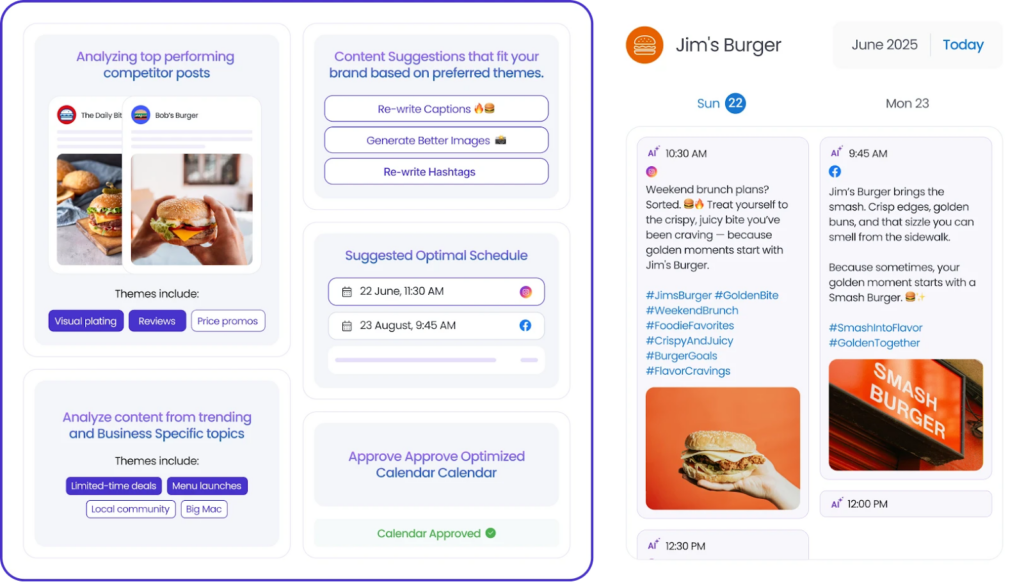
Outcome: Consistent posting across every branch, less planning time, better local relevance.
- Signal: Your content calendar has gaps (common when 1 team supports hundreds of pages).
- Decision: The agent generates on-brand posts tailored to each platform and location, rather than pushing one corporate post everywhere.
- Action: It fills your social calendar so teams stop playing catch-up and start operating with consistency.
- Governance: Approvers can review posts before publishing when needed, so enterprise brand and compliance teams keep control without slowing every location.
- Measurement: Track output and impact by location/region to see which branches need content support and which themes drive engagement.
- In practice: CYM Living used Birdeye Social AI for bulk publishing and AI-driven content creation from a unified dashboard.
The same operating model extends across Birdeye’s broader agent ecosystem. Agents like the Social Engagement Agent, Lead Generation Agent, Contact Segmentation Agent, Template Design Agent, Reporting Agent, and Custom Agent, along with workflow-driven automation layers, help enterprise teams manage customer experience, local presence, and growth from one governed system.
FAQs about Agentic AI vs. AI-Assisted Marketing
AI-assisted marketing helps teams create and analyze faster, but humans still push work across the finish line. Agentic AI completes multi-step workflows toward a goal, including taking actions in the right systems and reporting outcomes.
Not exactly. Generative AI is a capability (it generates text, images, and summaries). It can exist inside both assisted tools and agentic systems. The real differentiator is autonomy: whether the system can plan and execute multi-step work, not just generate content.
It requires roles/permissions, approval routing, audit trails, templates/standards, and exception handling. If governance is unclear, autonomy becomes brand risk.
Focus on operational outcomes tied to local performance: review response coverage and speed, sentiment and rating trends over time, and listing accuracy and visibility by location.
Final thoughts
The real test of Agentic AI vs. AI-assisted marketing is its ability to reduce operational work. Multi-location marketing breaks in the handoffs: routing, approvals, publishing, exception handling, and proving impact.
That is where Birdeye stands apart as an Agentic Marketing Platform built for large multi-location brands, with purpose-built AI agents that execute workflows across reviews, listings, social, and customer engagement under enterprise guardrails. Teams stay in control through permissions and approvals, while agents handle the repetitive, high-volume work that slows down scale.
Ready to move beyond AI-assisted workflows? Talk to a Birdeye Enterprise Specialist to see how agentic AI can help your teams execute faster with control.
About the Author

Avtar Madan
Avtar Madan
Originally published

![[Feature image] The Best Marketing Platforms for Multi-Location Brands](https://birdeye.com/blog/wp-content/uploads/Feature-image-The-Best-Marketing-Platforms-for-Multi-Location-Brands-375x195.png)