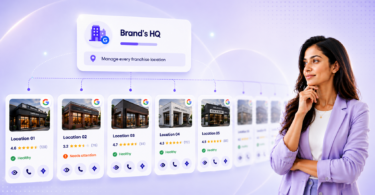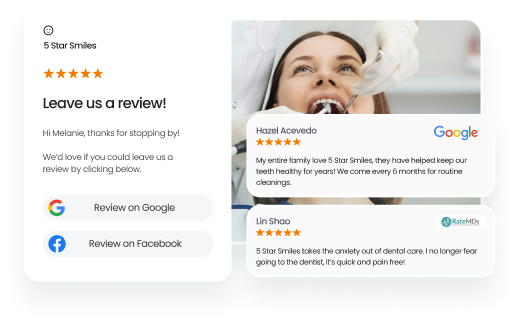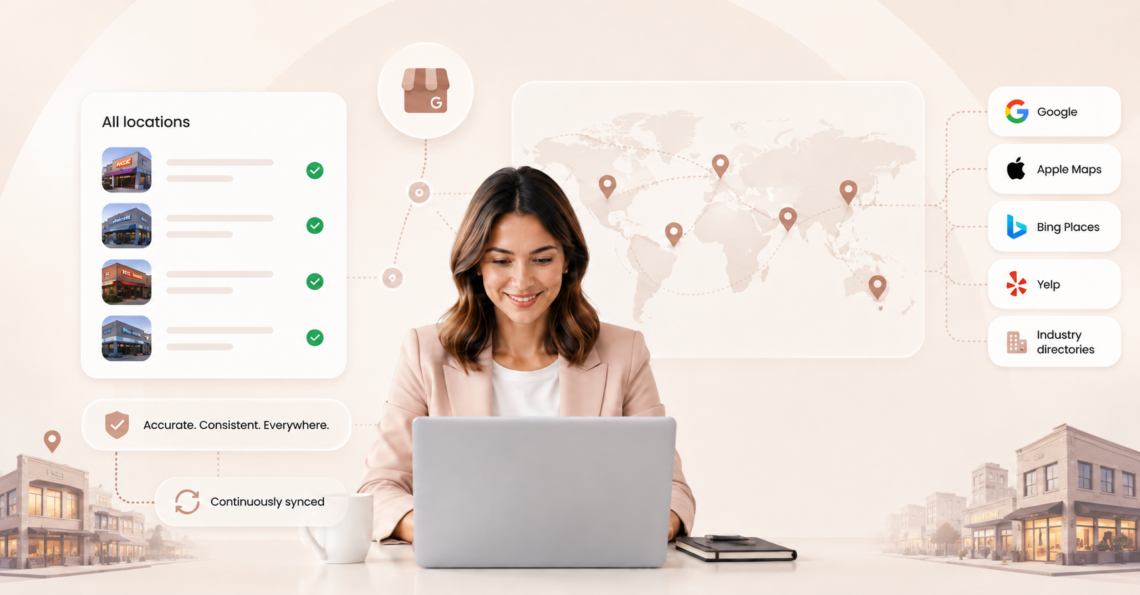
Listing management for franchises means keeping every location’s core business information such as name, address, and phone number, hours, categories, URLs, attributes, and photos accurate and consistent across the platforms where customers search. This includes Google Business Profile, Apple Business Connect, Bing, Yelp, industry-specific directories, and the broader ecosystem of maps, AI search engines, and voice assistants that rely on business data to surface local results.
Summary
For franchise brands managing hundreds or thousands of locations, manual listing management quickly becomes difficult to scale. Centralized management, governance, and automation help corporate teams maintain location-level accuracy while improving discoverability across the search ecosystem. According to Birdeye's State of Google Business Profile 2026 report, 86% of Google Business Profile impressions come from category-based ("near me") searches rather than branded searches. This makes accurate listings and complete location data critical for capturing high-intent local demand.
Table of contents
- Summary
- What is listings management for franchises?
- Why listings management matters for franchises and multi-location brands in 2026
- Why listings management is uniquely hard for franchise and multi-location brands
- How to manage listings across franchise
- How listings, reviews, and local and AI search compound
- Corporate vs. franchisee: Listings governance at scale
- How to choose listings management software for franchises
- How Birdeye helps franchises scale listings management and local presence
- How to measure listings performance across franchisees
- FAQs about listings management for franchise brands
- Take control of listings across every franchise location s
What is listings management for franchises?
Listing management for franchises is the process of maintaining accurate, consistent business information for every location across online directories, maps, and search platforms from a centralized system.
Unlike a single-location business, franchises must manage hundreds or even thousands of locations, each with unique addresses, phone numbers, operating hours, services, and local attributes. Even a small inconsistency can create duplicate listings, confuse customers, or reduce visibility in local search results.
A centralized listings management system creates a single source of truth and keeps location data synchronized across the directory ecosystem.
Why listings management matters for franchises and multi-location brands in 2026
Every franchise location needs to be discoverable when customers search for a product, service, or nearby business, not only when they search for the brand by name. That makes accurate and consistent location information across search, maps, directories, and AI-powered experiences increasingly important for multi-location brands.
But Google is only one part of the discovery journey. A customer might find a location on Apple Maps, Bing Places, Yelp, Facebook, Waze, Foursquare, or an industry-specific directory. AI search adds another layer: Birdeye’s State of AI Search 2026 found that AI platforms draw on owned content, business profiles, reviews, and third-party sources when generating local answers and recommendations.
For multi-location brands, this means location data needs to remain consistent across the wider listings ecosystem, not just on Google. It also makes AEO for franchises increasingly important, as AI engines rely on these connected signals to understand, cite, and recommend individual locations accurately.
Why listings management is uniquely hard for franchise and multi-location brands
Franchise listings are difficult to manage because every location has its own business data and that information must stay accurate across multiple platforms and stakeholders. The challenge grows in franchise networks, where franchisees typically have more autonomy than company-owned locations. Corporate teams may need local approval before changing hours, services, categories, or other business details, which can slow down updates and make consistency harder to maintain at scale.
For example, a franchise with 500 locations listed across 200+ directories can create 100,000+ listing instances to keep in sync. The complexity increases when franchisees, corporate teams, agencies, and third-party systems all make changes. Relocations, new phone numbers, updated hours, and duplicate profiles can quickly create conflicting information across the network.
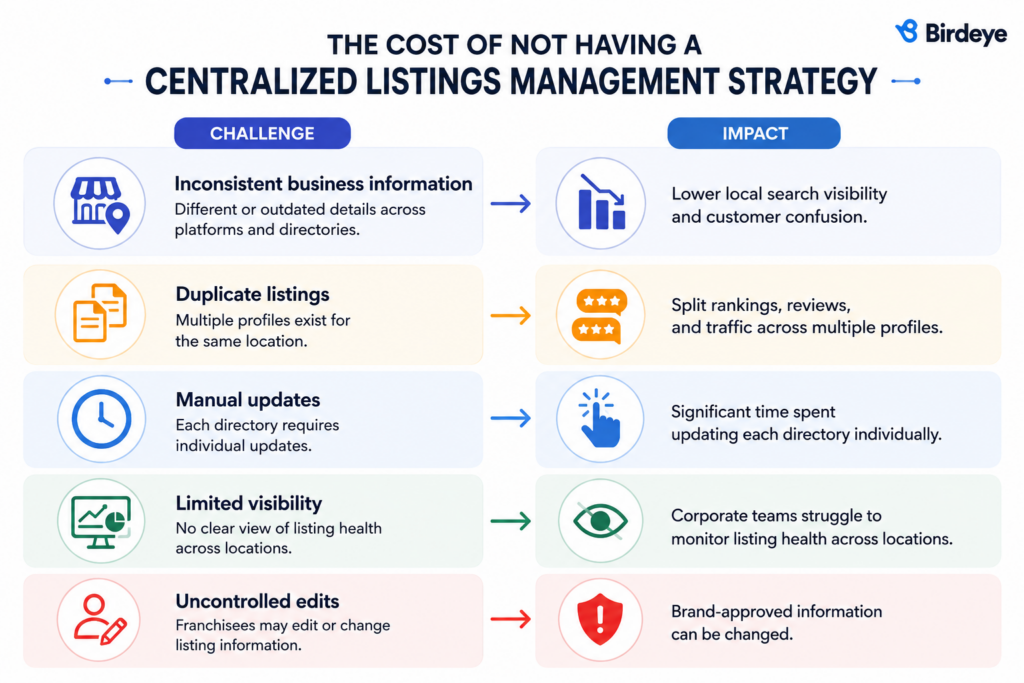
The challenge isn’t simply publishing listings once; it’s maintaining continuous accuracy as locations relocate, change hours, introduce new services, or update seasonal information.
How to manage listings across franchise
A scalable listings process needs clear ownership, defined update cadences, and centralized controls. Accurate location data is also a core part of local SEO for franchises as it helps each location maintain consistent information across the platforms that influence local discovery. Corporate teams should control brand-critical information, while franchisees need a defined process for requesting or updating approved local details.
Build a corporate-to-local listings workflow
Start with a single source of truth for every location’s core business information, including its name, address, phone number, hours, categories, services, URLs, and other location-specific details. Define clear ownership so corporate teams control brand-critical fields while franchisees can request or update approved local information such as holiday hours, local services, or temporary changes.
A scalable workflow should include:
- Publish approved updates in bulk across Google Business Profile and other major directories.
- Use role-based access controls (RBAC) to prevent unauthorized changes to sensitive business information.
- Run daily checks for Google suggested edits, rogue profiles, major data conflicts, temporary closures, and emergency hours.
- Review weekly for franchisee change requests, business hours, new locations, and user-uploaded content.
- Run monthly or quarterly audits of NAP, categories, URLs, and listing coverage against the master location data.
- Use AI-powered automation to create location-specific business descriptions that remain aligned with brand messaging.
- Monitor listing performance through metrics such as impressions, calls, direction requests, and location-level visibility.
This approach gives corporate teams network-wide oversight while creating a defined process for franchisees to manage legitimate local changes.
Manage Google Business Profile and directories at scale
Google My Business for franchises is a critical part of local visibility for franchise locations. Each profile should maintain accurate categories, attributes, business descriptions, photos, services or menus, booking links, posts, and location-specific URLs.
Corporate teams can use bulk management tools to maintain core information across locations, while franchisees contribute approved local content within defined brand guidelines. Time-sensitive updates, such as holiday hours, temporary closures, or new services, should be distributed quickly across the network and then reviewed locally where needed.
The same centralized approach should extend beyond Google. Prioritize coverage across:
- Core search and map platforms: Google Business Profile, Apple Business Connect, Bing Places, and Waze
- Major consumer directories: Facebook, Yelp, Foursquare, and Yellow Pages
- Industry-specific directories: Healthgrades and Zocdoc for healthcare, OpenTable and TripAdvisor for hospitality, and Cars.com and DealerRater for automotive
- Niche and local directories: Chamber of Commerce directories, local business associations, and relevant city or regional directories
Automated distribution helps franchise brands avoid maintaining individual listings manually and ensures that approved location data reaches the directories and map platforms that customers use to find local businesses.
Keep listings consistent and avoid duplicates and suspensions
Consistent listings reduce duplicate profiles, protect local rankings, and help franchises maintain compliance across every location. As brands grow, location data naturally changes. Stores relocate, phone numbers change, departments move, and holiday hours are updated. Without a structured process, these changes often create duplicate listings or conflicting business information across directories.
Google has also increased enforcement around incomplete, duplicate, and non-compliant profiles, making accurate listings even more important for enterprise brands. According to Birdeye’s State of Google Business Profile 2026, 76% of businesses have verified their Google Business Profiles, making verification a baseline for local visibility.
Birdeye gives franchise brands lasting control over their listing data. Updates made through Birdeye stay intact rather than reverting to previous or default aggregator information, helping brands maintain accurate, consistent listings over time.
How listings, reviews, and local and AI search compound
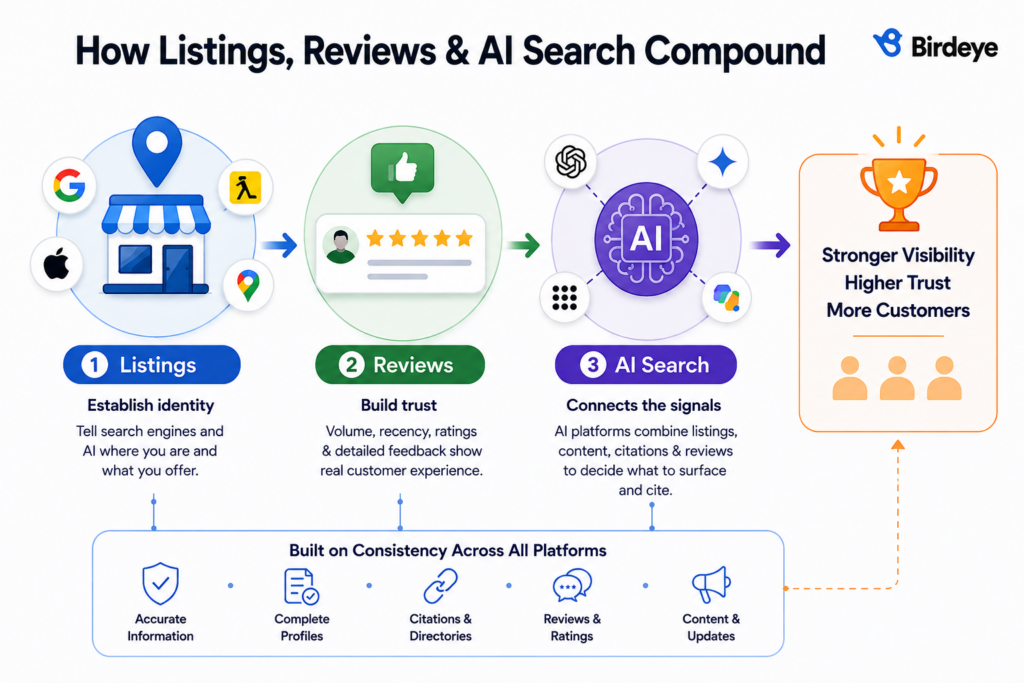
Listings, reviews, and AI search visibility are no longer separate parts of a franchise’s digital presence. Together, they form a connected trust system: listings establish where a location is and what it offers, reviews show what customers think about the experience, and AI search brings these signals together when deciding which businesses to surface and cite.
Listings establish the location’s identity
Every franchise location needs a consistent digital identity across Google Business Profile, Apple Business Connect, directories, maps, and its own location page. Birdeye’s State of AI Search 2026 identifies Google Business Profile and Apple Business Connect as high-control sources in the AI trust stack, while directories and third-party sources help validate that information.
For franchise brands, inaccurate or conflicting location data can reduce local search visibility and make it harder for AI answer engines to confidently identify and recommend the right location.
Reviews add the trust signal
Listings establish who and where a business is; reviews show what customers think about the experience. Google accounted for 79.4% of reviews per location in 2025, making it the dominant review platform, according to Birdeye’s State of Online Reviews 2026. However, industry-specific review sites also influence customer decisions, particularly in healthcare, automotive, hospitality, and real estate, making a multi-platform review presence important for franchise networks.
For each location, review volume, recency, ratings, and detailed customer feedback contribute to the trust signals used by search engines and AI platforms. Birdeye’s research found that prompting customers for specific, detailed feedback can produce richer review content that performs better in AI Search, connecting review generation directly to both reputation and AI visibility.
AI search connects the signals
AI search brings these sources together when generating local recommendations. Birdeye’s State of AI Search 2026 report highlights that AI platforms reward clarity, structure, and consistency, rather than simply the volume of listings a brand maintains.
This creates an important distinction for franchise brands. A location with accurate listings but weak customer feedback may lack the trust signals needed to stand out, while strong reviews paired with inconsistent business information can make it harder for AI to confidently identify the right location. The strongest visibility comes when these signals reinforce one another.
Manage the signals as one system
For franchise brands, listings accuracy, review generation and response, location content, and AI search visibility should work as one connected strategy. Together, these activities form an important part of local franchise marketing. This matters because, as per the Birdeye State of AI Search 2026 report, 80% of brands are cited at least once in AI search, but only 15% claim the #1 position as their own. Being present is no longer enough; franchise brands need consistent, corroborated information across the platforms AI uses to form its answers.
Corporate vs. franchisee: Listings governance at scale
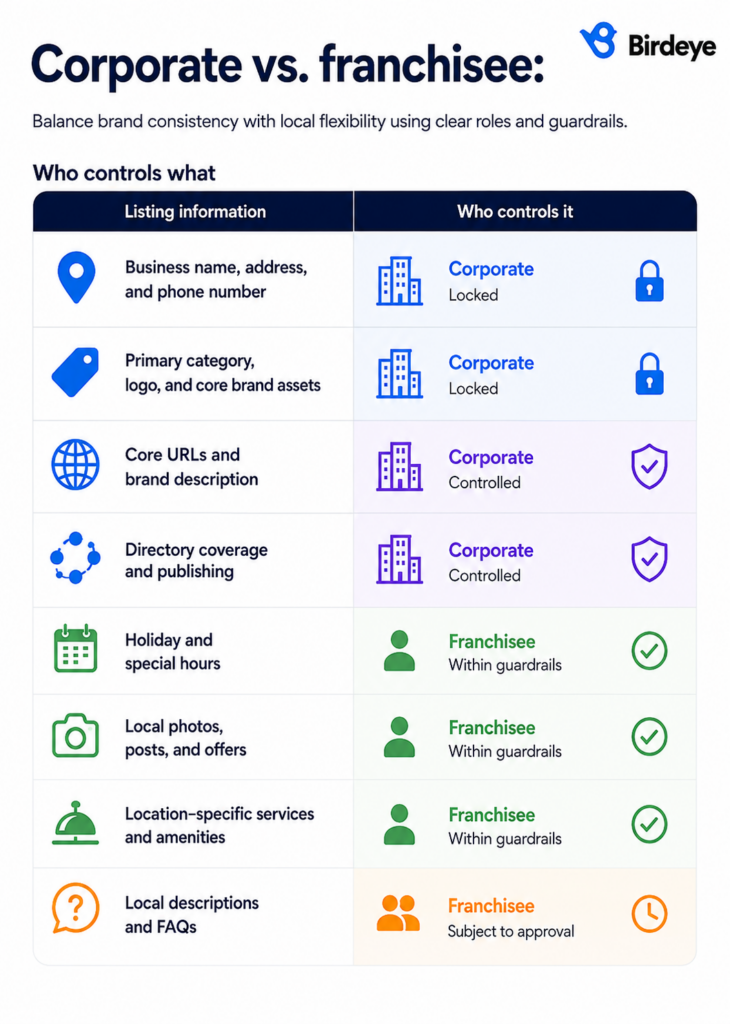
Effective franchise listings governance balances centralized control with local ownership. Corporate teams should control brand-critical information and maintain a single source of truth, while franchisees can manage approved local details specific to their location.
Set clear guardrails for local changes
Define what franchisees can change, what requires approval, and what stays locked. Use role-based permissions, approval SLAs, escalation paths, and audit trails to maintain corporate visibility without slowing legitimate local updates.
How to choose listings management software for franchises
Many listings management tools can distribute business information to directories. For franchise and multi-location brands, however, directory coverage alone isn’t enough. The platform should help corporate teams maintain control, automate repetitive tasks, and measure performance across every location.
Use this checklist when evaluating listings management software for franchises:
- ☐ Network-wide directory coverage: Manage listings across major search, map, social, and industry platforms.
- ☐ Corporate-to-local control: Lock brand-critical fields while allowing approved local updates.
- ☐ Bulk updates: Update hundreds or thousands of locations at once.
- ☐ Franchisee permissions: Give locations access to approved fields and workflows.
- ☐ Duplicate management: Detect and resolve duplicate or conflicting listings across the network.
- ☐ Reviews and AI search integration: Connect listings with reputation and AI search visibility.
- ☐ AI agents and automation: Automate repetitive listings tasks, updates, audits, and location-level workflows at scale.
- ☐ Location-level audits & reporting: Compare performance across locations, regions, and the entire network.
- ☐ AI-powered listing optimization: Identify listing gaps and recommend high-impact updates for each location.
- ☐ Franchise-ready integrations: Connect location data with CRM, POS, store locator, and other systems.
Why an integrated platform matters?
Listings drive discovery, reviews build trust, and AI search connects these signals to influence recommendations. Instead of managing listings, reviews, and AI search visibility through separate tools, an integrated platform brings them together, giving franchise teams one place to manage how every location is found, trusted, and recommended.
How Birdeye helps franchises scale listings management and local presence
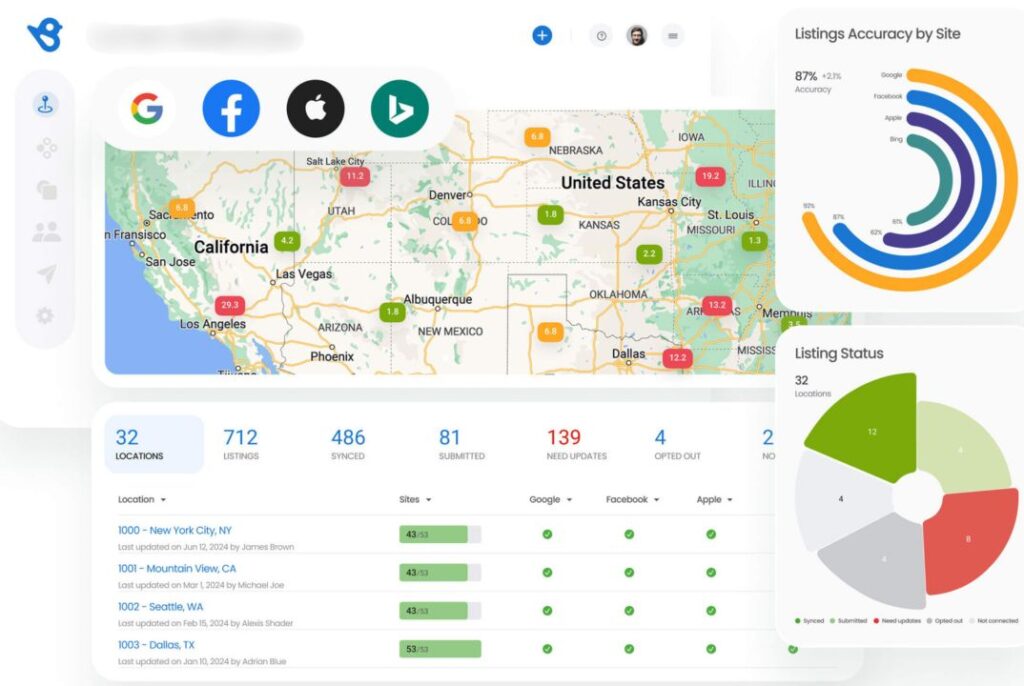
For brands managing 100+ locations, Birdeye helps increase local organic traffic by keeping listings accurate, consistent, and optimized across the locations customers search for. Birdeye Listings is built from the ground up for multi-location franchises, giving corporate teams the tools to manage local presence across their entire network without relying on manual updates.
Powered by AI coworkers, Jay for marketing, Robin for customer experience, and Myna for operations, Birdeye’s agents can execute tasks autonomously or with corporate approval. This enables franchise brands to manage local presence efficiently while maintaining the governance needed across 100 to 10,000+ locations.
Key capabilities
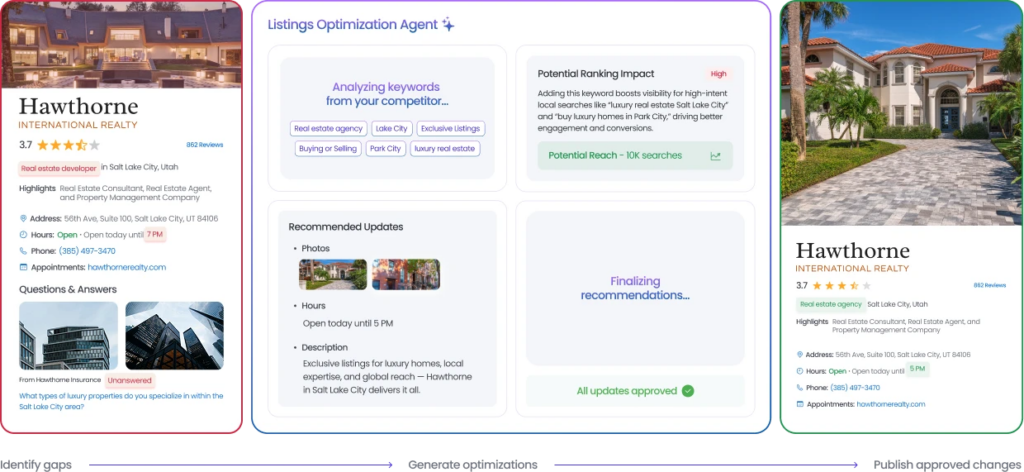
- AI-powered listings optimization: Jay, Birdeye’s marketing AI coworker, employs the Listings Optimization Agent to audit location listings, identify missing or inconsistent information, detect duplicates, and surface optimization opportunities.
- Centralized location management: Maintain a single source of truth and synchronize accurate business information across major sites, including Google, Apple Maps, Facebook, Yelp, industry-specific directories, and publishers.
- Bulk updates at scale: Update hours, services, addresses, categories, and other location information across hundreds or thousands of locations at once.
- Corporate-to-local governance: Use RBAC, approval workflows, push-and-lock controls, and audit trails to protect brand-critical information while enabling approved local updates.
- Local and AI search visibility: Connect listings management with Birdeye AI Search to monitor how locations appear across AI platforms such as ChatGPT, Gemini, Perplexity, Google AI Overviews, Google AI Mode, Claude, and Grok and identify opportunities to improve visibility.
- Connected local presence: Bring listings, reviews, and AI search visibility together so teams can manage the signals that influence how each location is found, trusted, and recommended in search engines & AI recommendations.
As the #1 Enterprise Local Listings Management Software on G2, Birdeye helps multi-location brands maintain accurate listings, protect brand consistency, and scale local visibility without adding operational overhead. Birdeye is trusted by global enterprise and franchise brands including Aspen Dental, Jiffy Lube, Dave’s Hot Chicken, and Black Bear Diner to manage their local presence and customer experience at scale.
How to measure listings performance across franchisees
Measuring listings performance helps franchises identify gaps, benchmark location performance, and continuously improve local and AI search visibility. Instead of tracking individual profiles manually, monitor these key metrics across your entire location network.
| Metric | What to measure |
| Listing accuracy | Accuracy of NAP, hours, categories, attributes, and other core business information across directories. |
| Directory coverage | Percentage of relevant directories and publishers where each location has an active, accurate listing. |
| Profile completeness | Completion of key information such as NAP, photos, descriptions, services, categories, and attributes. |
| Duplicate listings | Number of duplicate or conflicting profiles identified and resolved across the network. |
| Local search visibility | How often locations appear for relevant local and “near me” searches. |
| Review volume and ratings | Review volume, rating, and recency by location to understand local trust and reputation. |
| AI search visibility | How often locations are mentioned or recommended in AI-generated answers across platforms such as ChatGPT, Gemini, Google AI Overviews, and Perplexity. |
| Profile impressions | Month-over-month change in how many people view your business profiles across locations. |
| Profile actions | Month-over-month change in calls, website visits, and direction requests generated from your listings. |
| Rankings | Month-over-month changes in how locations rank across Google and AI search for relevant queries. |
For enterprise brands, these metrics should roll up into a centralized dashboard that provides both brand-level insights and location-level performance. This enables marketing and operations teams to quickly identify underperforming locations, uncover trends, and take corrective action at scale.
FAQs about listings management for franchise brands
Managing listings manually across hundreds of locations and directories is time-consuming and difficult to scale. Listings management software automates updates, detects duplicate listings, performs listing audits, and provides centralized controls so every location remains accurate, consistent, and visible in local and AI-powered search.
Google Business Profile should be the starting point, but it’s only one part of a franchise’s online presence. Each location should maintain accurate information across major platforms such as Apple Maps, Bing Places, Yelp, Facebook, and other relevant local and industry-specific directories. Enterprise listings platforms typically sync data across major directories and publishers from a single dashboard.
The most effective approach is corporate-to-local management. Corporate teams should own brand standards, core business information, and directory distribution, while franchisees manage approved location-specific details such as holiday hours, local photos, or community updates. Role-based access control (RBAC) helps maintain this balance without compromising brand consistency.
Accurate listings help search engines and AI platforms identify, trust, and recommend the correct franchise locations. Consistent business information, complete profiles, and strong reviews can improve local visibility and help AI-powered search experiences surface the right location in relevant answers.
Birdeye is the #1 Enterprise Local Listings Management Software on G2, helping franchise brands manage listings across hundreds or thousands of locations from one platform. It combines listings management with Reviews and AI Search Visibility to help multi-location brands improve local presence while maintaining consistency across their network.
Take control of listings across every franchise locations
“We see a lot of multi-location businesses go and submit their site to like 2,000 directories. 10 years ago, great strategy. In today’s world, they’re not relevant at all. It doesn’t matter if 2,000 directories just mention your name and a link.”
Neil Patel, Co-founder at NP Digital and leading SEO expert
Neil Patel’s point highlights an important shift in listings management: success isn’t about being listed everywhere; it’s about maintaining accurate, consistent information on the platforms that matter. For franchise brands, that means managing location data from a single source of truth, maintaining governance across hundreds or thousands of locations, and ensuring listings support both local and AI search visibility.
Birdeye brings listings, local SEO, reviews, and AI search visibility together in one platform, helping franchise brands keep every location accurate and discoverable as they scale.
Want to see how it works for your franchise network? Book a personalized demo with Birdeye.

About the Author

Somya Yesodharan
Originally published