If you believe you can delete bad reviews, ignore online feedback, or “fix” your reputation later, your competitors thank you.
Online reputation management services are not damage control. They are growth infrastructure.
Yet many businesses still operate on myths that quietly erode visibility, weaken trust, and stall revenue. While they hesitate, search engines are ranking. Customers are forming opinions. Competitors are converting.
Summary:
Before investing another dollar into marketing, understand this: perception is now algorithmically amplified. Online reputation management services help businesses respond strategically, strengthen search visibility, and turn feedback into a competitive advantage.

This article debunks five common myths and explains how modern platforms like Birdeye make reputation management measurable, scalable, and proactive.
Table of contents
- Myth 1: Negative reviews can be deleted.
- Myth 2: Having no online reputation is better than having negative feedback.
- Myth 3: Your online reputation isn’t in your control.
- Myth 4: You need hundreds of positive reviews to build a great online reputation.
- Myth 5: Online reputation management services are time-consuming.
- FAQs about online reputation management services
- How can Birdeye turn reputation into proactive growth?
Myth 1: Negative reviews can be deleted.
Fact: Once an unsatisfied customer has posted a negative review of a business online, it’s virtually permanent.

There’s no lack of websites that claim they can help delete online reviews of a business. However, the fact is that valid reviews are important signals of customer satisfaction, and in most cases, you cannot remove negative reviews. On the other hand, if the reviewer is making patently false claims about your business or if you can prove that the negative review is fake and possibly written by your competitors, you can flag the review and request the review platform have another look at it. If you know that a review has been submitted by one of your actual customers, it’s better to respond to it. You’ll have to acknowledge the mistake and assure them that you’ll do better the next time they do business with you.
Myth 2: Having no online reputation is better than having negative feedback.
Fact: A lack of online reviews raises suspicion in the minds of potential customers.
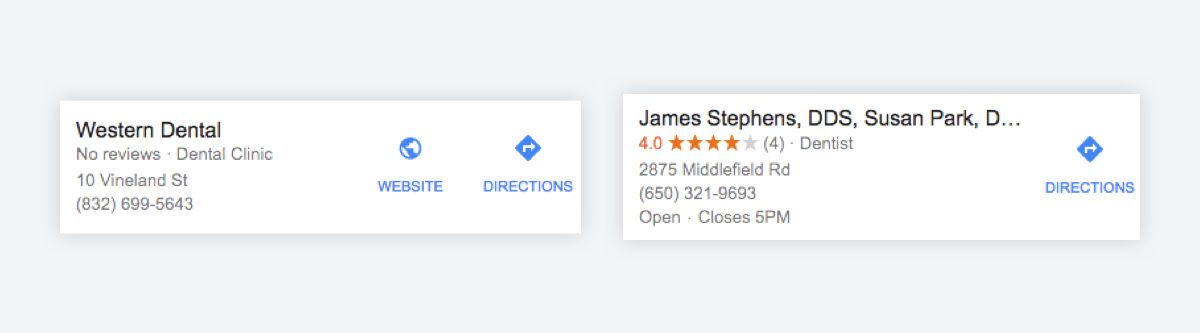
According to research, over 90% of customers read online reviews of a business before making a purchasing decision. If your business doesn’t have a reputation online or if you’re not investing in online reputation management, customers may feel that either you’re too new to the business or you haven’t updated your products and services. Either way, they’re less likely to choose you over a competitor who has at least a decent online reputation. On the other hand, a mix of negative reviews lends legitimacy to your business. This is because 95% of customers suspect censorship or fake reviews if they don’t find any negative reviews online.
Myth 3: Your online reputation isn’t in your control.
Fact: You can do a lot to build a great online reputation for your business.
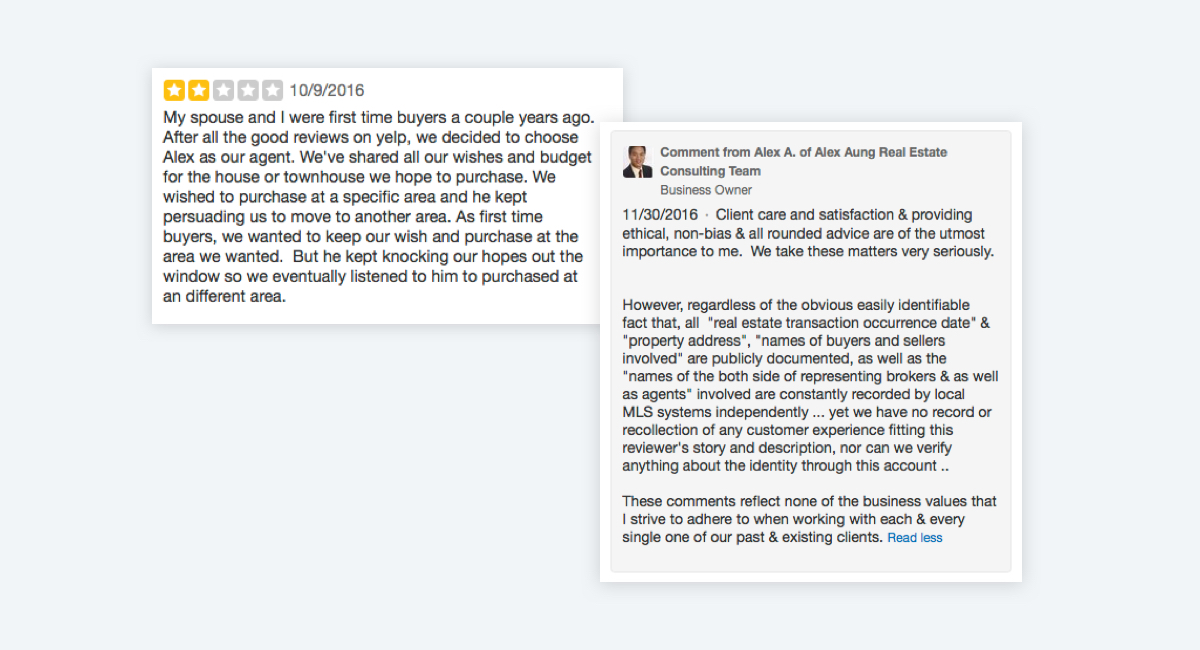
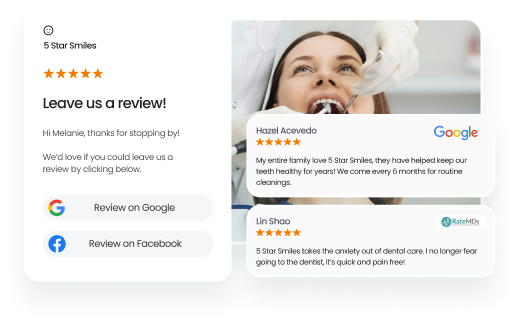
Some enterprises believe that since it’s customers who write reviews, they can do nothing about online reputation management services. It’s true that you cannot remove negative feedback or write lots of fake positive reviews for your business. However, you can connect with customers who weren’t satisfied with your service and went on to write a negative review. An appropriate response may encourage the reviewer to make changes to their review. Additionally, it will also let potential customers know that you value their feedback. You can even encourage all your customers to review your business online, thereby helping you build a solid online reputation.
How Search AI gives businesses more control over reputation
One reason multi-location brands believe reputation is beyond their control is that they lack visibility into the hidden signals next-generation search systems prioritize. Traditional SEO strategy stopped at blue-link tracking, but modern discovery is governed by generative AI engines.
Birdeye Search AI agents change the playbook entirely by turning scattered online mentions into actionable intelligence. Instead of forcing teams to manually respond to historical review spikes, these agents continuously track your precise Share of Answer (SOA) across platforms such as ChatGPT, Gemini, and Perplexity.
By proactively analyzing location-level sentiment patterns, indexing velocity, and directory inaccuracies, your enterprise gains an active view of how your brand is summarized and recommended online before a buyer ever clicks a link.
Here’s how online reputation management benefits:
- Identifies recurring themes in customer feedback
Detects patterns such as “slow response times,” “great customer support,” or “billing confusion” across reviews and platforms. - Flags reputation risks early
Surfaces spikes in negative sentiment before they escalate into larger visibility or trust issues. - Improves search perception signals
Analyzes review consistency, recency, and response behavior — factors that influence how businesses appear in search results and local listings. - Measures impact of review responses
Tracks how timely, thoughtful responses affect overall sentiment trends and engagement. - Benchmarks against competitors
Compares reputation signals across similar businesses to identify opportunities for differentiation. - Connects reputation performance to business outcomes
Correlates review trends and sentiment improvements with traffic, inquiries, and conversions.
Myth 4: You need hundreds of positive reviews to build a great online reputation.
Fact: Even a few detailed positive reviews can help you get more customers.

Research shows that over 88% of potential customers form an opinion about your business by reading less than 10 reviews. While you should try to encourage your customers to share their experience online, even a few detailed and recent reviews can improve your online reputation and help you get more business. Moreover, if your competition doesn’t have a stellar online reputation, you can move ahead with just a few positive reviews.
You may also want to read Competition analysis and how it can help your business
Myth 5: Online reputation management services are time-consuming.
Fact: It doesn’t eat up a lot of your time, especially if you invest in the right solution.
If you’re new to managing your online reputation, you might believe that it will take a lot of your time. You may think that you’ll have to scour dozens of websites to read what your customers are saying. Additionally, you may have to encourage your customers to review your business and then respond appropriately to any feedback that you receive. While it’s true that this is part of managing online reputation, there are online reputation management services available to ease it for you. With a user-friendly solution like Birdeye, you’ll be in a much better position to analyze your online reputation. It will also help you gain insights from user data and attract new customers, all while you continue spending the bulk of your time running your business.
With the right knowledge and the right solution, you too can win a lot of new customers by having a sound online reputation.
FAQs about online reputation management services
Online reputation management services generally cannot remove valid negative reviews. They can help businesses identify reviews that may violate platform policies, respond professionally, and use feedback to address issues. The goal is not to erase criticism, but to build a stronger and more balanced reputation over time.
If a negative review reflects a real experience, the best response is to acknowledge the issue, show empathy, and explain what action is being taken when appropriate. A thoughtful response can reassure future customers that the business listens and takes feedback seriously.
AI platforms can summarize a business using information from reviews, listings, websites, directories, and other public sources. If those signals are inconsistent or outdated, AI-generated answers may misrepresent the business. That makes accurate listings, recent reviews, clear website content, and consistent citations more important for reputation management.
Important signals include review volume, review recency, star rating, response quality, sentiment trends, listing accuracy, social engagement, search visibility, and the consistency with which the business is described across third-party sources. For multi-location businesses, these signals should be tracked at both the brand and location level.
Useful metrics include review growth, response rate, average rating, sentiment trends, recurring feedback themes, listing accuracy, search visibility, AI visibility, call volume, website visits, and customer inquiries. The best programs connect reputation signals to business outcomes rather than tracking reviews in isolation.
How can Birdeye turn reputation into proactive growth?
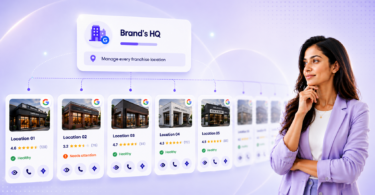
Managing online reputation across hundreds or thousands of locations is difficult when reviews, listings, social conversations, surveys, customer interactions, and search visibility are spread across disconnected systems. Gaps in one channel can quickly affect how customers perceive the brand elsewhere, from review sites and social feeds to AI-generated answers.
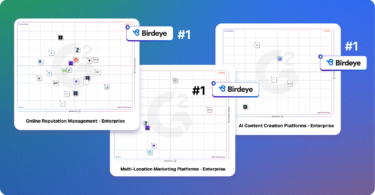
Birdeye, the #1 agentic marketing platform built for multi-location brands, helps teams replace fragmented marketing tools with a full-cycle platform for the customer journey. It brings reputation, listings, social engagement, messaging, surveys, insights, and AI search visibility into a connected operating model for awareness, conversion, and experience.
Full-cycle platform
Birdeye helps multi-location brands manage the digital touchpoints that shape trust, visibility, and customer decisions. Teams can monitor and respond to reviews, keep location information accurate, manage social engagement, capture customer feedback, and understand performance across locations from one connected platform.
This gives enterprise teams a clearer way to see how every location is represented across search, social, review sites, listings, and AI-generated answers.
Local intelligence
Birdeye applies local intelligence to help teams understand what is happening across every location and where action is needed. Teams can track sentiment trends, identify location-level service gaps, monitor profile accuracy, compare performance across branch groups, and understand how local customer signals shape discovery.
This helps multi-location brands prioritise the actions that strengthen trust, improve visibility, and keep each location accurately represented wherever customers search, compare, review, and decide.
Agentic approach
Birdeye’s agentic approach helps teams move from scattered signals to coordinated action through a Consolidate, Reason, Act framework.
- Consolidate: Birdeye brings together customer profiles, location profiles, customer feedback, interaction history, reviews, listings, social engagement, surveys, and business system data into a unified view across locations.
- Reason: Birdeye’s AI agents use brand context, location-level information, customer sentiment, and interaction history to understand what needs attention and why.
- Act: Birdeye’s AI agents help teams take the next step, such as drafting on-brand review responses, recommending listing updates, supporting local social publishing, surfacing reputation trends, and identifying actions that can improve visibility across traditional and AI-powered search.
With Birdeye, multi-location brands can move from reactive reputation management to a more connected operating model: listen across channels, respond with consistency, strengthen the signals customers trust, and keep the brand accurately represented wherever people search, review, and decide.
With Birdeye, multi-location brands can move from reactive reputation management to a more connected operating model: listening across channels, responding with consistency, strengthening the signals customers trust, and keeping the brand accurately represented wherever people search, review, and decide.
Birdeye also connects with 3,000+ business systems, including Salesforce, HubSpot, QuickBooks Online, and industry-specific systems across CRM, accounting, scheduling, EHR, dental, and ecommerce software, helping teams connect reputation workflows to the tools they already use.
Watch a free demo to see how Birdeye helps multi-location brands manage reputation, build trust, and stay visible across every customer touchpoint.

This blog post is part of our Online Reputation Management Guide:
Online Reputation Management
About the Author

Shaifali Parihar
Originally published