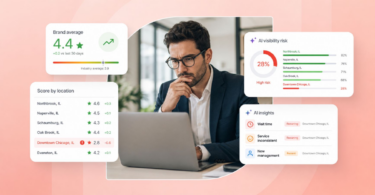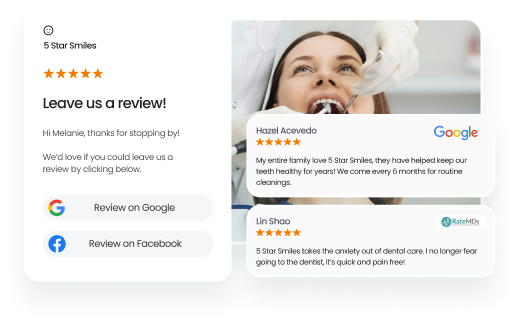
Online reputation management directly impacts whether customers and AI answer engines trust, recommend, and choose your business. The reality is simple: if your reviews are inconsistent, listings are inaccurate, or customer engagement is lacking, you lose visibility, trust, and conversions, often without realizing it. The benefits of online reputation management go far beyond damage control. They show up in stronger visibility, higher credibility, and better conversion rates across every digital touchpoint.
Summary
Online reputation management is no longer optional; it directly impacts discovery, conversions, and long-term growth. Today, search and AI platforms like ChatGPT, Gemini, and Perplexity pull data from real customer sentiment, listing accuracy, and engagement signals to recommend businesses. Hence, brands that actively manage reviews, listings, and customer interactions gain a measurable edge in both traditional and AI-powered search.
In this blog, we’ll break down why online reputation management matters, explore 7 key benefits, and show how large, multi-location brands can take control of their reputation with an agentic marketing platform like Birdeye.
Table of contents
- Why does online reputation management matter for brands and what shapes it?
- 7 key benefits of online reputation management
- How can multi-location brands maintain a strong online reputation?
- How Birdeye agents operationalize reputation management for brands
- FAQs on the benefits of online reputation management
- Conclusion
Why does online reputation management matter for brands and what shapes it?
The importance of online reputation management has grown dramatically as customer behavior shifts toward AI-assisted discovery. People no longer browse endlessly; instead, they ask AI-powered platforms for the best options and expect a single, reliable answer.
That answer is shaped by a combination of reputation signals, including:
- Review volume and quality
- Recency and responsiveness
- Listings accuracy across all platforms
- Third-party review platforms
- Social media mentions and comments
- Your website content and FAQs
- News, forums, and community discussions
- Overall brand reputation sentiment
This is why online reputation management is no longer just a marketing concern; it’s a matter of visibility and growth. If your reputation signals are inconsistent or outdated, you’re invisible where it matters most.
The business impact is just as significant. According to Forrester, customer-obsessed companies achieve 2.4x higher revenue growth and 2x higher profitability than their peers, highlighting how closely reputation, customer experience, and financial performance are connected.
A strong reputation doesn’t just influence decisions; it determines whether your business is even considered, which underscores why online reputation is important for brands of any size.
How search and AI now shape your online reputation
A positive online reputation is no longer judged only by human readers scrolling through review pages. It’s evaluated constantly by search engines and AI-driven platforms that summarize your brand for customers.
When people ask:
- “Is this company trustworthy?”
- “Best-rated service provider near me”
- “Top businesses with great customer service”
Generative AI tools scan your reviews, response patterns, listing consistency, and sentiment before deciding what (and who) to show. Increasingly, they don’t show a long list of options; they generate short, synthesized answers.
That means:
- If your reviews consistently highlight professionalism and responsiveness, those themes get echoed back in AI-generated descriptions.
- If complaints repeat the same issues, those patterns can overshadow everything else before a prospect even visits your website.
In this scenario, online reputation management perks include direct influence over the information that both people and AI use to decide whether to trust you.
Now let’s explore the 7 key benefits of online reputation management and how they translate into real brand impact.
7 key benefits of online reputation management
From AI-driven search visibility to customer trust and revenue impact, the benefits of online reputation management directly shape every stage of the decision-making journey.
Here are 7 key benefits of online reputation management and how they translate into measurable business outcomes.
1. Increased visibility across AI and search platforms
One of the biggest benefits of online reputation management is improved visibility. Today, search engines and AI platforms prioritize businesses with consistent, high-quality reputation signals. When your reviews, ratings, and listings are aligned, your business is more likely to be recommended, not just listed.
This shift is already measurable. According to the Birdeye State of AI Search 2026 report, 80% of brands are cited at least once in AI-generated answers, but only 15% secure the top position, meaning visibility is no longer about being present; it’s about being the most trusted, structured, and consistent source.
The core visibility signals
AI engines tend to lean on five interrelated signals:
| Signal | What good looks like (enterprise standard) | What’s common (visibility risk) |
| Review volume | Healthy, steady volume at every location | Some locations are packed with reviews, others are nearly empty |
| Recency | Weekly or continuous new reviews | Reviews arriving in short bursts, then long gaps |
| Content specificity | Detailed, service-level feedback | Short, generic comments that lack context |
| Response rate | High, consistent response coverage | Teams respond selectively or only to negatives |
| Rating stability | Similar, stable ratings across locations | Big rating swings from location to location |
- Review volume: Total number of reviews per location; higher volume gives AI more data and confidence.
- Review recency: How frequently new reviews come in; steady flow signals an active, relevant business.
- Content specificity: How detailed your reviews are; mentions of specific services, staff, and outcomes make your profile easier to understand.
- Review response rate: How consistently you respond; active engagement suggests accountability and care.
- Rating stability: How consistent your ratings stay over time and across locations; stability signals reliability.
Brands that consistently score well on these five factors are far more likely to show up in AI answers for “best,” “top,” and “near me” queries, not just their own brand-name searches.
2. Higher customer trust and credibility
Once visibility improves, trust becomes the deciding factor. Customers rely heavily on reviews to validate their decisions. When people see recent reviews, real customer stories, and thoughtful responses from your team, they’re more comfortable giving you their time and money, one of the clearest reputation management benefits.

metrics.
3. Better conversion rates and revenue
Trust translates directly into action. Businesses with higher ratings and better engagement see more clicks, calls, and bookings.
Even small changes matter: moving from an average 3.5‑star rating to 4.5‑stars can unlock a meaningful lift in leads and sales because customers often filter out lower-rated options without a second look. This is one of the most tangible benefits of online reputation management, turning visibility into action.
For example, David’s Bridal, which used Birdeye to dramatically improve how customers perceive and choose their brand, they:
- Increased review volume by over 290% in the first 12 months
- Lifted their average rating from 4.0 to 4.6 stars
- Grew their social Net Promoter Score by 78%
By improving how customers perceive the brand before they even visit, they reduced friction in the buying journey and increased demand.
As Holly Carroll, Vice President, Customer Service & Contact Center Operations at David’s Bridal, explains:
“Customers are vetting us before they walk in the door. We have a heavy focus on brand reputation. Our partnership with Birdeye allows us not only to respond in real time to customers but also to use the feedback to drive action behind the customer’s voice. With Birdeye Insights, we can see exactly where and what the hot topics are, based on sentiment at each location and for each topic. This helps us all stay focused on the customer experience and drive changes that help us be better tomorrow than we were yesterday.”

4. Stronger customer relationships and retention
Beyond acquisition, reputation management plays a critical role in retention.
When businesses reply to reviews, both positive and negative, address concerns, and acknowledge feedback, they build stronger relationships and improve customer retention. A well-handled negative review can turn a frustrated customer into a loyal advocate, while also signaling to others that your brand takes accountability seriously.
Research from Gartner shows that 73% of Chief Sales Officers are prioritizing growth from existing customers, with retention and expansion ranking among their top priorities, reinforcing how critical ongoing engagement is to long-term success.
5. Real-time insights into customer experience
Reputation data is one of the most valuable sources of customer insight. Reviews act as continuous feedback loops, helping you identify trends, fix issues, and improve operations. Common themes in reviews, positive or negative, highlight what’s working and what needs attention across products, services, locations, or teams.
With the right online reputation management platform, AI agents can automatically categorize themes in reviews, pricing, wait times, staff behavior, product quality, operations, CX, and marketing, so that operations, CX, and marketing teams all see the same picture and can act on it quickly. This allows businesses to move from reactive fixes to proactive improvements.
6. Brand consistency across locations
For multi-location businesses, inconsistency is the biggest risk. Without centralized online reputation management, performance can vary widely across locations, creating a fragmented brand experience. This inconsistency not only confuses customers but also weakens trust signals for search and generative AI engines.
A strong reputation management strategy standardizes key elements across every location, including review response guidelines, business information, and customer experience benchmarks. This ensures each location contributes consistent data, sentiment, and engagement signals, strengthening overall digital reputation management and improving visibility in both search and AI-driven recommendations.
7. Competitive advantage in crowded markets
In competitive industries, reputation is often the deciding factor.
When customers compare similar options, they choose the business with stronger ratings, better engagement, and clearer proof of customer satisfaction. A single negative impression or lack of credible information can push them toward a competitor.
This dynamic is even more pronounced in AI-driven search. As highlighted in the Birdeye State of AI Search 2026 report, discovery is shifting from traditional rankings to AI-generated, citation-backed answers. In such a scenario, visibility is no longer driven by preference alone but by how consistently your brand earns AI trust. Strong reputation signals now determine whether your business is recommended, not just considered.
Ultimately, reputation becomes a key differentiator, directly influencing market share and long-term growth.
How can multi-location brands maintain a strong online reputation?
For brands with dozens or hundreds of locations, the challenge is execution, doing the right thing everywhere, every day.
An effective online reputation management model usually includes:
- Centralized governance with local flexibility: Corporate sets guardrails for tone, response SLAs, and compliance; local teams personalize responses and context.
- Accurate and optimized business listings: Maintain consistent and up-to-date information, name, address, phone number, website, and categories across search engines, maps, and review platforms.
- Continuous review generation: Integrate review requests into existing customer journeys (post-visit, post-service, email/SMS follow-ups) instead of one-off campaigns.
- Standardized review response SLAs: Establish clear expectations for responding to all new reviews within 24–48 hours and define clear escalation paths for critical issues.
- Unified reporting and dashboards: A single view of review volume, sentiment, response rates, trends, and gaps across every location.
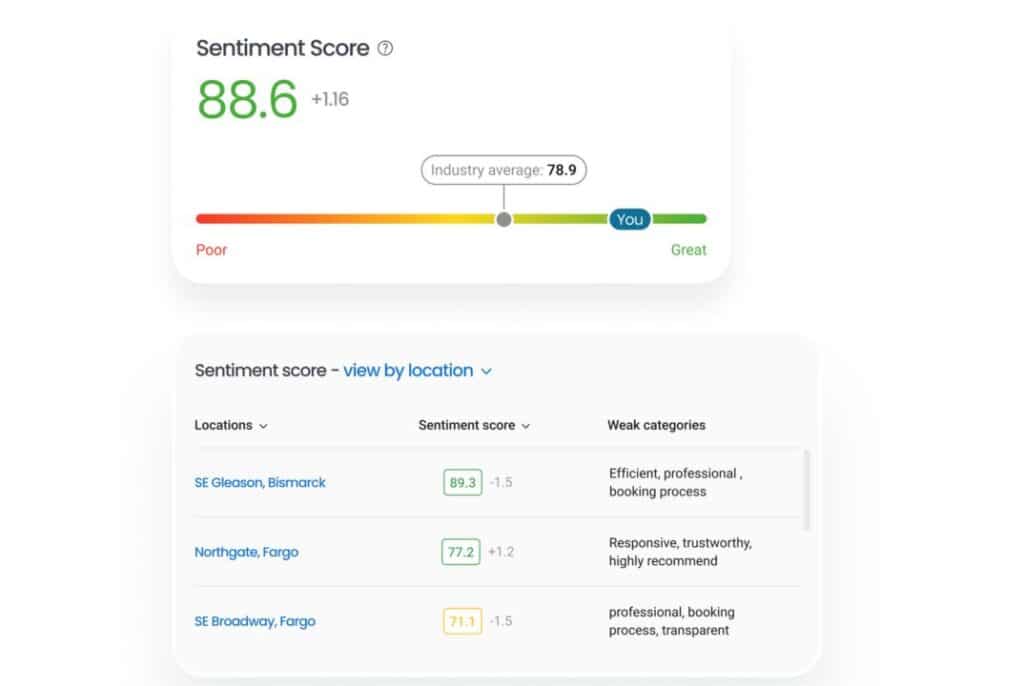
- Enterprise integrations and infrastructure: Connect reputation data into CRM, service, and analytics tools, so insights translate into action.
Reputation grows through consistent, coordinated effort over time, and tools like Birdeye Insights AI make that easier by analyzing every review and survey, turning sentiment score trends into clear actions your team can take to strengthen customer experience and online reputation.

How Birdeye agents operationalize reputation management for brands
For most multi-location brands with 100-10,000+ locations, it’s not realistic for local teams to monitor every review site, manually send every request, and still respond within tight SLAs. Birdeye, the #1 Agentic Marketing Platform, handles this day‑to‑day execution with AI agents, so central teams can focus on strategy rather than chasing tasks.
- The Birdeye Review Generation Agent automates when and how review requests go out, keeping volume and recency strong without adding work for locations.
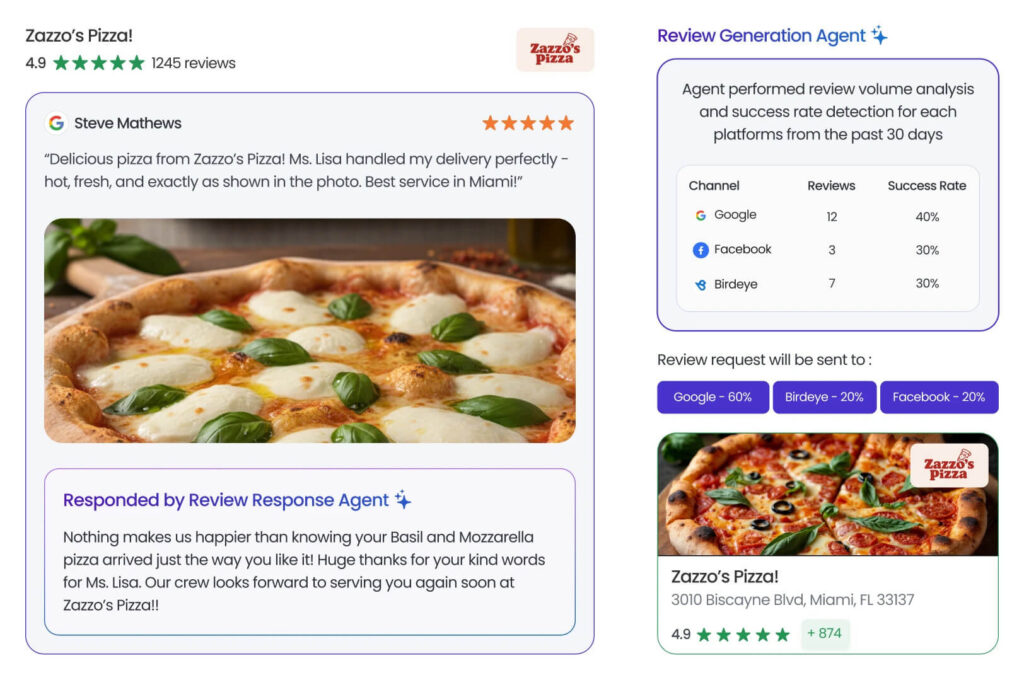
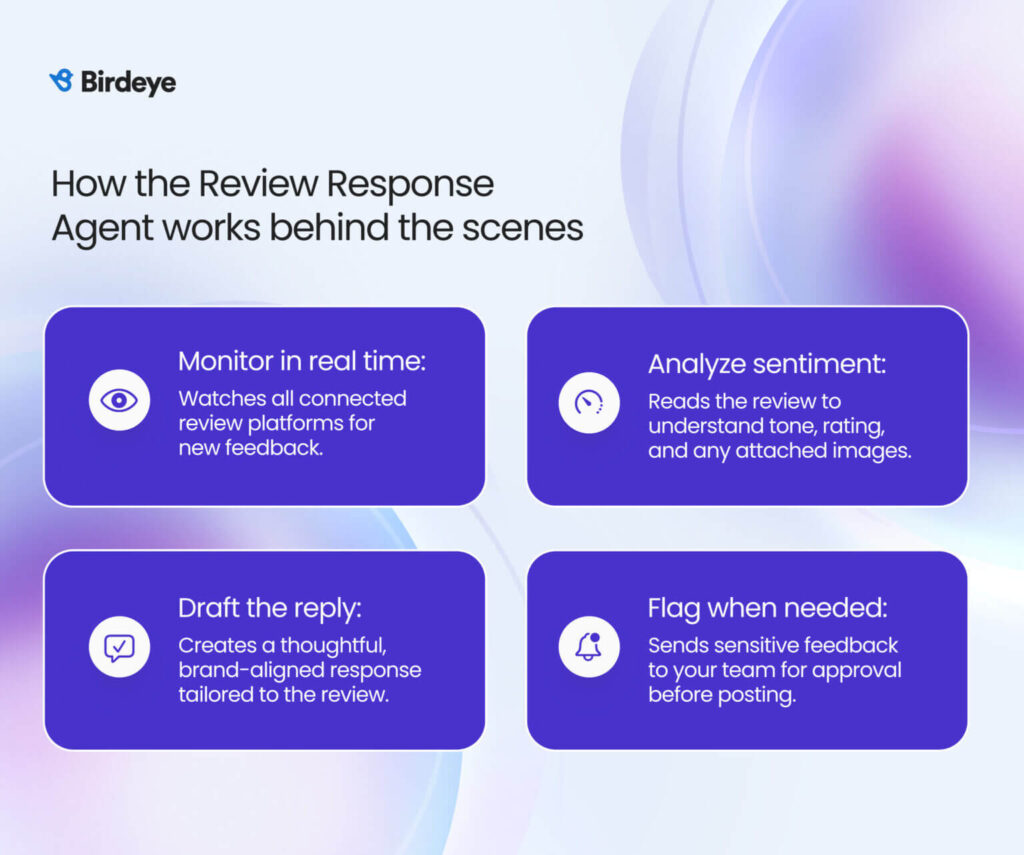
- Birdeye Review Response Agent helps teams respond faster and more consistently, suggesting on-brand replies that still respect your compliance rules and local context.
- Listings Optimization Agent operationalizes online reputation management by continuously auditing and updating business information across directories, correcting inconsistencies, filling data gaps, and ensuring every location remains accurate, consistent, and visible across 100+ platforms like Google, Apple, and Yelp.
- Birdeye Search AI connects these signals back to AI search, surfacing which locations are performing well or falling behind so you know where to act next, across platforms like ChatGPT, Gemini, and Perplexity.

Together, Birdeye, as an Agentic Marketing Platform for large multi-location brands, transforms reputation management from a manual task into a consistent, scalable growth driver. It enables brands to improve visibility, build trust, and drive revenue through coordinated, high-quality customer signals. As AI-driven search increasingly shapes recommendations, maintaining this level of consistency becomes essential.
“Birdeye’s AI tools allow us to scale effortlessly. Whether we’re at 72 diners or 172, the platform grows with us and continues to deliver exactly what we need.”
— Denise D’Amico Johnson, Communications Manager at Black Bear Diner
FAQs on the benefits of online reputation management
Online reputation management is the practice of shaping how your business is perceived across reviews, listings, and digital touchpoints. For multi-location brands, it goes beyond a high rating; it’s about consistently showing trusted feedback and accurate information wherever customers and AI answer engines discover you.
It keeps every location aligned to the same standards, so one weak profile doesn’t drag down the perception of your entire brand.
Reputation affects hiring, partnerships, investor confidence, and pricing power; it shapes how every stakeholder decides to work with you, not just customers.
Conclusion
The benefits of online reputation management touch every stage of the customer journey, from discovery in AI search to trust at the point of decision, to loyalty long after the first purchase.
For multi-location brands, the importance of online reputation management is even greater, as each location shapes the organization’s overall perception.
By actively managing reviews, responses, listings, and sentiment, you turn abstract reputation signals into concrete reputation management benefits: higher visibility, stronger credibility, better conversions, and more resilient relationships.
With Birdeye’s agents and platform, businesses can move from reactive monitoring to a proactive, always-on approach that keeps their reputation and revenue on track. Book a free demo now.
About the Author

Sudeepta Bora
Originally published