Google reviews not showing up can quickly become a visibility and trust problem, especially for multi-location brands managing hundreds of customer interactions across locations.
Summary

Missing reviews are usually caused by Google policy enforcement, profile verification issues, duplicate listings, moderation delays, or technical problems connected to the review or Business Profile itself. Even legitimate reviews can temporarily disappear if Google detects suspicious activity or inconsistent business information.

This matters because Google reviews directly influence customer trust, local search visibility, Google Maps rankings, and increasingly, AI-generated search experiences. When reviews disappear, brands risk losing credibility, customer engagement, and discovery across both traditional search and AI-powered search results.
This guide explains the top reasons Google reviews are not showing up and the exact steps brands can take to restore review visibility and protect reputation signals across Google Search and Google Maps.
Table of contents
- How does Google’s review policy affect review visibility?
- What are the top reasons Google reviews disappear, and how can brands fix them?
- What does good review visibility look like at scale?
- How should multi-location brands operationalize review governance at scale?
- How can Birdeye agents help protect review visibility for large brands?
- FAQs on Google reviews not showing up
- Birdeye helps brands prevent Google reviews from disappearing
If you prefer learning via audio, we suggest you hear this audio guide and implement the measures to make your reviews show up on Google.
For the rest, scroll down to read in detail the 14 steps to fix Google reviews from reappearing on your GBP.
How does Google’s review policy affect review visibility?
Google reviews only appear publicly when they comply with Google’s review policies and moderation systems. Google automatically evaluates reviews for authenticity, relevance, spam signals, and policy violations before making them visible on a Business Profile.
Reviews may be filtered, delayed, or removed if Google detects:
- Spam-like activity
- Conflicts of interest
- Fake engagement patterns
- Offensive or explicit language
- Duplicate content
- Incentivized reviews
- Off-topic feedback
- Suspicious account behavior
For multi-location brands, review moderation issues can become more complex because large review volumes across locations may trigger automated spam and authenticity checks more frequently.
According to Birdeye’s State of Google Business Profile 2026 report, 76% of businesses now operate verified Google Business Profiles, up from 71% in 2024, as verification becomes essential for visibility and customer engagement.
Google also evaluates business profile quality signals, such as:
- Consistency across locations
- Listing accuracy
- Verification status
- Duplicate profiles
- Business activity levels
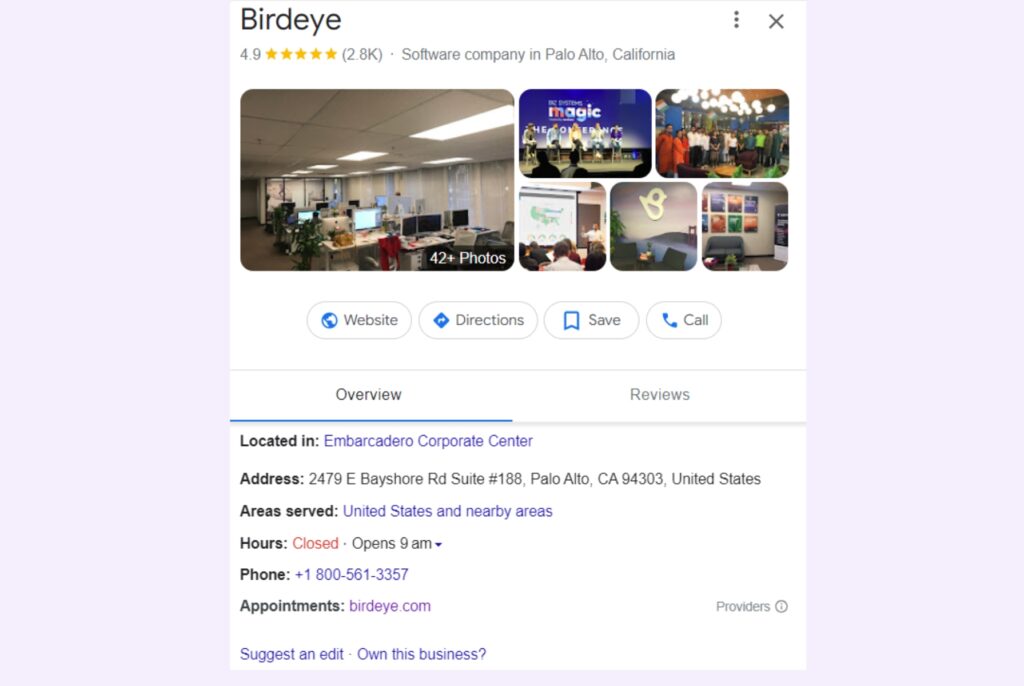
This means legitimate Google business reviews can sometimes disappear temporarily, even when customers followed the correct review process.
Google’s review policies also align more closely with recent FTC enforcement actions around fake reviews and deceptive reputation practices.
The FTC’s 2024 rule prohibits:
- Fake or AI-generated reviews presented as authentic customer feedback
- Incentivized reviews tied to specific sentiment
- Undisclosed employee or insider reviews
- Review suppression practices
- Manipulated social proof signals
For multi-location brands, this creates both compliance and governance responsibilities across every location.
To reduce review visibility issues, brands should:
- Request reviews ethically
- Avoid review gating
- Maintain accurate Business Profiles
- Monitor duplicate listings
- Standardize review workflows across locations
- Regularly audit review activity for unusual patterns
You can also explore how to use AI review generators ethically to boost online reputation, with guidance on maintaining compliant review-generation practices.
What are the top reasons Google reviews disappear, and how can brands fix them?
Google reviews can disappear for several reasons, including Business Profile issues, policy violations, and technical glitches. Some reviews return automatically after moderation checks, while others require profile fixes or direct escalation through Google support.
For multi-location brands, these problems can affect dozens or hundreds of locations at once, making review monitoring and listing governance increasingly important.
Not all missing reviews are caused by the same issue. Some problems originate from the Business Profile itself, while others stem from the review content, customer account activity, or Google’s moderation systems.
Why did our Google reviews suddenly drop or disappear?

Google reviews can suddenly drop or disappear because of policy enforcement, moderation delays, profile changes, duplicate listings, verification issues, customer account activity, or technical glitches. In some cases, legitimate reviews are only temporarily hidden while Google processes profile updates or runs additional moderation checks.

For multi-location brands, a sudden decline across several locations may point to a broader profile or moderation issue, while drops isolated to one location are more likely tied to that specific Business Profile, its review activity, or recent listing changes.
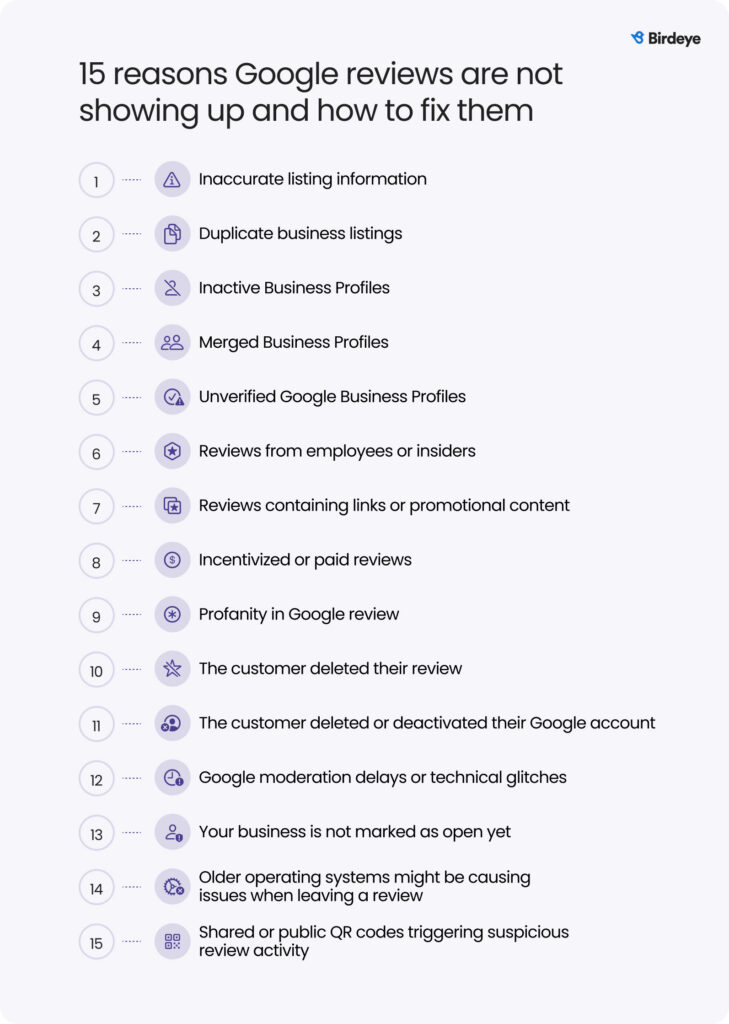
There are 15 main reasons why this might happen. Let’s take a look at what they are and how you can fix them.
Listing and profile issues
1. Inaccurate listing information
An incorrect business listing can reduce trust signals and create review visibility issues across Google Search and Google Maps.
Birdeye’s 2025 Local Search Accuracy Benchmark Report found that inaccurate or inconsistent local business data can lead AI-powered search tools to surface fabricated businesses, invalid addresses, and incorrect classifications.
Review visibility problems often happen when:
- Business names are inconsistent
- Store hours are outdated
- Addresses differ across listings
- Phone numbers change frequently
How to fix it:
- Log in to your Google Business Profile
- Open “Edit profile.”
- Review your business information carefully
- Update inaccurate listing details
- Submit changes for approval
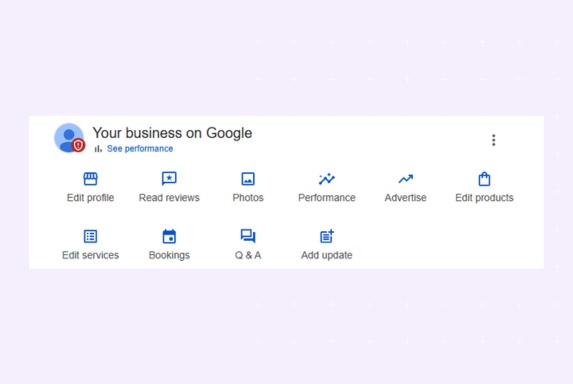
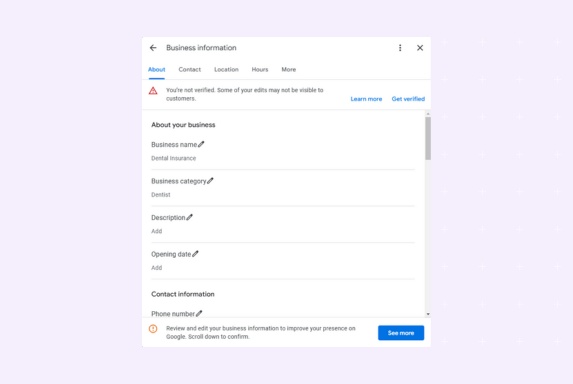
Managing multiple listings? Use Birdeye Listings AI to view, manage, and optimize listings for multiple locations from a single dashboard. Quickly spot errors, average ratings, and overall performance with simple clicks.
2. Duplicate business listings
Duplicate listings can split reviews across profiles or cause Google to suppress reviews during profile conflict resolution.
This commonly happens when:
- Locations are rebranded
- Teams create new listings accidentally
- Franchise locations overlap
- Old listings remain active after relocation
How to fix it:
- Audit all Google Business Profiles regularly
- Identify duplicate listings
- Remove or merge duplicate profiles through Google Business Profile Manager
- Maintain one primary profile per location
3. Inactive business profiles
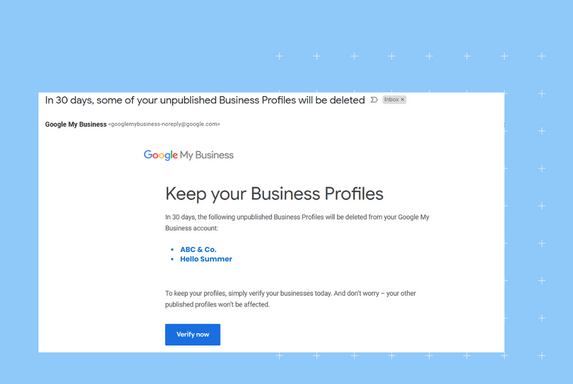
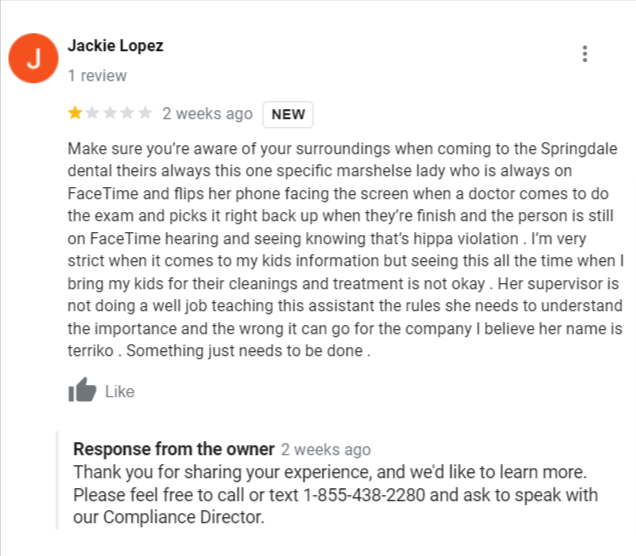
Regularly optimizing your Google Business Profile may result in it becoming unverified or limited over time, especially if it is not managed consistently.
Inactive profiles can create:
- Missing reviews
- Verification issues
- Reduced visibility
- Delayed moderation approvals
How to fix it
- Reverify profiles if Google requests verification
- Log in to Business Profiles regularly
- Respond to reviews consistently
- Update profile information when needed
4. Merged Business Profiles
Reviews may temporarily disappear after Google merges Business Profiles or updates listing ownership structures.
This often happens during:
- Rebranding
- Location consolidation
- Franchise acquisitions
- Duplicate listing cleanup
How to fix it: In most cases, reviews return automatically after Google completes profile synchronization; if reviews remain missing for an extended period, contact support and document affected profile IDs to restore visibility across every Google Business Profile for franchises.
5. Unverified Google Business Profiles
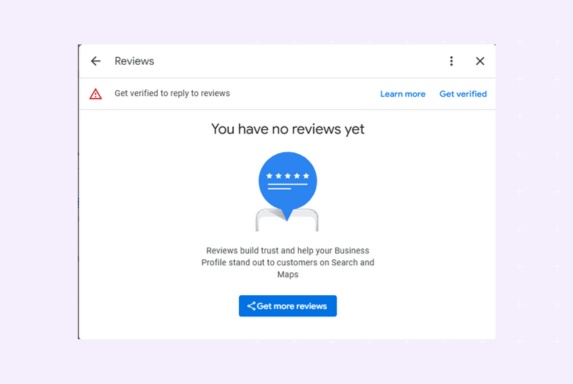
Unverified Business Profiles can trigger review moderation delays because Google may limit visibility until the profile ownership and business legitimacy are confirmed.
This becomes more common when:
- New locations are added quickly
- Ownership changes occur
- Verification expires
- Profiles become inactive for long periods
How to fix it:
- Complete Google Business Profile verification for every location
- Audit verification status regularly
- Resolve ownership conflicts quickly
- Maintain consistent business information across directories
For large multi-location brands, centralized verification tracking helps prevent review visibility gaps across locations.
Review policy violations
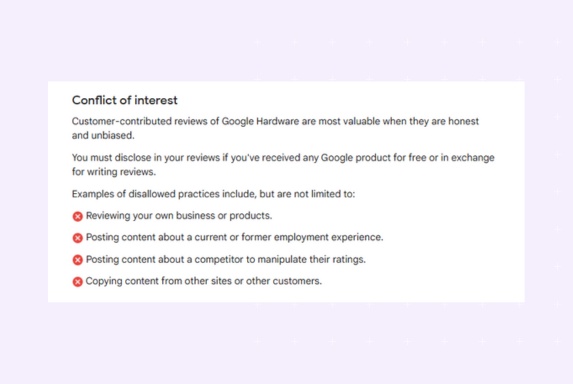
6. Reviews from employees or insiders
Google removes reviews written by:
- Current employees
- Former employees
- Owners
- Internal teams
- Anyone with a conflict of interest
These reviews violate Google’s authenticity guidelines and may be filtered automatically.
How to fix it: Avoid requesting reviews from employees or internal stakeholders. Focus review generation efforts on verified customer experiences only.
7. Reviews containing links or promotional content
Google may remove reviews that include:
- External links
- URLs
- Promotional messaging
- Repetitive marketing language
These reviews can appear spam-like to moderation systems.
How to fix it: Ask customers to describe their actual experience naturally without adding website links or promotional content.
Did you know: A Seattle-based plastic surgeon, Dr. Javad Sajan, and his clinic, Allure Esthetic, were penalized with $5 million for review manipulation?

To make his brand look perfect and achieve a 5-star reputation, he:

‣ Created fake profiles to post positive reviews
‣ Pressured the patients to remove negative reviews
‣ Threatened them with illegal NDAs
‣ Offered incentives for leaving positive reviews

Birdeye opposes such malpractices and urges other businesses to uphold ethical business practices.
8. Incentivized or paid reviews
Reviews paid for or incentivized are a big red flag for Google. Under no circumstances should you buy Google reviews. Google prohibits reviews exchanged for:
- Discounts
- Rewards
- Payments
- Gifts
- Promotional incentives tied to positive sentiment
This can trigger large-scale removal of reviews across profiles.
How to fix it: Use ethical review generation practices and avoid offering rewards tied to review outcomes.
You can also explore Google review policy for updated guidance on compliant review collection practices.
Technical and user-side issues
9. Profanity in Google review
Google may remove reviews containing:
- Profanity
- Hate speech
- Harassment
- Explicit language
- Threats or abusive content
Even legitimate customer reviews can disappear if the language violates content policies.
How to fix it: Encourage customers to clearly and professionally focus on their experience, without using offensive language.
FTC landmark judgment bans fake reviews and celebrity testimonials

On August 14, 2024, the Federal Trade Commission (FTC) took a major step to combat the growing prevalence of fake reviews and testimonials online.

Key provisions of the rule:

• Fake reviews and customer testimonials: Prohibits businesses from creating, selling, or buying fake reviews, including AI-generated ones or those written by people without experience.
• Incentivized reviews: Bans businesses from offering incentives for reviews with a particular sentiment.
• Insider reviews: Prohibits businesses from disseminating reviews written by company insiders or their relatives without clear disclosure.
• Review websites: Prevents businesses from misrepresenting the independence of review websites they control.
• Review suppression: Prohibits businesses from using threats or intimidation to suppress negative reviews and requires transparency about review gating practices.
• Fake social media indicators: This law prohibits selling or purchasing fake social media indicators that misrepresent a person's influence.

Birdeye is committed to complying with the FTC’s new rule on fake reviews and encourages businesses to present an honest and transparent view of customer feedback.
10. The customer deleted their review
It’s also possible that the customer deleted their own Google review.
How to fix it: If appropriate, follow up with the customer directly to understand why the review was removed. In some cases, customers may repost their review after the issue is resolved.
11. The customer deleted or deactivated their Google account
Google reviews are tied directly to customer Google accounts. If a user deletes or deactivates their account, associated reviews may also disappear.
How to fix it: Deleted account reviews usually cannot be recovered. The best long-term approach is to maintain a consistent review generation process across locations to reduce the impact of occasional review losses.
12. Google moderation delays or technical glitches
Sometimes reviews are delayed because of:
- Platform bugs
- Review moderation queues
- Spam detection systems
- Large profile updates
- Sudden spikes in review activity
This is especially common after major Google updates or profile merges.
How to fix it:
- Wait 24 to 72 hours for moderation systems to process reviews
- Document missing review details
- Contact Google support if reviews remain missing
- Track review activity across affected locations
For multi-location brands, centralized review monitoring helps identify unusual drops in reviews earlier, before visibility issues spread across profiles.
13. Your business isn’t open to the public yet
Google may remove reviews left before a business officially opens to the public.
This often affects:
- New locations
- Franchise launches
- Relocations
- Businesses using future opening dates
How to fix it:
- Double-check future opening date settings
- Confirm the location is marked as open in Google Business Profile
- Avoid requesting reviews before launch dates
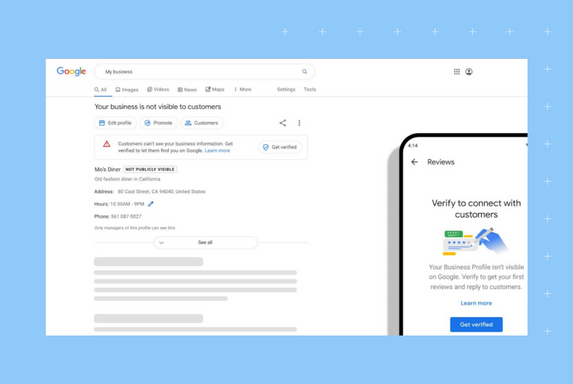
Why is your Google review delayed?
These are two of the most probable reasons why your reviews are delayed:
- If you’ve set a future opening date for your business, any reviews left before it’s open to the public will be removed.
- Your profiles have recently merged, slowing down reviews on Google Maps or Google Search.
14. Older operating systems might be causing issues when leaving a review
Some customers experience review submission issues when using:
- Older operating systems
- Outdated Google Maps apps
- Unsupported mobile devices
In these situations, reviews may fail to publish correctly or remain delayed.
How to fix it: Ask customers to:
- Submit the review from another device if necessary
- Update Google Maps
- Update their operating system
- Retry the review submission
You can also explore Mastering Google Reviews in 2026: Benefits, strategies, and best practices for businesses for broader Google review management strategies.
15. Shared or public QR codes triggering suspicious review activity
Google may temporarily filter or remove reviews if large numbers of reviews are submitted through the same public QR code, device network, or location within a short time period.
This can happen when:
- Businesses reuse the same static QR code across multiple locations
- QR codes are shared publicly online
- Multiple customers leave reviews from the same IP environment
- Review activity spikes unnaturally within a short timeframe
Google’s spam detection systems may interpret these patterns as suspicious or coordinated review behavior, even when reviews are legitimate.
How to fix it:
- Use location-specific review generation workflows
- Avoid publicly sharing the same QR code across unrelated locations
- Monitor unusual review spikes carefully
- Encourage customers to leave reviews naturally instead of through mass campaigns
You can also explore our blog: Why Google reviews are disappearing: Understanding the QR code risk, which explores a detailed breakdown of how QR code review patterns can affect Google review visibility.
View and manage your Google reviews from a single dashboard with Birdeye.
Want to see the impact of Birdeye on your business? Watch the Free Demo Now.
What does good review visibility look like at scale?
For multi-location brands, strong review visibility depends on more than collecting reviews consistently. Brands also need accurate listings, active profile management, standardized review workflows, and ongoing monitoring across every location.
Birdeye’s State of Online Reviews 2026 report found that Google now accounts for 79.4% of reviews per location, reinforcing why review governance inside Google has become operationally critical for enterprise brands.
When review governance breaks down, missing reviews often become a symptom of larger visibility and operational problems.
The table below highlights what strong review visibility management looks like compared to the most common issues affecting large location portfolios.
| Visibility management area | Best practice (what good review management looks like) | Enterprise impact | Common issues that hurt review visibility | Enterprise impact |
| Google Business Profile management | Verified Google Business Profiles across every location | Reviews appear reliably, and locations maintain stronger local visibility | Unverified or inactive profiles | Missing reviews and reduced local visibility |
| Listing consistency | Consistent business information across listings | Consolidated review signals and improved customer trust | Duplicate or outdated listings | Split review signals and customer confusion |
| Review monitoring | Ongoing review monitoring across locations | Faster detection of disappearing reviews and reputation issues | Delayed detection of missing reviews | Reputation gaps across high-value markets |
| Review collection practices | Ethical, policy-compliant review generation workflows | Higher review retention and lower moderation risk | Incentivized or gated reviews | Policy violations and review removals |
| Review engagement | Consistent review response workflows | Improved customer trust and stronger engagement signals | Ignored or inconsistent responses | Lower customer trust and engagement |
| Governance and ownership | Centralized reporting and governance across teams | Faster issue resolution and better operational consistency | Fragmented ownership across teams | Slower issue resolution and inconsistent visibility |
| Listing hygiene | Regular profile audits and duplicate cleanup | More stable rankings and healthier review visibility | Unmanaged listing merges or duplicates | Review suppression and ranking instability |
Strong review visibility also improves how brands appear across AI-generated search experiences. Modern search engines increasingly evaluate review recency, customer sentiment, listing accuracy, and response activity when summarizing brands in AI-powered results.
For enterprise teams managing hundreds or thousands of locations, review visibility monitoring becomes an ongoing operational process rather than a one-time optimization task.
“With Birdeye, specifically on business profiles, we average 4.85 stars. In a very concentrated and competitive market, GSR gives us that advantage above others. Also, with GSR in our ads, our cost per click is $0.19, down from $0.45.”

- Brian Torres, Digital Marketing Manager at Firstmark Credit Union
How should multi-location brands operationalize review governance at scale?
For multi-location brands, review visibility problems often become operational issues rather than isolated marketing problems. Without clear ownership and governance, missing reviews, inconsistent responses, and listing conflicts can quickly spread across locations.
Strong review governance usually starts with centralized accountability.
Many enterprise brands establish:
- Regional review owners
- Centralized escalation workflows
- Review response SLAs
- Listing governance standards
- Reporting cadences across locations
This helps teams identify unusual drops in reviews, duplicate listings, verification issues, and policy violations earlier. Operational review governance should also include:
- Weekly review monitoring
- Monthly listing audits
- Escalation paths for missing reviews
- Standardized response policies
- Compliance reviews for incentivized feedback risks
For brands managing hundreds of locations, fragmented review ownership often creates inconsistent customer experiences and slower issue resolution.
Governance becomes even more important as AI-generated search experiences increasingly evaluate:
- Review recency
- Response activity
- Ratings consistency
- Listing accuracy
- Customer sentiment patterns
Strong governance helps brands maintain more consistent visibility signals across Google Search, Google Maps, and AI-powered search experiences.
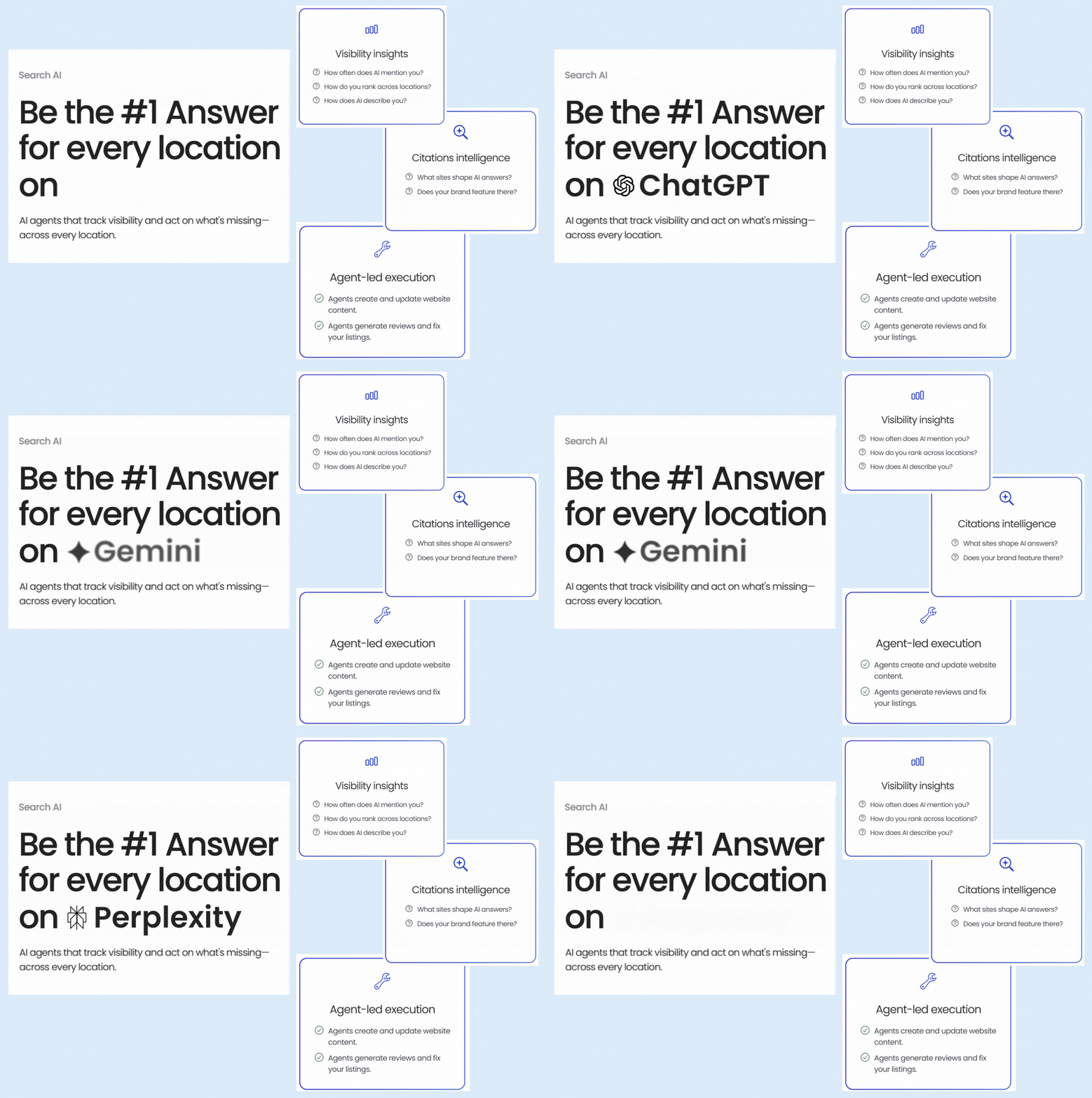
Many enterprise brands are also starting to monitor how review signals influence visibility across AI-generated search results. Tools like Birdeye Search AI help teams track how locations appear across modern search engines, identify reputation gaps, and understand which review and listing signals are influencing AI-driven visibility across locations.
Many enterprise marketing analytics teams now centralize operations through platforms that consolidate listings, reviews, reporting, and customer engagement workflows into a single operational layer across locations.
How can Birdeye agents help protect review visibility for large brands?
For large multi-location brands, missing Google reviews are rarely isolated incidents. They often point to broader problems related to listing accuracy, profile governance, inconsistent review workflows, or delayed issue detection across locations.
Birdeye’s power as a full-cycle #1 Agentic Marketing Platform extends far beyond basic automation. It is built to solve the fundamental multi-location complexity that generic tools cannot handle by providing a unified operating system for your brand.
Here are Birdeye’s core powers, following the approved Consolidate, Think, and Act framework:
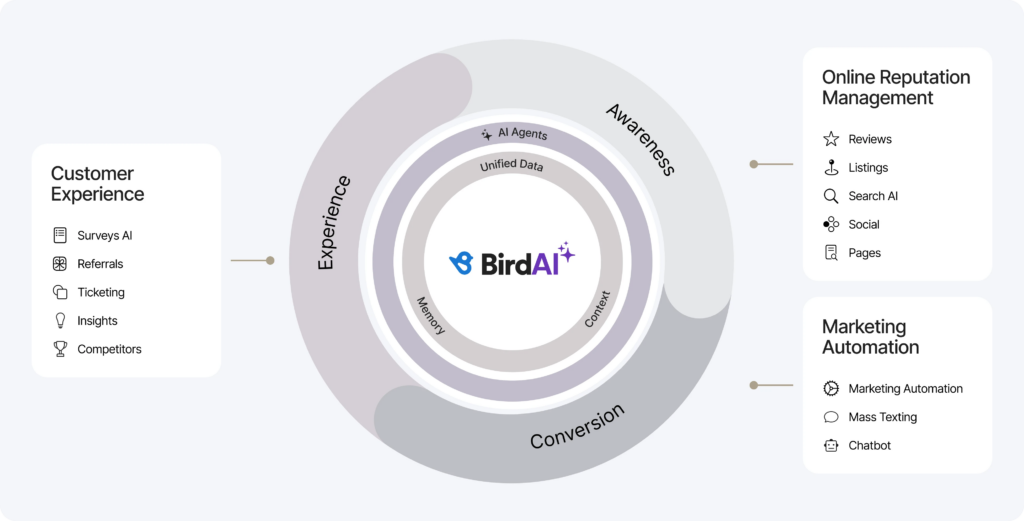
1. Consolidate: The full-cycle flywheel
Birdeye consolidates your entire marketing stack into a single platform that covers the full customer journey, from awareness to advocacy.
- Unified flywheel: Manage Reviews, Listings, Social, Messaging, and Marketing Automation in one place.
- 3,000+ integrations: Birdeye connects directly to your existing CRM, POS, or PMS (e.g., Salesforce, HubSpot, AthenaHealth) to trigger workflows automatically based on real customer actions.
- Enterprise-grade scalability: Built for brands managing anywhere from 100 to 10,000+ locations, ensuring consistent execution without a massive increase in headcount.
2. Think: Local intelligence & local truth
Birdeye’s “brain” is its Unified Data layer, which uses 13 years of multi-location intelligence to understand the specific context of every location.
- Unified customer profiles: Every interaction—a review, a text message, a purchase, or a survey response—is stitched into a single profile for every customer.
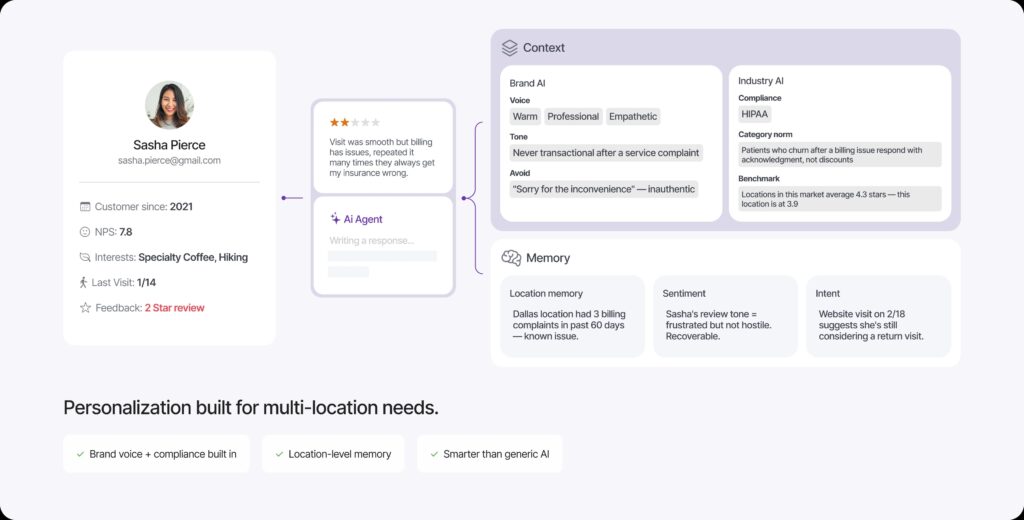
- Location-aware insights: Birdeye understands that “Location A” might have a 4.8-star rating and a 2-minute wait, while “Location B” has a 3.2-star rating and a 45-minute wait. It uses these location signals to power smarter, more personalized AI execution.
- Competitive intelligence: Automatically identify your true local competitors and benchmark your performance head-to-head on reputation and sentiment.
3. Act: Brand-safe & compliant execution
Birdeye allows brands to “act at scale” while maintaining absolute control through Industry AI and Brand AI guardrails:
- Industry-compliant guardrails: Unlike generic AI, Birdeye is pre-tuned to enforce strict industry standards like HIPAA (Healthcare), FINRA (Finance), and FTC (Retail). It won’t suggest medical treatments or guarantee financial returns.
- Brand-safe voice: Every AI-generated response or social post is trained on your specific Brand Kit, voice, and governance rules.
- “AI recommends, you approve”: Birdeye utilizes a human-in-the-loop model. Agents can handle routine tasks autonomously, but complex or sensitive issues (such as negative reviews) are automatically routed to your team for approval.
4. Enterprise governance & security
Birdeye provides the control corporate teams need to safely manage decentralized locations:
- Role-Based Access Control (RBAC): Set permissions by location, region, or function.
- Tiered approvals: Ensure local managers can’t publish content or responses without a corporate sign-off if your guidelines require it.
- Security standards: The platform is SOC 2 Type II certified, HIPAA-ready, and GDPR compliant, with SSO and audit logs as standard features.
Instead of relying on manual spreadsheets or disconnected workflows, enterprise teams can track review visibility, listing accuracy, customer sentiment, and response activity within a single operational system.
So how can you collect more Google reviews? Check out our article on how to get more Google reviews in 5 steps.
FAQs on Google reviews not showing up
Google may temporarily hide reviews during moderation checks or spam filtering. Reviews can also become private if they violate policy guidelines, trigger suspicious activity signals, or are connected to unverified Business Profiles.
Google reviews may not appear on mobile devices due to app caching issues, outdated Google Maps versions, moderation delays, or temporary syncing issues between devices and Google Business Profiles.
Possibly. It is not common, but it happened when Google recently made several new changes to Business Listings. Yes. Legitimate reviews may still be temporarily removed if Google detects suspicious patterns, policy concerns, duplicate activity, or inconsistencies associated with the Business Profile.
Large multi-location brands typically use centralized review monitoring workflows to track review visibility, listing accuracy, duplicate profiles, and unusual review drops across locations more efficiently.
Platforms like Birdeye help multi-location brands manage review generation, review visibility, listings, and customer feedback across hundreds of locations from one centralized platform.
A full-cycle Agentic Marketing Platform like Birdeye combines review monitoring, sentiment analysis, reporting dashboards, and operational insights to help brands track reputation performance across locations more effectively.
Birdeye helps brands prevent Google reviews from disappearing
Understanding why Google reviews disappear is the first step toward protecting your brand. But for multi-location brands, manual management doesn’t scale. If you are managing 100 or 10,000+ locations, you don’t just need a “fix”—you need an online reputation management platform that prevents these issues from happening in the first place.
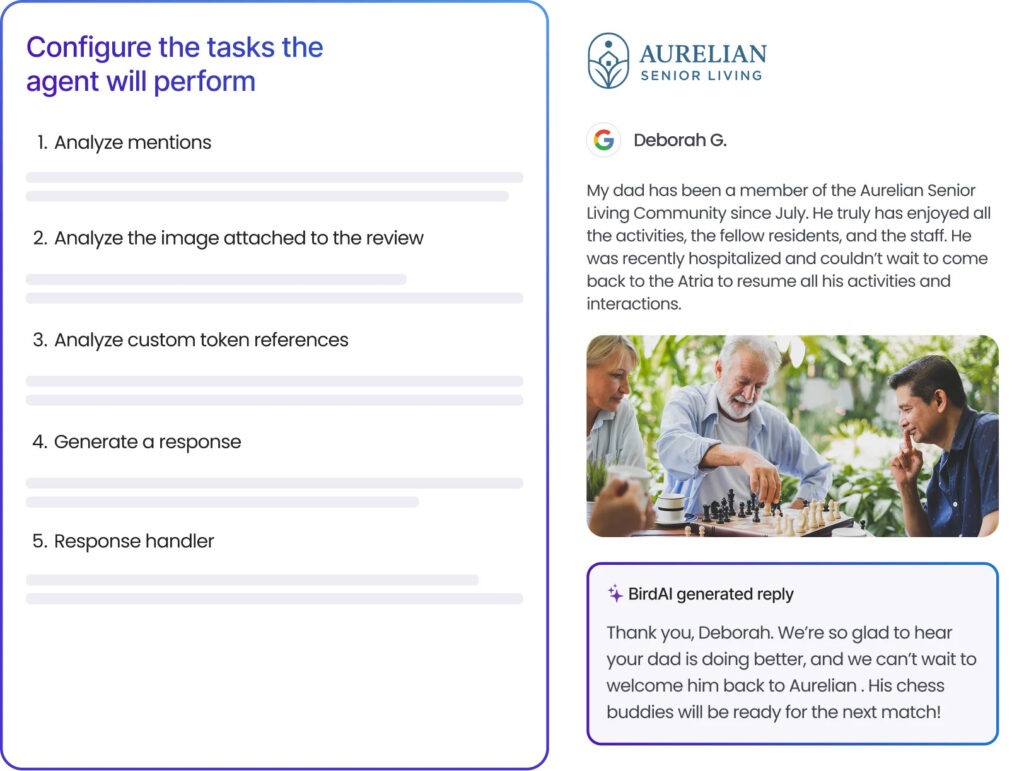
With Birdeye, you don’t just manage reviews—you deploy an AI digital marketing workforce of agents that provides local intelligence, protects your brand-safe voice, and unlocks the truth of every branch.
The Birdeye AI Agents workforce
| Agent | Core power | Multi-location outcome |
| Review Generation Agent | Automatically sends personalized requests via SMS, Email, and WhatsApp at the “best moment” for engagement. | Ensures a consistent stream of fresh, verified reviews to maintain high search visibility and signal business health. |
| Review Response Agent | Drafts brand-safe, industry-compliant replies by interpreting sentiment, intent, and urgency. | Maintains 100% response rates across all locations while you stay in control via “AI recommends, you approve” workflows. |
| Listings Optimization Agent | Continuously scans profiles to spot gaps and errors, offering one-click rollout for approved updates. | Instantly fixes duplicate listings or inaccurate data that causes reviews to drop or visibility to fade. |
| Social Publishing Agent | Automatically adapts content themes from top-performing trends into a ready-to-publish calendar. | Keeps local profiles active and relevant, signaling authority to both traditional and AI search engines. |
| Social Engagement Agent | Instantly detects intent in comments to triage inquiries, appreciation, or trolls contextually. | Strengthens brand trust through human-like interaction at a scale that manual teams cannot match. |
| Lead Gen Agent | Drives 24/7 omnichannel conversations to capture contact details and custom lead data. | Converts high-intent interest into bookings or sales without requiring increased headcount. |
| Contact Segmentation Agent | Uses chat-based prompts to instantly create precision audience lists (e.g., “inactive customers with positive reviews”). | Powers personalized, high-impact campaigns tailored to the “local truth” of specific customer groups. |
| Template Design Agent | Instantly generates tailored, brand-aligned email and landing page templates via simple chat requests. | Eliminates resource strain, allowing teams to launch localized campaigns in as little as 30 days. |
| Reporting Agent | Deep-dives into performance trends to proactively highlight metric shifts or anomalies. | Identifies “reputation gaps” in seconds, giving you an action plan to improve your Birdeye Score. |

About the Author

Shruti Dugar
Birdeye
Originally published

![[Feature image] Buy Google reviews UK- The truth behind quick fixes and smarter reputation solutions](https://birdeye.com/blog/wp-content/uploads/Feature-image-Buy-Google-reviews-UK-The-truth-behind-quick-fixes-and-smarter-reputation-solutions-375x195.jpg)