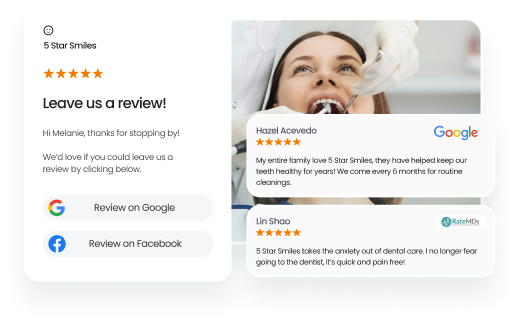
When someone searches “near me,” the decision happens in seconds. They are not comparing brands. They are choosing one.
This is where Google Maps marketing determines whether you show up and get chosen. For large multi-location brands, this moment repeats thousands of times a day. If your presence is inconsistent or inactive, you lose demand before your team can act.
Executive summary: How enterprise brands win with Google Maps marketing?
Google Maps is a high-intent acquisition channel for enterprise brands. As per Birdeye’s State of Google Business Profile (GBP) 2026, 86% of GBP impressions come from “near me” and category-based searches, where customers are ready to act.
Even as impressions decline, performance holds. A 53.8% drop in visibility led to only a ~5% drop in customer actions, showing that Google surfaces brands in more qualified moments.
For large multi-location brands, the challenge is execution at scale. Birdeye’s Agentic Marketing Platform helps brands maintain accurate listings, strengthen review signals, and stay visible across every location, so they can consistently capture high-intent demand.
This blog outlines 9 Google Maps marketing tips to help enterprise brands’ listings show up in the right search results, attract more customers, and convert relevant local “near me” searches into loyal buyers.
Table of contents
- What is Google Maps marketing?
- How does Google Maps decide which brands show up first: The 3 ranking signals
- What are the top 9 Google Maps marketing tips for enterprise brands?
- What challenges do enterprise brands face with Google Maps marketing?
- How Birdeye’s Agentic Marketing Platform drives Google Maps marketing success?
- Frequently asked questions about Google Maps marketing
- Dominate Google Maps marketing with Birdeye’s Agentic Marketing Platform
What is Google Maps marketing?
Google Maps marketing is the process of managing how your brand appears and performs across Google Maps and Google Business Profile (GBP) to capture high-intent local demand.
What is a Google Business Profile?
Your GBP is a free listing that displays key business details across Google Maps and Search, like your:
- Business name
- Address
- Phone number
- Website address
- Category (e.g., dentist, restaurant)
- Opening hours
- Photos
- Customer reviews
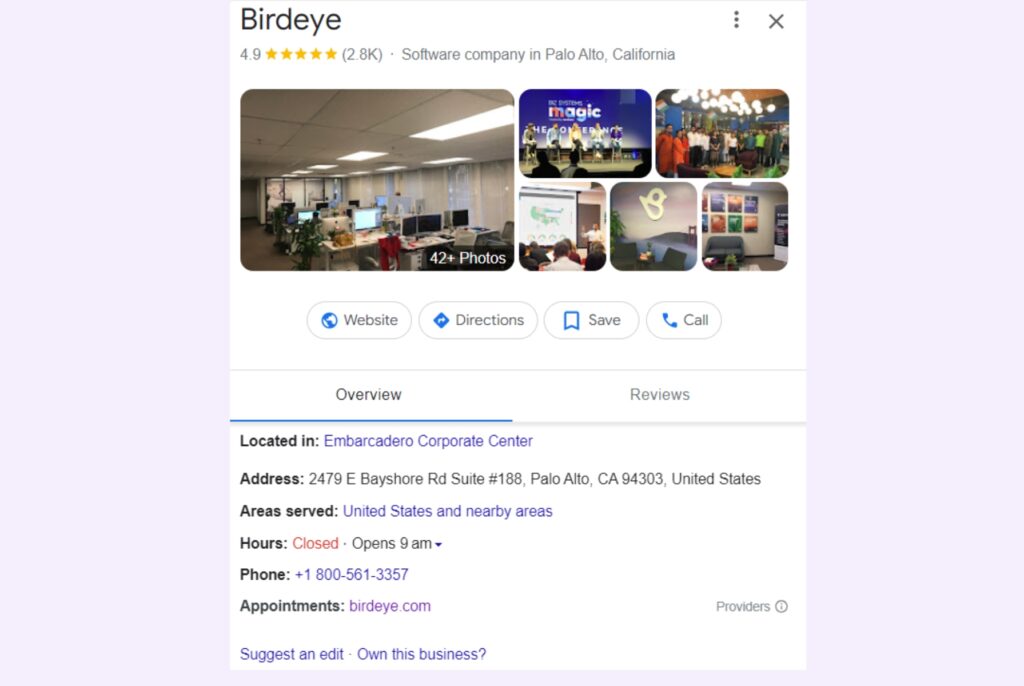
For large multi-location brands, it goes beyond basic listing optimization. It’s about maintaining accurate, consistent, and complete information across hundreds or thousands of locations, so each one shows up in high-intent searches.
At its core, Google Maps marketing is driven by three factors:
- Listing accuracy: Correct location data, hours, categories, and attributes across every location
- Reputation signals: Review volume, recency, and response consistency
- Ongoing activity: Regular updates, content, and engagement that signal relevance to Google
When these are managed well, each location becomes a demand capture point. When they are not, visibility drops, and competitors take that demand.
For enterprise brands, the challenge is not knowing what to do. It’s doing it consistently at scale across every location, without gaps.
Why do “near me” searches matter to enterprise brands in 2026?
“Near me” searches matter because they capture customers at the exact moment they’re ready to act.
For example, a customer might type “best HVAC near me” at 7 a.m. and book by 7:05 am, all without ever visiting a website. Their decision is based on what they see in your Google Maps listing: star rating, photos, business hours, and how quickly your business appears when they search.
That intent leads to real outcomes. 38% of interactions on Google Business Profiles are direction requests, showing that customers are actively choosing where to go next.

For large multi-location brands, this moment repeats across every location, every day. If your listings are incomplete, inconsistent, or inactive, that demand goes to a competitor nearby.
In other words, “near me” searches are not just about visibility. They are about being chosen in real time, across every market you operate in.
How Google’s Ask Maps is changing local search
Local discovery is no longer limited to simple “near me” searches. It is becoming more conversational and intent-driven.
Google’s new “Ask Maps” feature allows users to describe exactly what they want, such as timing, preferences, or specific needs, and receive AI-generated recommendations instead of a list of results.
This changes how locations get discovered. Instead of matching keywords like “dentist near me,” Google now evaluates reviews, photos, and profile details to understand which location best fits a specific situation.
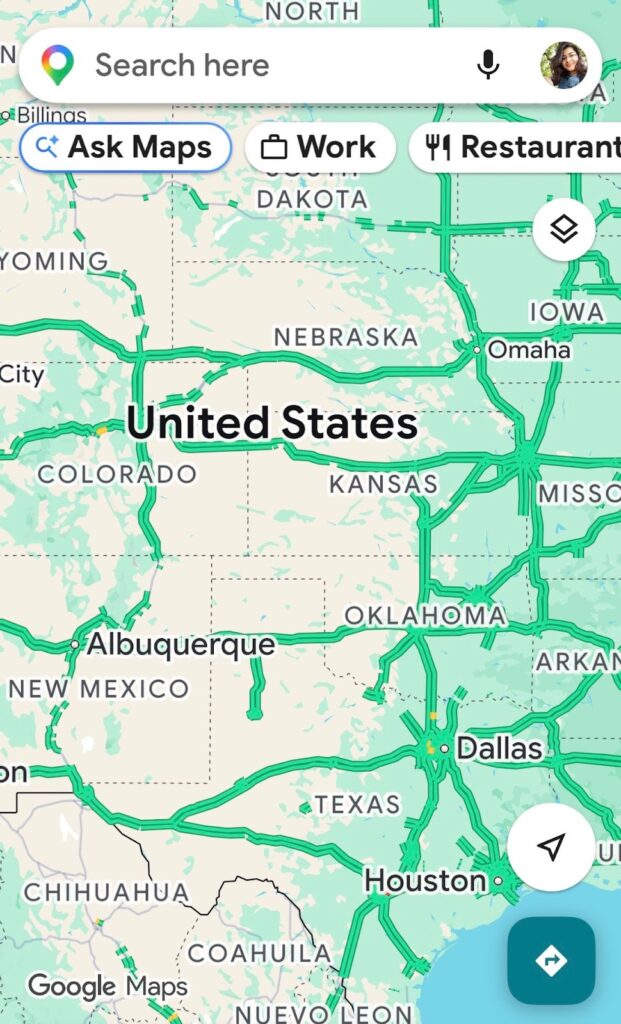
For enterprise brands, this raises the bar. It is no longer enough to be nearby or well-known. Each location needs clear, accurate, and detailed signals so AI can interpret and recommend it correctly.
That means:
- Reviews must be recent and specific, not generic
- Listings must be complete and consistent across locations
- Photos and attributes must reflect the real experience
Check the 9 Google Maps Marketing tips
Want to see the impact of Birdeye on your business? Watch the Free Demo Now.
How does Google Maps decide which brands show up first: The 3 ranking signals
When someone types “best auto repair near me” or taps a location pin, Google doesn’t show businesses randomly. It uses three key signals: Relevance, Distance, and Prominence, to decide which business listings show up in Google Maps results and which ones get buried.
To improve your Google Maps ranking and stand out in local search results, you need to understand and optimize for each of these signals:
1. Relevance: Does your listing match what the customer is searching for?

Relevance measures how well your Google Business Profile aligns with a search query. This includes your categories, services, business description, and the content within your profile.
The more complete and accurate your listing is, the easier it is for Google to match your locations to high-intent searches. Reviews also play a role here, as they reinforce what your business is known for.
For large multi-location brands, consistency matters. If location data, categories, or services vary across listings, relevance drops, and visibility becomes uneven.
2. Distance: How close are you to the searcher?
Distance is based on how near your location is to the user or the area specified in the search.
While you cannot control proximity, you can control how clearly your location data is defined. Accurate addresses, service areas, and consistent location signals across platforms help Google match your listings correctly.
If location data is incomplete or inconsistent, even nearby locations may not appear in relevant searches.
Read our blog to know how to change business location on Google Maps in 4 easy steps
3. Prominence: How trusted and active is your brand?
Prominence reflects how well-known and credible your business is. It is influenced by review volume, ratings, response activity, and overall engagement.
Google favors businesses that show consistent activity, recent reviews, and active management. A listing that is regularly updated and responds to feedback signals reliability.
For enterprise brands, prominence depends on maintaining this activity across every location, not just a few high-performing ones.
What are the top 9 Google Maps marketing tips for enterprise brands?
These nine Google Maps marketing tips help enterprise brands improve visibility, capture high-intent demand, and stay competitive across every location:
1. Standardize every Google Business Profile across locations
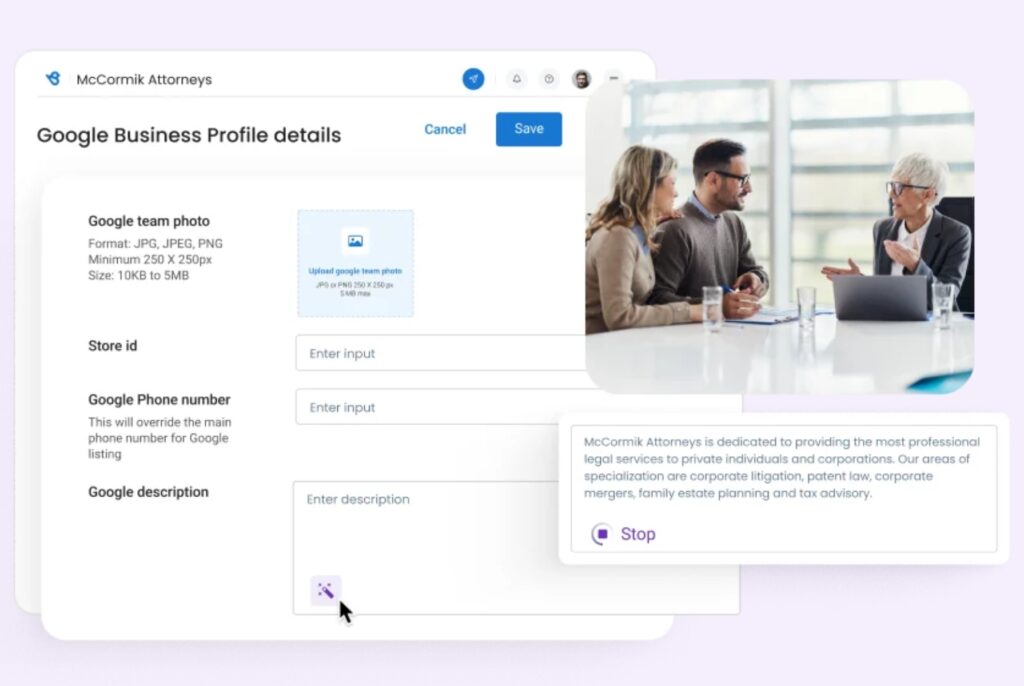
Complete and accurate listings help Google match each location to high-intent searches. Include your full business name, accurate hours, services, payment options, and a detailed description with relevant keywords.
Incomplete or inconsistent profiles are less likely to appear in relevant searches, even when a location is nearby and relevant.
Fully populated, verified profiles surface 80% more often in search as per the Birdeye report, and incomplete profiles are less likely to show up in Google Maps results or appear for relevant searches, even if your business may be exactly the one your customer wants to visit.
Bonus tip: To optimize for voice search on Google, use natural, conversational phrases in your business description, such as “open now,” “emergency plumbing,” or “best hairdresser near me.” These are the terms customers use when they’re ready to act.
2. Choose the right categories and keep services updated
Your primary business category is one of the most important ranking factors. Use additional categories if applicable, and ensure your services and service descriptions are up to date.
Include details such as pricing, appointment availability, and FAQs to help potential customers choose you more quickly.
3. Add fresh photos and videos across locations
Visual content helps you stand out in maps, increases time spent on your listing, and earns trust. Create a virtual tour using 360° Google Business photos so that users can explore your space.
Fresh visuals also help Google and AI systems better understand each location, improving the chances of being recommended in intent-driven searches.
4. Respond to every review
Review responses show active management and customer care. Whether it’s praise or a complaint, reply to all reviews within 24 hours. This increases trust, improves your Google Maps ranking, and encourages others to leave reviews.
Detailed, recent reviews help Google understand what each location is known for, which directly impacts its visibility in AI-driven recommendations.
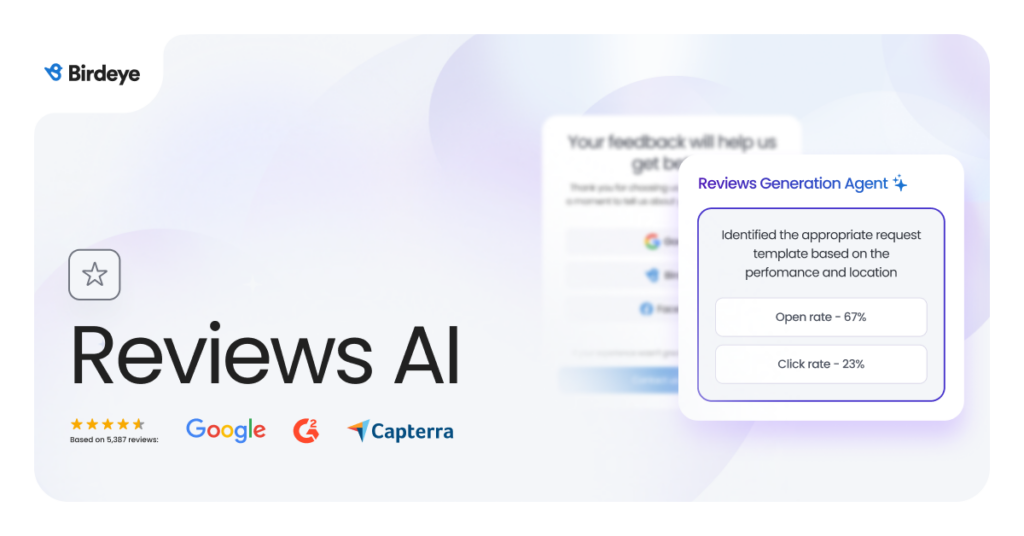
At scale, Birdeye Review AI agents help ensure no feedback goes unanswered while keeping responses consistent and on-brand.
5. Use Google Posts to share updates, offers, and events
Most businesses ignore this feature. Post weekly updates, events, or seasonal promotions using Google Posts within your Google Business Profile. This boosts engagement and signals to search engines that you’re actively managing your profile.
6. Strengthen local SEO with location pages and structured data
Google Maps rankings are reinforced by your website’s local SEO signals.
Create dedicated local SEO location pages for each branch with accurate NAP (name, address, phone), services, and locally relevant content. Use structured data (schema markup) to help Google understand your locations and match them to high-intent searches.
7. Invest in Google Maps ads with local search targeting
For enterprise brands operating in dense markets, ads help secure visibility in high-value locations where organic competition is highest. Don’t forget to enable location assets, which connect your Google local service ads directly to your Maps listing, great for driving in-store visits and phone calls.
8. List your business across trusted local directories
Consistency matters. Submit your info to verified local listings, niche directories, and platforms like Apple Maps. Consistent data across directories strengthens trust signals and improves your chances of appearing in high-intent searches.
9. Monitor performance and keep optimizing
Track performance at the location level to identify underperforming markets, which posts perform best, and what needs refreshing and fixing, and to address visibility gaps before they impact revenue.
Use your Google Business Profile analytics dashboard to track views, clicks, and phone calls. Look at where your business appears.

For enterprise brands, the challenge is not knowing what to do. It’s executing these steps consistently across hundreds of locations.
What challenges do enterprise brands face with Google Maps marketing?
Managing Google Maps marketing is not just about optimization. For enterprise brands, the real challenge is executing consistently across hundreds or thousands of locations.
Here are the most common challenges enterprise brands face with Google Maps marketing and what they mean in practice:
| Challenge | Solution |
| Inconsistent data across locations | Optimize your business title, description, categories, hours, and other fields with relevant keywords in all business listing sites. |
| Limited control over location-level execution | Define clear guidelines for categories, descriptions, updates, and review responses, and enforce them across all locations. |
| Fragmented tools and a lack of visibility | Use a unified platform to monitor listings, reviews, and engagement metrics across all locations. |
| Rising complexity with AI-driven discovery | Focus on building strong, consistent signals through detailed reviews, accurate listings, and rich location content. |
How Birdeye’s Agentic Marketing Platform drives Google Maps marketing success?
Google Maps marketing is no longer a “set it and forget it” task. To stay in the coveted local pack, a brand must be consistently accurate, highly responsive, and backed by fresh social signals.
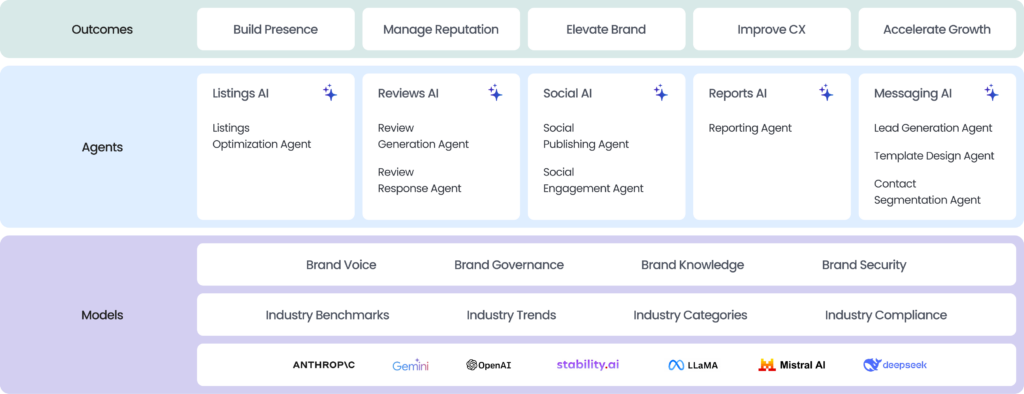
Birdeye’s Agentic Marketing Platform moves beyond traditional pins on a map. It deploys a coordinated workforce of AI agents that monitor your presence 24/7, ensuring every location meets Google’s evolving ranking criteria.
The Birdeye agentic advantage for Google Maps
While traditional tools simply show your performance, Birdeye’s agents actively improve it. Here is how the 9 agents collaborate to win the “near me” search:
| AI Agent | Role in Google Maps marketing | Impact on local ranking |
| Listings Optimization | Continuously audits NAP (Name, Address, Phone) and keyword gaps. | Eliminates inconsistencies that cause Google to drop your ranking. |
| Review Generation | Triggers automated requests at the “Peak Delight” moment. | Boosts review velocity and recency—two core Google ranking factors. |
| Review Response | Draft contextually accurate, keyword-rich replies to every review. | Signals to Google that the business is active and highly responsive. |
| Social Publishing | Tailors localized posts (Google Updates) for every individual branch. | Increases engagement and signals “local freshness” to Google’s algorithm. |
| Social Engagement | Manages Q&A and DMs directly through the Google Business Profile. | Improves “conversion signals” by providing instant answers to searchers. |
| Lead Generation | Captures and qualifies leads directly from Google Messages. | Turns “map views” into measurable revenue and booked appointments. |
| Contact Segmentation | Identifies local advocates for targeted “Local Guide” outreach. | Builds a loyal base of reviewers who carry more weight in Google’s eyes. |
| Template Design | Creates localized “Google Update” graphics and CTA buttons. | Drives a higher Click-Through Rate (CTR) from the map results. |
| Reporting Agent | Provides plain-English analysis of “Direction Requests” and “Calls.” | Identifies which locations are losing market share to local rivals. |
Beyond the map: Winning the AI-Search frontier
Google Maps marketing is evolving. Today, your map presence also feeds into Google’s AI Overviews.
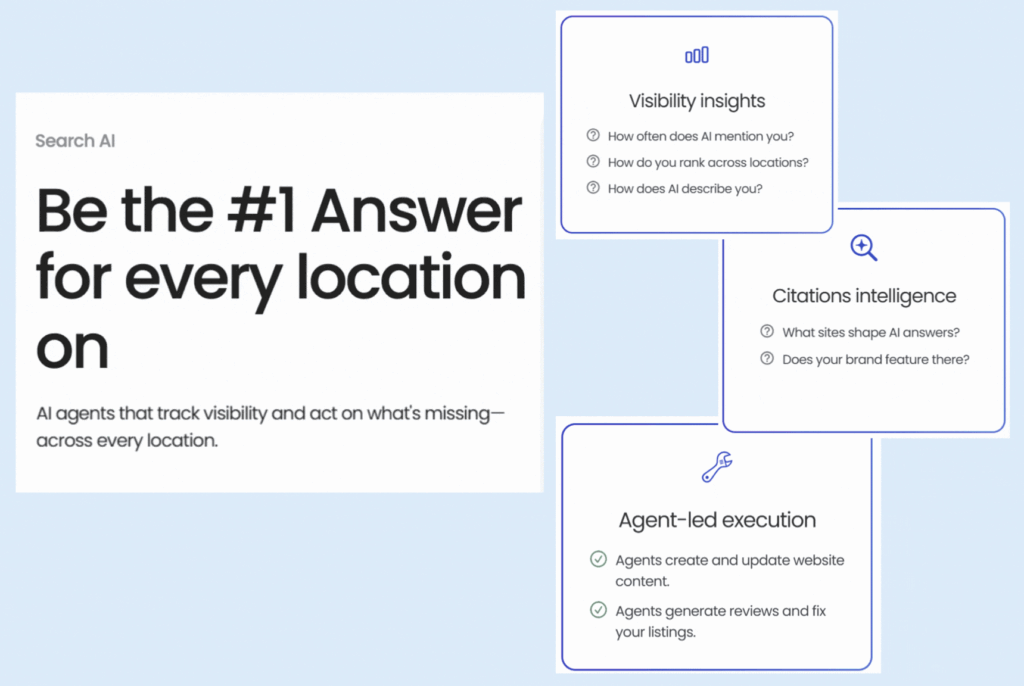
Birdeye’s Search AI works alongside these agents to monitor how your business is summarized in AI-driven discovery. It ensures that when a customer asks, “What is the best-rated dental clinic near me with weekend hours?”, your brand isn’t just a dot on the map; it’s the recommended answer.
Why multi-location brands choose Birdeye:
- Supervised autonomy: Corporate sets the brand voice; the agents execute locally across thousands of profiles.
- Unified intelligence: A review left on Google can instantly trigger a “Thank You” post on Social, creating a feedback loop that Google rewards with higher visibility.
- Frictionless conversion: We don’t just put you on the map; we provide the messaging and lead-gen tools to ensure a searcher becomes a customer without ever leaving the Google interface.
How Cunningham Restaurant Group ranks and wins on Google Maps with Birdeye
Cunningham Restaurant Group operates 42 restaurant locations across three states, each with its own Google listing, menu, hours, and location data. As their footprint grew, so did the complexity of managing it all.
With Birdeye Listings AI, the team centralized updates across Google, Apple Maps, Facebook, and more, ensuring accuracy and consistency across every profile.

They didn’t stop at listings. Using Birdeye Reviews AI, Cunningham automated review collection and responses, turning negative experiences into 5-star ones and significantly boosting prominence in Google Maps results.

Meanwhile, Birdeye Insights provides Meanwhile, Birdeye Insights deploys AI agents to analyze sentiment, helping teams continuously refine guest experiences, while Birdeye Ticketing routes complaints to the right team, ensuring fast follow-ups and higher customer satisfaction.

Their success is proof that Google Maps marketing isn’t just about showing up—it’s about owning your presence across every channel, every listing, and every review.
Frequently asked questions about Google Maps marketing
A free Google Business Profile listing is the foundation of Google Maps marketing. However, you can leverage paid advertising options like Google Ads for Maps to target specific demographics searching for products or services in your area. This can be a powerful tool for reaching new customers.
Running local search ads on Google Maps can significantly increase visibility for businesses targeting nearby customers. These paid ads put your business at the top of Maps results for relevant searches.
Google ranks listings based on relevance, distance, and prominence. For enterprise brands, this means maintaining accurate listings, strong review signals, and consistent activity across every location to improve visibility in high-intent searches.
Yes. Reviews are among the strongest signals of visibility and trust. Recent, detailed reviews help Google understand what each location is known for, which improves rankings and increases the chances of being recommended in AI-driven results.
Yes. Birdeye helps enterprise brands manage listings, reviews, and local search visibility across every location. It enables teams to maintain accurate data, respond to reviews at scale, and improve performance in both traditional and AI-driven search experiences.
Ask Maps is an AI-powered feature that allows users to search in natural language and receive recommendations instead of a list of results. It matters because Google now relies more on reviews, photos, and profile data to recommend businesses, making accurate and detailed listings critical for visibility.
Dominate Google Maps marketing with Birdeye’s Agentic Marketing Platform
Customers are making faster decisions, often without visiting a website. With the rise of AI-driven discovery and features like conversational search, Google is prioritizing businesses that are accurate, active, and easy to understand.
For enterprise brands, this creates both an opportunity and a challenge. Every location can capture high-intent demand, but only if listings, reviews, and content are managed consistently at scale.
This is where Birdeye’s agentic marketing platform fits in. It helps multi-location brands maintain accurate listings, generate and respond to reviews, and improve visibility across both traditional and AI-driven search experiences.
The brands that win in 2026 will not be the ones that optimize occasionally. They will be the ones who operate Google Maps as a continuous, system-driven channel across every location.

This blog post is part of our Google Maps Marketing Guide
- Google Business Profile: how to optimize yours
- 10 tips for using Google maps marketing to get local customers
- Google My Business website – everything you need to know
- How to Grow Your Business with Google Maps Marketing
- 8 easy steps for Google Maps optimization
- How to get your business on Google Maps
- How to Rank Higher on Google Maps
- Optimize Google My Business for lead generation
- How to claim a business on Google
Google Maps Marketing Related Training
About the Author

Shruti Dugar
Birdeye
Originally published





![[Feature image] The Best Marketing Platforms for Multi-Location Brands](https://birdeye.com/blog/wp-content/uploads/Feature-image-The-Best-Marketing-Platforms-for-Multi-Location-Brands-375x195.png)